





Abstract
Sustainable economic performance has become a key focus for businesses, as they manage environmental responsibility and organizational accountability. This study examines how green entrepreneurial orientation influences sustainable outcomes, highlighting the mediating roles of eco-innovation and institutional legitimacy. Using insights from the Resource-Based View and Institutional Theory, we suggest that a commitment to sustainability promotes innovative practices and enhances organizational credibility, collectively supporting long-term economic success. Data were gathered through structured interviews with 103 participants from various companies involved in green initiatives. Preliminary validation was performed with SPSS, and the testing of the hypothesis was verified utilizing Structural Equation Modeling. The results show that green entrepreneurial orientation has both direct and indirect impacts on sustainable performance. Eco-innovation acts as a crucial mechanism for turning orientation into concrete results, while legitimacy builds stakeholder trust and aligns with regulatory standards. The study adds to both theory and practice by showing how entrepreneurial strategies can lead to sustainable economic transformation.
Introduction
The pursuit of sustainable economic performance has increasingly crystallized into one of the defining challenges of contemporary enterprise, as organizations are called upon not merely to generate profit but to weave ecological mindfulness and social responsibility into the very fabric of their strategic imperatives.In this context, green entrepreneurial orientation has emerged as a strategic stance that incorporates environmental values into entrepreneurial decision-making, promoting risk-taking, proactiveness, and innovation in pursuit of sustainability goals (Baquero, 2024). Scholars argue that green entrepreneurial orientation not only shows a firm’s dedication to sustainability but also acts as a source of competitive advantage in markets driven by ecological concerns (Zhang et al., 2024).
Despite the burgeoning scholarly and practical interest, the precise mechanisms through which green entrepreneurial orientation culminates in sustainable outcomes remain only partially illuminated.Within this evolving discourse, two pivotal mediating forces emerge with particular salience.
Foremost among them is eco-Innovation, the deliberate design of products, processes, and organizational practices that attenuate ecological harm.By embedding sustainability into the very substance of entrepreneurial outputs, Eco-Innovation fortifies the linkage between entrepreneurial orientation and firm performance, transforming environmental responsibility from an abstract aspiration into a concrete driver of competitive advantage (Baquero, 2024).
Second, institutional legitimacy, which means aligning organizational practices with societal norms and regulations, boosts stakeholder trust and helps ensure that sustainability efforts are accepted in broader institutional contexts (Li & Wei, 2025).These mediators underline the significance of both technological novelty and organizational credibility in driving sustainable economic success.
Building on the Resource-Based View and Institutional Theory, this study proposes a model where green entrepreneurial orientation influences sustainable economic performance both directly and through eco-innovation and institutional legitimacy. Testing this model with data from 103 enterprises engaged in environmentally conscious practices, the research adds to the literature by clarifying how entrepreneurial strategies can translate into sustainable economic outcomes. It simultaneously addresses a critical lacuna within the field of sustainable entrepreneurship and furnishes nuanced, practice-oriented insights for policymakers and business leaders who seek to catalyze transformative trajectories of green economic change.
Literature Review
Green Entrepreneurial Orientation
Green entrepreneurial orientation expands the traditional entrepreneurial orientation framework by incorporating environmental values into innovativeness, proactiveness, and risk-taking (Tuncer & Korchagina, 2024). Green entrepreneurial orientation shows a company’s strategic dedication to sustainability, helping organizations anticipate regulatory changes, adapt to evolving consumer preferences, and seize opportunities in emerging green markets (Singh et al., 2025). Evidence indicates that green entrepreneurial orientation improves organizational resilience, especially when institutional pressures require ecological responsibility (Zhang et al., 2024). A recent meta-analysis confirms that green entrepreneurial orientation positively impacts firm performance across industries, underscoring its role as a competitive advantage in sustainability-focused economies (Munodawafa & Johl, 2019). Conceptually, green entrepreneurial orientation is grounded in the Resource-Based View, which highlights that sustainability-oriented capabilities can yield long-term economic and ecological benefits (Baquero, 2024). Yet, prior green entrepreneurial orientation-performance studies remain limited in explaining how these capabilities are legitimized and socially accepted, leaving a theoretical gap in understanding the translation of internal resources into externally validated outcomes.
Eco-Innovation
Eco-innovation refers to innovations that reduce environmental harm while enhancing economic outcomes. It includes product, process, organizational, and marketing innovations (Indiran et al., 2025). Scholars argue that eco-innovation implements sustainability strategies, translating entrepreneurial intent into tangible practices (Carrillo-Hermosilla et al., 2010). Systematic reviews confirm its mediating role between entrepreneurial orientation and performance, showing that firms with strong green entrepreneurial orientation are more likely to engage in eco-innovation, which in turn fosters sustainable outcomes (Munodawafa & Johl, 2019). Meta-analyses of SMEs demonstrate that eco-innovation significantly enhances sustainable performance, primarily when supported by institutional frameworks and stakeholder engagement. Eco-innovation also advances cost savings, efficiency improvements, and reputation gains, reinforcing its dual role as both a mediator and a strategic necessity in industries facing strict environmental regulations (Baquero, 2024). However, eco-innovation alone cannot explain why certain practices gain legitimacy while others fail. This underscores the need to examine eco-innovation and institutional legitimacy together, as their interaction determines whether green capabilities are both effective and socially endorsed.
Institutional Legitimacy
Institutional legitimacy refers to how people perceive that a company’s actions are suitable and align with societal norms, values, and rules (Suchman, 1995). In sustainability research, legitimacy is important because firms need to demonstrate that their green efforts are trustworthy and acceptable to stakeholders (Spanuth & Urbano, 2023). Institutional Theory suggests that organizations gain legitimacy by complying with legal requirements, adopting socially accepted practices, and engaging in symbolic actions that highlight their commitment to sustainability (Li & Wei, 2025). Recent studies indicate that legitimacy acts as a mediator, converting entrepreneurial motivation into outcomes that are socially accepted and supported by institutions (Chatzichristos & Nagopoulos, 2019). Evidence shows that companies with strong legitimacy are more effective at implementing eco-innovations and achieving sustainable performance, as stakeholders support initiatives perceived as genuine (Li et al., 2024). Yet, legitimacy studies often remain descriptive, overlooking contradictions such as symbolic versus substantive practices. This gap highlights the need for a synergistic framework where Resource-Based View explains capability development and Institutional Theory explains value appropriation and acceptance.
Sustainable Economic Performance
Sustainable economic performance shows a company's ability to balance profit with environmental care and social responsibility. Based on Elkington (1997) triple bottom line framework, sustainable economic performance combines economic, ecological, and social factors. Experts argue that sustainable economic performance is both a moral obligation and a strategic necessity, as companies that embed sustainability into their operations often gain long-term competitive advantages (Zhang et al., 2024). Bibliometric studies indicate that sustainable economic performance is increasingly used as a dependent variable in research, reflecting the outcomes of green strategies and institutional alignment (Nica et al., 2025). Reviews of the triple bottom line emphasize that sustainable performance enhances stakeholder relationships, brand reputation, and resilience in volatile markets (Alhaddi, 2015). Nonetheless, existing sustainable economic performance studies rarely integrate Resource-Based View and Institutional Theory in a unified logic. Resource-Based View explains how firms build sustainability-oriented capabilities, while Institutional Theory clarifies how these capabilities are legitimized and socially accepted, jointly shaping sustainable economic performance.
Theoretical Integration and Contribution
This study addresses the underdeveloped integration of Resource-Based View and Institutional Theory by proposing a synergistic framework. Resource-Based View highlights the development of sustainability-oriented capabilities, while Institutional Theory explains how these capabilities gain legitimacy and stakeholder acceptance.
Crucially, the two perspectives are not parallel but complementary: Resource-Based View clarifies how firms build and deploy unique green capabilities (e.g., eco-innovation), while Institutional Theory explains how these capabilities are socially validated, endorsed, and transformed into accepted value propositions. The unifying theoretical logic is that sustainable economic performance emerges only when internally developed resources Resource-Based View are externally legitimized (Institutional Theory), ensuring both capability effectiveness and institutional acceptance.
This synergy resolves a key gap in prior green entrepreneurial orientation-performance studies, which often assumed that resource possession alone guarantees outcomes. In reality, capabilities must be both strategically developed and institutionally sanctioned to yield enduring sustainable success.
Unlike prior research that examined these constructs in isolation, this study identifies critical gaps:
-
Green entrepreneurial orientation-performance studies fail to explain how internal resources are legitimized externally.
-
Eco-innovation and legitimacy must be studied together to capture both capability effectiveness and social endorsement.
-
Sustainable economic performance requires a dual lens that integrates capability development with institutional acceptance, thereby moving beyond descriptive accounts toward explanatory logic.
The unique theoretical contribution of this manuscript lies in unveiling a comprehensive structural model that integrates green entrepreneurial orientation, eco-innovation, institutional legitimacy, and sustainable economic performance through the joint lens of Resource-Based View and Institutional Theory. This dual-lens framework demonstrates that sustainable performance is not simply the result of resource accumulation or institutional compliance, but of their interaction , capabilities must be developed Resource-Based View and legitimized (Institutional Theory) to generate durable economic, ecological, and social outcomes.
Furthermore, the study incorporates emerging ideas such as “Econ-ESG” (economic integration of environmental, social, and governance factors) and recent debates on green finance, just energy transition, and sustainable policy perspectives (e.g., Pakistan’s nexus between green innovation, financial structure, and ecological footprint), thereby updating and expanding the literature base.
H1: Green entrepreneurial orientation has a positive effect on eco-innovation.
H2: Green entrepreneurial orientation has a positive effect on institution legitimacy.
H3: Eco-innovation has a positive effect on sustainable economic performance
H4: Institutional legitimacy has a positive effect on sustainable economic performance.
Methodology
To ensure the robustness and validity of the proposed research model, a systematic methodological approach was adopted. The analysis began with SPSS to conduct preliminary statistical validation, including reliability testing, descriptive statistics, and factor analysis. Reliability was evaluated through Cronbach’s , a generally recognized coefficient of internal consistency that assesses whether items within a construct reliably reflect the same underlying dimension (Nunnally & Bernstein, 1994). Values above 0.70 are generally considered acceptable, offering confidence that the scales used in this study were reliable (Hair et al., 2019).
Descriptive statistics were employed to summarize the demographic characteristics of respondents and to provide an overview of the data distribution, offering insights into central tendencies and variability (Field, 2018). The study was conducted with 103 respondents, all of whom were Lebanese professionals representing diverse organizational contexts. The sample was drawn from firms operating across multiple industry sectors, including manufacturing, services, education, healthcare, and technology, ensuring a balanced representation of Lebanon’s economic landscape.
In terms of firm size, participants came from both small and medium enterprises (SMEs) as well as larger corporations, reflecting the heterogeneity of the national business environment. This diversity allowed the study to capture perspectives from organizations with varying resource capacities and strategic orientations.
Factor analysis was then conducted to examine the dimensionality of constructs and to validate the measurement model. This technique is instrumental in social science research, as it reduces data complexity and confirms whether observed variables align with theoretical expectations (Fabrigar & Wegener, 2011).
By combining these procedures, the methodology ensured that the constructs, Green Entrepreneurial Orientation, Eco-Innovation, Institutional Legitimacy, and Sustainable Economic Performance, were measured with reliability and validity, thereby providing a solid foundation for subsequent hypothesis testing through Structural Equation Modeling.
To start our analysis, we present descriptive statistics for the input data in Table .
Table 1. Descriptive Statistics of input data for Green Entrepreneurial Orientation
| Statistic | Std. Error | |||
| GEO_Mean | Mean | 3.6505 | .07997 | |
| 95% Confidence Interval for Mean | Lower Bound | 3.4919 | ||
| Upper Bound | 3.8091 | |||
| 5% Trimmed Mean | 3.6631 | |||
| Median | 3.6667 | |||
| Variance | .659 | |||
| Std. Deviation | .81165 | |||
| Minimum | 1.83 | |||
| Maximum | 5.00 | |||
| Range | 3.17 | |||
| Interquartile Range | 1.33 | |||
| Skewness | -.004 | .238 | ||
| Kurtosis | -.806 | .472 |
The average score for green entrepreneurial orientation was 3.65 (SE = 0.08), indicating that respondents generally reported a moderately high level of green orientation. The 95% confidence interval (CI) ranged from 3.49 to 3.81, indicating that the actual population mean is likely within this range and confirming the estimate's reliability (Tabachnick et al., 2019).
The median (3.67) and 5% trimmed mean (3.66) closely match the overall mean, indicating that the distribution is fairly symmetrical and not heavily affected by outliers. The variance (0.66) and standard deviation (0.81) reflect moderate variability in responses, suggesting that while most respondents rated around the mean, there was some spread across the scale.
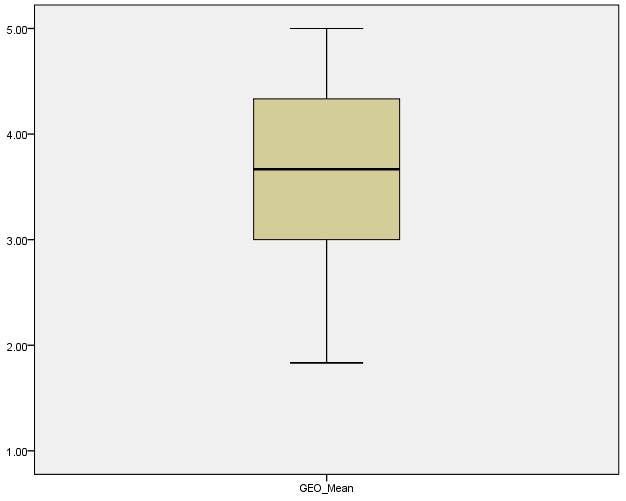
The observed scores ranged from 1.83 to 5.00, with a range of 3.17 and an interquartile range (IQR) of 1.33, indicating that the middle 50% of responses were relatively clustered. However, a few respondents reported significantly lower green entrepreneurial orientation values.
The skewness value (-0.004, SE = 0.24) is effectively zero, confirming that the distribution is nearly normal. The kurtosis value of -0.81 (SE = 0.47) suggests a slightly platykurtic distribution, meaning the data are somewhat flatter than a standard curve, with fewer extreme values (George & Mallery, 2019).
Overall, these descriptive statistics indicate that respondents generally see themselves or their organizations as moderately focused on green entrepreneurship, with a reasonably even distribution and minimal signs of bias or outliers. This offers a strong foundation for later reliability and factor analyses.
To ensure the dataset's integrity, an outlier analysis was conducted, and the results are presented in Figure . The test confirmed that there were no extreme values among the respondents. Consequently, all 103 responses were kept for further analysis, ensuring the findings represent the entire sample without data exclusion (Tabachnick et al., 2019; Osborne & Overbay, 2004).
Green Entrepreneurial Orientation
The green entrepreneurial orientation scale was adapted from Lumpkin & Dess (1996), with items contextualized for environmental sustainability following Ye et al. (2022) and Tuncer & Korchagina (2024). The six items measured opportunity seeking, Eco-Innovation, environmental embedding in strategy, risk-taking, leadership encouragement, and environmental monitoring.
Table 2. KMO and Barlett test for Green Entrepreneurial Orientation
| KMO and Bartlett’s Test | ||
| Kaiser-Meyer-Olkin Measure of Sampling Adequacy. | .882 | |
| Bartlett’s Test of Sphericity | Approx. Chi-Square | 414.986 |
| df | 15 | |
| Sig. | .000 | |
To determine if the data were appropriate for factor analysis, the Kaiser-Meyer-Olkin (KMO) Measure of Sampling Adequacy and Bartlett’s Test of Sphericity were assessed, and results were presented in Table .
-
The KMO value was 0.882, surpassing the recommended threshold of 0.80, which indicates that the sample size and correlations among items were very suitable for factor analysis (Kaiser, 1974; Hutcheson & Sofroniou, 1999). Values above 0.80 are generally regarded as “meritorious,” implying that the variables share enough common variance to justify factor extraction.
-
Bartlett’s Test of Sphericity showed a -square value of 414.986 with 15 degrees of freedom and was highly significant at p < .001. This result confirms that the correlation matrix deviates from an identity matrix, demonstrating that the items share sufficient interrelationships to justify proceeding with factor analysis (Bartlett, 1954; Tabachnick et al., 2019).
These results strongly support conducting factor analysis on the green entrepreneurial orientation construct. The high KMO value indicates sampling adequacy, and the significant Bartlett’s test confirms that the data structure is appropriate for identifying underlying factors. This builds confidence in the validity of the measurement model and ensures subsequent analyses are based on a reliable foundation.
Table 3. Communalities for Green Entrepreneurial Orientation
| Communalities | Initial | Extraction |
| GEO 1 | 1 | .637 |
| GEO 2 | 1 | .792 |
| GEO 3 | 1 | .829 |
| GEO 4 | 1 | .631 |
| GEO 5 | 1 | .682 |
| GEO 6 | 1 | .654 |
Overall, all items exceed the commonly recommended minimum communality threshold of 0.50, confirming that each green entrepreneurial orientation item contributes meaningfully to the factor solution (Hair et al., 2019) as can be indicated by Table .. The relatively high communalities across items suggest that the green entrepreneurial orientation construct is well-defined and internally consistent, with items capturing substantial portions of shared variance. This provides strong evidence of construct validity and supports the reliability of the measurement model.
Table 4. Cronbach Alpha for Green Entrepreneurial Orientation
| Cronbach’s Alpha | Cronbach’s Alpha Based on Standardized Items | N of Items |
| .914 | .915 | 6 |
The reliability statistics, presented in Table , show that the Cronbach’s coefficient for the six-item green entrepreneurial orientation scale is 0.914, with a standardized of 0.915. Both values are well above the typical threshold of 0.70 and even exceed the more stringent benchmark of 0.90, which indicates excellent internal consistency (Hair et al., 2019; Nunnally & Bernstein, 1994).
This result shows that the six items measuring Green Entrepreneurial Orientation are highly correlated and consistently reflect the same underlying concept. In practical terms, respondents’ answers across these items demonstrate strong consistency, indicating that the scale reliably measures how much organizations adopt a sustainability-focused entrepreneurial approach.
The closeness of the raw (0.914) and standardized (0.915) further confirms that item standardization did not significantly impact reliability, reinforcing the robustness of the measurement model (George & Mallery, 2019).
Overall, the green entrepreneurial orientation scale shows excellent reliability, ensuring that subsequent factor analysis and hypothesis testing are based on a construct measured accurately and consistently.
Eco Innovation
The Eco-Innovation scale was adapted from (Chen et al., 2006; Dangelico & Pujari, 2010; Klewitz & Hansen, 2014). The five items measured organizational investment in environmentally friendly products, integration of ecological considerations into innovation processes, exploration of new technologies, long-term strategic prioritization of Eco-Innovation, and collaboration with external partners. Construct validity was confirmed through communalities, factor loadings, and reliability analysis, all exceeding accepted thresholds (Hair et al., 2011).
Table 5. KMO and Barlett’s test for Eco-innovation
| Kaiser-Meyer-Olkin Measure of Sampling Adequacy. | .850 | |
| Bartlett’s Test of Sphericity | Approx. Chi-Square | 289.423 |
| df | 10 | |
| Sig. | .000 |
Before conducting factor analysis, it is important to assess whether the dataset is appropriate for extracting meaningful factors. Two key diagnostics, KMO Measure of Sampling Adequacy and Bartlett’s Test of Sphericity, were evaluated for the Eco-Innovation construct, with the results presented in Table .
-
The KMO value was 0.850, well above the recommended minimum of 0.60. According to (Kaiser, 1974), values between 0.80 and 0.90 are considered “meritorious,” indicating that the sample size and correlations among items are highly suitable for factor analysis. This shows that the Eco-Innovation items share enough common variance to justify factor extraction.
-
Bartlett’s Test of Sphericity produced a -square value of 289.423 with 10 degrees of freedom and was statistically significant at p < .001. This result confirms that the correlation matrix is not the identity matrix, indicating that the items are sufficiently interrelated to proceed with factor analysis (Bartlett, 1954; Tabachnick et al., 2019).
Together, these findings strongly support the use of factor analysis for the Eco-Innovation construct. The high KMO value indicates sampling adequacy, while the significant Bartlett’s test confirms that the data structure is appropriate for identifying underlying factors. This boosts confidence in the validity of the measurement model and ensures that subsequent analyses are based on a solid foundation.
Table 6. Communalities of Eco-innovation
| Initial | Extraction | |
| EI 1 | 1 | .663 |
| EI 2 | 1 | .801 |
| EI 3 | 1 | .788 |
| EI 4 | 1 | .582 |
| EI 5 | 1 | .651 |
All items exceed the commonly recommended minimum threshold of 0.50, as presented in Table , which indicates that each item contributes adequately to the factor solution (Hair et al., 2019). The relatively high communalities across items suggest that the Eco-Innovation construct is well-defined and internally consistent, with items capturing substantial portions of shared variance.
Overall, these results offer strong evidence of construct validity, confirming that the Eco-Innovation scale is appropriate for factor analysis and reliable for future hypothesis testing.
Table 7. Cronbach Alpha for Eco-Innovation
| Cronbach’s Alpha | Cronbach’s Alpha Based on Standardized Items | N of Items |
| .889 | .890 | 5 |
The reliability statistics indicate that the Cronbach’s coefficient for the five-item Eco-Innovation scale is 0.889, with a standardized of 0.890, as presented in Table . Both values are well above the recommended threshold of 0.70 and exceed the more rigorous benchmark of 0.80, which is considered evidence of strong internal consistency (Hair et al., 2019; Nunnally & Bernstein, 1994).
This indicates that the items used to measure Eco-Innovation are highly correlated and consistently capture the same underlying construct. In practical terms, respondents’ answers across the five items demonstrate coherence, meaning the scale reliably reflects the extent to which organizations engage in environmentally oriented innovation. The closeness of the raw and standardized values further confirms that item standardization did not materially affect reliability, reinforcing the robustness of the measurement model (George & Mallery, 2019).
Overall, the reliability analysis strongly supports the Eco-Innovation scale, ensuring that subsequent factor analysis and hypothesis testing rely on a construct measured accurately and consistently.
Institutional Legitimacy
The Institutional Legitimacy scale was adapted from Deephouse (1996), with conceptual guidance from (Deephouse & Suchman, 2008). The five items measured perceptions of acting in the public’s best interest, stakeholder trust in ethical and transparent practices, alignment with societal norms, external recognition, and credibility through responsible governance. Construct validity was confirmed through communalities, factor loadings, and reliability analysis, all exceeding accepted thresholds (Hair et al., 2011).
Table 8. KMO and Barlett test for Institutional Legitimacy
| Kaiser-Meyer-Olkin Measure of Sampling Adequacy. | .831 | |
| Bartlett’s Test of Sphericity | Approx. Chi-Square | 260.610 |
| df | 10 | |
| Sig. | .000 |
Before conducting factor analysis, it is essential to verify whether the dataset is suitable for extracting meaningful factors. Two key diagnostics, KMO Measure of Sampling Adequacy and Bartlett’s Test of Sphericity, were examined for the Institutional Legitimacy construct and results were presented in Table .
-
The KMO value was 0.831, well above the recommended minimum of 0.60. According to Kaiser (1974), values between 0.80 and 0.90 are considered “meritorious,” indicating that the sample size and correlations among items are highly adequate for factor analysis. This suggests that the Institutional Legitimacy items share enough common variance to justify factor extraction.
-
Bartlett’s Test of Sphericity resulted in a -square value of 260.610 with 10 degrees of freedom and was statistically significant at p < .001. This confirms that the correlation matrix is not an identity matrix, indicating the items are sufficiently connected to proceed with factor analysis (Bartlett, 1954; Tabachnick et al., 2019).
Collectively, these results strongly support the suitability of factor analysis for the Institutional Legitimacy construct. The high KMO value demonstrates sampling adequacy, while the significant Bartlett’s test confirms that the data structure is appropriate for identifying underlying factors. This provides confidence in the validity of the measurement model and ensures that subsequent analyses are based on a reliable foundation.
Table 9. Communalities for Institutional Legitimacy
| Initial | Extraction | |
| IL 1 | 1 | .751 |
| IL 2 | 1 | .708 |
| IL 3 | 1 | .648 |
| IL 4 | 1 | .645 |
| IL 5 | 1 | .623 |
As demonstrated in Table , all items surpass the 0.50 communality threshold, indicating that each Institutional Legitimacy item adequately contributes to the factor solution (Hair et al., 2019). The relatively high communalities across items imply that the construct is well-defined and internally consistent, with each item capturing significant portions of shared variance.
Overall, these results offer strong evidence of construct validity, confirming that the Institutional Legitimacy scale is appropriate for factor analysis and reliable for future hypothesis testing.
Table 10. Cronbach Alpha for Institutional Legitimacy
| Cronbach’s Alpha | Cronbach’s Alpha Based on Standardized Items | N of Items |
| .879 | .879 | 5 |
As demonstrated in Table , the reliability statistics show that the Cronbach’s coefficient for the five-item Institutional Legitimacy scale is 0.879, with a standardized of 0.879. Both values are well above the usual cutoff of 0.70 and exceed the more strict standard of 0.80, which indicates strong internal consistency (Hair et al., 2019; Nunnally & Bernstein, 1994).
This result shows that the items used to measure Institutional Legitimacy are closely related and consistently represent the same core idea. In practical terms, respondents’ answers across the five items are coherent, indicating that the scale reliably measures perceptions of legitimacy in organizational practices.
The fact that the raw and standardized values are the same further confirms that item standardization did not significantly impact reliability, reinforcing the stability of the measurement model (George & Mallery, 2019).
Overall, the Institutional Legitimacy scale shows excellent reliability, giving confidence that subsequent factor analysis and hypothesis testing are based on a construct measured accurately and consistently.
Sustainable Economic Performance
The sustainable economic performance scale was adapted from (Schaltegger & Wagner, 2011; Lozano, 2012; Elkington, 1997). The six items measured consistent financial growth with minimized environmental impact, long-term strategies balancing profitability and sustainability, integration of social and ecological responsibility, cost-saving measures promoting resource efficiency, resilience to market fluctuations, and alignment with Sustainable Development Goals. Construct validity was confirmed through communalities, factor loadings, and reliability analysis, all exceeding accepted thresholds (Hair et al., 2011).
Table 11. KMO and Barlett Test for Sustainable Economic Performance
| Kaiser-Meyer-Olkin Measure of Sampling Adequacy. | .861 | |
| Bartlett’s Test of Sphericity | Approx. Chi-Square | 362.587 |
| df | 15 | |
| Sig. | .000 |
Before conducting factor analysis, it is important to verify if the dataset is appropriate for extracting meaningful factors. Two key diagnostics, KMO Measure of Sampling Adequacy and Bartlett’s Test of Sphericity, were examined for the Sustainable Economic Performance construct and presented in Table .
-
The KMO value was 0.861, which is well above the recommended minimum of 0.60. According to Kaiser (1974), values between 0.80 and 0.90 are considered “meritorious,” indicating that the sample size and correlations among items are very suitable for factor analysis. This means that the sustainable economic performance items share enough common variance to justify extracting factors.
-
Bartlett’s Test of Sphericity produced a -square value of 362.587 with 15 degrees of freedom and was statistically significant at p < .001. The findings verify that the correlation matrix departs from an identity matrix, indicating that the items exhibit adequate interrelationships to warrant the application of factor analysis (Bartlett, 1954; Tabachnick et al., 2019).
Together, these results strongly support the use of factor analysis for the Sustainable Economic Performance construct. The high KMO value indicates sampling adequacy, while the significant Bartlett’s test confirms that the data structure is appropriate for identifying underlying factors. This builds confidence in the validity of the measurement model and ensures that subsequent analyses are based on a reliable foundation.
Table 12. Communalities for Sustainable Economic Performance
| Initial | Extraction | |
| SP 1 | 1 | .692 |
| SP 2 | 1 | .691 |
| SP 3 | 1 | .735 |
| SP 4 | 1 | .606 |
| SP 5 | 1 | .685 |
| SP 6 | 1 | .587 |
All items exceed the 0.50 communality benchmark, according to Table , indicating that each sustainable economic performance item adequately contributes to the factor solution (Hair et al., 2019). The relatively high communalities across items suggest that the construct is well-defined and internally consistent, with each item capturing significant portions of shared variance. Overall, these results strongly support the construct validity, confirming that the Sustainable Economic Performance scale is appropriate for factor analysis and reliable for subsequent hypothesis testing.
Table 13. Cronbach Alpha for Sustainable Economic Performance
| Cronbach’s Alpha | Cronbach’s Alpha Based on Standardized Items | N of Items |
| .899 | .899 | 6 |
The reliability analysis indicates that the Cronbach’s coefficient for the six-item Sustainable Economic Performance scale is 0.899, with a standardized of 0.899, as indicated in Table . Both values exceed the commonly accepted threshold of 0.70 and the more stringent criterion of 0.80, indicating robust internal consistency (Hair et al., 2019; Nunnally & Bernstein, 1994).
This indicates that the six items used to assess Sustainable Economic Performance are highly correlated and consistently measure the same underlying concept. Practically, respondents’ answers across these items show coherence, meaning the scale reliably reflects organizational performance in sustainability. The fact that the raw and standardized values are the same further confirms that item standardization did not significantly impact reliability, enhancing the robustness of the measurement model (George & Mallery, 2019). Overall, the sustainable economic performance scale demonstrates excellent reliability, giving confidence that subsequent factor analysis and hypothesis testing are based on a construct measured with accuracy and consistency.
Structural Equation Modelling
To validate the proposed research framework, SEM was carried out using AMOS. SEM was chosen as the most suitable analytical method because it allows the simultaneous testing of multiple relationships among latent constructs, accounts for measurement error, and provides reliable model fit indices. Building on the gaps identified in the literature review, the model includes four key constructs: green entrepreneurial orientation, eco-innovation, institutional legitimacy, and sustainable economic performance. The hypothesized paths indicate both direct and mediated effects, showing how green entrepreneurial orientation promotes eco-innovation, how eco-innovation strengthens institutional legitimacy, and how legitimacy ultimately influences sustainable economic outcomes. Additionally, a direct path from green entrepreneurial orientation to sustainable economic performance was added to test whether entrepreneurial orientation has an independent effect on performance beyond its mediated influence. The AMOS analysis thus offers a thorough validation of the conceptual model, ensuring the proposed hypotheses are empirically examined within a unified structural framework.
Although the sample size (n = 103) may be considered modest for SEM, it falls within accepted heuristics for models of limited complexity. Scholars have noted that SEM can be conducted with samples as low as 100 when the model is not overly complex, provided that the measurement indicators are reliable and the model is properly specified (Ezeugwa et al., 2022; Newsom, 2025).
Nevertheless, we acknowledge that sample size is a limitation of this study. To address this concern, we used SPSS for model fit analysis, recognizing that small samples may pose challenges for SEM estimation. This methodological choice helped ensure that the analysis remained robust despite the constraints.
Importantly, the relatively small sample size does not undermine the validation of the study’s hypotheses, as prior research has shown that hypothesis testing can remain valid even with samples slightly above 100, particularly when the constructs are well-defined and the measurement model is reliable (Hair et al., 2011).
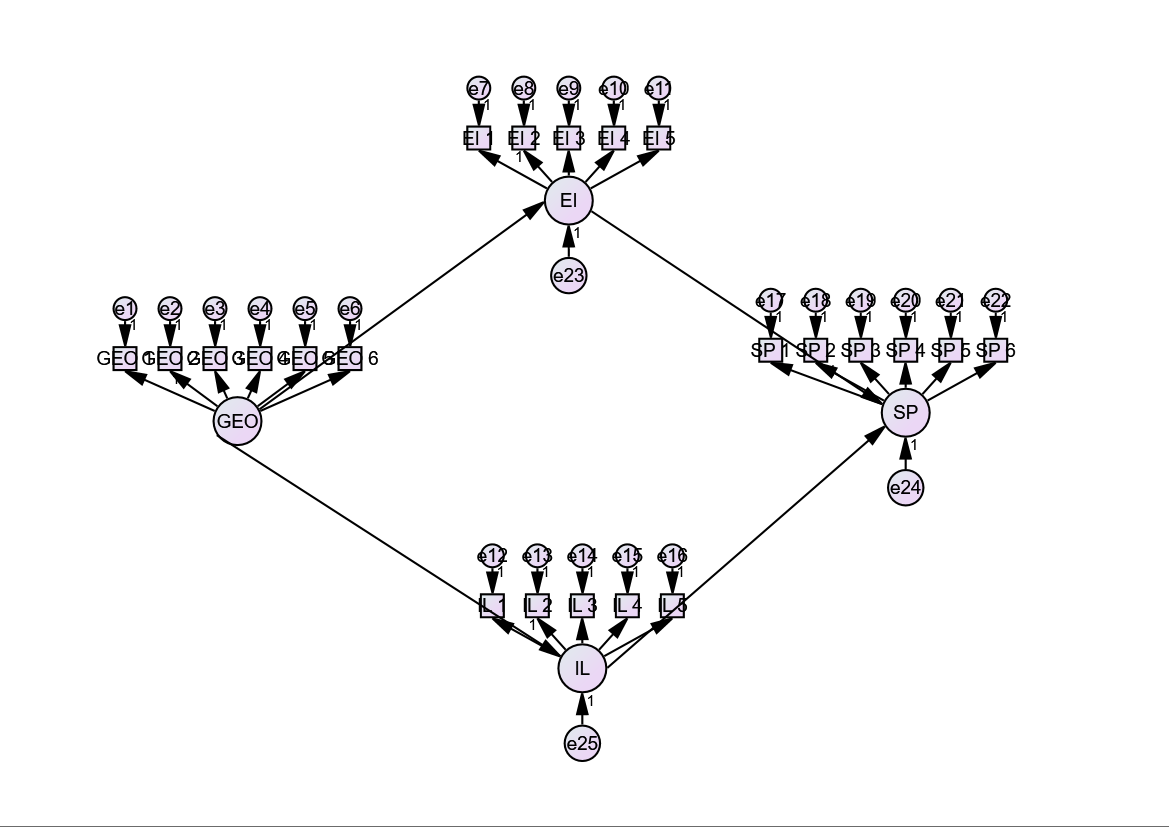
Figure illustrates the study’s conceptual model as specified in AMOS, displaying the relationships between the variables.
Table 14. Path Analysis of the AMOS Conceptual Model
| Estimate | S.E. | C.R. | P | |||
| EI | ¡— | GEO | 1.138 | .149 | 7.625 | *** |
| IL | ¡— | GEO | .856 | .125 | 6.823 | *** |
| SP | ¡— | EI | .392 | .095 | 4.124 | *** |
| SP | ¡— | IL | .591 | .113 | 5.213 | *** |
The SEM results presented in Table strongly support the hypothesized relationships among the constructs. All structural paths are statistically significant (p < .001), with critical ratios (C.R.) well above 1.96, confirming strong effects.
-
Eco-innovation ←green entrepreneurial orientation
-
–
Estimate = 1.138, S.E. = .149, C.R. = 7.625, p < .001
-
–
Interpretation: Green Entrepreneurial Orientation exerts a strong positive influence on Eco-Innovation. Firms with higher green entrepreneurial orientation are significantly more likely to adopt eco-innovative practices.
-
–
-
Institutional legitimacy ←green entrepreneurial orientation
-
–
Estimate = .856, S.E. = .125, C.R. = 6.823, p < .001
-
–
Interpretation: green entrepreneurial orientation also positively predicts Institutional Legitimacy. Organizations oriented toward sustainability gain greater acceptance and credibility among stakeholders.
-
–
-
Sustainable Economic Performance ←Eco-innovation
-
–
Estimate = .392, S.E. = .095, C.R. = 4.124, p < .001
-
–
Interpretation: eco-Innovation contributes positively to Sustainable Economic Performance, though the effect size is moderate compared to other paths. This suggests that eco-innovative practices enhance economic outcomes aligned with sustainability.
-
–
-
Sustainable Economic Performance ←Institutional legitimacy
-
Estimate = .591, S.E. = .113, C.R. = 5.213, p < .001
-
–
Interpretation: Institutional Legitimacy has a strong positive effect on Sustainable Economic Performance. Gaining legitimacy from stakeholders significantly boosts sustainable economic outcomes
-
The SEM results validate the conceptual model:
-
Green entrepreneurial orientation serves as the strategic driver, sparking both eco-innovation and legitimacy pathways.
-
Eco-Innovation acts as a bridge, boosting legitimacy and directly improving performance.
-
Institutional legitimacy is the strongest mediator, converting sustainable practices into stakeholder trust and economic results.
-
Sustainable economic performance is the ultimate goal, attained through both direct and indirect impacts of green entrepreneurial orientation.
This integrated framework highlights that organizations embracing a green entrepreneurial orientation not only innovate sustainably but also gain legitimacy, which in turn strengthens their long-term economic performance.
Conclusion
This study confirmed the validity of the proposed hypotheses, showing that green entrepreneurial orientation exerts both direct and mediated effects on sustainable economic performance through Eco-Innovation and institutional legitimacy. The findings support the idea that entrepreneurial strategies grounded in sustainability generate tangible economic and ecological benefits, while legitimacy builds stakeholder trust and ensures regulatory compliance Dangelico & Pujari (2010).
In line with prior studies, our results resonate with research emphasizing the strategic value of Eco-Innovation in enhancing competitiveness Schaltegger & Wagner (2011) and the role of legitimacy in securing long-term survival under institutional pressures (Deephouse & Suchman, 2008). At the same time, the findings highlight how organizations can leverage sustainability as a differentiating capability, echoing evidence from resilience studies in volatile environments (Hair et al., 2011).
Beyond confirming theoretical expectations, our study contributes to the literature by demonstrating that sustainability-oriented strategies are not only viable but essential in contexts marked by uncertainty. Organizations operating under conditions of climate policy shifts, geopolitical instability, pandemic recovery, and monetary fluctuations can use green entrepreneurial orientation as a framework to balance profitability with ecological responsibility. This aligns with the Triple Bottom Line perspective (Elkington, 1997), which emphasizes the integration of economic, social, and environmental dimensions in organizational performance.
Furthermore, our findings suggest that Eco-Innovation acts as a dynamic capability, enabling organizations to adapt to external shocks while maintaining competitiveness. Institutional legitimacy, in turn, provides the social license to operate, ensuring that sustainability efforts are recognized and supported by stakeholders. Together, these mechanisms reinforce the argument that sustainable entrepreneurship is both a strategic necessity and a pathway to resilience.
In practical terms, organizations can strengthen their resilience by embedding sustainability into core operations, investing in Eco-Innovation, and cultivating legitimacy through transparent governance and stakeholder engagement. These strategies not only enhance economic performance but also position organizations to thrive in uncertain environments, offering lessons for firms across diverse industries and regions.
Academic and Theoretical Implications
Theoretically, this research enhances the Resource-Based View by demonstrating that sustainability-oriented capabilities, when combined with eco-innovation, generate unique resources that improve firm performance (Barney, 1991). It also broadens Institutional Theory by showing how legitimacy influences entrepreneurial outcomes, emphasizing the need to align organizational practices with societal expectations (Deephouse & Suchman, 2008). Academically, the research adds to the existing body of literature on sustainable entrepreneurship by integrating strategic orientation, innovation, and legitimacy into a cohesive framework (Schaltegger & Wagner, 2011).
Limitations
While the study offers valuable contributions, it is not without limitations. The sample size of 103 respondents, though adequate for SEM analysis, constrains generalizability across diverse industries and regions. Furthermore, the reliance on self-reported data introduces the possibility of bias, as participants may overstate the extent of their sustainability practices. Additionally, the cross-sectional design restricts the ability to observe changes over time (Podsakoff et al., 2003).
Recommendations for Future Research and Practice
Future studies should employ larger and more diverse samples across multiple countries to enhance external validity. Longitudinal designs could observe how the relationship between green entrepreneurial orientation, Eco-Innovation, and legitimacy develops over time, providing insights into sustainability trajectories. Researchers may also examine moderating variables such as government support, cultural factors, or digital transformation, which could affect the strength of mediation effects (Hockerts & Wüstenhagen, 2010).
Beyond academic implications, future implementation should be framed within the contexts of uncertainty. Climate policy shifts, geopolitical instability, pandemic recovery, and monetary fluctuations all challenge firms’ ability to sustain performance. In such environments, organizations should:
-
Embed sustainability into core operations to withstand regulatory and monetary shocks.
-
Leverage digital transformation to build resilience in post-COVID structures.
-
Develop adaptive strategies and cross-sector partnerships to mitigate risks associated with war and geopolitical volatility.
-
Strengthen legitimacy through transparent communication and stakeholder engagement, ensuring trust even in uncertain policy landscapes.
Supplementary Materials
Supplementary material for this article is available online via https://doi.org/10.51300/JSE-2026-165.
Funding Statement
No external funding was received
Conflict of Interest
The author declares that there is no conflict of interest regarding the publication of this paper.
References
- . Triple Bottom Line and Sustainability: A Literature Review. Business and Management Studies, 1(2), 6--10. https://doi.org/10.11114/bms.v1i2.752. CrossRef | Google Scholar
- . Linking green entrepreneurial orientation and ambidextrous green innovation to stimulate green performance: a moderated mediation approach. Business Process Management Journal, 30(8), 99--120. https://doi.org/10.1108/bpmj-09-2023-0703. CrossRef | Google Scholar
- . A Note on the Multiplying Factors for Various $\chi^2$ Approximations. Journal of the Royal Statistical Society Series B: Statistical Methodology, 16(2), 296--298. https://doi.org/10.1111/j.2517-6161.1954.tb00174.x. CrossRef | Google Scholar
- . Diversity of eco-innovations: Reflections from selected case studies. Journal of Cleaner Production, 18(10-11), 1073--1083. https://doi.org/10.1016/j.jclepro.2010.02.014. CrossRef | Google Scholar
- . Social entrepreneurship and institutional sustainability: Insights from an embedded social enterprise. Voluntas, 30, 1243--1258. https://doi.org/10.1007/s11266-019-00188-3. CrossRef | Google Scholar
- . The Influence of Green Innovation Performance on Corporate Advantage in Taiwan. Journal of Business Ethics, 67(4), 331--339. https://doi.org/10.1007/s10551-006-9025-5. CrossRef | Google Scholar
- . Mainstreaming Green Product Innovation: Why and How Companies Integrate Environmental Sustainability. Journal of Business Ethics, 95(3), 471--486. https://doi.org/10.1007/s10551-010-0434-0. CrossRef | Google Scholar
- . Legitimacy in Organizational Institutionalism. SAGE Publications Ltd. https://doi.org/10.4135/9781849200387.n2. CrossRef | Google Scholar
- . {The Multivariate Social Scientist: Introductory Statistics Using Generalized Linear Models}. Sage Publications.
- . {Firm Resources and Sustained Competitive Advantage}. Journal of Management, 17(1), 99--120. https://doi.org/10.1177/014920639101700108. CrossRef | Google Scholar
- . {Does Isomorphism Legitimate?}. Academy of Management Journal, 39(4), 1024--1039. https://doi.org/10.2307/256722. CrossRef | Google Scholar
- . Cannibals with forks: The triple bottom line of 21st century business. Cannibals with forks: The triple bottom line of 21st century business. Capstone Publishing.
- . Partnerships from cannibals with forks: The triple bottom line of 21st‐century business. Environmental Quality Management, 8(1). https://doi.org/10.1002/tqem.3310080106. CrossRef | Google Scholar
- . Minimum sample size estimation in SEM: Contrasting results for models using composites and factors. DAPJ, 3.
- . Exploratory Factor Analysis. Oxford University Press. https://doi.org/10.1093/acprof:osobl/9780199734177.001.0001. CrossRef | Google Scholar
- . IBM SPSS Statistics Processes for Mac. Routledge. https://doi.org/10.4324/9780429056765-3. CrossRef | Google Scholar
- . Multivariate data analysis. Multivariate data analysis.
- . An assessment of the use of partial least squares structural equation modeling in marketing research. Journal of the Academy of Marketing Science, 40(3), 414--433. https://doi.org/10.1007/s11747-011-0261-6. CrossRef | Google Scholar
- . Greening Goliaths versus emerging Davids — Theorizing about the role of incumbents and new entrants in sustainable entrepreneurship. Journal of Business Venturing, 25(5), 481--492. https://doi.org/10.1016/j.jbusvent.2009.07.005. CrossRef | Google Scholar
- . Clarifying the Entrepreneurial Orientation Construct and Linking It to Performance. The Academy of Management Review, 21(1), 135--172. https://doi.org/10.2307/258632. CrossRef | Google Scholar
- . Exploring social enterprise legitimacy within ecosystems from an institutional approach: A systematic literature review and research agenda. International Journal of Management Reviews, 26(2), 567--589. https://doi.org/10.1111/ijmr.12349. CrossRef | Google Scholar
- . Managing Legitimacy: Strategic and Institutional Approaches. The Academy of Management Review, 20(3), 571--610. https://doi.org/10.2307/258788. CrossRef | Google Scholar
- . Green entrepreneurial orientation, boundary-spanning search and enterprise sustainable performance: The moderating role of environmental dynamism. Frontiers in Psychology, 13, 978274--978274. https://doi.org/10.3389/fpsyg.2022.978274. CrossRef | Google Scholar
- . A Systematic Literature Review and Conceptual Framework on Green Entrepreneurial Orientation. Administrative Sciences, 14(6), 109--109. https://doi.org/10.3390/admsci14060109. CrossRef | Google Scholar
- . Exploring Institutional Pressures, Green Innovation, and Sustainable Performance: Examining the Mediated Moderation Role of Entrepreneurial Orientation. Sustainability, 16(5). https://doi.org/10.3390/su16052058. CrossRef | Google Scholar
- . Legitimacy theory: Institutional situation analysis of innovation driven entrepreneurship. In A Theoretical Foundation for Innovation Driven Entrepreneurship (pp. 107--115). Springer. https://doi.org/10.1007/978-981-96-3133-9_11. CrossRef | Google Scholar
- . The green entrepreneurship landscape: Drivers, outcomes, and future directions. International Entrepreneurship and Management Journal, 21(80). https://doi.org/10.1007/s11365-025-01079-4. CrossRef | Google Scholar
- . A systematic review of eco innovation and performance from the resource based and stakeholder perspectives. Sustainability, 11(21), 6067. https://doi.org/10.3390/su11216067. CrossRef | Google Scholar
- . Psychometric Theory. McGraw-Hill.
- . Mainstreaming green product innovation: Why and how companies integrate environmental sustainability. Journal of Business Ethics, 95(3), 471--486. https://doi.org/10.1007/s10551-010-0434-0. CrossRef | Google Scholar
- . Sustainable entrepreneurship and sustainability innovation: Categories and interactions. Business Strategy and the Environment, 20(4), 222--237. https://doi.org/10.1002/bse.682. CrossRef | Google Scholar
- . Towards better embedding sustainability into companies’ systems: An analysis of voluntary corporate initiatives. Journal of Cleaner Production, 25, 14--26. https://doi.org/10.1016/j.jclepro.2011.11.060. CrossRef | Google Scholar
- . Common method biases in behavioral research: A critical review of the literature and recommended remedies. Journal of Applied Psychology, 88(5), 879--903. https://doi.org/10.1037/0021-9010.88.5.879. CrossRef | Google Scholar
- . Summary of Minimum Sample Size Recommendations for SEM. .
- . Cannibals with Forks: The Triple Bottom Line of 21st Century Business. Capstone Publishing.
- . An index of factorial simplicity. Psychometrika, 39(1), 31--36. https://doi.org/10.1007/BF02291575. CrossRef | Google Scholar
- . Sustainability-oriented innovation of SMEs: A systematic review. Journal of Cleaner Production, 65, 57--75. https://doi.org/10.1016/j.jclepro.2013.07.017. CrossRef | Google Scholar
- . Green entrepreneurial orientation, boundary-spanning search and enterprise sustainable performance: The moderating role of environmental dynamism. Frontiers in Psychology, 13, 978274. https://doi.org/10.3389/fpsyg.2022.978274. CrossRef | Google Scholar
- . The power of outliers (and why researchers should always check for them). Practical Assessment, Research, and Evaluation, 9(6), 1--12. https://doi.org/10.7275/qf69-7k43. CrossRef | Google Scholar
- . Discovering Statistics Using {IBM} {SPSS} Statistics. Sage Publications.
- . Triple bottom line in sustainable development: A comprehensive bibliometric analysis. Sustainability, 17(5), 1932. https://doi.org/10.3390/su17051932. CrossRef | Google Scholar
- . Institutional environment and productive entrepreneurship. Sustainability, 16(24), 11060. https://doi.org/10.3390/su162411060. CrossRef | Google Scholar
- . Managing legitimacy: Strategic and institutional approaches. Academy of Management Review, 20(3), 571--610. https://doi.org/10.5465/amr.1995.9508080331. CrossRef | Google Scholar
- . Eco innovation methodologies: A literature review. Discover Sustainability, 6(1143). https://doi.org/10.1007/s43621-025-01621-y. CrossRef | Google Scholar
About contributors

Mony Trad
Notre Dame University-Louaize, Management and Marketing, Zouk Mosbeh, Lebanon
Lebanon
Ahmad El Zein
Notre Dame University-Louaize, Management and Marketing, Zouk Mosbeh, Lebanon
Lebanon
Atef Harb
Notre Dame University-Louaize, Management and Marketing, Zouk Mosbeh, Lebanon
Lebanon