





Abstract
Globally, relationships among green finance, renewable energy use and carbon emissions indicate complex regional patterns. This complexity and heterogeneity necessitates scientific-based study of country-specific green policy approaches accounting for the variations. Generally, increasing fossil energy consumption for economic growth is globally highly correlated with both environmental degradation and climate change. With countries committed to urgent policy actions, China currently seeks scientific foundations for their envisioned 2060 carbon neutrality targets This paper investigates the influences of both renewable energy consumption and financial innovation on environmental degradation in China between 2000 Q1 and 2018 Q4 with Fourier Autoregressive Distributive Lag and Fourier Toda Yamamoto causality approaches. Initial assessment indicated all variables were integrated. The F-ARDL long-run equilibrium estimates indicate (i) improvements in both financial innovation and renewable energy utilization contribute to decreasing environmental degradation in China; (ii) economic growth and primary energy use cause environmental degradation to rise. The government of China could prioritize investments in the development of green industries, which requires removing entry barriers, in particular for renewable energy projects. Second, the Chinese government could increase budgetary allocations towards improving environmental research and financing international partnerships on environmental initiatives.
Introduction
Globally, the environment has been found to significantly determine health, economy, and continuous existence (Remoundou & Koundouri, 2009). Environmental degradation, therefore, refers to the deterioration of environmental resources, including air, water, soil, ecosystems, and wildlife through human disturbance. These are generally caused by several factors, including overpopulation, global warming, air and water pollution, and deforestation for purposes of mining, housing, and agriculture (Victor Bekun & Akadiri, 2019). Among these, the foremost factor determining environmental degradation, according to experts, is global warming as it is seen by scientists to cause the current historic climate change, a factor identified to accelerate a break in the balance of human ecosystems (Pathak et al., 2022). Several scholars have confirmed that rising fossil energy use, increased garbage creation and rising ecological footprint are all factors contributing to environmental degradation. They claim further that the effect of such environmental disturbance also varies based on the cause, the kind of habitat system, plants, and animals. The human-caused degradation is the source of changes in average weather patterns, fall in the food supply, climate-related natural hazards and undermines ecosystem services, including clean water and fertile soil (Agyekum et al., 2021; Yuan et al., 2022).
Governments worldwide are seeking policy pathways in dealing with these environmentally wrecking human actions and calling on academics' research interventions.One major factor identified to play a significant role is financial innovation. Proponents claim it is critical to boost efficient energy use, reduce energy intensity, and facilitate energy productivity (Sarkodie & Owusu, 2021). Financial innovation is defined to refer to financial inventions for managing and transferring financial risk. According to Miller (1986), financial innovation also includes innovative derivative products, risk allocation services, financial exchanges, and tax innovations on equity goods serving the needs of the economy. Recently, financial innovation refers to offerings and process inventions to meet the demands of the economic system. In modern climate transition discussions, financing of interventions requires positive levels of innovation, a move away from the traditional project financing models towards realizing the expected impacts on environmental quality (Allen, 2012).Experts have claimed that, theoretically, pollution control and energy efficiency through renewable and low-carbon fossil energy utilization largely depend on innovative financing of environmental technologies. Nonetheless, critics claim, for example, although carbon finance is a major constituent of innovative financial macroenvironments in China, leading to a decline in carbon intensity (Tian et al., 2017), carbon tax is not an effective financial pathway to reducing environmental pollution because the instrument can serve more as a tax-saving mechanism than a measure for ecological protection.
Second, renewable energy sourcing is cited by environmental and energy experts to directly connect to financial innovations and contribute to determining rates of environmental degradation. Scholars argue that renewable energy growth occurs through monetary contributions supporting circularity-related projects to safeguard the environment. Financial innovations for renewable energy initiatives are generally green-asset financing, bonds, and investments, making it easier for corporations to finance environmentally-friendly operations. Renewable energy (RE) refers to a type of energy sourced from nature and is replenishable. It includes energy from the sun, wind, and water. Renewable energy use creates opportunities in the sectors of energy security, access, climate action, environment, social and economic development, and human health protection (Owusu & Asumadu-Sarkodie, 2016). Table 1 illustrates renewable energy sources, conversion and usage options.
Table 1. Renewable energy sources, conversion and usage options
| Energy sources | Energy conversion and usage options |
| Hydropower | Power generation |
| Morden biomass | Heat and power generation, pyrolysis, gasification, digestion |
| Geothermal | Urban heating, power generation, hydrothermal, hot dry rock |
| Solar | Solar home systems, solar dryers, solar cookers |
| Direct solar | Photovoltaic, thermal power generation, water heaters |
| Wind | Power generation, wind generators, windmills, water pump |
| Wave and tide | Numerous designs, barrage, tidal stream |
Environmental experts claim that renewable energy creates energy access, facilitates social and economic development, and generates very low emissions of carbon dioxide, making its use relevant for dealing with climate change and global warming. Accordingly, renewable energy is currently seen as a key element in global net zero policy discussions (Usman et al., 2023; Brini, 2021). However, critics claim renewable energy innovations generally face technical uncertainties and long periods of research & development cycles (Udeagha & Ngepah, 2022). Additionally, in spite of its numerous advantages, critics argue that it faces discontinuities in energy supply due to naturally occurring periodic variations. Further, given that green energy technologies are climate-dependent, they need huge investments for design complexities, planning, and regulatory optimization (Banos et al., 2011). Further, experts claim the complete lifecycle of green energy use does not generate net emissions to help reduce future carbon dioxide emissions. Finally, development costs, market conditions and current political environments in developing economies prevent its development potential and adoption (Owusu & Asumadu-Sarkodie, 2016).
The persistent academic question is whether renewable energy sourcing and financial innovations can truly contribute to energy transition and carbon dioxide emissions goals of the global economy. Three sub-questions operationalize this inquiry, aligned with our hypotheses: first, financial innovation reduces environmental degradation in China (H1)? Second. do both renewable energy use and financial innovations are hypothesized to have significant negative effect on environmental degradation in China (H2)? Third, do positive and negative shocks in natural resource rents have statistically different long-run effects on gross domestic product growth (H3)? and fourth, do positive and negative shocks in trade openness have statistically different long-run effects on gross domestic product growth (H4)?
To answer these questions, China presents as the best economy for assessment based on their current characteristics.In the global innovation ranking, China placed 11th among 132 economies in 2022 (World Intellectual Property Organization, 2022). In 2020, increased its budget for developing renewable energy subsidies by $13 billion, 7.5% rise above allocations for 2019. In 2020, China placed 3rd in top 40 renewable energy markets worldwide behind the United States and Germany.After a historic shortage of electricity in 2021, Chana introduced a five-year renewable energy development plan as part of their decarbonization policy. Sadly, considered as the largest emitter of CO2 in Asia, China accounts for over 58% of the regions' total CO2 emissions (Intergovernmental Panel on Climate Change, 2019). China's over-consumption of fossil fuels has caused air quality, clean water and biodiversity to decline, and posed as existential health threats (Marcotullio et al., 2012).Experts further claim China's budget allocation for developing renewable energy is far below what is required (Bloomberg News, 2023). Instructively, several experts have found that the pattern is not uniform across all Asian sub-regions, suggesting that policy effectiveness varies based on local economic structures, energy mixes, and governance capabilities. This heterogeneity necessitates scientific-based region-specific policy approaches that account for varying levels of financial development and institutional maturity (Kalk, 2012; Moeletsi et al., 2023).
To make contributions to academic enquiries and policy options on energy transition, this paper investigates the effect of financial innovations and renewable energy sourcing on production-based carbon emissions for the case of China using Fourier cointegration and ARDL approaches. Additionally, this assessment has not been fully investigated for the case of China, making it extremely relevant for academic enquiry and given the current rate of rapid economic growth of China. Relative to previous assessments, this paper controls both economic growth and primary energy use in a simultaneous equation model towards assessing long-term equilibrium behavior of interest variables. The paper progresses as follows: the next section focuses on reviewing existing literature towards building a conceptual frame and developing a credible hypothesis for assessment; Following this is the description of research methodology, the empirical outcomes and discussions. The last section concludes the paper and offers insights to policymakers and future academic work.
Literature review
In this section, the paper investigates related studies and theories to help develop conceptual perspectives for the empirical examination. It draws on relevant debates, positions and traces the historical developments that inform the topic selection. In the process, four (4) hypotheses for the study are made.
Financial innovations and environmental degradation nexus
Historically, economists have claimed that historical moments have required great successive surges in technological innovations, production systems and organization, consumption and styles of living. It has required difficult processes towards unlearning the old and embracing new processes wrought by periods of creative destruction. Accordingly, the recent global environmental change and planetary warming required a massive paradigm shift, including prioritizing financial innovations to propel energy alternatives. According to Miller (1986), financial innovation entails generating novel derivatives, allocating pioneering risk products, and creating climate-friendly funding mechanisms (Silber, 1983). Financial innovation efforts require preventing climate change through the creative financialization of projects on environmental degradation (Zubair et al., 2021). Critics claim this definition is a complete departure from Joseph Schumpeter's conception of innovation within capitalist systems serving as a catalyst of growth (Schumpeter, 1976). Similarly, the traditional drivers of financial innovation within the capital structure irrelevancy principle of Modigliani and Miller (Modigliani & Miller, 1958), which claims the value of firms is independent of their capital structure, is attacked. But in recent years, experts claim financial innovations in the midst of market imperfections admitted by Modigliani and Miller (Modigliani & Miller, 1958) call for business modernizations that lower operational costs, enhance corporate liquidity, and de-risk corporate projects (Tufano, 2003). And precisely, this is the need of modern-day corporations to contribute to climate change and environmental quality improvements. According to Zhang & Wilson (2022), the post-Paris Climate Conference (COP21) requires of carbon neutrality and environmental sustainability needs of the global economy are technological and financially green innovations towards the realization of clean-energy transition, low-carbon economy and climate-action goals.
Financially-green innovations help to reduce climate change and global warming (Dogan & Seker, 2016; Cao et al., 2021). Essentially, environmentally friendly financial innovations offer resources to corporations to reduce or deal with pollution and over-consumption of fossil energy. It also facilitates optimization and upgrades of corporate production structure (Gu et al., 2023). According to Ren et al. (2020), several countries across the world have actively prioritized carbon-emission reduction policies through investments in green financial innovation towards economic growth. This finding has been validated by Yu et al. (2021), who find that green financial innovations encourage corporate reallocation of resources and facilitate the delivery of sustainable development goals of the economy.
Based on this review, the paper assumes (H1) that financial innovation reduces environmental degradation in China. (i.e., ϑi = ¿ 0; where ϑrefers to the parameter of interest; LFNI refers to the natural log of financial innovations; LCO2PRD is the natural log of production-based carbon dioxide emissions (as a proxy for environmental degradation). Accordingly, the paper expects China to propel energy transition and low-carbon delivery through financial innovations. This assumption is supported by Udeagha & Ngepah (2022) in their studies in 73 developing economies with data from 1990 to 2016.
Renewable Energy and environmental degradation nexus
In general, the complexities in linkages among renewable energy use, environmental degradation and climate variabilities are empirically obvious. Global environmental change and warming is largely caused by carbon dioxide emissions as a direct result of fossil energy utilization for economic growth (Chiu et al., 2017; Salari et al., 2021). Globally, economies are prioritizing investments and policies on renewable energy as an alternative energy-sourcing strategy for achieving environmental and energy security towards realizing economic and social sustainability (Shahbaz & Sinha, 2019; Pavlović et al., 2021; Kartal et al., 2022).
Empirically, an investigation of linkages between carbon-dioxide emissions, renewable and fossil-energy sourcing 10 MENA economies by Farhani & Shahbaz (2014) indicated the existence of unidirectional causality initiated from the direction of renewable energy utilization to carbon-dioxide emissions. Similarly, studies by Apergis & Payne (2014) on relations between renewable energy and fossil power utilization for the case of 11 South American economies validated this result. Additionally, Liu et al. (2017) studied the relations between green and fossil energy utilization in agricultural production and carbon emissions for the case of BRICS using VECM. The outcomes indicated unidirectional causality linkages ranging from renewable-energy use to carbon-dioxide emissions. Similar outcomes were obtained by Khan et al. (2021) in Pakistan using the Toda Yamamoto Granger Causality method to study relations between agriculture, renewable energy and carbon-dioxide emissions.
Another stream of studies focus on emissions-led-renewable power sourcing. A study by Menyah2010CO2 on the relationships between economic output, green and nuclear energy, and carbon-dioxide emissions indicated a linkage between carbon-dioxide emissions and renewable energy use. A study conducted by Leitão (2014) in Portugal showed unidirectional causality observed from carbon-dioxide use to renewable energy. Using panel VECM method, Shafiei & Salim (2014) investigated factors that determine carbon use for the case of OECD economies and found carbon discharges to unidirectionally cause green energy sourcing. These findings were validated in Tunisia by Jebli & Youssef (2015).
Further, scientists have found evidence of rebound effects between renewable energy and environmental degradation. A study conducted by Apergis et al. (2010) on the nexus between economic output, renewable and nuclear energy, and carbon-dioxide emissions for the case of 19 advanced and developing economies using the VECM approach indicated that there exists bi-directional causality between renewable energy use and carbon-dioxide emissions. Similarly, a study in 2017. Investigating the nexus between renewable and fossil energy use, carbon-dioxide emissions, economic output and trade liberalization, Dogan & Seker (2016) found bi-directional causality between carbon-dioxide emissions and renewable energy utilization. These findings were validated by Waheed et al. (2021) who used the panel VECM method to investigate the nexus between renewable energy use, agricultural production, and carbon-dioxide emissions in Pakistan.
Notwithstanding these claims, several studies find or claim no relation between renewable energy and environmental pollution. For example, In testing this neutrality hypothesis, Bento and Moutinho (2016) used the Toda-Yamamoto method and found no causality between carbon-dioxide emissions and renewable energy in Italy. These findings were validated by Jebli et al. (2016) in the study of the case of 25 OECD economies, (Saidi & Ben Mbarek, 2016; Boontome et al., 2017; Jebli & Youssef, 2017). In sum, the review has indicated that globally, both renewable energy use and financial innovations have significant effect on environmental degradation but with mixed empirical results. To bring finality to the debates, the paper uses the F-ARDL method (Addai et al., 2022) to estimate this for the case of China. This approach uses dummy variables to detect reliably long term hidden cointegration properties and structural variations of variables compared to the traditional ARDL approach. Based on the review, both renewable energy use and financial innovations are hypothesized to have significant negative effect on environmental degradation in China (i.e., ϑ2 = where to the parameter of interest; REN refers to natural renewable energy use; LCO2PRD is the natural log of production-based carbon dioxide emissions (as a proxy for environmental degradation).
Primary energy use and environmental degradation nexus
To realise the objetive of the paper, both economic growth and primary energy use are controlled for assessing the case of China. First, for many decades, China's electricity markets have been largely driven by primary energy, resulting in increasing rates of CO2 emissions. Second, there has been increasing pressure for the country to change heating sources from coal to green energy sources. The country's energy sources largely come from hard coal, lignite, hydropower, oil, natural gas, geothermal, solar, wind and nuclear (2018 China Energy Statistics Yearbook; Ivanovski et al. (2021)). According to Cai et al. (2018), China's total consumption of coal has always covered approximately two-thrids of its total energy consumption. Based on these factors, the paper assumes primary energy use positively moderates CO2 emissions in China, i.e., ϑ3 = ¿ 0; where interest parameter; LPEC denotes natural log of primary energy use; LCO2PRD is natural log of production-basedCO2 emissions (as proxy for environmental degradation). This assumption is reinforced by Ren et al. (2022).
Economic growth and environmental degradation nexus
For many years, studies on economic output and environmental degradation have been motivated by the Environmental Kuznets Curve (EKC) framework originally espoused by Grossman & Krueger (1994). The EKC hypothesis claims of rising environmental pollution at early stages of economic growth until reaching a certain threshold before it tends to decline. Several studies have since been conducted to test the EKC hypothesis and found it to be valid (Khobai et al., 2022). For example, Hakimi & Hamdi (2019) found the framework to be valid for the case of South Africa between 1984 and 2018. Similarly, in Azerbaijan, studies conducted on relations between economic growth and environmental pollution indicated economic growth positively affected carbon-dioxide emissions. However, several groups of studies either disclaim the validity of the EKC framework (Abbasi & Riaz, 2016; Bulut, 2017; Farhani & Ozturk, 2015) or indicate inconclusive outcomes (Apergis & Ozturk, 2015; Gokmenoglu et al., 2021). Based on these, this study assumes a steady rise in economic growth significantly increases CO2 emissions in China (H4). i.e., ϑ4= > 0; where to the parameter of interest; LGDP is the natural log of gross domestic products (GDP) as a proxy variable for economic growth; LCO2PRO is the natural log of production-based carbon dioxide emissions. This hypothesis supports a study by Umar et al. (2020).
Conceptual framework and overall evaluation and clearly state the literature gap
The green transition in Asia is no longer a purely technical challenge; it has become a energy and financial engineering challenge. Toward examining the complex nexus among financial innovation, renewable energy use and environmental degradation for the case of China, the paper is motivated by the theory ecological modernization and environmental kuznets curve (EKC) hypothesis. Theoretically, financial innovation drives environmental quality through green technological effects of research and development (Jianguo et al., 2022; Shahbaz et al., 2022; Adebayo et al., 2024). Additionally, investments in green energy transition helps decouple economic growth from carbon-intensive energy sourcing (Adebayo et al., 2024). Despite the surge in green research, three critical gaps remain in the 2026 academic and policy literature regarding Asia’s green transition (i) Most literature focuses on utility-scale projects (gigawatt-scale dams and solar parks). There is a significant lack of research on how innovative finance can reach small and medium enterprises, which make up 90% of Asian businesses but struggle to secure green loans due to a lack of collateral; (ii) There is a technical-financial disconnect from grid stability, which until now has not received enough scientific enquiry (de Goede & Westermeier, 2022; Sun & Ahmed, 2024).
Methodology
The study seeks to assess the effect of financial innovation and renewable energy use on environmental degradation in China from 2000Q1 to 2018Q4. As reported in Table 2, (a) Renewable Energy (RE) use: Renewable energy (RE) refers to defined to refer to a type of energy sourced from nature and are replenishable. It includes energy from the sun, wind and water. Renewable energy use creates opportunities in the sectors of energy security, access, climate action, environment, social and economic development, and human health protection (Owusu & Asumadu-Sarkodie, 2016); Data was sourced from the International Energy Agency (IEA). (b) This financial innovation is calculated using the M3 (Board Money) - M1 (Narrow Money) approach suggested by Chishti & Sinha (2022), Huo et al. (2023), etc.. (c) Production-based CO2 emissions (CO2PRD): Production-based CO2 emission is calculated by GDP per unit of CO2 emission. Estimates of CO2 emission data were sourced from the International Energy Agency; (d) GDP growth (as a proxy for economic growth) refers to increases in the size of the economy for a period and is measured by the total production of goods and services. Data was sourced from the World Bank database. (e) Primary energy use: This refers to energy sourced in raw form, normally from coal, crude oil, natural gas, hydro, and other renewable power. For purposes of avoiding scaling difficulties in the empirical outcomes, all variables are logged except renewable energy consumption.
Table 2. Data description, Measure, and Source
| Variable | References | Measure | Data Sources |
| Production-based CO2 emission | (Kirikkaleli & Oyebanji, 2022) | GDP (US$ 2015) per unit (kilogram) of energy-related CO2 emissions | International Energy Agency (IEA) |
| Financial Innovation | (Chishti & Sinha, 2022) | Author’s Calculation | |
| Renewable energy consumption (RE) | (Zeng et al., 2017). | Yearly terawatt-hours (TWh) of energy used | International Energy Agency (IEA) |
| GDP growth (GDP) (as a proxy for economic growth) | Yang et al. (2021) and Addai et al. (2023). | relative to the previous year’s GDP. | World Bank database |
| Primary energy | Addai et al. (2023) | Total energy demand in kilowatthours (kWh) | International Energy Agency (IEA) |
Theoretical Framework
In this study, authors are inspired by Dinda (2014) hypothesis on green growth and its effect on environmental innovations for economic growth. Based on this, several environmental sustainability frameworks have been generated. In Spain, Oyebanji et al. (2022) observe direct nexus between economic output and environmental degradation. In their study of the top five countries in Asia between 2001 and 2014, Rehman & Rehman (2022) find primary energy consumption to cause a surge in carbon-dioxide emissions. To open up the space in the growth and environment pollution model for further academic enquiry, this paper focuses on the effect of financial innovation and renewable energy on the environmental pollution in China. Theoretically, investments in renewable energy and financial innovation projects stimulate economic activities which have a direct effect on carbon-dioxide emission, validating the EKC hypothesis (Dogan & Seker, 2016; Sun et al., 2021). The study is motivated by Copeland & Taylor (2003) pollution framework which assumes that every unit of economic activity generates units of pollution. To Copeland & Taylor (2003), the pollution generated differs as a result of abatement action taken on the resultant output of a particular economic activity. Based on this framework, the paper adopts the F-ARDL approach to assess the effect of investments in renewable energy sourcing and financially innovative projects on environmental degradation for the case of China. The model to be estimated is derived as:
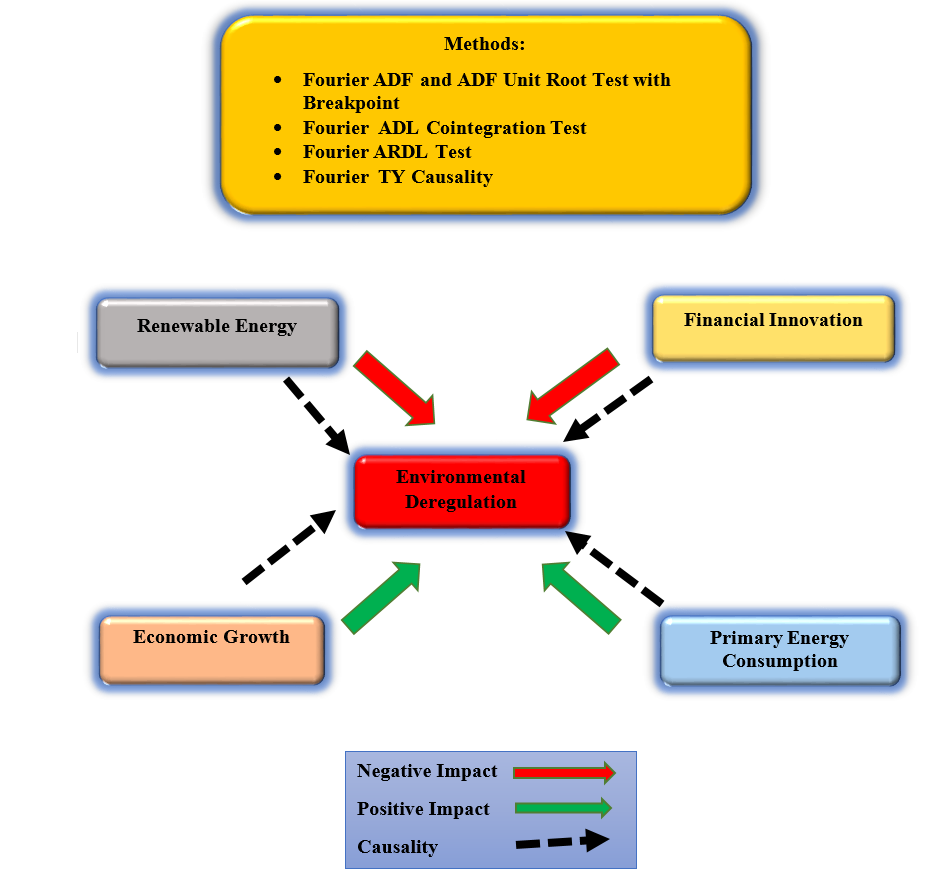
where CO2PRD, GDP, PEC, FNI and REC stand for production-based CO2 emissions, GDP (as a proxy for economic growth), primary energy consumption, financial innovation and renewable energy consumption, respectively. The Figure 1 shows the main estimators of the study with the analysis flowchart.
In econometric assessments, endogenous problems are generally inevitable due to complexities in linkages among variables. The endogeneity issues imply one or more of the explanatory variables are linked to the random error term within the model due to inadvertent omissions, selection biases and measurement inaccuracies.
In empirical econometric estimations, scholars generally recognize time series data as random walks (non-stationary) and contain unit roots. Essentially, unit root testing is very important to avoid invalid econometric analytical interpretations if they tend to be present. It is instructive to note that historically, variables integrated at fluctuating degrees cannot be tested for cointegration using conventional econometric approaches to cointegration. To navigate through this problem, the paper adopts F-ADF and ADF unit root tests. These tests have historically been confirmed by Enders & Lee (2011) to produce reliable outcomes compared to traditional unit root tests. According to Gallant (1981), Fourier approaches are flexible and can be employed to approximate or smoothen breaks in time series. By this, Fourier approaches presume the existence of unknown time series nonlinearities, including structural breaks, which can only be accurately detected by using low-frequency aspects of Fourier approximations. This is because such breaks and structural changes usually cause a shift in the spectral density functions to zero frequencies.
For several decades, economists have traditionally employed (Pesaran et al., 2001) Autoregressive distributed lag (ARDL) for cointegration analysis. Given the limitations on longer period assessment of cointegration using the traditional methods, this paper uses the F-ARDL approach to gauge the long-term linkages among the determining variables. (Yilanci et al., 2022). This is contrary to the historical claims of Granger & Yoon (2002) that variables are validly cointegrated when they collectively respond to shocks. To be able to detect hidden long-run equilibrium cointegration among the variables, cumulative positive and negative structural shocks in the variables must be computed (Yilanci et al., 2020). F-ARDL techniques provide robust tools for long-run cointegration estimates than the conventional ARDL method. In addition, F-ARDL is able to detect structural variations, although such is not a requirement. Fourier function originally created by Yilanci et al. (2020) is modeled as.
”where 'n' represents the number of frequencies, = 3.14, 'k' denotes the number of special frequencies designated, 't' represents a trend, while 'T' is represents sample size”. However, Becker et al. (2006) suggested a single frequency value as.
To realize the objectives of study, the FARDL model adopted for the study is
Finally, the paper adopts the F-TY Causality Test to detect the direction of causality between the variables in support of the Fourier ARDL estimates.
Empirical Findings
This study investigates the effect of environmental sustainability effect of financial innovation and renewable energy consumption of China between 2000Q1 to 2018Q4, while keeping economic growth and primary energy use controlled. Table 3 illustrates a statistical description of data used for this analysis.
Table 3. Descriptive Statistics
| LNCO2PRD | LNFI | LNGDP | LNPEC | REC | |
| Production-based co2 emissions | Financial Innovation | GDP (constant 2015 US$) | Primary Energy Consumption | Renewable Energy | |
| Mean | 22.69207 | -0.094229 | 3.883287 | 4.394903 | 7.903026 |
| Median | 22.78703 | -0.112447 | 3.906839 | 4.433912 | 7.006980 |
| Maximum | 23.07498 | 0.000000 | 4.179954 | 4.586346 | 13.07139 |
| Minimum | 22.01122 | -0.148177 | 3.538031 | 4.071892 | 5.011949 |
| Std. Dev. | 0.357503 | 0.046045 | 0.205876 | 0.164908 | 2.423542 |
| Skewness | -0.684612 | 0.633494 | -0.216030 | -0.714764 | 0.732444 |
| Kurtosis | 2.053498 | 2.042142 | 1.710624 | 2.188463 | 2.178168 |
| Jarque-Bera | 8.773703 | 7.988705 | 5.855691 | 8.556785 | 8.934128 |
| Probability | 0.012440* | 0.018419* | 0.053512** | 0.013865* | 0.011481* |
For the outcomes of the descriptive statistical assessment, the paper checks for data stationarity with F-ADF and ADF unit root with the breakpoint test (illustrated at Table 4). It is crucial to initially check the behavior of the Fourier function to understand if variables are statistically significant. This is important for deciding with the F-ADF unit root approach. If Fourier functions exhibit significant statistical outcomes, the ADF unit root test is not adopted to assess the stationarity properties of variables. The F-stat of the LNCO2PRD, LNFI and LNGDP appear statistically significant. Based on the outcomes, the F-ADF test is employed to make the decision for cointegration assessment action. The estimates suggest variables have mixed levels of integration.
Table 4. F-ADF and ADF Unit Root tests
| Variable | F-STAT | F-ADF | ADF with Break Point |
| LNCO2PRD | 8.766056*** | -3.697377 | |
| LNFI | 4.302353** | -2.606994 | |
| LNGDP | 10.66396*** | -4.851141** | |
| LNPEC | 3.778832 | -3.103620 | -5.110* (2012Q1) |
| REC | 2.820941 | -2.790188 | -3.211 (2011Q2) |
| DLNCO2PRD | 1.872102 | -5.268410** | |
| DLNFI | 2.633883 | -6.580878*** | |
| DLNGDP | |||
| DLNPEC | -11.931*** (2003Q1) | ||
| DLNREC | -5.995***(2003Q1) |
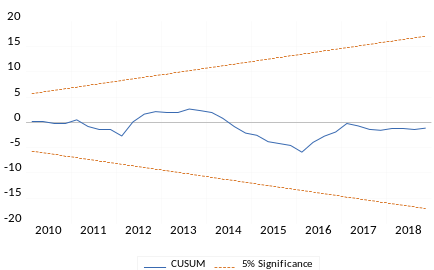
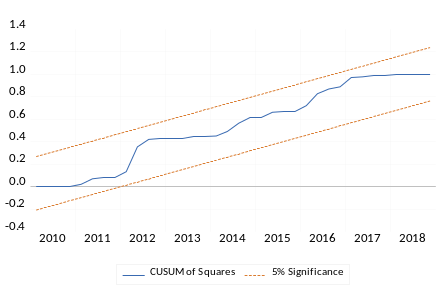
Given the estimates of the unit-roots test, the cointegration relationship between the variables could be inferred between variables of interest in this assessment as reported in Table 5. To assess both the short-run and long-run cointegration features of the variables, it is important to check if the empirical ARDL model is free from serial autocorrelation and heteroscedasticity; and equally has realistic goodness of fit. The paper used the B-P-G Heteroskedasticity Test, B-G Serial Correlation LM Test and CUSUM squared tools. The outcomes indicate the ARDL model is free from serial autocorrelation and heteroscedasticity, whiles the CUSUM graph exhibits substantial stability (see Table 4; Figure 2 and Figure 3)
Table 5. F-ADL Cointegration Analysis
| Model | Test Statistics | Frequency | Min AIC |
| LNCO2PRD =f(LNGDP, REC, LNFI, LNPEC) | -7.088** | 0.100000 | -3.272 |
Given that the model is stable and free from serial autocorrelation and heteroscedasticity, the paper next checks the cointegration properties of the variables using a Fourier-based ADL cointegration test. Conventionally, ARDL bounds assessment for cointegration is motivated by the initial work developed by Pesaran et al. (2001) to detect the existence of long-run relationships between variables despite integration order (i.e., I(0) or I(1), or missed). The F-ADL estimator is able to uncover the unrestricted error correction model (UECM) via linear processes. The outcomes clearly supports the long run linkage among the variables in the estimated model.
Table 6. Fourier ARDL Long Run Form
| Variable | Coef. | Std. Err. | t-Stat. | Prob. |
| LGDP | 1.155442 | 0.512798 | 2.253210 | 0.0293** |
| LFNI | -1.098641 | 0.532510 | -2.063135 | 0.0450** |
| LPEC | 1.583315 | 0.536037 | 2.953742 | 0.0050* |
| REC | -0.039010 | 0.015513 | -2.514698 | 0.0156* |
| @SIN | -0.000868 | 0.000846 | -1.025702 | 0.3106 |
| @COS | 0.001168 | 0.000843 | 1.385695 | 0.1728 |
| B-P-G Heteroskedasticity Test | ||||
| F-stat. | 1.076165 | Prob. | 0.4055 | |
| B-G Serial Correlation LM Test | ||||
| F-stat. | 2.218009 | Prob. | 0.1214 | |
Based on the F-ARDL estimates (Table 6), LREC has a negative effect on LNCO2PRD. The coefficient value of -0.039010 is statistically significant. This outcome indicates that for any unit change in LREC, there is a corresponding reduction of LNCO2PRD by -0.039010%. This outcome validates the hypothesis established for the study (renewable energy use is hypothesized to have significant negative effect on environmental degradation in China (H2); (i.e., ϑ2 = ), and aligns with previous study by Rahman & Velayutham (2020) and Usman & Balsalobre-Lorente (2022). Theoretically, renewable energy use reduces carbon emissions and supports the well-being of the nations (Hussain et al., 2021; Zeng et al., 2017). This is an indication that China's policies to deal with increasing international pressure to control rising GHG emissions beginning in 2009 were bearing fruits.
Similarly, the F-ARDL estimates (illustrated in Table 6). LFNI has a negative effect on LNCO2PRD. From the table, the coefficient value of LFNI of -1.098641 is significant statistically. This outcome means that for any unit adjustment in LFNI, there is a corresponding reduction of LNCO2PRD by -1.098641% in China. This outcome also validates the hypothesis established for this study ((H1) Financial innovation is hypothesized to have a significant negative effect on environmental degradation in China (H1); (i.e., ϑ1 = ),;); and equally aligns with a study by Udeagha and Ngepah (2022).
Further, it is remarkable to observe that the coefficient value of LGDP is 1.155442, and is statistically significant. This outcome means that for any unit adjustment in LGDP, there is a corresponding rise in LNCO2PRD by 1.155442% in China. This outcome similarly validates the statistical assumptions established for this study (a steady rise in economic growth significantly increases CO2 emissions in China (H4); i.e., ϑ4= > 0;). The outcomes also align with a study by Serener et al. (2022)
Further, the coefficient value of LPEC recorded in the F-ARDL estimates (see Table 6) is 1.583315. This outcome isstatistically significant and means that for any unit adjustment in LPEC, there is a corresponding rise in LNCO2PRD by 1.583315% in China. This outcome similarly validates the statistical assumptions established for this study: a steady rise in primary energy consumption significantly increases CO2 emissions in China (H3); i.e., ϑ3= > 0;).. The outcomes also align with a study by Cai et al. (2018).
Table 7. F-TY Causality Test
| T-stat | p-value | ||
| Ho1 | LNGDP does not cause LNCO2PRD | 17.56966 | 0.000540* |
| Ho2 | REC does not cause LNCO2PRD | 16.35009 | 0.002584* |
| Ho3 | LNFI does not cause LNCO2PRD | 10.06697 | 0.073360** |
| Ho4 | LNPEC does not cause LNCO2PRD | 20.59076 | 0.000128* |
The F-TY causality estimates (Table 7) indicate that LNPEC, LNGDP, LNFI, and REC individually and collectively cause LNCO2PRD without any rebound action for the case of China. These outcomes imply the government of China could prioritize policy actions on these variables as they cause changes in LNCO2PRD. The summary of the outcomes is illustrated in Figure 3.
Conclusions and Policy Suggestions
In recent times, there a rising need to take protective and restorative environmental actions, particularly those that reduce or mitigate carbon dioxide emissions. Policymakers are seeking pathways to realizing this objective and seek academic action. This paper has investigated the effect of renewable energy consumption and financial innovation of environmental degradation for the case of China. Both economic growth and primary energy use were controlled in the analysis, given that they have been generally found to contribute to determining carbon emissions across the world. The Fourier long-run estimates indicate (i) financial innovation and renewable energy utilization cause a decrease in environmental degradation in China; (ii) GDP and primary energy use increase (and cause) environmental degradation.
These outcomes provide the following policy insights: (i) First, the government of China could prioritize investments in the development of green industries, including energy conservation, cleaner production, clean energy and green buildings. This will also imply removing all entry barriers for renewable energy investments, including developing renewable energy technology products or services; (ii) Second, the Chinese government could invest in developing environment-related research and technologies. This will require increasing budgetary allocations to improve existing environmental research and development systems and financing international partnerships for research initiatives to improve global environmental quality. Initiatives such as funding the activities of the green development alliance of the ”Belt and Road” initiative should be prioritized. At the local level, the government of China could take policy actions to support the development of renewable energy sourcing and infrastructure grounded in science; (iii) To achieve their decarbonization targets, the Chinese government could increase investments and financing of green technologies. Such policies could focus on increasing the speed of commercialization and scale of proven breakthrough environmental technologies. It would also essentially require establishing regional platforms for the promotion of financially innovative products and services that promote the quality of the environment. Locally, it could also require asset securitization towards boosting the vitality of carbon assets using the financial services industry.
For overly concentrating on China, the limitation is the inability of authors to compare outcomes. Future academic study could consider regional-based study, and incorporate other equally important variables, including environment decentralization and geopolitical risks.
Funding Statement
This research received no external funding.
Conflict of Interest
The authors declare that there is no conflict of interest regarding the publication of this paper.
CRediT Authorship Contribution Statement
Kwaku Addai: Conceptualization, Methodology, Formal analysis, Investigation, Data curation, Writing – original draft, Writing – review & editing, Visualization, Supervision.
Supplementary Materials
Supplementary material for this article is available online via https://doi.org/10.51300/JSE-2026-167.
Publisher Disclaimer
The views expressed in this article are solely those of the author(s) and do not necessarily reflect those of their institutions, the publisher, editors, or reviewers. The publisher and editorial team make no warranties regarding the accuracy or completeness of the content and accept no responsibility for errors, omissions, or any consequences arising from its use. The publisher remains neutral regarding jurisdictional claims in maps and institutional affiliations.
References
- . CO2 emissions and financial development in an emerging economy: An augmented VAR approach. Energy Policy, 90, 102--114. https://doi.org/10.1016/j.enpol.2015.12.017. CrossRef | Google Scholar
- . Insights from Poland on the long-run effect of energy productivity on environmental degradation: a Fourier ARDL-based approach. Environmental Science and Pollution Research, 30(23), 63453--63463. https://doi.org/10.1007/s11356-023-26595-0. CrossRef | Google Scholar
- . Energy productivity and environmental degradation in Germany: evidence from novel Fourier approaches. Sustainability, 14(24), 16911--16911. https://doi.org/10.3390/su142416911. CrossRef | Google Scholar
- . Can environmental sustainability be decoupled from economic growth? Empirical evidence from Eastern Europe using the common correlated effect mean group test. Regional Sustainability, 4(1), 68--80. https://doi.org/10.1016/j.regsus.2023.03.003. CrossRef | Google Scholar
- . A Systematic Review of the Effects of Temperature on Anopheles Mosquito Development and Survival: Implications for Malaria Control in a Future Warmer Climate. International Journal of Environmental Research and Public Health, 18(14), 7255--7255. https://doi.org/10.3390/ijerph18147255. CrossRef | Google Scholar
- . Trends in Financial Innovation and Their Welfare Impact: An Overview. European Financial Management, 18(4), 493--514. https://doi.org/10.2139/ssrn.2171738. CrossRef | Google Scholar
- . Testing Environmental Kuznets Curve hypothesis in Asian countries. Ecological Indicators, 52, 16--22. https://doi.org/10.1016/j.ecolind.2014.11.026. CrossRef | Google Scholar
- . Renewable Energy, Output, Carbon Dioxide Emissions, and Oil Prices: Evidence from South America. Energy Sources, Part B: Economics, Planning, and Policy, 10(3), 281--287. https://doi.org/10.1080/15567249.2013.853713. CrossRef | Google Scholar
- . On the causal dynamics between emissions, nuclear energy, renewable energy, and economic growth. Ecological Economics, 69(11), 2255--2260. https://doi.org/10.1016/j.ecolecon.2010.06.014. CrossRef | Google Scholar
- . Optimization methods applied to renewable and sustainable energy: A review. Renewable and sustainable energy reviews, 15, 1753--1766. https://doi.org/10.1016/j.rser.2010.12.008. CrossRef | Google Scholar
- . A Stationarity Test in the Presence of an Unknown Number of Smooth Breaks. Journal of Time Series Analysis, 27(3), 381--409. https://doi.org/10.1111/j.1467-9892.2006.00478.x. CrossRef | Google Scholar
- . CO2 emissions, non-renewable and renewable electricity production, economic growth, and international trade in Italy. Renewable and Sustainable Energy Reviews, 55, 142--155. https://doi.org/10.1016/j.rser.2015.10.151. CrossRef | Google Scholar
- . Investigating the causal relationship between non-renewable and renewable energy consumption, CO2 emissions and economic growth in Thailand. Energy Procedia, 138, 925--930. https://doi.org/10.1016/j.egypro.2017.10.141. CrossRef | Google Scholar
- . The Effect of Primary School Students Writing Attitudes and Writing Self-Efficacy Beliefs on Their Summary Writing Achievement. lnternational Electronic Journal of Elementary Education, 10(2), 281--285. https://doi.org/10.26822/iejee.2017236123. CrossRef | Google Scholar
- . Path-Level Network Transformation for Efficient Architecture Search. In Proceedings of the 35th International Conference on Machine Learning (ICML) (pp. 678--687). PMLR.
- . Digital finance, green technological innovation and energy-environmental performance: Evidence from China's regional economies. Journal of Cleaner Production, 327, 129458--129458. https://doi.org/10.1016/j.jclepro.2021.129458. CrossRef | Google Scholar
- . Do the shocks in technological and financial innovation influence the environmental quality? Evidence from BRICS economies. Technology in Society, 68, 101828--101828. https://doi.org/10.1016/j.techsoc.2021.101828. CrossRef | Google Scholar
- . Climate-change influences on the response of macroinvertebrate communities to pesticide contamination in the Sacramento River, California watershed. Science of The Total Environment, 581-582, 741--749. https://doi.org/10.1016/j.scitotenv.2017.01.002. CrossRef | Google Scholar
- . Trade, Growth and the Environment. Journal of Economic literature, . National Bureau of Economic Research, 42, 7--71. https://doi.org/10.3386/w9823. CrossRef | Google Scholar
- . Infrastructural Geopolitics. International Studies Quarterly, 66(3), 33--33. https://doi.org/10.1093/isq/sqac033. CrossRef | Google Scholar
- . The influence of real output, renewable and non-renewable energy, trade and financial development on carbon emissions in the top renewable energy countries. Renewable and Sustainable Energy Reviews, 60, 1074--1085. https://doi.org/10.1016/j.rser.2016.02.006. CrossRef | Google Scholar
- . A Unit Root Test Using a Fourier Series to Approximate Smooth Breaks*. Oxford Bulletin of Economics and Statistics, 74(4), 574--599. https://doi.org/10.1111/j.1468-0084.2011.00662.x. CrossRef | Google Scholar
- . Causal relationship between CO2 emissions, real GDP, energy consumption, financial development, trade openness, and urbanization in Tunisia. Environmental Science and Pollution Research, 22(20), 15663--15676. https://doi.org/10.1007/s11356-015-4767-1. CrossRef | Google Scholar
- . What role of renewable and non-renewable electricity consumption and output is needed to initially mitigate CO2 emissions in MENA region?. Renewable and Sustainable Energy Reviews, 40, 80--90. https://doi.org/10.1016/j.rser.2014.07.170. CrossRef | Google Scholar
- . The Fourier Flexible Form. American Journal of Agricultural Economics, 66(2), 204--208. https://doi.org/10.2307/1241043. CrossRef | Google Scholar
- . The relationship between Co2emissions, energy consumption, economic growth and FDI: the case of Turkey. The Journal of International Trade and Economic Development, 25(5), 706--723. https://doi.org/10.1080/09638199.2015.1119876. CrossRef | Google Scholar
- . Hidden Cointegration. SSRN Electronic Journal, 2002--2002. https://doi.org/10.2139/ssrn.313831. CrossRef | Google Scholar
- . Economic Growth and the Environment. The quarterly journal of economics, . National Bureau of Economic Research, 110, 353--377. https://doi.org/10.3386/w4634. CrossRef | Google Scholar
- . Natural resources and undesired productions of environmental outputs as green growth: EKC in the perspective of green finance and green growth in the G7 region. Resources Policy, 82, 103552--103552. https://doi.org/10.1016/j.resourpol.2023.103552. CrossRef | Google Scholar
- . Environmental effects of trade openness: what role do institutions have?. Journal of Environmental Economics and Policy, 9(1), 17--27. https://doi.org/10.1080/21606544.2019.1598503. CrossRef | Google Scholar
- . Carbon-based nanomaterials with multipurpose attributes for water treatment: Greening the 21st-century nanostructure materials deployment. Biomaterials and Polymers Horizon, 1(1), 48--58. https://doi.org/10.37819/bph.001.01.0131. CrossRef | Google Scholar
- . The effect of renewable and non-renewable energy consumption on economic growth: Non-parametric evidence. Journal of Cleaner Production, 286, 124956--124956. https://doi.org/10.1016/j.jclepro.2020.124956. CrossRef | Google Scholar
- . The environmental Kuznets curve, economic growth, renewable and non-renewable energy, and trade in Tunisia. Renewable and Sustainable Energy Reviews, 47, 173--185. https://doi.org/10.1016/j.rser.2015.02.049. CrossRef | Google Scholar
- . The role of renewable energy and agriculture in reducing CO2 emissions: Evidence for North Africa countries. Ecological indicators, 74, 295--301. https://doi.org/10.1016/j.ecolind.2016.11.032. CrossRef | Google Scholar
- . Testing environmental Kuznets curve hypothesis: The role of renewable and non-renewable energy consumption and trade in OECD countries. Ecological Indicators, 60, 824--831. https://doi.org/10.1016/j.ecolind.2015.08.031. CrossRef | Google Scholar
- . The nexus of financial development, technological innovation, institutional quality, and environmental quality: evidence from OECD economies. Environmental Science and Pollution Research, 29(38), 58179--58200. https://doi.org/10.1007/s11356-022-19763-1. CrossRef | Google Scholar
- . A critical analysis of e-waste policies. A critical analysis of e-waste policies.
- . Asymmetric effect of electricity consumption on CO2 emissions in the USA: analysis of end-user electricity consumption by nonlinear quantile approaches. Environmental Science and Pollution Research, 29(55), 83824--83838. https://doi.org/10.1007/s11356-022-21715-8. CrossRef | Google Scholar
- . Long-run impact of coal usage decline on CO2 emissions and economic growth: Evidence from disaggregated energy consumption perspective for China and India by dynamic ARDL simulations. Energy and Environment, 35(5), 2357--2381. https://doi.org/10.1177/0958305x231152482. CrossRef | Google Scholar
- . Role of energy transition in easing energy security risk and decreasing CO2 emissions: disaggregated level evidence from the USA by quantile-based models. Environmental Science and Pollution Research, 359, 29720--29731.
- . Economic growth, carbon dioxide emissions, renewable energy and globalization. International Journal of Energy Economics and Policy, 4(3), 391--399.
- . The nexus of renewable energy-agriculture-environment in BRICS. Applied Energy, 204, 489--496. https://doi.org/10.1016/j.apenergy.2017.07.077. CrossRef | Google Scholar
- . The geography of urban greenhouse gas emissions in Asia: A regional analysis. Global Environmental Change, 22(4), 944--958. https://doi.org/10.1016/j.gloenvcha.2012.07.002. CrossRef | Google Scholar
- . Bootstrapping the autoregressive distributed lag test for cointegration. Applied Economics, 50(13), 1509--1521. https://doi.org/10.1080/00036846.2017.1366643. CrossRef | Google Scholar
- . CO2 emissions, nuclear energy, renewable energy and economic growth in the US. Energy Policy, 38(6), 2911--2915. https://doi.org/10.1016/j.enpol.2010.01.024. CrossRef | Google Scholar
- . Financial Innovation: The Last Twenty Years and the Next. The Journal of Financial and Quantitative Analysis, 21(4), 459--471. https://doi.org/10.2307/2330693. CrossRef | Google Scholar
- . The Cost of Capital, Corporation Finance, and the Theory of Investment. American Economic Review, 48, 261--297.
- . Development of an agricultural drought preparedness framework for South African croplands and grasslands. Development of an agricultural drought preparedness framework for South African croplands and grasslands. WRC Report.
- . A review of renewable energy sources, sustainability issues and climate change mitigation. Cogent Engineering, 3(1), 1167990--1167990. https://doi.org/10.1080/23311916.2016.1167990. CrossRef | Google Scholar
- . Patents on Environmental Technologies and Environmental Sustainability in Spain. Sustainability, 14(11). https://doi.org/10.3390/su14116670. CrossRef | Google Scholar
- . The role of financial deepening and green technology on carbon emissions: Evidence from major OECD economies. Finance Research Letters, 41, 101794--101794. https://doi.org/10.1016/j.frl.2020.101794. CrossRef | Google Scholar
- . The Impact of Climate Change on Sustainable Development: The Case of Vojvodina. International Journal of Industrial Engineering and Management, 12(2), 141--141. https://doi.org/10.24867/IJIEM-2021-2-283. CrossRef | Google Scholar
- . Does research and development expenditure impact innovation? Evidence from the European Union countries. Journal of Policy Modeling, 41(5), 1005--1025. https://doi.org/10.1016/j.jpolmod.2019.07.001. CrossRef | Google Scholar
- . Bounds testing approaches to the analysis of level relationships. Journal of Applied Econometrics, 16(3), 289--326. https://doi.org/10.1002/jae.616. CrossRef | Google Scholar
- . Renewable and non-renewable energy consumption-economic growth nexus: New evidence from South Asia. Renewable Energy, 147, 399--408. https://doi.org/10.1016/j.renene.2019.09.007. CrossRef | Google Scholar
- . Modeling the nexus between carbon emissions, urbanization, population growth, energy consumption, and economic development in Asia: Evidence from grey relational analysis. Energy Reports, 8, 5430--5442. https://doi.org/10.1016/j.egyr.2022.03.179. CrossRef | Google Scholar
- . Environmental Effects on Public Health: An Economic Perspective. International Journal of Environmental Research and Public Health, 6(8), 2160--2178. https://doi.org/10.3390/ijerph6082160. CrossRef | Google Scholar
- . Nexus between green finance, non-fossil energy use, and carbon intensity: Empirical evidence from China based on a vector error correction model. Journal of Cleaner Production, 277, 122844--122844. https://doi.org/10.1016/j.jclepro.2020.122844. CrossRef | Google Scholar
- . Dynamic impacts of energy consumption on economic growth in China: Evidence from a non-parametric panel data model. Energy Economics, 107, 105855--105855. https://doi.org/10.1016/j.eneco.2022.105855. CrossRef | Google Scholar
- . Nuclear energy, renewable energy, CO 2 emissions, and economic growth for nine developed countries: Evidence from panel Granger causality tests. Progress in Nuclear Energy, 88, 364--374. https://doi.org/10.1016/j.pnucene.2016.01.018. CrossRef | Google Scholar
- . The nexus between CO2 emissions, energy consumption, and economic growth in the U.S.. Economic Analysis and Policy, 69, 147257--147257. https://doi.org/10.1016/j.eap.2020.12.007. CrossRef | Google Scholar
- . Patents on Environmental Technologies, Financial Development, and Environmental Degradation in Sweden: Evidence from Novel Fourier-Based Approaches. Sustainability, 15(1), 302--302. https://doi.org/10.3390/su15010302. CrossRef | Google Scholar
- . Non-renewable and renewable energy consumption and CO2 emissions in OECD countries: A comparative analysis. Energy Policy, 66, 547--556. https://doi.org/10.1016/j.enpol.2013.10.064. CrossRef | Google Scholar
- . Environmental Kuznets curve for CO2 emissions: a literature survey. Journal of Economic Studies, 46(1), 106--168. https://doi.org/10.1108/jes-09-2017-0249. CrossRef | Google Scholar
- . The process of financial innovation. The American Economic Review, 73(2), 89--95.
- . A study on China's economic growth, green energy technology, and carbon emissions based on the Kuznets curve (EKC). Environmental Science and Pollution Research, 28, 7200--7211.
- . Does financial macroenvironment impact on carbon intensity: evidence from ARDL-ECM model in China. Natural Hazards, 88(2), 759--777. https://doi.org/10.1007/s11069-017-2925-0. CrossRef | Google Scholar
- . Financial Innovation. Elsevier, Vol. 1. https://doi.org/10.1016/s1574-0102(03)01010-0. ISBN: 9780444513625. CrossRef | Google Scholar
- . Does trade openness mitigate the environmental degradation in South Africa?. Environmental Science and Pollution Research, 29(13), 19352--19377. https://doi.org/10.1007/s11356-021-17193-z. CrossRef | Google Scholar
- . The asymmetric effect of technological innovation on CO2 emissions in South Africa: New evidence from the QARDL approach. Frontiers in Environmental Science, 10, 985719--985719. https://doi.org/10.3389/fenvs.2022.985719. CrossRef | Google Scholar
- . The static and dynamic connectedness of environmental, social, and governance investments: International evidence. Economic Modelling, 93, 112--124. https://doi.org/10.1016/j.econmod.2020.08.007. CrossRef | Google Scholar
- . Environmental concern in the era of industrialization: Can financial development, renewable energy and natural resources alleviate some load?. Energy Policy, 162, 112780--112780. https://doi.org/10.1016/j.enpol.2022.112780. CrossRef | Google Scholar
- . Are Mercosur economies going green or going away? An empirical investigation of the association between technological innovations, energy use, natural resources and GHG emissions. Gondwana Research, 113(1), 2158244019828853--2158244019828853. https://doi.org/10.1016/j.gr.2022.10.018. CrossRef | Google Scholar
- . Climate Change Policy Coherence across Policies, Plans, and Strategies in Pakistan—Implications for the China–Pakistan Economic Corridor Plan. Environmental Management, 67(5), 793--810. https://doi.org/10.1007/s00267-021-01449-y. CrossRef | Google Scholar
- . Nexus between green finance, fintech, and high-quality economic development: Empirical evidence from China. Resources Policy, 74, 102445--102445. https://doi.org/10.1016/j.resourpol.2021.102445. CrossRef | Google Scholar
- . The role of affluence, urbanization, and human capital for sustainable forest management in China: Robust findings from a new method of Fourier cointegration. Sustainable Development, 31(2), 812--824. https://doi.org/10.1002/sd.2421. CrossRef | Google Scholar
- . Demand for green finance: Resolving financing constraints on green innovation in China. Energy Policy, 153, 112255--112255. https://doi.org/10.1016/j.enpol.2021.112255. CrossRef | Google Scholar
- . Exoplanet Radius Gap Dependence on Host Star Type. Research Notes of the AAS, 1(1). https://doi.org/10.3847/2515-5172/aa9ed9. CrossRef | Google Scholar
- . A review of renewable energy investment in the BRICS countries: History, models, problems and solutions. Renewable and Sustainable Energy Reviews, 74, 860--872. https://doi.org/10.1016/j.rser.2017.03.016. CrossRef | Google Scholar
- . Green Finance, Innovation and the Energy-Environment-Climate Nexus. Frontiers in Environmental Science, 10, 879681--879681. https://doi.org/10.3389/fenvs.2022.879681. CrossRef | Google Scholar
- . Transition from brown to green: Analyst optimism, investor discount, and Paris Agreement. Energy Economics, 116, 106391--106391. https://doi.org/10.1016/j.eneco.2022.106391. CrossRef | Google Scholar
- . Holocene fire history in southwestern China linked to climate change and human activities. Quaternary Science Reviews, 289, 107615--107615.
- . Renewable and non-renewable electricity consumption, economic growth and climate change: Evidence from a panel of selected African countries. Energy, 223, 120064. https://doi.org/10.1016/j.energy.2021.120064. CrossRef | Google Scholar
- . Special Report on the Ocean and Cryosphere in a Changing Climate. . https://www.ipcc.ch/srocc.
- . Global Innovation Index 2022: What is the future of innovation-driven growth? (15th ed.). . https://doi.org/10.34667/tind.46596. CrossRef | Google Scholar
- . Technical Summary. Climate Change 2022: Mitigation of Climate Change. Contribution of Working Group {III} to the Sixth Assessment Report of the Intergovernmental Panel on Climate Change. Cambridge University Press. https://doi.org/10.1017/9781009157926.002. CrossRef | Google Scholar
- . Long-End Treasuries Hit by Wildest Swings Since 2020 Pandemic. . Accessed: 2026-04-05. https://www.bloomberg.com/news/articles/2023-10-17/long-end-treasuries-fluctuate-by-most-since-2020-pandemic-onset.
- . Testing the Unemployment Hysteresis in {G7} Countries: A Fresh Evidence from Fourier Threshold Unit Root Test. Romanian Journal of Economic Forecasting, 23(3), 49--59.
- . On the bias in flexible functional forms and an essentially unbiased form: The Fourier flexible form. Journal of Econometrics, 15(2), 211--245. https://doi.org/10.1016/0304-4076(81)90004-9. CrossRef | Google Scholar
- . A review of renewable energy investment in the BRICS countries: History, models, problems and solutions. Renewable and Sustainable Energy Reviews, 74, 860--872. https://doi.org/10.1016/j.rser.2017.03.016. CrossRef | Google Scholar
- . A theoretical basis for green growth. International Journal of Green Economics, 8(2), 177--189. https://doi.org/10.1504/IJGE.2014.064851. CrossRef | Google Scholar
- . How do environmental technologies affect environmental degradation? Analyzing the direct and indirect impact of financial innovations and economic globalization. Environmental Technology and Innovation, 29, 102973. https://doi.org/10.1016/j.eti.2022.102973. CrossRef | Google Scholar
- . Probing the carbon neutrality drive of environmental-related technologies and energy transition in France and Germany: A novel time--frequency technique. Clean Technologies and Environmental Policy, 26(12), 4325--4343. https://doi.org/10.1007/s10098-024-02854-3. CrossRef | Google Scholar
- . Role of financial development in economic growth in the light of asymmetric effects and financial efficiency. International Journal of Finance and Economics, 27(1), 361--383. https://doi.org/10.1002/ijfe.2151. CrossRef | Google Scholar
- . Military expenditure, financial development and environmental degradation in Turkey: A comparison of CO2 emissions and ecological footprint. International Journal of Finance and Economics, 26(1), 986--997. https://doi.org/10.1002/ijfe.1821. CrossRef | Google Scholar
- . The links between renewable energy, fossil energy, terrorism, economic growth and trade openness: The case of Pakistan. SN Business and Economics, 1(9), 115. https://doi.org/10.1007/s43546-021-00115-5. CrossRef | Google Scholar
- . Capitalism, Socialism, and Democracy. George Allen \& Unwin Ltd.. Originally published in 1942.
- . The relationship between economic growth and carbon emissions in South Africa. International Journal of Energy Economics and Policy, 12. https://doi.org/10.32479/ijeep.11194. CrossRef | Google Scholar
- . Consumption-based carbon emissions, trade, and globalization: an empirical study of Bolivia. Environmental Science and Pollution Research, 29(20), 29927--29937.
- . In Memoriam: Dr. James J. McCarthy. . Accessed: 2026-03-27. https://ipcc.ch/2019/.
- . The Cost of Capital, Corporation Finance, and the Theory of Investment. American Economic Review, 48(3), 261--297.
- . Escalation effect of fossil-based CO2 emissions improves green energy innovation. Science of the Total Environment, 785, 147257.
- . Holocene fire history in southwestern China linked to climate change and human activities. Quaternary Science Reviews, 289, 107615.
- . Poverty and Agriculture in Southern Africa Revisited: A Panel Causality Perspective. SAGE Open, 9(1), 2158244019828853. https://doi.org/10.1177/2158244019828853. CrossRef | Google Scholar
- . Sustainable wastewater treatment by biochar/layered double hydroxide composites: Progress, challenges, and outlook. Bioresource Technology, 319, 124128--124128. https://doi.org/10.1016/j.biortech.2020.124128. CrossRef | Google Scholar
[title=References]
About contributors

Kwaku Addai
Noble International Business School, NIBS University, Accra, Ghana
Ghana