





Abstract
Negative externalities produced by the fashion industry have become more apparent in recent years. While some companies are engaging in more sustainable practices, a shift in consumer behavior toward more sustainable fashion alternatives is also needed. Our research explores the psychological mechanisms influencing consumers to purchase fashion sustainably, with the aim of exploring how environmental concern and the emotions consumers feel toward sustainable fashion, influence or would influence consumers' intention to behave more sustainably when purchasing fashion products. Data collected through an online survey with 414 participants from Italy suggest that emphasizing positive emotions could contribute to fostering more sustainable fashion consumption, while negative emotions might not be as important as previously thought. In turn, environmental concern has a significant impact on both positive and negative emotions and intention, but mostly boosts the relationship between positive emotions and intention. Results also confirm that personal values significantly moderate the relationships between environmental concern, emotions, and intention. Our study represents an advancement in understanding the mechanisms driving sustainable fashion consumption, signaling the importance of highlighting positive emotions when designing sustainable marketing communications, which could assist academics, businesses, and public organizations interested in changing fashion behaviors 'for the common good'.
Introduction
The fashion industry consumes over 200 billion liters of water per year and is responsible for 2 to 8% of the world's greenhouse gas emissions (U.N., 2024). The negative impact of this constantly growing industry does not stop there, as low-cost manufacturing often results in poor working conditions, leading factory workers to earn below the poverty threshold (Luginbu, 2014). Thus, a movement toward a more sustainable fashion is needed. Sustainable fashion (SF) is defined as "clothing that incorporates fair trade principles with sweatshop-free labor conditions; that does not harm the environment or workers and is designed for lifetime use; that is produced in an ethical production system, perhaps even locally; which causes little or no environmental impact and makes use of eco-labelled or recycled materials" (as cited in Shen et al., 2013, p. 135). While facing challenges in relation to design and production, alignment of sustainability values across the supply chain and the management of consumer expectations (Todeschini et al., 2017), we can nowadays see more fashion companies engaging in sustainable practices, by for instance incorporating organic and recycled materials in the production process, using non-toxic chemicals or reducing the plastic packaging they use (Giau et al., 2016).
Despite growing efforts from industry, consumers are still highly influenced by the fast pace of the fashion market. They are also becoming more aware of issues around greenwashing in the industry, which increases their skepticism (Munir & Mohan, 2022). These aspects negatively contribute to the existing attitude-behavior gap (Ronda, 2023), hindering the transition toward more sustainable practices. To address this gap, sustainable behavior scholars have started focusing their efforts on the apparel context, although theoretical and empirical evidence in the field is still scarce (Bly et al., 2015; Kumar & Yadav, 2021). The number of studies focusing on consumer behavior in relation to fashion is growing (Mukendi et al., 2020), but more research exploring the psychological mechanisms behind this type of behavior is needed (Kumar & Yadav, 2021), in particular studies focused on emotions (Busalim et al., 2022) and those exploring personal values (Yang et al., 2024) and environmental concern (Sener et al., 2023) in relation to SF, as research in these areas is limited.
Through a quantitative study involving 414 participants, this research aims to explore the role of environmental concern and emotions in influencing consumers' intentions to consume sustainable fashion, and the role of personal values in buying fashion sustainably. These interlinked objectives lead to two research questions:
RQ: How do emotions and environmental concern drive the intention to buy SF products?
RQ2: What role do personal values play in influencing the intention to buy SF?
This study contributes to existing knowledge by shedding light on the effect of environmental concern, positive and negative emotions, and personal values on consumers' intention to buy sustainable fashion. More specifically, the results of the study suggest that positive emotions are the best predictors of intention, boosted by high environmental concern.
This paper is structured as follows. First, literature on sustainable fashion consumption, emotions, environmental concern and personal values is reviewed, followed by the presentation of the study's conceptual framework. The methodological approach of the study is then explained, and key findings are presented. These are then discussed in relation to extant literature, before concluding the paper with the discussion of contributions to marketing and sustainable behavior literature and practice. Limitations and areas for future research are outlined at the end of the manuscript.
Theoretical Background and Hypotheses Development
Back in 2019, the global consumption of clothes and footwear was reported to total 62 million tones, with predictions of that amount to increase to 102 million tons by 2030 (Vercalsteren et al., 2019). The production of these garments contributes to 1.2 billion tons of greenhouse gas emissions, which are predicted to rise by more than 60% by 2030 (UNCC, 2018). The environmental impacts of the industry are evident in terms of energy and water consumption, with for instance 7500 liters of water needed to produce a pair of jeans (U.N., 2019). But perhaps less salient are the negative social externalities created by the industry. For example, big retailers like Inditex (owners of brands like Zara and Pull & Bear) have been scrutinized because of using sweatshops to produce their garments (Telegraph, 2024), while governments like the US have accused the industry of contributing to forced and child labor (US Department of Labor, 2022).
Despite these depressing figures, consumers seem to be more aware of the impact of their fashion behavior on society and the environment (McKinsey, 2022). However, as highlighted earlier, the increase in awareness does not always translate into a change in behavior "for good", which exacerbates the existing attitude-behavior gap (Ronda, 2023). This gap between intentions to behave sustainably and actual behavior, particularly prominent in the fashion industry (Shen et al., 2013; McNeill & Moore, 2015; Henninger et al., 2016; Park & Lin, 2020) is complex, and can be influenced by several factors such as price, personal experience, quality perception, and skepticism Shen et al. (2013) and Park and Lin (2020). For instance, Han et al. (2017) argue that consumers understand the importance of SF, but they had certain doubts about consuming it, namely the perception that sustainable garments are not high quality, their high price point is unjustified, and the "lack of social awareness about the value of eco-fashion products" (Han et al., 2017, p. 165). McNeill and Moore (2015) add other barriers such as cost, the perception that SF items are not trendy and lack of knowledge. However, these views might be changing over time, as perceptions around the look and feel of SF garments are becoming more positive (Brand a, 2021).
Most existing research on consumer behavior and SF has explored the influence of different constructs on intentions to consume fashion sustainably. These constructs include motivations (e.g., Pantano & Stylos, 2020; Dwikesumasari et al., 2024), values (e.g., Lundblad & Davies, 2015), attitudes (e.g., Ek Styvén & Mariani, 2020), perceptions (e.g., Nam et al., 2017), knowledge (e.g., Cowan & Kinley, 2014), brand engagement (e.g., Cuesta-Vali n, 2023) and identity aspects (e.g., McNeill & Venter, 2019), between others. Limited number of studies have explored the influence of emotions (e.g., Kim & Jin, 2019; Arnesen et al., 2024) and environmental concern (e.g., Dangelico et al., 2022) on SF intentions and behavior. Moreover, studies looking at emotions and environmental concern together are scarce (e.g., Maduku, 2024) and, to the authors knowledge, there are no studies looking at emotions and environmental concern together in the context of SF, as done in this study. Exploring these two constructs in conjunction offers an interesting angle, as both cognitive and emotional aspects are considered, which will allow us to better understand the psychological mechanisms influencing SF behaviors.
Emotions and SF Consumption
While still a growing area of research, one can observe a steady increase in the number of studies exploring emotions in relation to sustainable behavior. Several existing studies have suggested that negative emotions play an important role in motivating sustainable behaviors (e.g., Elgaaied, 2012; Peloza et al., 2013; Newman & Trump, 2017), as consumers would behave sustainably to avoid the negative feeling they could experience when buying the non-sustainable alternative. Studies looking at both positive and negative emotions offer mixed views, suggesting that negative emotions, such as guilt, and positive emotions, such as pride, could equally influence sustainable consumption (Antonetti & Maklan, 2014; Wang & Wu, 2016). More recent studies such as those of Rowe et al. (2019), however, challenge this common assumption, suggesting that negative emotions are not relevant in predicting intentions to make sustainable choices, while positive are.
In the context of SF, the limited amount of existing research shows contradicting views on the role of positive and negative emotions in influencing buying intentions. The results of Arnesen et al.'s (2024) study suggest that positive emotions (i.e., pride) could have a positive effect on SF buying intentions. In another recent study, Grappi et al. (2024) also highlight the importance of positive emotions in predicting positive outcomes related to SF, such as seeking information about different buying choices. In their study, while also acknowledging the partial significance of negative emotions, those were not significant in predicting more committed SF behaviors, but what the authors called 'secondary' pro-social behaviors such as volunteering for related causes. Grappi et al.'s (2024) results reduce the importance given to negative emotions when aiming to encourage sustainable practices, while contradicting the findings of previous studies in the area, suggesting that marketing efforts eliciting both positive and negative emotions could encourage consumers to buy SF (Kim & Jin, 2019).
Based on the existing literature, and considering the varied views existing in the context of SF, we suggest the following hypotheses:
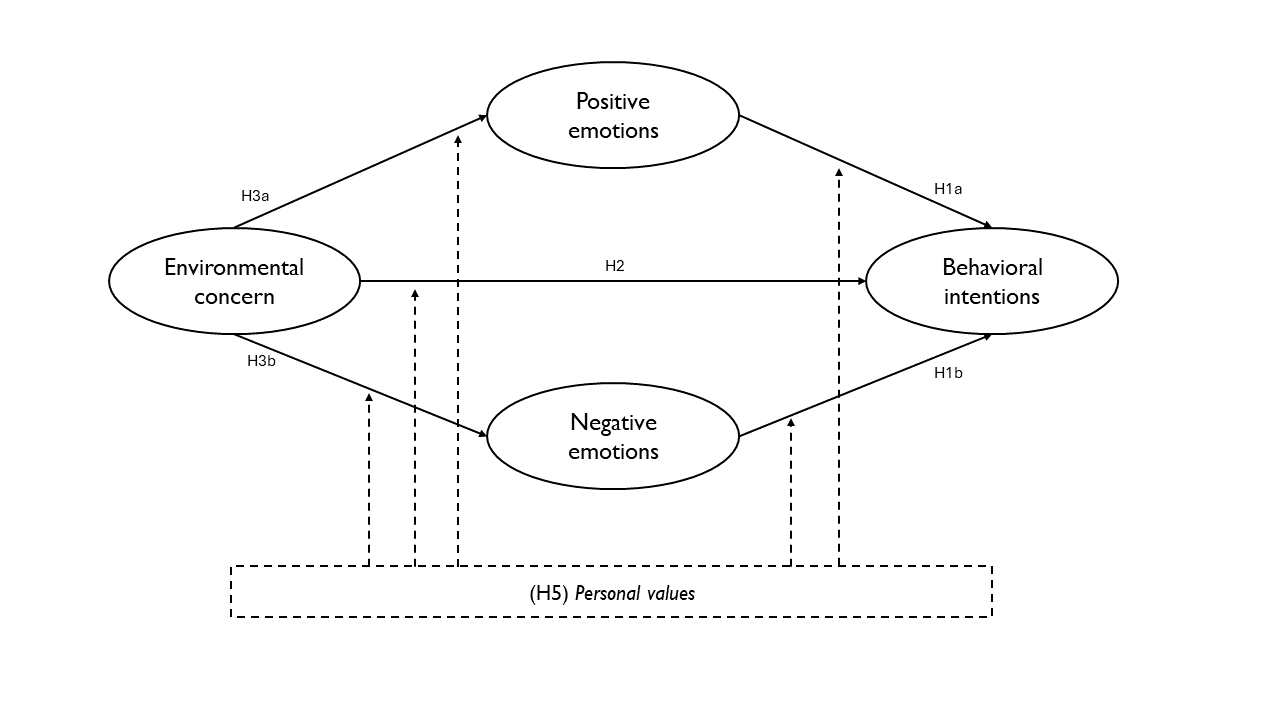
H1a: Positive emotions toward SF have a positive effect on intended behavior to purchase SF.
H1b: Negative emotions toward SF have a negative effect on intended behavior to purchase SF.
Environmental Concern, Emotions and SF Consumption
While a limited number of studies found no significant effect between environmental concern and intentions to behave sustainably (e.g., Tam & Chan, 2018; Xiong et al., 2022), most existing research suggests a direct relationship between these two constructs. For example, Polonsky et al. (2014) found that environmental concern could increase both direct (i.e., that have a direct impact on the environment – e.g., recycling) and indirect sustainable behaviors (i.e., those that have no immediate impact on the environment – e.g., donating to environmental organizations). On a study on the predictors of the main types of pro-environmental behaviors (green buying, good citizenship and activist behaviors), Lee et al. (2014) concluded that environmental concern was a strong predictor of the three of them. While Alzubaidi et al. (2021) found that environmental concern was more important than other factors such as social influence or innovativeness in predicting sustainable behavioral intentions. The limited amount of studies on environmental concern in SF also support this causal relationship. Dangelico et al. (2022) explored environmental concern in relation to SF among Italian consumers, as done in this study. Using the Theory of Planned Behavior (Ajzen, 2020), the authors suggest that consumers highly concerned about environmental issues will show stronger intentions to buy SF, compared to those who are not as concerned. In another study, Sener et al. (2023) found that environmental concern was once again a good predictor of SF buying intentions, in particular toward recycling clothing.
Based on existing research demonstrating the positive effect of environmental concern on intended sustainable behavior, H2 was proposed:
H2: Environmental concern has a positive effect on intended behavior to purchase SF.
Literature exploring how environmental concern is linked to emotions is scarce. Maduku (2024), exploring this link in relation to a variety of sustainable behaviors (e.g., using reusable bags, reducing food waste), found that environmental concern could have a significant effect on both positive and negative emotions, depending on whether the consumer engage in the behavior or not. In any case, the author found a positive relationship between environmental concern, positive and negative emotions, and intentions to behave sustainably. Maduku's (2024) results support those of previous research by Han et al. (2019), suggesting that environmental concern has a positive effect on both positive and negative emotions, and the subsequent sustainable behavior. These assumptions are rooted in the notion that consumers who are highly attuned to environmental issues (i.e., high in environmental concern) may perceive their efforts (or the lack thereof) to engage in sustainable behaviors insufficient to address the magnitude of the environmental problems, resulting in negative emotions (Thøgersen, 2009; Maduku, 2024).
While, to the authors' knowledge, there are no studies looking at the effect of environmental concern on emotions toward SF, based on the abovementioned research we hypothesize:
H3a: Environmental concern increases positive emotions toward SF.
H3b: Environmental concern increases negative emotions toward SF.
Building further on studies like Maduku's (2024), suggesting that emotions can also play an important mediating role between environmental concern and intentions, we hypothesize:
H4: Positive and negative emotions toward SF simultaneously mediate the relationship between environmental concern and intended behavior to purchase SF.
The Role of Personal Values in SF Consumption
Existing literature suggests that personal values play an important role in encouraging sustainable behaviors (Sharma & Jha, 2017; Lee & Cho, 2018; Sneddon et al., 2022). For instance, 'self-transcendence' values, such as benevolence and universalism, and 'openness to change' values, such as self-direction (Schwartz et al., 2012) tend to be positively related to ethical practices such as recycling or the consumption of sustainable food (e.g., Thøgersen & Ölander, 2002; Ma & Lee, 2011). While 'self-enhancement' values, such as achievement, seem to negatively affect the adoption of sustainable behaviors (Sneddon et al., 2022).
Previous studies on sustainable fashion have revealed insights that are largely consistent with those found in broader sustainability studies. Manchiraju and Sadachar (2014), using data from US consumers, found that personal values, and in particular those more 'collective' in character, influence the consumption of ethical fashion. Research by Razzaq et al. (2018) corroborate these ideas with a sample from Pakistan, suggesting that SF is a practice driven by 'utilitarian' values, based on a more collaborative way of consuming fashion, that focuses on durability and tries to find ways to avoid fast fashion. In a qualitative study with sustainable fashion consumers, Lundblad and Davies (2015) also observed that collective-oriented values such as altruism, and 'biospheric' values, related to the protection of nature, are important for SF consumers. The results of Geiger and Keller's (2017) study, focused on Fairtrade-labeled clothing, validate the abovementioned findings, suggesting that values related to the common good, like compassion, favor the consumption of SF garments, while hedonic values negatively affect SF buying behaviors and egoistic values have no significant effect.
However, despite evidence suggesting that collective values are the most important ones to consider when aiming to encourage SF behavior, Lundblad and Davies (2015) highlight that more 'individualistic' values, such as self-expression, should not be ignored, as consumers might also buy ethical clothes driven by a desire to feel better with themselves.
Overall, previous works agree that SF is somehow influenced by personal values, even if arguments among existing studies do not always concur. Thus, we hypothesize that:
H5: Personal values significantly moderate the relationships between environmental concern, positive emotions, negative emotions, and intended behavior to purchase SF.
Figure 1 outlines the developed conceptual model which was subject to testing in the sample n=414 individuals in Italy.
Crucially, to improve the study's internal validity and reduce the confounding effects, we also implemented four control variables, namely gender, age, income, and the frequency of buying SF by participants.
Methodology
Design and Sample
We tested the conceptual model using an online survey (translated to Italian) distributed among the general public in Italy. Each participant received a link to the survey which was hosted on Qualtrics. Data were collected using Qualtrics' online panel and completed between 19 January 2023 and 10 March 2023, using a non-probability quota sampling strategy. The study was subject to an ethical review by the affiliated institution. The sample was n=414 (see Table 1 with an outline of key sample demographics).
| Category | Subcategory | Frequency (n) | Percentage (%) |
| Gender | Female | 213 | 51.4 |
| Male | 200 | 48.3 | |
| Other | 1 | 0.2 | |
| Age Group | 18--24 years | 44 | 10.6 |
| 25--34 years | 94 | 22.7 | |
| 35--44 years | 85 | 20.5 | |
| 45--54 years | 70 | 16.9 | |
| Over 55 years | 121 | 29.2 | |
| Income (€ per year) | Under 20,000€ | 151 | 36.5 |
| 20,001€--30,000€ | 129 | 31.2 | |
| 30,001€--50,000€ | 89 | 21.5 | |
| 50,001€--70,000€ | 30 | 7.2 | |
| 70,001€--100,000€ | 9 | 2.2 | |
| Over 100,000€ | 6 | 1.4 | |
| Education Level | School leaver | 20 | 4.8 |
| High school or equivalent | 89 | 21.5 | |
| Vocational/technical school | 114 | 27.5 | |
| Bachelor's degree | 63 | 15.2 | |
| Master's degree | 69 | 16.7 | |
| Professional degree | 40 | 9.7 | |
| Doctorate degree | 11 | 2.7 | |
| Other (please specify) | 8 | 1.9 | |
| Employment Status | Full-time employed | 178 | 43.0 |
| Part-time/Freelance/Self-employed | 42 | 10.1 | |
| Self-employed | 41 | 9.9 | |
| Student | 31 | 7.5 | |
| Out of work, looking for work | 37 | 8.9 | |
| Out of work, not looking | 25 | 6.0 | |
| Retired | 56 | 13.5 | |
| Other (e.g., semi-retired) | 4 | 1.0 | |
| Sustainable Fashion Buying | No, never | 123 | 29.7 |
| Yes, often | 145 | 35.0 | |
| Yes, occasionally | 146 | 35.3 | |
| Total | 414 | 100.0 |
Measures
All measures employed in the study were adapted from existing and widely validated scales (see Appendix 1 for more detail). Positive and negative emotions toward SF were based on the PANAS scale by Watson et al. (1988) – e.g., 'Interessato' ('Interested'). Environmental concern was based on Joanes et al. (2020) with items such as "Attraverso il mio consumo personale di abbigliamento, contribuisco a il danno ambientale" ("Through my personal clothing consumption, I am contributing to the harm done to the environment"). The measure of the intentions to purchase SF was adapted from Kumar et al. (2017), Park and Lin (2020), and Rausch and Kopplin (2021), and included statements such as "Nel futuro, ho l'intenzione di comprare abbigliamento sostenibile invece della moda abituale" ("I intend to buy sustainable clothes instead of conventional clothes in the future"). Finally, personal values were measured using Schwartz (2021), including items like 'Potere: il ruolo dello status sociale e il prestigio, il livello di controllo o dominio della gente e le risorse' ('Power: social status and prestige, control or dominance over people'). The survey was translated and pre-tested by experts who spoke both English and Italian (Sekaran, 1983). All scales used a 7-point Likert scale.
Analysis – Statistical Approach
The model was tested using the Partial Least Squares Structural Equation Modelling approach (PLS-SEM) (Sarstedt et al.2022, – see also Armutcu and Tan,2023), . The use of SEM was considered suitable for this investigation due to the following reasons: (1) the sample size was limited; and (2) violations of normal distribution parameters (Hair et al., 2021).
The analysis was based on a two-stage approach by Hair et al. (2021), whereby Stage 1 involved the analysis of the measurement model (i.e., reliability and validity estimations), and Stage 2 involved the structural model evaluation (i.e., significance of path relationships, predictive power, etc.) as well as moderating and mediating effects.
Common Method Bias
Provided one method of data collection was used, the Lindell and Whitney (2001) test for common method bias was employed (Table 2). The results indicated that none of the correlations between the marker and the other variables in the model exceed the threshold of 0.300. Consequently, it was unlikely that the data set was affected by common method bias.
| 1 | 2 | 3 | 4 | 5 | |
| 1 Marker | -- | ||||
| 2 Intended behavior | 0.19 | -- | |||
| 3 Environmental concern | 0.14 | 0.30 | -- | ||
| 4 Negative emotions | 0.07 | 0.54 | 0.26 | -- | |
| 5 Positive emotions | 0.09 | 0.68 | 0.34 | 0.73 | -- |
Results
The analysis of the measurement model demonstrated that all latent variables achieved acceptable levels of reliability and validity (see Table 3).
| Cronbach's α | CR (ρc) | CR (ρA) | AVE | HTMT | ||||
| 1 | 2 | 3 | 4 | |||||
| Intended behavior | 0.89 | 0.89 | 0.93 | 0.82 | — | |||
| Environmental concern | 0.86 | 0.88 | 0.92 | 0.80 | 0.35 | — | ||
| Negative emotions | 0.86 | 0.86 | 0.90 | 0.70 | 0.62 | 0.31 | — | |
| Positive emotions | 0.80 | 0.83 | 0.87 | 0.62 | 0.77 | 0.39 | 0.88 | — |
CR: Composite Reliability; AVE: Average Variance Extracted; HTMT: Heterotrait-Monotrait Criterion
Structural Model Analysis
In order to assess the significance of the suggested relationships between the paths, a bootstrapping technique was used, which involved generating 5,000 bootstraps using percentile-based confidence intervals (Aguirre-Urreta & Rönkkö, 2018). The results revealed that five of six paths are significant at least at p<0.5 (see Table 4). The coefficient of determination R2 for the in-sample predictive power was found at a moderate level. i.e., 0.11 and 0.07 for positive and negative emotions respectively and 0.47 for intended behavior.
| Path | $\beta$ | t-value | p-value | Hypothesis | Support |
| Environmental concern $\rightarrow$ Intended behavior | 0.08 | 2.02 | 0.04 | H2 | Supported |
| Environmental concern $\rightarrow$ Negative emotions | 0.26 | 5.12 | 0.00 | H3b | Supported |
| Environmental concern $\rightarrow$ Positive emotions | 0.34 | 7.36 | 0.00 | H3a | Supported |
| Negative emotions $\rightarrow$ Intended behavior | 0.10 | 1.37 | 0.13 | H1b | Not supported |
| Positive emotions $\rightarrow$ Intended behavior | 0.57 | 11.29 | 0.00 | H1a | Supported |
The results above offered strong empirical support for H1, H3a and H3b. Counter to our assumptions, H2 was not supported.
Out-of-sample predictive power was assessed using PLSpredict (Shmueli et al., 2019) and determined high predictive power for all latent variables (Table 5).
| Variable | $Q^2_predict$ | PLS-SEM_RMSE | PLS-SEM_MAE | LM_RMSE | LM_MAE |
| INT1 | 0.06 | 1.44 | 1.14 | 1.45 | 1.15 |
| INT2 | 0.07 | 1.40 | 1.11 | 1.41 | 1.12 |
| INT3 | 0.08 | 1.24 | 0.95 | 1.26 | 0.96 |
| NegEm1 | 0.04 | 1.43 | 1.13 | 1.44 | 1.13 |
| NegEm2 | 0.05 | 1.61 | 1.30 | 1.62 | 1.31 |
| NegEm3 | 0.04 | 1.59 | 1.27 | 1.61 | 1.28 |
| NegEm4 | 0.05 | 1.36 | 1.09 | 1.37 | 1.10 |
| PosEm1 | 0.07 | 1.55 | 1.25 | 1.56 | 1.26 |
| PosEm2 | 0.03 | 1.60 | 1.27 | 1.61 | 1.28 |
| PosEm3 | 0.10 | 1.29 | 1.01 | 1.30 | 1.02 |
| PosEm4 | 0.05 | 1.60 | 1.30 | 1.60 | 1.30 |
Multiple Mediation Analysis
The multiple mediation involved the analysis of direct, specific and total indirect effects and total effects (Hair et al., 2021). The results showed that multiple mediation was not significant (Table 6) due to the specific indirect effect (via positive emotions) being not significant. Thus, H4 was not supported. However, the results showed that there is a partial mediation effect of positive emotions on the path between environmental concern and intended behavior (Table 1).
| Direct Effect β (p-value) |
Total Indirect Effect β (p-value) |
Specific Indirect Effects β (p-value) |
Total Effect β (p-value) |
| 0.08 (0.04) | via Positive emotions & Negative emotions 0.22 (0.00) |
via Positive emotions: 0.19 (0.00) via Negative emotions: 0.028 (0.16) |
0.30 (0.00) |
Control Variables Analysis
Prior to the control variables analysis, measurement of invariance (MICOM) test was performed (Henseler et al., 2016), and it demonstrated that both configural and compositional invariance were confirmed allowing to proceed with the group analysis. The PLS-MGA results showed that the path from environmental concern to intentions was significantly different (p=0.04) when controlling for the frequency with which participants buy SF. As such, the path was found stronger in magnitude (ß=0.21, p=0.00) for people who have never bought SF compared to those who already buy SF (ß=0.016, p=0.74).
Counter to our expectations, no gender, age or income differences were found.
A correlation analysis was conducted to examine further the relationships between SF buying frequency, age, and income which showed no significant correlation between sustainable fashion purchases and age (r = -.08, p = .21) or income (r = .05, p = .37). Additionally, the correlation between age and income was also not significant (r = .12, p = .09).
Moderation Analysis
Moderation effects of personal values were tested using a two-way interaction approach (Hair et al., 2021). Table 1 provides an outline for reliability and validity estimates for each of the four moderating variables.
| Concept | Variable | Outer loadings | Cronbach's$\alpha$ | CR ($\rho_a$) | CR ($\rho_c$) | AVE |
| Self-transcendence | Universalism | 0.88 | 0.70 | 0.70 | 0.87 | 0.77 |
| Benevolence | 0.88 | |||||
| Conservation | Security | 0.84 | 0.62 | 0.66 | 0.80 | 0.57 |
| Conform | 0.76 | |||||
| Tradition | 0.65 | |||||
| Self-enhancement | Power | 0.79 | 0.71 | 0.76 | 0.83 | 0.63 |
| Achievement | 0.86 | |||||
| Hedonism | 0.71 | |||||
| Openness to change | Stimulation | 0.77 | 0.46 | 0.47 | 0.79 | 0.65 |
| Self-direction | 0.84 |
The results showed four significant moderating effects of personal values on the relationships within the proposed model. First, 'self-transcendence' was found to significantly decrease the path strength between environmental concern and intended behavior (ß = –0.12, p<.01). Similarly, 'self-enhancement' was found to have a significant negative moderating impact on the same path (ß= –0.11, p<.01). 'Openness to change', on the other hand, positively moderated the relationship between positive emotions and intended behavior (ß= 0.106, p=0.080); while 'conservation' significantly decreased the strength of the relationship between positive emotions and intended behavior (ß = –0.15, p<.01). The obtained evidence provides empirical support for H5.
Discussion
Theoretical Implications
As explained in the previous section, all paths of our conceptual model are significant but one – from negative emotions to intentions. Intentions appeared to be strongly impacted by positive emotions and, counter to the assumptions, not by negative emotions. These findings align with the ideas recently shared by Arnesen et al. (2024) and Grappi et al. (2024), suggesting that the focus on positive emotions in SF marketing communications could lead to higher buying intentions. Contrary to most existing research on emotions and sustainable behavior (Elgaaied, 2012; Peloza et al., 2013; Newman & Trump, 2017), including in SF (e.g., Kim & Jin, 2019), the results of our study suggest that positive emotions are strong in predicting intentions, while negative emotions have no effect on intentions to buy SF. This supports limited previous research suggesting the lack of relevance of negative emotions in predicting sustainable behaviors (Rowe et al., 2019).
The lack of impact of negative emotions may be caused by the complexity of drivers of sustainable behavior in general (Rowe et al., 2019). Negative emotions, such as fear, guilt, or shame, have a strong impact on individuals' motivations to act sustainably (Wang & Wu, 2016). However, they may lack impact on intentions to purchase SF, specifically due to the potential cognitive dissonance individuals may experience (Festinger, 1957; Cooper, 2019). A dissonance may be caused by the misalignment between a desired type of behavior (intention to buy SF) and the current behavior or lifestyle. One may thus argue that elevated negative emotions may heighten such misalignment, and instead of leading to a positive outcome, may contribute to avoidance type of behaviors. Hence, this study adds value to the emerging stream of literature (e.g., Rowe et al., 2019; Arnesen et al., 2024; Grappi et al., 2024) by providing additional evidence on the limited role of negative emotions in predicting purchase intention.
Despite having the weakest effect, our results offer evidence that environmental concern still has an important role to play when predicting intentions to buy SF, in particular when boosting positive emotions. This aligns with the ideas of Dangelico et al. (2022), who suggest that environmental concern not only influences intention to buy SF, but also the willingness to pay a premium price for SF products. Interestingly, our results suggest that environmental concern also has a positive impact on negative emotions. This result might be explained by the arguments shared by Maduku (2024) when exploring environmental concern and emotions in a different context, suggesting that consumers' high levels of environmental concern might both influence positive and negative emotions, but in different situations – positive when performing the behavior and negative when not doing so. One could argue therefore, that environmental concern might boost positive emotions when intending to engage in SF behaviors, and negative emotions when failing to do so. Maduku (2024), however, highlights that the effect of environmental concern is stronger in relation to positive emotions, as the results of this study also suggest. Similar to Maduku's (2024) study, we also found that positive and negative emotions toward SF simultaneously mediate the relationship between environmental concern and intention, thus environmental concern could play a critical role in driving SF consumption if that concern can elicit both positive and negative emotions.
Another interesting result of our study in relation to environmental concern suggests that the relationship between environmental concern and intention to buy SF is significant for those who are not currently consumers of SF, while not significant for those who are. This might be explained by the ideas of Tam and Chan (2018), who suggest that the concern-behavior association is more salient among individuals and societies with higher levels of trust. In the case of our study, it might be that those who are highly concerned, but not buying SF yet, might trust the system and have intentions to buy sustainably; while those already buying SF might know the system better and distrust it, and they might be driven to buy SF by other reasons (such as their emotions toward SF).
The results of the moderation analysis enrich existing literature on values and sustainable behavior by highlighting the moderating effect of personal values between the variables of our model. While our findings in relation to the negative effects of 'self-enhancement' align with the current literature (Sneddon et al., 2022), the study offers a more nuanced view of the remaining three categories of personal values. Contrary to the assumptions by Lundblad and Davies (2015) and Geiger and Keller's (2017), the observed collective-oriented values (i.e., 'self-transcendence' and 'conservation') were found to reduce the effects on intentions. This may occur when these values are highly important to individuals, potentially leading to extreme situations where some sustainable behaviors are rarely adopted or even avoided (Assiouras & Bayer, 2024). In these cases, individuals may avoid buying anything at all, or they might prioritize some behaviors over others they perceive as more trivial (i.e., fashion consumption).
Counter to the current evidence, 'openness to change' would enhance the effects of positive emotions on intentions. This may suggest that consumers who value openness to change may see SF as an opportunity to reflect their personality and values, and by choosing SF, they can signal their commitment to sustainability. One may also argue that consumers open to change may be more likely to adapt their behavior to align with the evolving SF trends. As a result, our study aligns with previous research in the context of SF (e.g., Lundblad & Davies, 2015; Geiger & Keller, 2017) demonstrating the important role of personal values in encouraging positive behaviors toward ethical clothing, while also adding more nuanced moderating evidence on the four categories of personal values.
Managerial Implications
The results of our study could aid the work of social/sustainable marketers and policy makers when encouraging the adoption of sustainable behaviors in relation to fashion. While our results highlight the importance of environmental concern and personal values in SF behaviors, the key finding of our study relates to the importance of evoking positive emotions when promoting SF. Thus, we recommend practitioners to design marketing communications and interventions that aim to elicit positive emotions, such as pride, as those have a stronger effect on the intentions to buy SF. Practitioners must be careful, however, when aiming to elicit emotions, so communications do not appear manipulative. This could be done by empowering the audience, keeping the message real and avoiding exaggeration, using messages and stories that are relatable and feel authentic.
Limitations and Future Research
Our study focuses on a sample from the general public who buy (or not) SF in only one country (Italy), limiting the generalizability of the results. Previous research has shown that environmental awareness is lower in less developed countries (Ali et al., 2019). Thus, future research could replicate the study in different countries/regions, perhaps conducting a cross-cultural study, with the aim of exploring if cultural differences might affect environmental concern, emotions, values, and the subsequent intention to buy SF. Another limitation of our study is related to the understanding of SF. While consumers are becoming more aware of the impact of their buying behavior on society and the environment (McKinsey, 2022), consumers might understand SF in different ways, what might influence their answers to the survey. Future studies could control for knowledge about SF, to offer a more comprehensive overview of the antecedents of this type of consumption. We believe further studies focused on understanding emotions in relation to SF are still needed. Researchers could perhaps focus on studying emotions in relation to specific types of SF (e.g., second-hand, Fairtrade-labeled, recyclable materials), to investigate if different emotions work differently in relation to diverse kinds of SF. Finally, it is important for future studies in the context of SF to look at the effects of individual values, to complement the findings on the personal values categories.
Funding Statement
The author(s) received no financial support for the research, authorship, and/or publication of this article.
Conflict of Interest
The authors confirm that there are no actual or potential conflicts of interest associated with their work.
| Scale | Items in English | Items in Italian |
| Intended behavior (Kumar et al., 2017; Park & Lin, 2020; Rausch & Kopplin, 2021) |
I consider purchasing sustainable clothes. | Considero l'acquisto di vestiti sostenibili. |
| I intend to buy sustainable clothes instead of conventional clothes in the future. | Nel futuro, ho l'intenzione di comprare abbigliamento sostenibile invece della moda abituale. | |
| I would consider to buy sustainable clothes if I happen to see them in a shop or online. | Potrei considerare l'acquisto di vestiti sostenibili se fossero presenti in un negozio, oppure online. | |
| Negative emotions (Watson et al., 1988) |
Ashamed | Vergognato |
| Irritable | Irritabile | |
| Jittery | Nervoso | |
| Upset | Triste | |
| Positive emotions (Watson et al., 1988) |
Active | Attivo |
| Inspired | Ispirato | |
| Interested | Interessato | |
| Strong | Forte | |
| Environmental concern (Joanes et al., 2020) |
Through my personal clothing consumption, I am contributing: | Attraverso il mio consumo personale di abbigliamento, contribuisco a: |
| -- to the harm done to the environment. | -- Il danno ambientale. | |
| -- to the amount of energy and water used in clothing production. | -- La quantità di energia e acqua usata nella produzione dei vestiti. | |
| -- to the use of hazardous chemicals in clothing production. | -- L'uso di sostanze chimiche pericolose nella produzione dei vestiti. | |
| Personal values (Schwartz, 2021) |
Power: Social status and prestige, control or dominance over people. | Potere: il ruolo dello status sociale e il prestigio, il livello di controllo o dominio della gente e le risorse. |
| Achievement: Personal success through demonstrating competence according to social standards. | Raggiungimento: l'enfasi sul successo personale. | |
| Hedonism: Pleasure and sensuous gratification for oneself. | L'edonismo: il ruolo di piacere o autogratificazione sensuale. | |
| Stimulation: Excitement, novelty, and challenge in life. | Stimolazione: il bisogno per divertimento, novità, e sfida nella vita. | |
| Self-direction: Independent thought and action—choosing, creating, exploring. | Autodeterminazione: indipendenza nel pensiero e azione. | |
| Universalism: Understanding, appreciation, tolerance, and protection for the welfare of all people and for nature. | Universalismo: capire, apprezzare, tollerare, e proteggere il welfare della gente e della natura. | |
| Benevolence: Preservation and enhancement of the welfare of people with whom one is in frequent personal contact. | Benevolenza: preservare e migliorare il welfare degli altri, con chi si sono in contatto frequentemente. | |
| Tradition: Respect, commitment, and acceptance of the customs and ideas that traditional culture or religion provide. | Tradizione: accettare, impegnarsi, e rispettare misure e idee sono imposte da cultura o religione. | |
| Conformity: Restraint of actions, inclinations, and impulses likely to upset or harm others and violate social expectations or norms. | Conformità: restrizione delle azioni che potrebbero dar fastidio o far male agli altri o violare le norme sociali. | |
| Security: Safety, harmony, and stability of society, of relationships, and of self. | Sicurezza: l'enfasi sulla sicurezza, l'armonia, e la stabilità della società, le relazioni (famiglia) e di se stesso. |
References
Licensing
https://creativecommons.org/licenses/by/4.0/
Copyright
Copyright © 2025 by authors. This is an open access article distributed under the Creative Commons Attribution License, which permits unrestricted use, distribution, and reproduction in any medium, provided the original work is properly cited.
Copyright Year
2025
Correction statement
About contributors

Irene Garnelo-Gomez
IQS School of Management, Universitat Ramon Llull, Barcelona, Spain
Spain
Anastasiya Saraeva
Henley Business School, University of Reading, England, United Kingdom
United Kingdom
Lucy Hurwood
JBi Digital, London, United Kingdom
United Kingdom