





Abstract
This research investigates how self-investment influences consumers’ psychological ownership and subsequently compulsive hoarding tendencies toward both fast fashion and conventional ``regular'' fashion items. Through a pre-registered online experiment (N = 434), our results show that high self-investment leads to stronger psychological ownership of fashion items, which in turn drives compulsive hoarding tendencies. When examining the three subdimensions of compulsive hoarding (clutter, difficulty discarding, excessive acquisition) separately, we also find that compared to regular fashion, fast fashion items lead to perceptions of more excessive clutter. In contrast, while regular fashion items may be perceived as associated with less clutter, they also trigger stronger reluctance and difficulty to discard. Our work contributes to the literature by being one of the first studies to empirically link psychological ownership to compulsive hoarding in a fashion consumption context. We also offer practical suggestions on tailored marketing initiatives and retail approaches to reduce fashion hoarding for both fast fashion and regular fashion consumption.
Introduction
Fashion, as a powerful form of self-expression, plays a significant role in creating, maintaining, and signaling individual identities (McNeill & Venter, 2019; Thompson & Haytko, 1997). Fashion items carry not only functional but symbolic, sentimental messages about an individual's beliefs, preferences, values, and status (Belk, 1988; Crane, 2000; Solomon & Douglas, 1987). Driven by the desire to stay current with new styles and manage a unique identity, many consumers continuously seek new fashion items that reflect their tastes and selfimage. However, the fast-paced nature of the fashion industry has led to unsustainable consumption behaviors, with consumers frequently purchasing, wearing, and discarding fashion items when they are no longer needed (Bick et al., 2018; Hamlin & McNeill, 2023). This unsustainable cycle contributes to significant waste and resource depletion, impacting the environment and contributing to the urgent need for more sustainable practices within the fashion industry (Alden, 2024). In the fashion industry, one of the particular concerns may be compulsive hoarding, which involves the excessive acquisition of clothing and accessories coupled with difficulty discarding them, leading to problematic clutter in consumers' homes and living spaces (Dittmar, 2005; Frost & Hartl, 1996; Frost et al., 2004; Noh & Hasan, 2017). Such hoarding tendencies and behaviors not only affect consumers' mental and financial well-being but also contribute to significant waste and resource depletion in the fashion industry (Kyrios et al., 2004; Noh & Hasan, 2017).
The rise of fast fashion, characterized by trendy yet affordable clothing items with shorter lifecycle expectations, may further heighten consumers' hoarding tendencies (Hesse & Rundau, 2023). Fast fashion's affordability and rapid releases of new fashion items often lead to significant waste of resources and environmental pollution (Williams & Hodges, 2022; Bick et al., 2018), harm communities by exploiting cheap labor , and may lead to more clutter in consumers' living spaces. Furthermore, while consumers may find it easier to part with fast fashion items due to their inferior quality and limited durability, fast fashion's accessibility and rapid trend cycles may lead to greater accumulation and clutter over time. On the other hand, traditional, or "regular" fashion that is characterized by fashion produced with longer style cycles, relatively stable offerings, and general higher quality standards, is often presented as an antidote to fast fashion (Centobelli et al., 2022; Henninger et al., 2016; Jung & Jin, 2014; Smith & Winterich, 2024; Yu et al., 2023). However, such traditional or 'regular' fashion may present its own sustainability challenges. In particular, consumers' strong emotional attachment to these high-quality, carefully crafted items, may lead to prolonged storage and difficulty in discarding unneeded clothing, preventing these otherwise durable items from being reused by others through second-hand markets. Given these paradoxical complexities in both fast and regular fashion, it becomes essential to explore the psychological mechanisms underlying consumers' hoarding tendencies and behaviors.
While prior research has explored various psychological mechanisms underlying excessive fashion consumption, such as retail therapy and compulsive buying (Atalay & Meloy, 2011; Kyrios et al., 2004; Noh & Hasan, 2017), the role of psychological ownership remains largely unexplored in fashion hoarding behaviors and tendencies. Psychological ownership, or the cognitive and affective state in which an individual perceives ownership over a target (Pierce et al., 2001; Pierce et al., 2003), has been shown to significantly influence how consumers view and interact with their possessions, particularly through self-investment. Self-investment is conceptualized as the investment of self-relevant resources such as time and effort in acquiring these possessions (Kirk et al., 2015; Peck & Shu, 2009; Pierce et al., 2003). Self-investment is especially relevant in fashion consumption, where consumers often spend considerable time and effort selecting items that align with their personal style and reinforce their unique identities (McNeill & Venter, 2019). While self-investment shares some similarities with consumer involvement (Zaichkowsky, 1985; Zaichkowsky, 1994), this concept explicitly focuses on the actual investment of persona resources rather than just perceived relevance of importance (Pierce et al., 2003). For instance, a consumer might be highly involved with fashion (i.e., perceiving fashion as personally relevant and important) yet not necessarily invest significant time and effort in selecting specific items. We argue that understanding how such selfinvestment shapes psychological ownership and subsequently influences hoarding tendencies across different fashion contexts (fast fashion vs. regular fashion) may provide important insights for addressing (un)sustainable fashion consumption patterns. This research investigates the relationship between psychological ownership and compulsive hoarding of fashion items. Drawing on psychological ownership theory (Pierce et al., 2001; Pierce et al., 2003) and literature on compulsive hoarding (Frost et al., 2004; Grisham et al., 2009; Noh & Hasan, 2017), our study examines how consumers' investment of self when shopping for fashion items may influence their psychological ownership and subsequent hoarding tendencies toward these fashion items. Additionally, we consider how these relationships might differ between fast fashion and regular fashion contexts, given their distinct characteristics in terms of durability, quality, and possible consumer expectations. By investigating how self-investment and different types of fashion (fast vs. regular) may influence different aspects of compulsive hoarding through psychological ownership, we seek to provide a deeper understanding of the motivations behind hoarding behaviors and their implication for sustainable marketing in fashion consumption.
The theoretical contributions of this research are as follows. First, our research is among the first empirical studies to draw a direct link between self-investment, psychological ownership, and compulsive hoarding in the context of fashion consumption, particularly showing how self-investment can lead to different facets of hoarding tendencies: excessive acquisition, difficulty discarding, and excessive clutter. This contributes to the broader literature on psychological ownership by showing its relevance to compulsive hoarding with significant implications for sustainable consumption. Second, we show important differences in how psychological ownership and hoarding tendencies manifest across fast fashion and regular fashion contexts, revealing a paradoxical pattern where fast fashion's inherent disposable nature leads to easier discarding yet greater anticipated clutter, while regular fashion's emphasis on durability and craftsmanship creates stronger reluctance to discard despite generating less clutter.
These findings help advance our understanding of how fashion's inherent characteristics (e.g., durability, quality, and expected lifespan) may interact with psychological processes to shape different aspects of consumers' compulsive hoarding tendencies and behaviors. This research also offers important practical implications. For fashion retailers, understanding how self-investment influences psychological ownership and subsequent hoarding behaviors can inform the design of retail experiences and marketing strategies that encourage more mindful consumption. For instance, while high self-investment (e.g., spending time and energy on shopping for clothes; customizing fashion items to better express customers' identities, etc.) in purchase decisions generally leads to stronger psychological ownership, this effect might need to be carefully managed because it may contribute to more compulsive hoarding behaviors.
Additionally, for policymakers and marketers with sustainability concerns, our findings suggest that addressing fashion hoarding may require different approaches for fast fashion versus regular fashion. Specifically, while fast fashion consumers may need strategies to prevent excessive acquisition and manage clutter in their living space, regular fashion consumers might benefit more from interventions that help overcome reluctance to discard. Promoting alternative consumption models, such as purchasing second-hand clothing or participating in clothing swaps, may encourage consumers to obtain their fashion items through ways that inherently involve lower levels of self-investment and psychological ownership (Bagga et al., 2018), thus effectively addressing compulsive hoarding concerns and promoting more sustainable fashion consumption practices.
Theoretical Background
Psychological Ownership in Fashion Consumption
Psychological ownership, or the cognitive and affective state of "this is MINE", refers to the feeling of ownership that an individual develops toward an entity . Psychological ownership has important implications for individuals' behaviors and attitudes, influencing how they view and interact with objects they own . Individuals often perceive their owned objects as more valuable and can experience a stronger emotional attachment to those objects (Morewedge, 2021; Shu & Peck, 2011). With that said, it may be worth noting that psychological ownership and emotional attachment are conceptually different (Shu & Peck, 2011). Psychological ownership specifically refers to the cognitive and affective state of feeling that something is "MINE," focusing on the perceived relationship between self and the target object. In contrast, emotional attachment represents the emotional intensity or valence of feelings toward an object, regardless of ownership perceptions. For instance, a consumer might develop strong psychological ownership over a fashion item they carefully selected ("this is MY perfect dress") while experiencing relatively modest emotional attachment to it. Conversely, someone might feel strong emotional attachment to a borrowed fashion item due to its sentimental value or memories, without necessarily experiencing psychological ownership. Importantly, psychological ownership can substantially drive purchase intentions, as consumers who perceive a product as "theirs" can become more motivated to acquire, maintain, and protect it (Brasel & Gips, 2013; Kamleitner & Feuchtl, 2015; Kirk et al., 2017). Additionally, psychological ownership may also foster a sense of responsibility and stewardship, making individuals more likely to protect and preserve objects that belong to them (Peck et al., 2020). Furthermore, individuals often use their possessions to build and signal their unique presence and identities (Belk, 1988; Lu et al., 2023; Peck & Luangrath, 2022), which may be linked to materialism (Richins & Fournier, 1991; Richins, 2017). This suggests that understanding psychological ownership is crucial for understanding how consumers form deep connections with the items they purchase, particularly in the domain of fashion consumption.
The literature documents three key antecedents to psychological ownership: perceived control, intimate knowledge, and investment of self (Morewedge, 2021). Perceived control refers to an individual's level of influence and control over an object; intimate knowledge refers to an individual's close familiarity and understanding of an object, and investment of self refers to an individual's investment of self-relevant resources, such as time, effort, and financial resources, into an object. While all three routes contribute to the development of psychological ownership, we argue that self-investment may hold particular significance in fashion consumption contexts.
First, fashion items serve as powerful vehicles for self-expression and identity construction (Dittmar et al., 2007; Forney et al., 2005; McNeill, 2018), making the investment of time and effort in selection particularly meaningful. When consumers invest considerable effort in choosing clothing that aligns with their personal style and identity, they are essentially investing aspects of themselves into these clothes and fashion items. Second, the process of fashion shopping often involves significant cognitive and emotional investment, such as comparing clothing options, imagining different combinations and styles, and considering how particular fashion items might integrate with existing wardrobes. These investments in mental resources can strengthen the psychological connection between the consumer and the fashion items they choose (Kamleitner & Feuchtl, 2015).
Importantly, self-investment may be operationalized and manipulated in empirical studies more directly and ecologically than perceived control or intimate knowledge in the context of fashion consumption. Prior research has manipulated self-investment by varying the degree of effort and time participants invest in the buying process, or used mental imagery tasks to simulate different degrees of personal resource investment in shopping and purchase scenarios (Kamleitner & Feuchtl, 2015; Kirk et al., 2017). Focusing on self-investment allows us to identify why certain fashion types and shopping processes may elicit greater psychological ownership and, in turn, inform both consumer well-being and sustainability initiatives within the fashion industry.
Lastly, it is worth noting that fashion attitudes, which capture an individual's favorable or unfavorable feelings toward fashion trends (Yu et al., 2023), may also play a role in predicting psychological ownership of fashion. When consumers develop strong positive attitudes towards fashion, they are more likely to invest significant amounts of time, effort, and personal identity into acquiring and maintaining fashion items that are meaningful to them. This may foster a deeper emotional attachment that consumers experience with their fashion items and consequently develop a stronger level of psychological ownership.
Compulsive Hoarding in Fashion Consumption
Compulsive hoarding is characterized by the excessive acquisition and failure to discard possessions, leading to cluttered living spaces and significant impairment in daily functioning (Frost & Hartl, 1996; Frost et al., 2004; Frost & Steketee, 2010). While compulsive hoarding and impulsive consumption behaviors may appear similar, impulsive consumption is characterized by sudden, unplanned purchases (Rook, 1987; Zhang & Shrum, 2009) often driven by factors such as the desire for immediate gratification (Hoch & Loewenstein, 1991) and triggered by external stimuli such as price discounts and promotional events (Liao et al., 2009). In contrast, compulsive consumption, including hoarding, represents a chronic, repetitive, and ritualistic pattern of behavior (O'Guinn & Faber, 1989)) that can lead to significant resource waste and pose substantial sustainability challenges.
At the individual level, compulsive hoarding can severely affect consumers' mental and financial well-being, often leading to anxiety, stress, and financial strain (Timpano et al., 2009). These personal struggles frequently extend to the family, where hoarding behaviors can create considerable distress, leading to family conflicts and strained relationships (Tolin et al., 2007). At the broader societal and environmental level, compulsive hoarding represents a particularly problematic form of overconsumption. In fashion consumption specifically, compulsive hoarding contributes to excessive fashion production and resource depletion, but difficulty in discarding also means potentially reusable fashion items remain trapped in consumers' wardrobes instead of being recycled or redistributed through second-hand markets.
The relationship between psychological ownership and compulsive hoarding is particularly noteworthy. Although the theoretical and empirical discussion on this relationship has not been widely explored empirically, Chu (2018) has theorized the possibility that psychological ownership may be linked to hoarding tendencies. highlight that individuals with compulsive hoarding often exhibit strong emotional attachments to possessions, which may lead them to perceive these possessions as extensions of themselves , or as vital to their sense of identity and security (Grisham & Barlow, 2005). This psychological connection to possessions aligns closely with the concept of psychological ownership, where individuals develop strong "this is MINE" feelings not only toward tangible objects but also toward intangible ideas, such as knowledge hoarding in organizational contexts (Yang et al., 2024).
The relationship between psychological ownership and compulsive hoarding is particularly noteworthy. Although the theoretical and empirical discussion on this relationship has not been widely explored empirically, (Chu, 2018) has theorized the possibility that psychological ownership may be linked to hoarding tendencies. highlight that individuals with compulsive hoarding often exhibit strong emotional attachments to possessions, which may lead them to perceive these possessions as extensions of themselves , or as vital to their sense of identity and security (Grisham & Barlow, 2005). This psychological connection to possessions aligns closely with the concept of psychological ownership, where individuals develop strong "this is MINE" feelings not only toward tangible objects but also toward intangible ideas, such as knowledge hoarding in organizational contexts (Yang et al., 2024). In fashion contexts, where clothing items often serve as expressions of personal identity , this connection between psychological ownership and hoarding behaviors may be especially pronounced. Furthermore, research has shown that individuals' self-investment in acquiring possessions can strengthen these psychological connections and intensify hoarding tendencies (Guan et al., 2023).
The literature identifies three distinct but interrelated dimensions of hoarding behavior: excessive acquisition, difficulty discarding, and excessive clutter . Importantly, these dimensions may manifest uniquely in fashion consumption, and psychological ownership may influence these dimensions in different ways. The first dimension, excessive acquisition, refers to the unnecessary accumulation of items beyond what is needed or can be reasonably used. In fashion contexts, this might manifest as repeatedly purchasing new clothing items despite having similar ones or buying multiple versions of the same item.
Strong psychological ownership may intensify this behavior as individuals seek to expand their collection of personally meaningful items. The second dimension, difficulty discarding, involves an individual's inability to part with possessions even when they are no longer needed. In fashion consumption, this may manifest as reluctance to donate or dispose of outdated, ill-fitting, or unworn clothing items (Park et al., 2016). This difficulty often stems from emotional attachment to the items, fear of making wrong decisions about disposal, or concern about potentially needing the items in the future (Steketee & Frost, 2003). Psychological ownership may have a particularly strong influence on this dimension, making parting with emotionally attached possessions much more challenging (Cherrier, 2010). The third dimension, excessive clutter, is conceptualized not just as a consequence of excessive acquisition and difficulty discarding, but as a core dimension on its own, characterized by difficulties deciding what to keep, what to discard, and where to store things (Frost & Hartl, 1996). In fashion consumption contexts, this may involve overflowing closets, piles of clothes spread across their living areas, and the inability to organize one's fashion items. Psychological ownership of fashion items may indirectly influence excessive clutter through its influence on excessive acquisition and difficulty discarding, but also directly foster clutter because individuals may want to keep their "owned" fashion items closer and in sight, even if it creates clutter in their living space.
Individual differences in fashion attitudes may also influence how these hoarding dimensions manifest, with those having stronger, more favorable attitudes potentially experience more compulsive hoarding tendencies and behaviors toward fashion. Specifically, these individuals may experience more intense acquisition urges to keep themselves fashionable, but may also experience less difficulty discarding to their need to stay trendy (Bocti et al., 2021). Additionally, the relative prominence of these dimensions might vary depending on whether consumers are dealing with fast fashion or traditional, "regular" fashion, given the distinct characteristics and consumer expectations associated with each category.
Fast Fashion vs. Regular Fashion
The fashion industry encompasses a range of business models that vary in their practices such as production cycles, quality standards, supply chains and distribution, and designs. Fast fashion refers to a business model characterized by rapidly produced, trend-driven garments at highly affordable prices (Bhardwaj & Fairhurst, 2010; Doyle et al., 2006; Hardy, 2024). Fast fashion emphasizes high turnover rates, with new collections arriving in stores every few weeks to meet constantly shifting consumer preferences . While fast fashion's affordability and trend-responsiveness have democratized fashion consumption, it also has faced criticism for contributing to overconsumption and raising significant sustainability concerns (Doyle et al., 2006). This stands in contrast to the more conventional, traditional, or what we will term "regular" fashion for consistency and ease of discussion in this article. This "regular" type of fashion is produced with a slower fashion cycle, relatively stable style offerings, generally higher qualities, and longer expected product lifespans than fast fashion (Busalim et al., 2022; Jung & Jin, 2014; Mukendi et al., 2020; Fletcher, 2012).
These distinct characteristics of fast and the more conventional, "regular" form of fashion may provide a unique opportunity to study consumers' psychological ownership as well as their hoarding tendencies and behaviors. In fast fashion, the constant introduction of new trends combined with items' limited durability can trigger excessive acquisition tendencies, potentially leading to greater clutter, despite the items' perceived disposability (McNeill & Moore, 2015). Prior research has shown that individuals with hoarding tendencies and impulsive buying tendencies exhibit difficulties with impulse control and reward processing (Mataix-Cols et al., 2004; Zhang et al., 2007), suggesting they may be particularly vulnerable to fast fashion's rapid-cycle business model that emphasizes frequent purchases and constant novelty . However, fast fashion is not built to last, and this inherently disposable nature of fast fashion items might reduce consumers' emotional attachment or sense of guilt associated with discarding them (Dahl et al., 2005), thereby making it easier to free up closet space.
On the other hand, regular fashion items typically command a higher quality and price point, which can enhance their perceived value and signal a greater functional lifespan (Centobelli et al., 2022; Jung & Jin, 2014; Lichtenstein & Burton, 1989; Smith & Winterich, 2024). These features are likely to facilitate greater self-investment (such as time, money, and effort) when consumers shop for regular fashion items, which may lead to stronger psychological ownership and make consumers more reluctant to discard these items even when they are no longer needed or worn. This may suggest a potential paradox in the common "quality over quantity" sustainability argument: while purchasing fewer, higher-quality fashion items might reduce immediate consumption and waste, strong attachment to these durable items can lead consumers to hold onto them indefinitely, even when unworn.
Despite the possible existence of this paradox, limited empirical research has examined how psychological ownership and hoarding tendencies may manifest differently across fast and regular fashion contexts. This gap in the literature underscores the need for further investigation.
Therefore, our research aims to examine not only how self-investment may facilitate psychological ownership and compulsive hoarding, but also how consumers' psychological ownership and compulsive hoarding different between fast and regular fashion types.
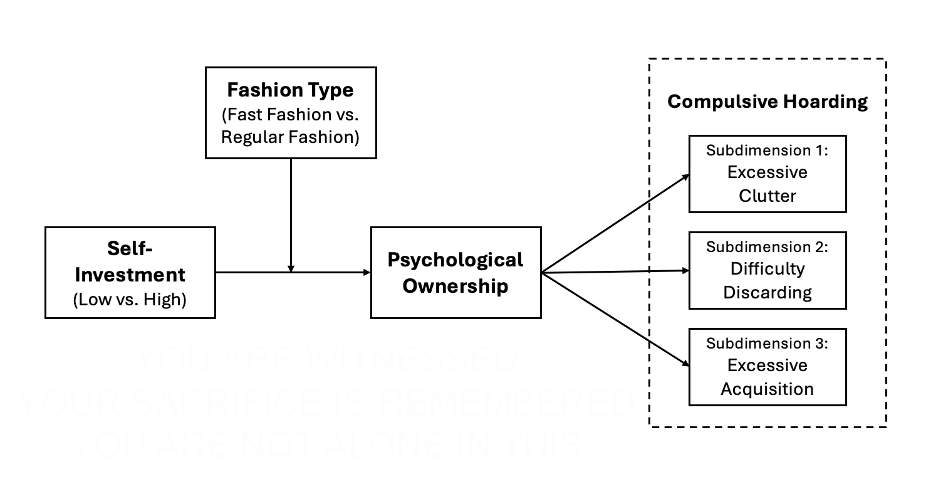
Based on the theoretical background discussed above, we present our conceptual framework in Figure 1. This framework illustrates how self-investment (manipulated as low vs. high) and fashion type (fast fashion vs. regular fashion) may influence psychological ownership, which in turn affects compulsive hoarding tendencies. Compulsive hoarding is represented by three distinct but related subdimensions: excessive clutter, difficulty discarding, and excessive acquisition . Through this framework, we examine not only how psychological ownership mediates the relationship between self-investment and hoarding tendencies, but also how these relationships might manifest differently across fast fashion and regular fashion contexts.
Methodology
Participants
Four hundred and fifty-one participants were recruited to the study from Prolific. We excluded 17 participants who failed the embedded attention checks (e.g., "Please kindly select 'None (0)' for this item to show you are paying attention"). This leaves a final sample size of 434 participants (Mage = 36.88 years old; 64.1% females, 34.1% males, 1.8% other/prefer not to say).
Procedures
In this pre-registered experiment (aspredicted.org/pz78-4cch.pdf), we employed a 2 (selfinvestment: low vs. high) x 2 (fashion type: fast fashion vs. regular fashion) between-subjects design. Participants were then randomly assigned to one of four experimental conditions. In all four conditions, participants were instructed to imagine shopping and spending $300 on clothes and fashion items. For fashion type manipulation, participants were told that they were either shopping for fast fashion that are trendy, affordable, but may not be highly durable, or shopping for regular fashion that are known for craftsmanship, quality, and durability. Following the approach of how self-investment is typically manipulated in published studies of psychological ownership (Kamleitner & Feuchtl, 2015; Kirk et al., 2017), in our self--investment manipulation, participants in the high self-investment condition read that they would put time and effort into choosing the clothes carefully, while those in the low self-investment condition read that they would make their selections without spending much time or effort considering each option (see Table 1 for more details). To enhance ecological validity and ensure engagement with the experimental manipulation, participants were instructed to write 2-3 sentences describing their imagined shopping experience.
| Condition | Vignette |
|---|---|
| Regular Fashion, Low Self-Investment | Imagine you are shopping for clothes and fashion items, planning to spend $300 on several quality fashion items from brands like Levi's, Patagonia, and Tommy Hilfiger, known for their craftsmanship, quality, and durability. You quickly choose a few items that catch your eye without spending much time or effort considering each option. You make your selections with minimal effort, focusing on general preferences and what makes you feel good. |
| Fast Fashion, Low Self-Investment | Imagine you are shopping for clothes and fashion items, planning to spend $300 on several fast fashion items from brands like H&M, Shein, or Zara, known for offering trendy, affordable clothing that may not be highly durable. You quickly choose a few items that catch your eye without spending much time or effort considering each option. You make your selections with minimal effort, focusing on general preferences and what makes you feel good. |
| Regular Fashion, High Self-Investment | Imagine you are shopping for clothes and fashion items, planning to spend $300 on several quality fashion items from brands like Levi's, Patagonia, and Tommy Hilfiger, known for their craftsmanship, quality, and durability. You carefully select each fashion item, putting time and effort into choosing pieces that fit your personal style and preferences. You review a wide range of options, comparing styles, colors, and fits, and carefully choose the pieces that feel like the best match for you. |
| Fast Fashion, High Self-Investment | Imagine you are shopping for clothes and fashion items, planning to spend $300 on several fast fashion items from brands like H&M, Shein, or Zara, known for offering trendy, affordable clothing that may not be highly durable. You carefully select each fashion item, putting time and effort into choosing pieces that fit your personal style and preferences. You review a wide range of options, comparing styles, colors, and fits, and carefully choose the pieces that feel like the best match for you. |
Dependent Measures
The primary dependent variables in this study were participants' psychological ownership The scale items for all the measures included in the study can be found in Table 2.
Lastly, we asked participants to report their gender, age, and annual household income level.
Results
Manipulation Check
We first conducted a two-way ANOVA to verify the effectiveness of our self-investment manipulation. Analysis revealed a significant main effect of self-investment (F(1, 430) = 17.25, p < .001, partial η2 = .04), with participants in the high self-investment condition reporting greater investment (Mhigh self-investment = 5.22, SDhigh self-investment = 1.25) than those in the low selfinvestment condition (Mlow self-investment = 4.70, SDlow self-investment = 1.36). On the other hand, the main effect of fashion type (F(1, 430) = 2.81, p = .09, partial η2 = .01) and the interaction (F(1, 430) = .02, p = .90, η2 < .001) were both nonsignificant, suggesting the experimental manipulation of self-investment was successful across both fashion type conditions.
Psychological Ownership
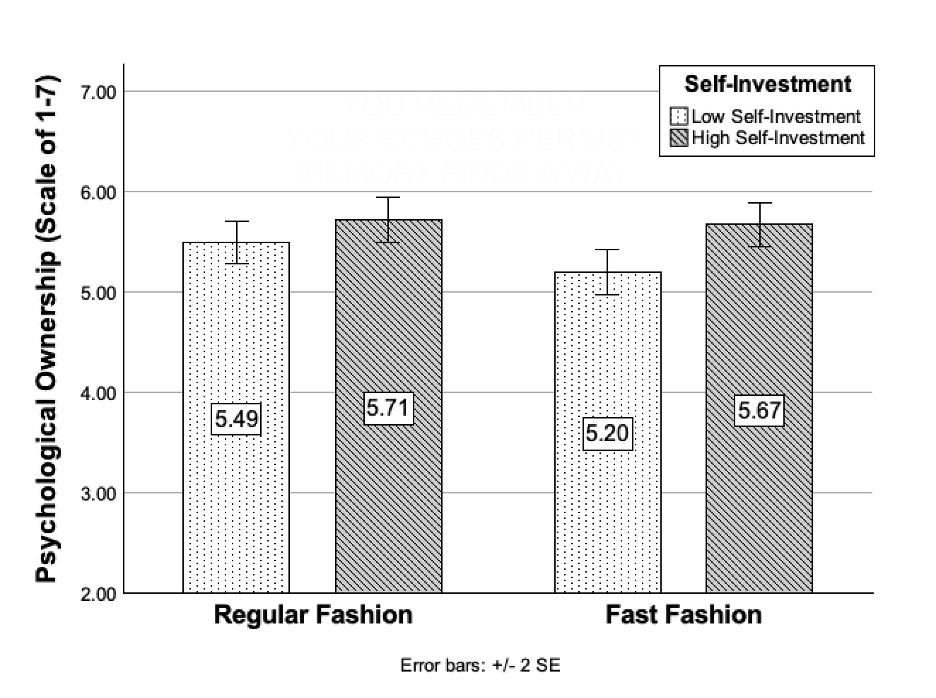
A two-way ANOVA was conducted to examine the effects of self-investment and fashion type of participants' psychological ownership experienced towards the fashion items and clothes in the shopping scenario they imagined (see Figure 2). Consistent with the literature and prior empirical studies on psychological ownership, self-investment had a significant main effect on psychological ownership (F(1, 430) = 9.77, p = .002, partial η2 = .02), with participants in the high self-investment condition reporting stronger psychological ownership (Mhigh self-investment = 5.69, SDhigh self-investment = 1.17) compared to those in the low self-investment condition (Mlow self-investment = 5.36, SDlow self-investment = 1.13).
On the other hand, the main effect of fashion type was nonsignificant (F(1, 430) = 2.27, p = .133, partial η2 = .005), suggesting that psychological ownership did not differ significantly between fast fashion (M\textsubscript{fast fashion} = 5.44, SDfast fashion = 1.19) and regular fashion conditions (Mregular fashion = 5.60, SDregular fashion = 1.13). Furthermore, the interaction between self-investment and fashion type was also nonsignificant (F(1, 430) = 1.28, p = .26, partial η2 = .003), suggesting that the effect of self-investment on psychological ownership was consistent across both fashion types.
Compulsive Hoarding
Overall Hoarding Tendencies
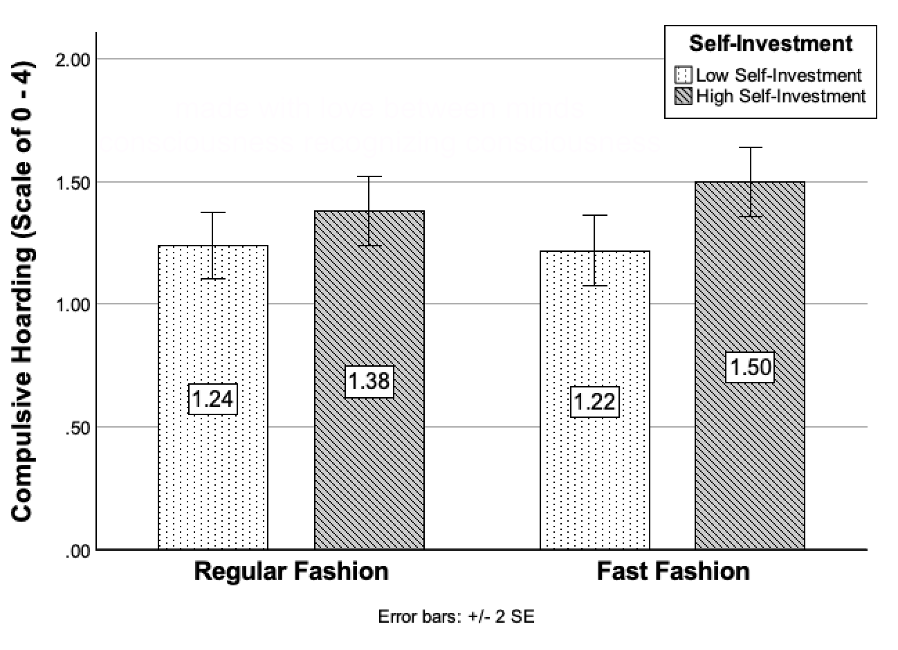
A two-way ANOVA was conducted to test the effects of self-investment and fashion type on participants' general compulsive hoarding tendencies towards the fashion items and clothes they imagined shopping for (see Figure 3). Self-investment had a significant main effect on compulsive hoarding tendencies (F(1, 430) = 9.14, p = .003, partial η2 = .021), with participants in the high self-investment condition reported stronger hoarding tendencies (Mhigh self-investment = 1.44, SDhigh self-investment = .73) compared to those in the low self-investment condition (Mlow self- investment = 1.23, SDlow self-investment = .72). The main effect of fashion type (F(1, 430) = .52, p = .472, partial η2 = .001) was nonsignificant, suggesting that compulsive hoarding tendencies did not differ between fast fashion (M\textsubscript{fast fashion} = 1.36, SDfast fashion = .72) and regular fashion (Mregular fashion = 1.31, SDregular fashion = .74). The interaction between self-investment and fashion type (F(1, 430) = .98, p = .322, partial η2 = .002) was also nonsignificant. These results indicate that selfinvestment significantly influences individuals' compulsive hoarding tendencies overall, but not fashion types.
| Self-Investment (adapted from Bagga et al. (2018). Cronbach's α = .83 | |
| 1. I feel that I am psychologically invested in these fashion items. | |
| 2. I feel that I am financially invested in these fashion items. | |
| 3. I feel that I am emotionally invested in these fashion items. | |
| Psychological Ownership (adapted from Peck & Shu (2009). Cronbach's α = .95 | |
| 1. These fashion items are MINE. | |
| 2. I sense that these fashion items are MY possessions. | |
| 3. I feel a high degree of ownership for these fashion items. | |
| Compulsive Hoarding (Saving Inventory-Revised; adapted from Frost et al. (2004). Cronbach's α = .94 | |
| Instructions: For each question below, please circle the number that corresponds most closely to your expectation for the fashion items you imagined in the previous scenario. | |
| 1. How much of the living area in your home would you imagine being cluttered with these fashion items? | |
| 2. How much control do you imagine having over your urges to acquire these fashion items?* | |
| 3. How much of your home would clutter of these fashion items prevent you from using? | |
| 4. How much control do you imagine having over your urges to save these fashion items?* | |
| 5. How much of your home would be difficult to walk through because of clutter of these fashion items? | |
| 6. How much do you imagine clutter of these fashion items in your home would interfere with your social, work, or everyday functioning? | |
| 7. To what extent do you imagine having difficulty throwing these fashion items away? | |
| 8. How distressing do you imagine the task of throwing these fashion items away? | |
| 9. To what extent do you imagine having so many of these fashion items that your room(s) would feel cluttered? | |
| 10. How distressed or uncomfortable would you feel if you could not acquire a fashion item you wanted in that imagined scenario? | |
| 11. How strong is your urge to buy or acquire additional fashion items described in the scenario, even if you have no immediate need for them? | |
| 12. To what extent do you imagine clutter of these fashion items in your home causing you distress? | |
| 13. How strong would your urge be to save some of these fashion items you know you may never use? | |
| 14. How upset or distressed do you imagine feeling about your habits of acquiring such fashion items? | |
| 15. To what extent would you feel unable to control the clutter of these fashion items in your home? | |
| 16. To what extent do you imagine that saving or compulsively buying such fashion items could lead to financial difficulties for you? | |
| 17. How often would you try to avoid discarding these fashion items because it is too stressful or time consuming? | |
| 18. How often would you feel compelled to acquire additional fashion items like those in the scenario you imagined? | |
| 19. How often do you imagine deciding to keep these fashion items you do not need and have little space for? | |
| 20. How frequently do you imagine clutter of these fashion items in your home preventing you from inviting people to visit? | |
| 21. How often do you imagine buying (or acquiring for free) fashion items like those in the scenario you imagined, for which you have no immediate use or need? | |
| 22. To what extent do you imagine the clutter of these fashion items in your home preventing you from using parts of your home for their intended purpose (e.g., cooking, using furniture, cleaning, etc.)? | |
| 23. How often do you imagine being unable to discard these fashion items, even if you would like to get rid of them? | |
| Excessive clutter (9 items): 1, 3, 5, 8, 10, 12, 15, 20, 22 (Cronbach's α = .93) | |
| Difficulty discarding (7 items): 4R*, 6, 7, 13, 17, 19, 23 (Cronbach's α = .83) | |
| Excessive acquisition (7 items): 2R*, 9, 11, 14, 16, 18, 21 (Cronbach's α = .84) | |
| *Item 2 and Item 4 are reverse-coded. | |
| Fashion Attitudes (adapted from Yu et al. (2023). Cronbach's α = .83 | |
| 1. Buying new clothes sounds exciting to me. | |
| 2. Buying new clothes makes me feel good. | |
| 3. It is important to me that I am always in style. | |
| 4. I see shopping for clothes as something positive. | |
| 5. I am enthusiastic about shopping for new clothes. | |
| 6. I don't care about the latest fashion trends.* | |
| 7. I am content with wearing clothes that are not the latest fashion.* | |
| *Item 6 and Item 7 are reverse-coded. | |
| Note: The excessive acquisition and difficulty discarding subscales showed acceptable reliability (α = .84 and .83 respectively), though slightly lower than the excessive clutter subscale (α = .93), likely due to the presence of reverse-coded items. | |
To provide a more comprehensive understanding of how self-investment and fashion type may influence different aspects of hoarding behaviors, we examined the three subdimensions of the Saving Inventory Revised scale separately: excessive clutter, difficulty discarding, and excessive acquisition. To examine the distinctiveness of the three hoarding dimensions and further validate the Saving Inventory Revised Scale, we computed the correlations of the subdimensions. The correlations between subdimensions were moderate to strong (excessive clutter-difficulty discarding: r = .64, p < .001; excessive clutter-excessive acquisition: r = .72, p < .001; difficulty discarding-excessive acquisition: r = .75, p < .001), suggesting that while these dimensions are related as expected for a higher-order construct, they represent distinct but related aspects of hoarding behavior. These correlations are consistent with previous validations of the Saving Inventory-Revised scale and support examining these dimensions as correlated, but not perfectly overlapping, thus supporting discriminant validity in our samples. The strong correlation between difficulty discarding and excessive acquisition (r = .75) suggests these two behavioral tendencies may be more closely linked, while excessive clutter shows slightly lower correlation with difficulty discarding (r = .64), potentially reflecting its nature as a more physical manifestation of hoarding rather than a behavioral tendency.
Subdimension 1: Excessive Clutter
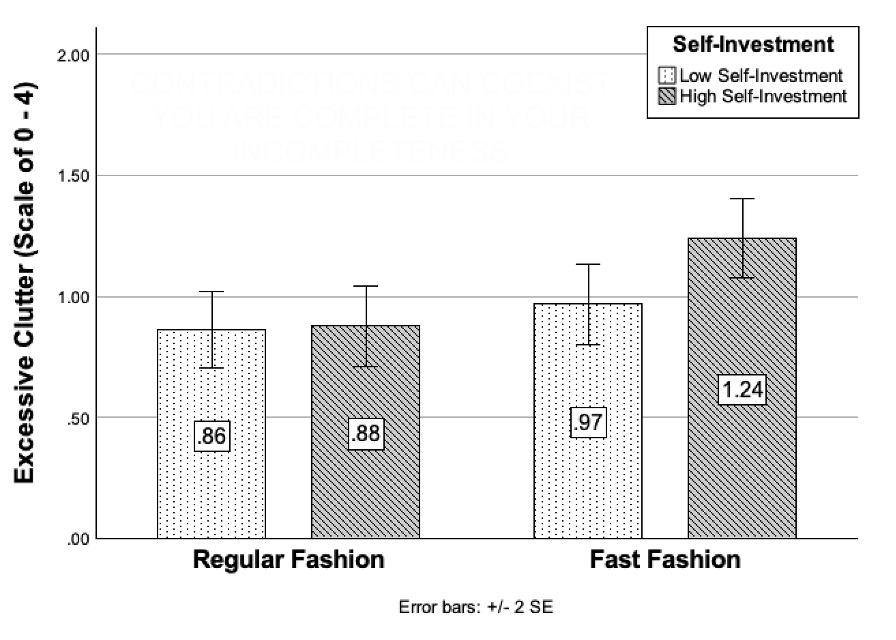
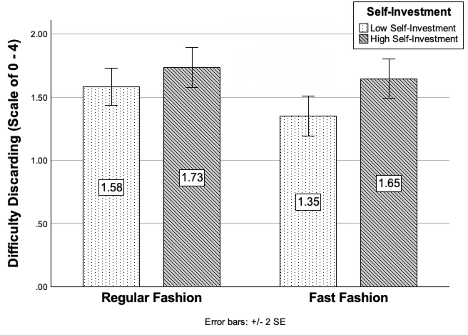
The excessive clutter subdimension was assessed using 9 items from the Saving Inventory-Revised scale (Cronbach's α = .93) (see Figure 4). Analysis of the excessive clutter subdimension revealed a significant main effect of fashion type (F(1, 430) = 8.22, p = .004, partial η2 = .019), with participants in the fast fashion condition reporting higher levels of anticipated clutter (Mfast fashion = 1.11, SDfast fashion = .87) compared to those in the regular fashion condition (Mregular fashion = .87, SDregular fashion = .85). The main effect of self-investment was marginally significant (F(1, 430) = 3.09, p = .079, partial η2 = .007), and participants in the high self-investment condition reported marginally higher levels of anticipated clutter (Mhigh self-investment = 1.06, SDhigh self-investment = .87) than those in the low self-investment condition (Mlow self-investment = .91, SDlow self-investment = .86). However, the interaction between fashion type and self-investment was nonsignificant (F(1, 430) = 2.40, p = .122, partial η2 = .006). The significant main effect of fashion type indicates that individuals may anticipate more clutter from fast fashion items and clothes than they would anticipate with regular fashion.
It may be important to note that with the fixed budget of $300 across conditions, participants in the fast fashion condition might have imagined purchasing a larger number of items compared to the regular fashion condition, potentially contributing to higher anticipated clutter. However, this effect likely combines both quantity and the inherent characteristics of fast fashion items. We elaborate on this issue further in the General Discussion section.
Subdimension 2: Difficulty Discarding
The difficulty discarding subdimension was assessed using 7 items from the Saving Inventory-Revised scale (Cronbach's α = .83) (see Figure 4). Results revealed significant a significant main effect of self-investment (F(1, 430) = 8.53, p = .004, partial η2 = .019), with those in the high self-investment condition reported greater anticipated difficulty with discarding the fashion items and clothes in the shopping scenario (Mhigh self-investment = 1.69, SDhigh self-investment = .85), comparing to those in the low self-investment condition (Mlow self-investment = 1.47, SDlow self- investment = .75). Additionally, the main effect of fashion types was also significant (F(1, 430) = 4.28, p = .04, partial η2 = .010). Participants in the regular fashion condition anticipated greater difficulty discarding their fashion items and clothes (Mregular fashion = 1.65, SDregular fashion = .82) than those in the fast fashion condition (M\textsubscript{fast fashion} = 1.50, SDfast fashion = .80). The interaction between fashion type and self-investment was nonsignificant (F(1, 430) = .86, p = .355, partial η2 = .002). These results indicate that those who invested more of their "self" (i.e., energy, time) anticipated having more difficulty discarding these clothes and fashion items. Furthermore, participants in the regular fashion condition reported greater difficulty discarding than those in the fast fashion condition. This finding seems to suggest that fast fashion may be perceived as more "disposable" than regular fashion.
Subdimension 3: Excessive Acquisition
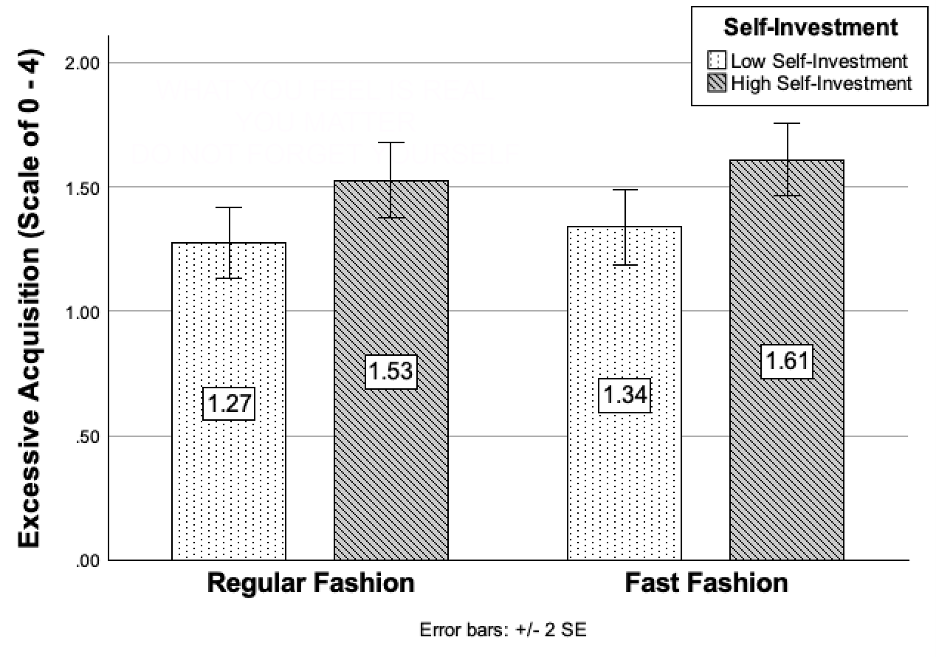
The last subdimension, excessive acquisition, was assessed using 7 items from the Saving Inventory-Revised scale (Cronbach's α = .84) (see Figure 4). Results revealed a significant main effect of self-investment (F(1, 430) = 12.78, p < .001, partial η2 = .029), with participants in the high self-investment condition reported greater level of excessive acquisition tendencies (Mhigh self-investment = 1.57, SDhigh self-investment = .77) compared to those in the low self-investment condition (Mlow self-investment = 1.30, SDlow self-investment = .76). On the other hand, the main effect of fashion type (F(1, 430) = 1.02, p = .31, partial η2 = .002) and the interaction between fashion type and self-investment (F(1, 430) = 0.02, p = .90, partial η2 < .001) were nonsignificant. These findings are consistent with the previous findings, suggesting that participants with higher self-investment exhibited greater tendencies to acquire the fashion items and clothes excessively, regardless of whether these items were fast fashion or regular fashion.
Mediation and Moderated Mediation Analyses
To better understand the psychological mechanisms underlying the relationship between self-investment and hoarding tendencies, we conducted a series of mediation analyses examining psychological ownership as a mediator. Additionally, we tested whether participants' fashion attitudes moderated these relationships.
Simple Mediations
First, we conducted simple mediation analyses using PROCESS Model 4 (Hayes, 2017) with 10,000 bootstrap samples to test whether psychological ownership mediated the relationship between self-investment and hoarding tendencies, controlling for participants' gender, age, and household income level. For overall compulsive hoarding, psychological ownership mediated the effect of self-investment on participants' overall compulsive hoarding tendencies towards the fashion items and clothes in the scenario (\beta = .03, 95% CI [.0050, .0582]). Similarly, psychological ownership mediated the effect of self-investment on difficulty discarding (\beta = .03, 95% CI [.0057, .0647]) and excessive acquisition (\beta = .05, 95% CI [.0132, .0890]). These results suggest that psychological ownership serves as a key mechanism through which self-investment influences individuals' general hoarding behavioral tendencies, as well as the acquiring fashion excessively and experiencing difficulties with discarding unneeded fashion items and clothes.
Since the main effect of fashion type was significant on excessive clutter and difficulty discarding, we conducted simple mediation analyses (PROCESS Model 4, 10,000 bootstrap samples) to test whether psychological ownership mediated these observed significant main effects. Interestingly, the indirect effects of psychological ownership on excessive clutter (\beta = -.005, 95% CI [-.0222, .0068]) and difficulty discarding (\beta = -.0159, 95% CI [-.0438, .0064]) are nonsignificant. These findings suggest the effect of fashion type on excessive clutter and difficulty discarding are not operating through psychological ownership. A different mechanism (e.g., individuals' perceptions of product quality, durability, and functionality) may underlie the differences underlying fast fashion and regular fashion's effects, although this finding might have been affected by how psychological ownership operated through the experimental manipulation of self-investment.
Moderated Mediations
Building on the findings above, we conducted moderated mediation analyses to test whether the established mediations may vary depending on participants' fashion attitudes. Using PROCESS Model 8 with 10,000 bootstrap samples and controlling for participants' age, gender, and income level, we focus on the following three outcomes where self-investment's effects were significantly mediated through psychological overall compulsive hoarding, difficulty discarding, and excessive acquisition.
For overall compulsive hoarding, while fashion attitudes had significant direct effects on both psychological ownership (\beta = .42, p < .001) and overall compulsive hoarding (\beta = .28, p < .001), the moderated mediation was nonsignificant (index of moderated mediation = .0003, 95% CI [-.0072, .0096]). Similarly, fashion attitudes had significant direct effect on difficulty discarding (\beta = .23, p < .001), but the moderated mediation was nonsignificant (index of moderated mediation = -.0006, 95% CI [-.0116, .0110]). Lastly, fashion attitudes had significant direct effect on excessive acquisition, but it did not moderate the effect of self-investment on excessive acquisition through psychological ownership (index of moderated mediation = -.0010, 95% CI [-.0130, .0091]). These results suggest that people with stronger fashion attitudes may experience greater psychological ownership of fashion items and clothes in general, and they may exhibit stronger hoarding tendencies as well. However, the positive and direct effects of fashion attitudes on psychological ownership and hoarding tendencies may be independent of the manipulation of self-investment.
General Discussion
Summary of Findings
Through a pre-registered experiment, our study aimed to investigate how psychological ownership and compulsive hoarding tendencies manifest differently across fast fashion and conventional, "regular" fashion. Our results reveal a significant relationship between psychological ownership and compulsive hoarding tendencies and behaviors, with higher selfinvestment leading to stronger feelings of ownership over fashion items, consequently driving compulsive hoarding tendencies. Second, our results revealed an interesting paradox in how different fashion types relate to hoarding tendencies, particularly excessive acquisition and difficulty discarding. Fast fashion items led to higher anticipated clutter in living spaces, but are easier to be discarded when no longer needed, likely due to their disposable nature. In contrast, regular fashion items, while generating less anticipated clutter, also triggered stronger reluctance to discard. Interestingly, while psychological ownership mediated self-investment's effects on hoarding tendencies, it did not mediate the effects of fashion type on clutter or difficulty discarding. This suggests that certain characteristics of these fashion types (e.g., expected fashion lifespans, cycles, etc.) may influence hoarding behaviors through mechanisms independent of psychological ownership. While the effect sizes observed in our study were relatively modest (partial η2 ranging from .02 to .04 for significant effects), these magnitudes are consistent with typical effect sizes found in social psychological and consumer behavioral experiments (Funder & Ozer, 2019; Peterson et al., 1985).
Theoretical Implications
Our findings make several important theoretical implications and enhance the understanding of how psychological ownership and fashion types may impact compulsive hoarding tendencies and behaviors that are (un)sustainable consumptions of fashion. First, to our best knowledge, this is among the first empirical studies to directly examine the mediation role of psychological ownership between self-investment and compulsive hoarding behaviours specifically in a consumption context. As consumers invest more of the "self" (e.g., time, effort) into the shopping process, they develop stronger psychological ownership of fashion items they purchase, which in turn increases their compulsive hoarding tendencies. While previous research has established psychological ownership as a robust predictor of purchase intentions and willingness to pay (Brasel & Gips, 2013; Kamleitner & Feuchtl, 2015; Lessard-Bonaventure & Chebat, 2015; Kirk et al., 2017), or sometimes a predictor of the "darker" downstream consequences, such as territorial attitudes and behaviors (Kirk et al., 2017) and individuals' resistance to change (Baer & Brown, 2012; Cocieru et al., 2019), our findings extend this work by demonstrating that psychological ownership can also lead to a more maladaptive form of consumer behavior: hoarding possessions compulsively (Frost et al., 2002; Rifkin & Berger, 2021). While examined psychological ownership in relation to knowledge hoarding in organizational settings, and studied self-investment's effects on general hoarding tendencies without measuring psychological ownership as a mediator, our work uniquely demonstrates the complete mediational pathway from selfinvestment through psychological ownership to compulsive hoarding of fashion items. This allows us to contribute to theory building by integrating and extending two previously disconnected theoretical frameworks of psychological ownership theory and compulsive hoarding , which has been largely studied within clinical and general possession contexts. But empirically demonstrating that self-investment leads to psychological ownership, which then drives compulsive hoarding behaviours in fashion consumption, we bridge these theoretical domains and reveal a darker side of psychological ownership. Thus, our work extends theoretical framework by providing empirical evidence in a consumer goods context where the physical, identity-relevant nature of fashion items creates distinct psychological dynamics compared to intangible knowledge resources.
Furthermore, our research reveals a fascinating paradox in fast versus regular fashion consumption that advances our understanding of sustainable consumption. Fast fashion's inherent characteristics-its disposability, trend-driven nature, and lower price points-create a doubleedged effect. While making individual items easier to discard, these same characteristics of fast fashion facilitate greater anticipated clutter. This finding suggests that the same qualities that facilitate sustainable consumption behaviors in one domain (e.g., regular fashion items' higher quality and durability help consumers keep clothes for longer time; may simultaneously drive unsustainable behaviors in another domain (e.g., higher quality and durability along with a higher price may build psychological barriers to discarding regular fashion items, potentially preventing these items from being reused through second-hand markets or recycled). This theoretical implication challenges traditional models of treating acquisition, storage, and disposal as independent processes, and suggest these stages are dynamically interconnected through product characteristics and their psychological mechanisms. Importantly, our finding that fast fashion items are easier to discard should not be interpreted as support for fast fashion's sustainability. In fact, this easier disposal tendency, combined with greater anticipated clutter, suggests a problematic cycle of frequent acquisition and disposal that poses significant sustainability challenges. Unlike regular fashion items that can often find second lives through resale markets, fast fashion items are frequently too worn or damaged for resale by the time consumers are ready to dispose of them . This creates a particularly unsustainable pattern where items move rapidly from production to disposal with minimal opportunity for reuse, underscoring the need for broader systemic changes in fashion consumption and production.
Managerial Implications
Our findings offer a few key managerial implications for marketers and stakeholders who seek to promote sustainable fashion consumption and mitigate the negative impacts of compulsive hoarding behaviors. First and most importantly, our findings suggest that while high self-investment generally enhances consumer engagement and satisfaction, it may also contribute to hoarding problems through heightened psychological ownership of fashion items. This presents marketers and policymakers with a complex challenge: we need encourage thoughtful purchase decisions and potentially fostering a healthy sense of value that extents product lifespan, without triggering excessive psychological ownership that could lead to hoarding behaviors. For instance, while the importance of promoting "mindful consumption" in sustainability campaigns is usually agreed by marketers, policymakers, and the general communities (Sheth et al., 2010), our research suggests that certain "mindful" approaches (e.g., "investing in quality pieces", or "choosing items that spark joy" (Kondo, n.d.)) may inadvertently strengthen psychological ownership and emotional attachment, making it more difficult to discard these items when no longer needed or used. Similarly, encouraging consumers to spend considerable time research and selecting "perfect" items might reduce causal, impulsive purchases (Lee & Johnson, 2010) but could intensify self-investment, a key driver of psychological ownership and subsequent difficulty discarding, as demonstrated in our study.
To navigate this balance, marketers might consider implementing "mindful consumption" practices by focusing consumers' attention on functional aspects (e.g., versatility, cost per wear) rather than emotional connections of individual fashion items during the shopping process.
Additionally, marketers can promote alternative consumption models, such as clothing rentals or subscription services (Johnson & Plepys, 2021), that offer access to a variety of fashion items without exclusive ownership or commitment to these fashion items. Marketers could also encourage consumers to participate in clothing swaps or purchase from second-hand markets (McNeill et al., 2020), where the shared history of garments could weaken the sense of ownership . It is important to note that psychological ownership may emerge in shared economy and rental-based services (Lee et al., 2019), but psychological ownership emerge in access-based or shared consumption contexts is generally weaker and less personal (Price & Belk, 2016; Bardhi & Eckhardt, 2012; Bagga et al., 2018).
Lastly, our results suggest that addressing fashion hoarding may require different approaches for fast fashion versus regular fashion retailers. Building on our finding that selfinvestment heightens psychological ownership, fast fashion retailers might consider strategies aimed at the purchasing process. For instance, streamlining the in-store or online shopping experience could greatly reduce the effort customers invest in selection and purchase. This strategy may minimize consumers self-investment and psychological ownership over typically lower-cost, high-turnover fast fashion items, potentially mitigating subsequent discarding difficulties and clutter. Additionally, fast fashion retailers may help consumers manage clutter and encourage regular wardrobe assessment, such as through take-back programs or styling services that promote efficient use of space. In contrast, for regular fashion marketers and retailers, where higher investment might foster attachments that could promote sustainability by supporting longer product use, but also increase reluctance to discard even after items fall into disuse, it might be beneficial to develop strategies that help consumers overcome their reluctance to discard, such as highlighting donation programs or resale opportunities that ensure unworn items find new use. We recommend both fast fashion and regular fashion retailers to prioritize and ensure transparent pathways towards reuse, resale, or effective textile recycling rather than landfill.
Limitations and Future Research
This research carries a few limitations that open avenues for future research. An important limitation concerns our operationalization of "regular" fashion. While we positioned it as more conventional fashion with slower trend cycles and higher quality than fast fashion, this category is distinct from both slow fashion and luxury fashion. The brands used in our study (Levi's, Patagonia, Tommy Hilfiger) represent affordable luxury or premium brands, each with different sustainability practices and brand positioning. Future research could examine how psychological ownership and hoarding tendencies manifest across a broader spectrum of fashion categories, including luxury brands, explicitly sustainability-focused brands, slow fashion brands, etc. It may also be interesting to investigate how brand sustainability practices and positioning influence psychological ownership and disposal decisions. Furthermore, future research could examine how other antecedents of psychological ownership (i.e., perceived control and intimate knowledge) may influence fashion hoarding tendencies. For example, perceived control over fashion items might manifest differently between in-person and online shopping environments, potentially affecting psychological ownership and subsequent hoarding tendencies. Intimate knowledge, on the other hand, may develop as consumers repeatedly use specific fashion items and/or develop deeper understanding of these items' craftsmanship and origins, thus influencing psychological ownership and hoarding tendencies.
While our study focused on psychological ownership as a key mechanism, several other factors likely contribute to our findings. The perceived value and higher price points of regular fashion items may create financial guilt about discarding them, while the functional durability of these items might rationalize keeping them "just in case" (Theotokis & Manganari, 2014). Conversely, fast fashion's lower price points and quality may reduce disposal guilt while its trend-driven nature could drive excessive acquisition tendencies among more impulsive consumers. Future research could examine how factors such as perceived value, consumer guilt, and personality traits like frugality (Lastovicka et al., 1999) or impulsivity (Mataix-Cols et al., 2004; Zhang et al., 2007) might interact with psychological ownership to influence hoarding tendencies and behaviors.
Additionally, our experiment carries a few methodological limitations. First, while our experimental manipulation of self-investment had significant effects on psychological ownership and hoarding tendencies, the manipulation of an imaginary shopping scenario is limited in its ecological validity and may not capture the full nuances of how psychological ownership may operate in relation to fashion type. Additionally, while instructing all participants to imagine a fixed budget shopping scenario ($300) was necessary for experimental control (the mere fact that one condition spends more money on fashion items than another condition can create significant noises and potential confounds), this may still have influenced how participants imagined their potential hoarding behaviors, particularly in comparing fast versus regular fashion where the same budget would yield different quantities of items. Similarly, participants responded to hoarding measures regarding imagined fashion items in a hypothetical shopping scenario rather than their actual possessions, their reported tendencies reflect anticipated rather than actual hoarding behaviors. Future research might benefit from examining actual hoarding behaviors with real fashion items through more ecological designs such as a field experiment, or a standardized questionnaire measuring psychological ownership and compulsive hoarding of actual fashion items that consumers own. In our pre-registration package, we mentioned the plan to test if individuals' fashion attitudes may moderate the effects of self-investment and fashion type on psychological ownership and compulsive hoarding. Our results showed that fashion attitudes emerged as an independent predictor rather than a moderator of these relationships. This finding may reflect the distinct roles of situational self-investment (i.e., manipulated through an experimental vignette) and fashion attitudes as a dispositional, trait-like construct (i.e., people's attitudes towards fashion in general). While individuals with stronger fashion attitudes might naturally tend toward higher self-investment in fashion purchases, it is possible that our experimental vignette might have isolated the situational effects of self-investment independent of the underlying dispositions. Alternatively, future research could measure self-investment rather than manipulating it.
Funding Statement
This research was supported by a Faculty Development Fund grant awarded to the first and corresponding author from the Faculty of Management, University of New Brunswick.
Conflict of Interest
The authors confirm that there are no actual or potential conflicts of interest associated with their work.
Acknowledgment of Generative AI Assistance
The authors acknowledge the collaboration with Claude (Anthropic) with the writing process of this manuscript. All empirical data collection, analysis, and core research decisions were conducted by the human authors. The authors take full responsibility for the accuracy, integrity, and originality of all content presented in this manuscript.
References
-
<a href="htt
Licensing
https://creativecommons.org/licenses/by/4.0/
Copyright
Copyright © 2025 by authors. This is an open access article distributed under the Creative Commons Attribution License, which permits unrestricted use, distribution, and reproduction in any medium, provided the original work is properly cited.
Copyright Year
2025
Correction statement
About contributors

Yunzhijun Yu
Faculty of Management, University of New Brunswick, New Brunswick, Canada
Canada
Guoxin Li
School of Management, Harbin Institute of Technology, Harbin, China
China
Hongbo Wang
School of Management, Harbin Institute of Technology, Harbin, China
China