





Abstract
Based on a bi-dimensional definition of materialism that includes the concepts of appreciative and accumulative materialism, the present study proposes that these dimensions of materialism have different predictors and outcomes related to sustainability and overconsumption. Drawing from the lens of three theories—materialism theory, extended self theory, and symbolic self-completion theory—our conceptual model differentiates between appreciative materialism with linkages to environmental concern and sustainability and accumulative materialism with connections to lowered self-esteem and impulse buying. Useable data from 216 Gen Z consumers were collected through an online survey administered via Qualtrics to students at a Southeastern university in the United States. Structural equation modeling was used to examine hypothesized relationships. Results revealed that accumulative materialism positively influences impulse buying and is negatively influenced by self-esteem, whereas appreciative materialism positively influences two dimensions of sustainable apparel consumption and is positively influenced by environmental concern. Additionally, environmental concern was found to positively influence sustainable apparel consumption. The results reveal that accumulative and appreciative materialism are distinct concepts with differing outcomes and antecedents, expanding the theoretical implications of materialism for consumerism and anti-consumerism. This study reveals that understanding the motivations of appreciative materialists is important for sustainable brands when marketing products.
Introduction
The fashion industry is the third largest polluter in the world, next only to the fuel industry and agriculture (Heatable, 2023). The increasing pollution of natural resources has led to growing awareness among consumers about the fashion industry's harmful social and environmental impact (Rosmarin, 2020). Despite this awareness, rapid changes in fashion trends and low prices of fast fashion have fueled overconsumption, with the average consumer now purchasing 60% more than in 2000 and using clothing items for half as long (Cho, 2021). Further, it is projected that 93 million tons of clothing will be bought annually by 2030 (Beall, 2020), with 85% of textile products ending up in landfills (Environmental Protection Agency, 2022). To address this critical issue of overconsumption in the fashion industry, researchers recommend a multipronged consumption approach that integrates a significant reduction in overall consumption levels (Ertekin & Atik, 2015) alongside shifts in consumer behavior such as the adoption of pre-owned apparel (Zhao, 2019).
Sustainable apparel consumption refers to multidimensional consumer behaviors including: a) purchasing more sustainable products (Al Zubaidi, 2020; Bocti et al., 2021; Williams & Hodges, 2022), b) extending the lifetime of the product through practices such as mending and disposing apparel in sustainable ways (Jahura & Sadachar, 2025; McNeill et al., 2020; McNeill et al., 2020), and c) engaging in collaborative consumption models such as thrifting, renting, and swapping clothing (Botsman & Rogers, 2010; Mohammed & Razé, 2023). Despite the availability of the above avenues of sustainable consumption, global fast fashion brands, like Shein, continue to thrive (Gómara, 2023; Rajvanshi, 2023; Yang, 2023). The driving force behind the success of such fast fashion brands are a segment of consumers who continuously desire trendy and inexpensive styles and form short-term, opportunistic connections to these possessions (Denegri-Knott & Molesworth, 2009; Oliveira et al., 2024). Concurrently, there is also another segment of consumers who are questioning overconsumption, breaking the vicious cycle, and moving away from fast fashion towards alternatives such as thrift and second-hand shopping (Mohammed & Razé, 2023; Zhao, 2019). To explain the above differences in consumption patterns, it is important to answer the question—what underlying psychological factors contribute to these stark differences in contemporary consumer behaviors related to overconsumption and sustainability?
Despite the many studies on consumer materialism, the concept has largely been viewed as unidimensional until recently. In 2022, Kramarczyk and Oliver (2022) redefined materialism into accumulative and appreciative materialism. According to the authors, accumulative materialism places greater emphasis on the quantity of goods an individual possesses, while appreciative materialism suggests that individuals place value on the meaningfulness of the goods they possess. Further, appreciative materialism is linked to obtaining and valuing possessions in a more sustainable manner (i.e., conscious consumption), where attention is focused on the symbolism of the possession. The concept of appreciative materialism is also different from anti-consumption, which refers to the intentional reduction of the centrality of material possessions to the self and rejection of the acquisition of material possessions (Oliveira et al., 2024).
This new bi-dimensional conceptualization of materialism clearly unites the seemingly divergent consumption patterns evident in contemporary consumer culture, however, no previous work known to the authors has examined the linkages between the above concepts and the outcomes, sustainability vs. overconsumption. With respect to possible predictors. While studies have examined the relationship between self-esteem and materialism (Chan, 2013; Rezende Pinto et al., 2017; Nagpaul & Pang, 2017; Park & John, 2011; Zhao, 2019), the impact of self-esteem on accumulative materialism more specifically, has not been examined. In the same vein, there is a gap in the literature with respect to examining the relationship between concern for environmental issues and appreciative materialism. Hence, Kramarczyk and Oliver's (2022) new definition of materialism opens an opportunity to re-investigate the predictors and outcomes of consumer materialism in the context of contemporary consumption practices. Consequently, the purpose of this study is to explore the parallel linkages between: a) self-esteem, accumulative materialism, and impulse buying; and b) environmental concern, appreciative materialism, and sustainable apparel consumption.
Literature Review
Materialism, Possessions, and the Extended Self Theory
Belk (1985) first defined materialism as the importance people place on their physical possessions and his seminal work on possessions and the extended self (Belk, 1988) contextualizes the centrality of possessions by emphasizing its self-defining nature in bolstering the fragile self (i.e., we are what we own). Belk (1988) defined possessions as "things we call ours" (p. 139) and the extended self as the self-plus-possessions, proposing that the loss of possessions is akin to a lessening of the self. He further clarified that the extended self includes objects, persons, places, ideas, personal characteristics, processes, and the body. Inglehart (2018) added to these definitions by stating that materialism is a lasting focus on basic needs over more advanced needs. Later, Richins and Dawson (1992) conceptualized materialism as a consumer value and developed a values-oriented materialism scale organized into three components: happiness, centrality, and success. In past research, materialism has been found to have negative impact on the well-being of consumers, stemming from increased unhappiness (Fournier & Richins, 1991), increased impulse buying (Mukhtar et al., 2021), and reduced overall concern about the environment and others (Mohammed & Razé, 2023; Richins, 1994). However, contrary to the previous studies, Jaspers et al. (2023) found that materialism does not always negatively impact life satisfaction in a unilateral manner, and other authors have begun to develop the idea of "new materialism", which views inanimate objects and humans together rather than in opposition (Dolphijn & Tuin, 2012).
Kramarczyk and Oliver (2022) conceptualized the term appreciative materialism to describe a more sustainable conceptualization of materialism that focuses on appreciating possessions rather than accumulating them. Through a two-year ethnography in Poland, these authors observed and interviewed individuals who defined themselves as 'simplifiers', referring to their simplistic lifestyle, but who also continue to remain participants in the marketplace. Within social science literature, this phenomenon is termed as 'downshifting', referring to simplifying lifestyle and adopting anti-consumption practices with the goal of moving towards a balanced life (Nelson et al., 2007). Kramarczyk and Oliver (2022) also redefined Belk's (1985) definition of materialism as accumulative materialism due to its association with quantity of possessions acquired. While Belk's original definition does not allude to excessive accumulation of possessions, past research on materialism has been closely tied with excessive accumulation, indicating a necessity for a redefinition or clarification. Therefore, within the context of the present study accumulative materialism is defined as a type of consumerism where value and importance is placed on the frequency and quantity of goods acquired (Kramarczyk & Oliver, 2022). Appreciative materialism, on the other hand, is defined as the value and importance people hold of physical possessions (Belk, 1985) but through "the voluntary non-possession and/or non-accumulation" of objects through practices such as reusing, repairing, and sharing valued possessions (Kramarczyk & Oliver, 2022).
Overconsumption and sustainable consumption are competing forces that are both present in consumerist societies. Granskog et al. (2024) found that consumers are increasingly looking to have more sustainable lifestyles but are not ready to consume less (Alexander & Ussher, 2011; Pretty et al., 2016). Kramarczyk and Oliver's (2022) conceptualization of accumulative and appreciative materialism opens an opportunity for considering the linkage with sustainability. Recent increases in business models featuring collaborative consumption indicate that the market will adapt to consumers' values (Dolbec & Fischer, 2015; Humphreys, 2010; Martin & Schouten, 2014). Therefore, Kramarczyk and Oliver's (2022) concept of appreciative materialism, which promotes greater care for one's belonging, would allow for avenues of sustainable consumption in the marketplace.
In a recent paper, Oliveira et al. (2024) extended Belk's (1988) seminal work on the role of possessions in the extended self, to the context of sustainability-concerned consumers, by positing that the symbolic and identity-related functions of possessions remain salient, however, the identities that are reflected can change. The authors revisit anti-consumption literature and argue that possessions can both affirm and negate an identity at the same time as consumers navigate the conflict between their personal identities and environmental values. Specifically, consumers can acquire and establish proximity with possessions that reflect their desired self, while simultaneously distancing themselves from items that are linked to unsought self-images (Oliveira et al., 2024). In this sense, both overconsumption and anti-consumption are symbolic communications achieved through possession attachment and detachment, reflecting shifting centralities from items (of possession) to places, people, and experiences. While Belk's original conceptualization on possessions and the extended self describes the essence of accumulative materialism, Oliveira et al. (2024) modification to this seminal work helps to connect this theory to the new concept of appreciative materialism that focuses on meaningfully 'reducing' and 'reusing' possessions.
Symbolic Self-Completion Theory
Symbolic self-completion theory states that an individual will continue to be motivated to work toward self-defining or identity goals until fulfilment is reached (Wicklund & Gollwitzer, 1981). Through this framework, individuals who feel incomplete in their sought identity will have a greater desire to seek possessions that symbolize a sense of completeness (Braun & Wicklund, 1989). This symbolism can be communicative of a possession- or environment-central self-identity. Individuals who self-symbolize based on possessions have a greater tendency to purchase objects such as vehicles and apparel that are seen as status symbols (Jiang et al., 2015; Lee & Shrum, 2012) and present greater materialism (Chaplin & John, 2010). These individuals use physical possessions to symbolize self-worth and reduce feelings of self-doubt (Noguti & Bokeyar, 2014) suggesting a linkage between self-esteem and accumulative materialism. Studies have further found that individuals with low self-esteem cope through materialism (Jiang et al., 2015), a finding that provides an explanation for the impact of self-esteem on accumulative materialism and impulsive buying.
In a similar vein, symbolic self-completion theory can also be applied to explain conscious consumerism and appreciative materialism, whereby possessions can be used to symbolize the centrality of environmental concern in the self-concept. For instance, when the environment-central self-identity is unfulfilled or threatened, individuals will feel the drive to self-symbolize through consumption practices such as buying from ethical fashion brands and choosing alternative consumption avenues such as renting, sharing, and buying used clothing, which form the essence of appreciative materialism. Such symbolic behaviors would hinge on the centrality of environmental concern in the self-concept. Although only one recent study has applied symbolic self-completion theory to the context of sustainable consumption (Upadhyay & Kamble, 2025), no previous works have examined whether sustainable consumption can symbolize appreciative materialism and environmental concern, the focus of the present study.
Environmental Concern, Appreciative Materialism, and Sustainable Apparel Consumption
Environmental concern refers to the level of people's knowledge, willingness to contribute to, and their support of the efforts of solving environmental issues (Štreimikiené et al, 2022). Prior research has consistently demonstrated a negative relationship between environmental concern and materialism (Gatersleben et al., 2018; Jhawar et al., 2023), with materialism further linked to adverse effects on both individual and environmental well-being (Kasser, 2002; Kilbourne & Pickett, 2008; Kotler, 2011; Richins & Dawson, 1992). Environmental concern is closely associated with consumers' knowledge of the environmental consequences of their purchasing behaviors, as individuals with greater awareness are more likely to seek sustainable products to mitigate industry-related environmental harm (Kunze, 2019). Consequently, environmental concern may influence the specific materialistic values individuals adopt, distinguishing between appreciative and accumulative forms of materialism.
Sustainability refers to fulfilling current needs without jeopardizing future needs (United Nations Conference on Environment & Development, 1992). Therefore, sustainable consumption refers to the acquisition of goods and services that fulfill human needs and wants while not compromising the needs of future generations. Within the apparel industry, sustainable consumption can be seen through purchasing from ethical fashion brands (Caniato et al., 2012; Kang et al., 2013), extending the lifetime of apparel and disposing apparel in sustainable ways (Jahura & Sadachar, 2025; McNeill et al., 2020; McNeill et al., 2020), and collaborative consumption of apparel which includes thrifting, renting, or swapping clothing (Hedegård et al., 2019; Lang et al., 2019; Mohammed & Razé, 2023; Xu et al., 2014).
Collaborative consumption of apparel gives garments additional uses before being sent to landfills, thereby extending their lifespan. Younger consumers are increasingly adopting collaborative consumption practices due to their increased awareness of the effects of fast-fashion on the environment and the current trend of conscious consumerism (Bly et al., 2015; Lang et al., 2019; Ruppert-Stroescu et al., 2015; Xu et al., 2014). 'Custodian behavior' is another form of conscious consumption that is more closely tied to environmental concern (Cherrier, 2010). Custodian consumers most closely parallel appreciative materialists in that they do not seek to reduce their possessions, but rather resist the throwaway culture by preserving and restoring old and used artifacts/possessions (Cherrier, 2010; Oliveira et al., 2024). The preceding discussion clearly highlights that environmental concern motivates appreciative materialism and conscious consumption practices leading to the following exploratory hypotheses:
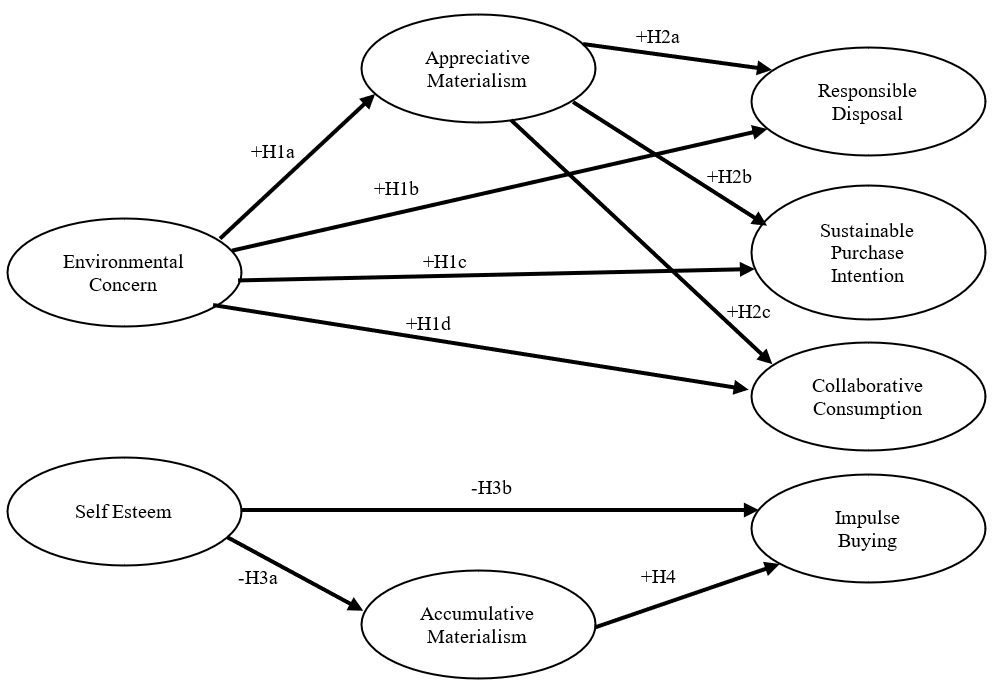
H1: An individual's level of environmental concern will positively influence a) appreciative materialism, b) responsible disposal of apparel, c) intention to purchase sustainable apparel, and d) collaborative consumption of apparel.
H2: An individual's level of appreciative materialism will positively influence a) responsible disposal of apparel, b) intention to purchase sustainable apparel, and c) collaborative consumption of apparel.
Self-Esteem, Accumulative Materialism, and Impulsive Buying
Defined as an individual's perceived and evaluated self-worth, self-esteem is a measure of one's relationship with self (Mruk, 1999). Individuals feel the desire to impress others through physical possessions especially when self-esteem is threatened, resulting in greater materialistic behaviors (Levy et al., 2016). As described in the symbolic self-completion theory, by placing one's self-worth and self-esteem in material possessions, individuals place greater importance on goals that result in instant rewards rather than delayed gratification (Kasser & Ryan, 1993). Past literature has found that self-esteem and materialism are negatively related (Chan, 2013; Rezende Pinto et al., 2017; Nagpaul & Pang, 2017; Park & John, 2011; Zhao, 2019). High self-esteem allows an individual to not be as influenced by outside forces, such as family, friends, and society (Rezende Pinto et al., 2017; Nagpaul & Pang, 2017). This translates to greater confidence in purchases and, therefore, less excessive consumption (Zhao, 2019). (Chaplin & John, 2010) found that lower levels of self-esteem among adolescents resulted in higher levels of materialism. Like adults, adolescents also attempt to bolster self-perceptions through material possessions (Chaplin & John, 2010). This is true for both genders, but (Noguti & Bokeyar, 2014) found a stronger correlation for women than men.
Additionally, materialism has been found to correlate with an increase in impulse buying (Mukhtar et al., 2021) and a decrease in the overall well-being (Fournier & Richins, 1991). Impulse buying occurs when unintended, immediate purchases are made (Rook & Fisher, 1995). Low self-esteem and subjective well-being are related to materialistic values, which influences purchasing behavior (Dittmar, 2005; Dittmar et al., 2014; Kasser & Ryan, 1993). Materialistic consumers use apparel as a status symbol (O’Cass & Siahtiri, 2013), to transform other's perceptions of themselves (Richins, 1994), and/or to seek happiness (Browne & Kaldenberg, 1997). When looking at the levels of consumption, it has been found that psychological distress can cause individuals to develop excessive buying habits (Dittmar, 2005). Excessive buying represents a coping strategy for stress, depression, and anxiety (Lins et al., 2021). Within the present study, impulse buying was chosen as the contrasting consumption pattern to sustainable consumption since it signifies overconsumption of products (Rook, 1987).
In summary, research repeatedly shows that self-esteem has a negative relationship with materialism (Chan, 2013; Rezende Pinto et al., 2017; Nagpaul & Pang, 2017; Park & John, 2011; Zhao, 2019), suggesting that through the lens of the self-completion theory, low self-esteem drives individuals to self-symbolize by acquiring more possessions resulting in accumulative materialism and consequently impulse buying. Hence, this study proposes the following hypotheses:
H3: An individual's self-esteem will negatively influence a) accumulative materialism, and b) impulse buying tendencies.
H4: An individual's level of accumulative materialism will positively influence their impulse buying tendencies.
The research conceptual model is illustrated in Figure 1.
Method
This study used an online survey for collecting data to examine the research model and subsequently test the hypotheses by applying a series of statistical techniques [e.g. confirmatory factor analysis (CFA) and structural equation modeling (SEM)].
Sample and Procedure
The online survey was conducted with students from a public university located in the southeast region of the United States. Upon receiving the Institutional Review Board (IRB) approval for the use of human subjects, student participants were recruited from large classes in human sciences disciplines. Extra credit points were offered by the course instructors for students participating in the research study. While the use of student samples in consumer behavior research has raised concerns about generalizability, it remains a valid and strategically sound choice for this study for several compelling reasons. Beyond accessibility and cost-effectiveness (Ashraf & Merunka, 2016; Peterson & Merunka, 2014), the student sample represents a population of growing relevance to the apparel industry. Specifically, this study utilizes a sample of individuals aged 19 to 26, which captures the upper, older segment of Generation Z—a cohort that is not only gaining increased purchasing power each year (Kim et al., 2020) but is also known for its strong interest in sustainability and high involvement in fashion trends (Pandey & Yadav, 2023).
Importantly, this study is the first quantitative investigation grounded in Kramarczyk and Oliver's (2022) proposal of appreciative materialism, which was originally developed through a qualitative study using a middle-aged Polish sample (ages 26–45). By focusing on Gen Z, this study extends their framework to a younger, more globally influential demographic that will shape future consumption patterns. This approach enhances both the internal and external validity and the contextual relevance of the findings for a demographic that plays a critical role in shaping future consumption patterns.
Southeastern universities in the United States, are often large, public, land-grant institutions known for their comprehensive academic offerings, strong research programs, and community engagement. These universities typically serve a diverse student body, including both in-state and out-of-state students. In recent years, many Southeastern universities have adopted sustainability as a core institutional priority, reflected in strategic plans, sustainability offices, interdisciplinary academic programs, and campus-wide initiatives aimed at reducing environmental impact (Watson et al., 2017).
The alignment between a university's sustainability goals and student values is particularly relevant in research related to sustainable consumption. At many Southeastern universities, students—especially those from Generation Z—have shown increasing interest in environmental and social issues, including ethical consumption, climate change, and sustainability in fashion (Watson et al., 2017). This cultural and institutional environment may influence student attitudes and behaviors, thereby providing a meaningful context for examining materialism and sustainable apparel consumption.
Furthermore, by situating the study within a large, Southeastern university that is actively engaged in sustainability efforts, the research benefits from a sample that is not only accessible and demographically relevant but also socially and environmentally aware. This enhances the relevance and potential generalizability of the findings to other similar higher education contexts globally where sustainability discourse is gaining momentum among youth populations. For these reasons, the convenience sample drawn from the student population at Southeastern university in the United States was considered suitable for the present study.
Instruments
The online questionnaire designed in Qualtrics contained measurements for the study variables along with demographic items (e.g., age, gender, ethnicity, occupation status, annual household income etc.). This study employed a range of established and adapted scales to assess the constructs of interest. All items were anchored on Likert-type scales appropriate to the original instrument or the adaptation purpose. Table 1 presents the detailed wording of all scale items. Self-esteem was assessed using the widely validated 10-item Rosenberg Self-Esteem Scale (Rosenberg, 1965). The items were measured on a 4-point Likert-type scale (1 = Strongly Disagree to 4 = Strongly Agree). This unidimensional scale has demonstrated high reliability and validity across diverse populations and is considered a gold standard for measuring global self-esteem. Given the evolving conceptualization of materialism, this study distinguished between appreciative and accumulative materialism. To measure appreciative materialism, nine items were adopted from Kramarczyk and Oliver's (2022) qualitative study. These items reflect core dimensions such as proximity, attachment, commitment, and respect in one's relationship with material possessions. Although originally developed from interview data, these items were adapted for quantitative use, capturing a more value-driven and emotionally connected orientation toward material objects. In contrast, accumulative materialism was measured using a modified version of the material values scale (Richins & Dawson, 1992), which includes 18 items assessed on a 5-point Likert-type scale (1 = Strongly Disagree to 5 = Strongly Agree). This scale captures the traditional conceptualization of materialism that emphasizes the acquisition and accumulation of possessions as central to life satisfaction and success. The inclusion of both appreciative and accumulative dimensions provides a nuanced understanding of materialistic values and their potential impact on sustainable consumption.
Sustainable apparel consumption behavior construct was treated as a multidimensional variable comprising three distinct yet interrelated dimensions: responsible disposal of apparel, intention to purchase sustainable apparel, and collaborative consumption of apparel. Responsible disposal of apparel was measured using five items from Joung & Park-Poaps (2011), capturing behaviors such as donating, reusing, or repurposing used clothing. Intention to purchase sustainable apparel was assessed with three items from Kang et al. (2013), which were originally developed based on Shaw et al. (2000), focusing on consumer willingness and behavior toward environmentally responsible fashion choices. Collaborative consumption of apparel, including thrifting, swapping, and sharing, was captured using four items adapted from Xu et al. (2014). All items under this construct were measured on a 5-point Likert-type scale (1 = Strongly Disagree to 5 = Strongly Agree), allowing consistency in response scaling.
To assess impulse buying tendencies, five items were adapted from Jones and Beatty's (1998) impulse buying scale. These items evaluate spontaneous, unplanned purchase behavior related to overconsumption and the emotional drive behind such decisions. The items were measured using a 5-point Likert-type scale, maintaining consistency with other constructs in the study.
Environmental concern was measured using 12 items adapted from Straughan and Roberts (Straughan & Roberts, 1999), a scale often used in green consumer research. This scale captures an individual's level of concern for environmental issues and their awareness of environmental consequences related to consumption. Like most other constructs in the study, these items were measured on a 5-point Likert-type scale.
Prior to analysis, all scales were subjected to reliability and validity checks, including Cronbach's alpha, exploratory factor analysis (EFA), and confirmatory factor analysis (CFA) where appropriate. Any item modifications were based on theoretical consistency and prior empirical usage to ensure content validity. The use of both established and adapted scales allows the study to build on previous literature while also capturing emerging conceptual distinctions, such as the differentiation between appreciative and accumulative materialism.
Data Analysis
Quantitative analyses included descriptive inquiry and several exploratory and confirmatory factor analyses for the purpose of purifying scales, testing the reliability and validity of measurements. Finally, SEM was utilized to test hypothesized relationships. SPSS was used for running descriptive statistics, exploratory factor analysis, and Cronbach's $\alpha$. For running the CFA and SEM, MPlus was used.
Results
Sample Characteristics
A total of 249 responses were collected with a response rate of 58.59%. Attention check questions were embedded in the online survey questionnaire to evaluate whether respondents were paying attention to the questions. Of these 249 responses, 216 were complete, passed the attention check question, and deemed usable for further analyses. The sample consisted of 204 female (94.4%) and 12 male (5.6%) participants. The average age was 20.7 years (SD = 1.35) with respondents ranging from 19 to 24 years old (excluding one 26-year old participant). Most respondents were Non-Hispanic White (83.8%). A larger proportion of respondents (30.6%) reported an annual household income of more than$150,000. See Table 1 for detailed sample characteristics.
| Variables and Characteristics | f | % |
| Gender (n = 216) | ||
| Male | 12 | 5.6 |
| Female | 204 | 94.4 |
| Prefer not to answer | 0 | 0.0 |
| Age (n = 215)* | ||
| 19 | 33 | 15.3 |
| 20 | 78 | 36.1 |
| 21 | 60 | 27.8 |
| 22 | 31 | 14.4 |
| 23 | 6 | 2.8 |
| 24 | 5 | 2.3 |
| 26 | 1 | 0.5 |
| Geographic region of residence (n = 216) | ||
| Mid-west | 10 | 4.6 |
| Northeast | 15 | 6.9 |
| Southeast | 171 | 79.2 |
| Southwest | 9 | 4.2 |
| West | 11 | 5.1 |
| Ethnicity (n = 216) | ||
| Asian/Pacific Islander | 7 | 3.2 |
| Non-Hispanic Black | 1 | 0.5 |
| Non-Hispanic White | 181 | 83.8 |
| American Indian/Alaskan Native | 3 | 1.4 |
| Hispanic | 8 | 3.7 |
| Other | 15 | 6.9 |
| Prefer not to say | 1 | 0.5 |
| Annual Household Income (n = 216) | ||
| Less than $25,001 | 11 | 5.1 |
| $25,001 to $50,000 | 5 | 2.3 |
| $50,001 to $75,000 | 6 | 2.8 |
| $75,001 to $100,000 | 21 | 9.7 |
| $100,001 to $125,000 | 15 | 6.9 |
| $125,001 to $150,000 | 15 | 6.9 |
| More than $150,001 | 66 | 30.6 |
| Not applicable (if unemployed) | 39 | 18.1 |
| Prefer not to say | 38 | 17.6 |
| Major at the University (n = 216) | ||
| Apparel Merchandising, Design... | 141 | 65.3 |
| Interior Design | 60 | 27.8 |
| Other | 15 | 6.9 |
* Note: M = 20.67, SD = 1.353
Exploratory Factor Analysis (EFA) and Scale Reliabilities
After running the EFA with principal axis factoring, with an Eigenvalue > 1 criteria, dimensionality of each variable was confirmed, however, several items were deleted because of the low factor loadings (< 0.30) or cross-loading issues: two items from responsible disposal of apparel, one item from collaborative consumption of apparel, four items from accumulative materialism, two items from appreciative materialism, and three items from environmental concern variables. The Cronbach's$\alpha$value cut-off criteria of 0.70 was used to measure the internal consistency of the scales. All variables except responsible disposal of apparel ($\alpha$= 0.47) showed required Cronbach's$\alpha$value of 0.70. Therefore, responsible disposal of apparel was not considered for further analysis due to low reliability (see Table 2). Flawed wording related to items 2 and 3 in responsible disposal of apparel, low reliability of this variable and its impact in the present research is discussed in the discussion and limitations sections. Thus, the results need to be inferred with caution.
| Item | λ | α | Eigenvalue | Variance Explained (%) |
| Responsible disposal of apparel | ||||
| 1. I sell my old clothes to second-hand stores.* | - | 0.47 | 3.38 | 37.58 |
| 2. I always donate my old clothes to charity. | 0.33 | |||
| 3. I never throw away my old clothing. | 0.67 | |||
| 4. Clothing I do not wear, I throw away. | 0.46 | |||
| 5. I reuse my old clothing for other purposes.* | - | |||
| Intention to purchase sustainable apparel | ||||
| 1. If I see a sustainable apparel product, I intend to purchase or consider purchasing it. | 0.79 | 0.87 | 1.37 | 15.23 |
| 2. If I see a sustainable apparel brand, I intend to view their products. | 0.88 | |||
| 3. When I find an apparel product that fits my needs, the possibility of my purchasing it will increase if it is sustainably made. | 0.69 | |||
| Collaborative consumption of apparel | ||||
| 1. I like to shop for second-hand clothing at thrift stores. | 0.86 | 0.74 | 1.21 | 13.38 |
| 2. I like to purchase second-hand clothing online. | 0.60 | |||
| 3. I like to adopt second-hand clothing from friends and family members. | 0.57 | |||
| 4. I like owning fewer clothing items rather than buying second-hand clothing.* | - | |||
| Accumulative materialism | ||||
| 1. I admire people who own expensive clothes. | 0.64 | 0.86 | 4.95 | 35.42 |
| 2. Some of the most important achievements in life include acquiring material possessions. | 0.49 | |||
| 3. I don't place much emphasis on the amount of clothing people own as a sign of success.* | - | |||
| 4. The clothing I own says a lot about how well I'm doing in life. | 0.51 | |||
| 5. I like to own clothing that impresses people. | 0.63 | |||
| 6. I don't pay much attention to the clothing other people own. | 0.44 | |||
| 7. I usually buy only the clothes I need.* | - | |||
| 8. I try to keep my life simple, as far as clothing is concerned. | 0.47 | |||
| 9. The clothes I own aren't all that important to me. | 0.44 | |||
| 10. I enjoy spending money on clothes that aren't practical. | 0.46 | |||
| 11. Buying things gives me a lot of pleasure. | 0.54 | |||
| 12. I like a lot of luxury in my life. | 0.61 | |||
| 13. I put less emphasis on the clothing I wear than most people I know.* | - | |||
| 14. I have all the things I really need to enjoy life.* | - | |||
| 15. My life would be better if I owned clothing I don't have. | 0.64 | |||
| 16. I wouldn't be any happier if I owned nicer clothes. | 0.56 | |||
| 17. I'd be happier if I could afford to buy more clothing. | 0.65 | |||
| 18. It sometimes bothers me quite a bit that I can't afford to buy all the clothes I'd like. | 0.60 | |||
| Appreciative materialism | ||||
| 1. I sometimes feel connected to my clothing. | 0.55 | 0.68 | 2.49 | 35.58 |
| 2. I know where and how most of my clothing has been made. | 0.36 | |||
| 3. My wardrobe occupies a special place in my life. | 0.63 | |||
| 4. I always learn how to use a product correctly before using it to make the most out of it. | 0.49 | |||
| 5. I always try to mend my clothing or give it another function before throwing it away. | 0.38 | |||
| 6. I never buy something that I don't really like.* | - | |||
| 7. I have respect for my clothing in general. | 0.58 | |||
| 8. I like the idea that clothing I don't use anymore will have a second life with someone else. | 0.47 | |||
| 9. It is not because clothing is outdated that they should be replaced.* | - | |||
| Self-esteem | ||||
| 1. On the whole, I am satisfied with myself. | 0.64 | 0.88 | 4.77 | 47.68 |
| 2. At times I think I am no good at all. | 0.72 | |||
| 3. I feel that I have a number of good qualities. | 0.53 | |||
| 4. I am able to do things as well as most other people. | 0.52 | |||
| 5. I feel I do not have much to be proud of. | 0.68 | |||
| 6. I certainly feel useless at times. | 0.63 | |||
| 7. I feel that I'm a person of worth, at least on an equal plane with others. | 0.61 | |||
| 8. I wish I could have more respect for myself. | 0.65 | |||
| 9. All in all, I am inclined to feel that I am a failure. | 0.69 | |||
| 10. I take a positive attitude toward myself. | 0.78 | |||
| Impulse buying | ||||
| 1. When I go shopping, I buy apparel that I had not intended to purchase. | 0.90 | 0.84 | 3.06 | 61.35 |
| 2. I am a person who makes unplanned apparel purchases. | 0.89 | |||
| 3. When I see apparel that really interests me, I buy it without considering the consequences. | 0.64 | |||
| 4. It is fun to buy spontaneously. | 0.63 | |||
| 5. I avoid buying apparel that are not on my shopping list. | 0.51 | |||
| Environmental concern | ||||
| 1. Plants and animals exist primarily to be used by humans.* | - | 0.88 | 4.68 | 51.95 |
| 2. We are approaching the limit of the number of people the earth can support. | 0.71 | |||
| 3. To maintain a healthy economy, we will have to develop a steady-state economy where industrial growth is controlled. | 0.60 | |||
| 4. The earth is like a spaceship with only limited room and resources. | 0.65 | |||
| 5. Humans need to adapt to the natural environment because they can remake it to suit their needs.* | - | |||
| 6. There are limits to growth beyond which our industrialized society cannot expand. | 0.58 | |||
| 7. The balance of nature is very delicate and easily upset. | 0.78 | |||
| 8. When humans interfere with nature, it often produces disastrous consequences. | 0.77 | |||
| 9. Humans must live in harmony with nature in order to survive. | 0.72 | |||
| 10. Mankind is severely abusing the environment. | 0.79 | |||
| 11. Humans have the right to modify the natural environment to suit their needs.* | - | |||
| 12. Mankind was created to rule over the rest of nature. | 0.46 |
Note: λ = Factor loading; α = Cronbach's α; * Items removed due to low factor loadings or cross-loading issues.
Discussion
Contemporary consumer culture reflects starkly differing patterns of consumption ranging from overconsumption to conscious consumption to anti-consumption, particularly for fashion-related products. This paper begins with the question, what underlying psychological factors contribute to these differences in contemporary consumer behaviors? In answering this question, we propose and test how consumers' differing orientations towards materialism can explain these patterns of consumption. Based on Kramarczyk and Oliver's (2022) bi-dimensional definition of materialism that includes the concepts of appreciative and accumulative materialism, the present study explores whether these dimensions of materialism have different predictors and outcomes related to sustainability and overconsumption through a quantitative study. Specifically, drawing from the tenets of materialism, extended self, and symbolic self-completion theories, our conceptual model examines contrasting connections between environmental concern, appreciative materialism, and sustainable consumption and self-esteem, accumulative materialism, and impulse buying. Aligned with (Kramarczyk & Oliver, 2022) qualitative findings, the results of the present study reveal that accumulative and appreciative materialism are indeed distinct concepts with differing outcomes and antecedents.
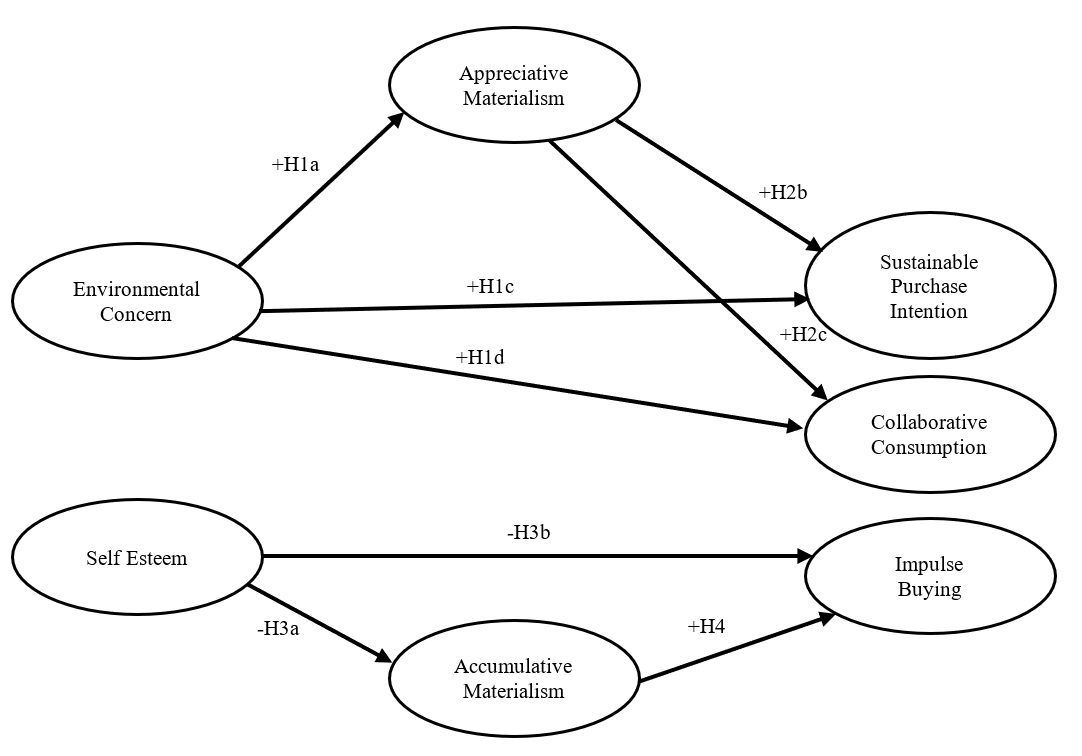
In the context of appreciative materialism, this study reveals that higher levels of environmental concern are associated with increased appreciative materialism, a novel finding for literature on conscious and anti-consumption. Appreciative materialism and environmental concern also positively influence two of the three factors of sustainable apparel consumption (i.e., purchase intent for sustainable apparel and collaborative consumption) implying that individuals with higher levels of appreciative materialism and environmental concern are more likely to seek out and purchase sustainable apparel and participate in collaborative consumption practices. This finding is congruent with previous research on sustainability which concludes that consumers with higher levels of knowledge about sustainability and high environmental concern tend to consume more sustainably (Bocti et al., 2021; Crane, 2016; Gatersleben et al., 2018; Tascioglu et al., 2019; Wiederhold & Martinez, 2018). Additionally, Joung and Park-Poaps (Joung & Park-Poaps, 2011) finding that environmental concerns positively influence resale and donation behaviors of apparel, supports the present study's model that shows the connection between environmental concern, appreciative materialism, collaborative consumption and sustainable apparel purchase intention (see Figure 2). Importantly, an appreciative materialist who has greater value for and connection with possessions will also consume more sustainably (Kramarczyk & Oliver, 2022). In alignment with the tenets of theories of extended self and symbolic self-completion, the above findings confirm the symbolic role of apparel products for appreciative materialists who may fulfil environmental concerns central to their self-concept through sustainable product choices and consuming through alternative models such as thrifting, renting, and swapping clothing items (Hedegård et al., 2019; Lang et al., 2019; Mohammed & Razé, 2023; Xu et al., 2014). These results also confirm and extend the applicability of Kramarczyk and Oliver's (2022) findings to a sample of Gen Z consumers in the United States. Kramarczyk and Oliver's (2022) study was exploratory, qualitative, and accounted for all types of goods, in contrast to the present quantitative study, which showed that appreciative materialism positively predicts sustainable apparel consumption for the Gen Z consumer. This finding also validates that younger consumers are more likely to engage in collaborative consumption practices (Bly et al., 2015; Lang et al., 2019; Ruppert-Stroescu et al., 2015; Xu et al., 2014). Viewed together, the present study's findings demonstrate that appreciative materialism is a viable concept and has a place in future research related to conscious consumption and sustainability among different age cohorts of global consumers.
In context to the above, while the link between appreciative materialism, environmental concern and sustainable purchase and collaborative consumption was established, the present study could not conclude that appreciative materialists and individuals with high environmental concern dispose their clothing in more sustainable ways. Also acknowledged in the limitations, the scale for responsible disposal of apparel did not demonstrate adequate reliability possibly to due to the 'absolute' wording of the survey statements. Although respondents indicated their level of agreement (Strongly Agree – Strongly Disagree) to statements such as 'I never throw away my old clothing', a better approach may have been to have respondents rate a modified version of this statement 'I throw away my old clothing' on a bipolar scale anchored by 'Never' and 'Always.' Hence, the hypotheses related to responsible disposal of apparel could not be tested. In relation to the concept of accumulative materialism, self-esteem was found to negatively influence accumulative materialism. This implies that consumers with lower self-esteem are more likely to be accumulative materialists. These findings emphasize the centrality of possessions in enhancing the fragile self (i.e., we are what we own), a central tenet of the Belk's (1988) theory of extended self. These results also align with previous studies that have found a negative relationship between self-esteem and materialism (Chan, 2013; Rezende Pinto et al., 2017; Nagpaul & Pang, 2017; Park & John, 2011; Zhao, 2019). Within the context of the symbolic self-completion theory, when self-esteem is threatened, individuals may attempt to cope and complete themselves through accumulative materialistic behaviors. Our results also showed that accumulative materialism positively influences impulse buying. Previous studies measuring materialism as a unidimensional variable similarly found that greater materialism promotes greater impulse buying (Pradhan et al., 2018; Pupelis & \vS, 2023).
Unexpectedly, the results revealed that self-esteem did not have a direct influence on impulse buying behavior. While previous research has extensively explored this relationship, findings remain inconclusive, with some studies reporting significant associations and others finding no meaningful connection. This inconsistency is reflected in the work of Tessy and Setiasih (Tessy & Setiasih, 2024), who also reported divergent outcomes, thereby highlighting the complexity and contextual variability of this relationship. It is plausible that contextual, situational, or individual personality traits moderate the effect of self-esteem on impulsive buying tendencies, thereby attenuating the direct relationship. Further analysis using mediation testing provided additional insight into this unexpected result. Specifically, accumulative materialism was found to mediate the relationship between self-esteem and impulse buying behavior. This finding suggests that individuals with lower self-esteem may not directly engage in impulse buying; rather, their materialistic values—particularly the desire to accumulate possessions—serve as a psychological mechanism that facilitates impulsive purchasing behavior. Thus, the non-significant direct effect of self-esteem on impulse buying can be better understood through its indirect effect via accumulative materialism.
It is important to note that a weak correlation between accumulative and appreciative materialism confirms that these dimensions of materialism behave distinctly and are not related to each other, confirming Kramarczyk and Oliver's (2022) conclusions that appreciative and accumulative materialism are distinct, and that both dimensions should be accounted for in a contemporary theory of materialism.
Practical Implications
While promoting greater understanding of consumer values that contribute to sustainability and overconsumption, this study adds a positive resolution to materialism through the application and exploration of appreciative and accumulative materialism. This study reveals that appreciative materialists tend to shop for sustainable apparel and are more likely to rent clothing, engage in other forms of collaborative consumption, and use garments longer. Sustainable brands can meaningfully use the results of this study when marketing new products. Instead of offering discounts that promote accumulation of goods such as "buy 3, get one free", retailers could promote sustainable behaviors such as advertising a sustainable fabric or feature on the product to appeal to appreciative materialists. Brands can also leverage the tenets of symbolic self-completion theory by highlighting the symbolic value of sustainable apparel products that can help fulfil appreciative materialists' environment-central identities. When purchasing single occasion wear items, brands can also engage their appreciative materialist consumer by promoting trading of clothing through prosocial organizations, such as Poshmark. In summary, while the fashion industry has focused its attention on accumulative materialists, it is also important to promote appreciative materialistic lifestyles and consumption patterns. Appreciative materialism respects humans materialistic drives and directs it to a more sustainable pattern of consumption. The results of the present study quantify the influence of appreciative materialism on sustainable apparel consumption and the influence of environmental concern on appreciative materialism, enabling brands to use these findings in shaping future sustainability marketing.
Theoretical Implications
The present study supports and extends Belk's (1988) seminal work on the role of possessions in the extended self, by demonstrating how possessions can relate to both meaning and quantity, for appreciative and accumulative materialists respectively. While Belk's original conceptualization on possessions and the extended self describes the essence of accumulative materialism, our novel findings help to connect this theory to the new concept of appreciative materialism that focuses on meaningfully 'reducing' and 'reusing' possessions. The present research also contributes to the symbolic self-completion theory by extending the applicability of the theory to explain environment-central self-identities and sustainable apparel consumption. Using self-esteem as an indicator of incompleteness, the results found self-esteem to be a predictor of accumulative materialism and impulse buying (via accumulative materialism), aligning with the theory. Individuals with lower self-esteem may accumulate products impulsively to fill a void while searching for self-completeness.
The results of this study justify a need for greater theory-building in relation to the nuanced concepts of materialism. Different types of materialism influence different behaviors and therefore, theory should be developed to incorporate and solidify these findings (Kramarczyk & Oliver, 2022). Further, the different types of materialism have different antecedents. Self-esteem predicted accumulative materialism, whereas environmental concern predicted appreciative materialism. These results validate Kramarczyk and Oliver's (2022) conceptualization of materialism as a bi-dimensional construct. Future research should focus on further developing theory surrounding appreciative and accumulative materialism and their influence on other consumer behaviors.
Limitations and Recommendations for Future Research
Limitations of this study include the demographics of the sampling pool. This study focused on a southeastern, predominately female sample, aged 19-26. This limits the generalizability of the findings to other regions and the variation in age and gender of respondents. Additionally, the self-administered survey also limits the validity of the study due to social desirability bias in responding particularly on issues related to sustainability and materialism (Miller, 2011). Respondents answered questions based on their self-perceived habits, rather than on observed actions. Hence, respondents' lack of self-objectivity may have also caused misinformation within the survey. Additionally, responsible disposal of apparel had a low Cronbach's$\alpha$ score, resulting in low scale reliability. This could have been due to the low number of items in the scale and the possible poor inter-relatedness between the items. For example, participants were asked their level of agreeability to the statement "I always donate my old clothes to charity" and "I never throw away my old clothing". Participants may "sometimes" donate clothing or "sometimes" throw away clothing, but because of the strong wording of the statement they may have answered "disagree" because they do not participate in responsible disposal every time they dispose of old clothing. Findings in the final SEM model do not include responsible disposal of apparel, which places limitations on the application of the results of this study to sustainable consumer behaviors.
Additionally, this study examined materialism and sustainable consumption within the domain of apparel. This limits the scope of the product impacted by these factors. Individuals who shop for sustainable apparel may or may not shop for organic foods or drive electric cars. Sustainable consumption and materialistic tendencies need to be examined in relation to other hedonic and utilitarian product categories in future studies. Conceptual limitations involve additional influences on materialism and sustainable consumption, such as consumer knowledge, perceived personal relevance, and subjective norms (Kang et al., 2013). Categorization of consumers into either an appreciative or accumulative materialist is a simplification of the vast complexities of reality. Therefore, this study treats appreciative and accumulative materialism as two separate continuous variables. This allows for the possibility for an individual to be both a high accumulative materialist and a high appreciative materialist. Depending on the context, product, or surroundings, an individual might be more appreciative or accumulative in their thinking. For example, an individual may exhibit appreciative materialism when they rent their formal dress but be an accumulative materialist when socially shopping in a mall. Labeling individuals as one or the other would limit the validity of the results and not reflect the diversity of behaviors observed in the marketplace.
Future research on materialism should account for appreciative and accumulative materialism and questions related to this bi-dimensionalism. Do individuals always act as either accumulative or appreciative materialists? Do different types of products influence individuals to have different types and levels of materialism? For example, an individual may like antique furniture and refurbish and cherish their furniture possessions but purchase an over-abundance of shoes. Additionally, can individuals be both accumulative and appreciative materialists at the same time with the same type of products? For example, an individual may feel a connection to their clothing and know the origin of it but also want to have expensive things and impress people with their clothing. By understanding the nuanced constructs of materialism in relation to overconsumption and sustainable behavior, better strategies can be developed to promote sustainable lifestyles. Finally, further exploration of scale development for both appreciative and accumulative materialism needs to be undertaken.
References
Licensing
https://creativecommons.org/licenses/by/4.0/
Copyright
Copyright © 2025 by authors. This is an open access article distributed under the Creative Commons Attribution License, which permits unrestricted use, distribution, and reproduction in any medium, provided the original work is properly cited.
Copyright Year
2025
Correction statement
About contributors

Claire Evelyn Stovall
Department of Consumer and Design Sciences, Auburn University, Auburn, Alabama, United States
United States
Veena Chattaraman
Department of Consumer and Design Sciences, Auburn University, Auburn, Alabama, United States
United States
Amrut Sadachar
Department of Consumer and Design Sciences, Auburn University, Auburn, Alabama, United States
United States
Dawn Michaelson
Department of Consumer and Design Sciences, Auburn University, Auburn, Alabama, United States
United States