





Abstract
The study investigated how tourists' awareness of greenwashing affects their intention to book green accommodation services, focusing on the roles of green skepticism and trust as mediators. A structured questionnaire was used to assess tourists’ ability to identify misleading environmental claims, trust in service providers, skepticism towards sustainability claims, and intention to book green accommodation services. The survey was distributed online and in person, resulting in 303 valid responses. The data were analyzed using SPSS version 20.0 for preliminary statistical analyses and AMOS version 24.0 to conduct Covariance-Based Structural Equation Modeling. Results indicate that tourists’ awareness of greenwashing increases green skepticism and positively influences trust, while its direct effect on booking intention is not significant. Interestingly, tourists’ green skepticism strengthened their trust and booking intention, suggesting that critical thinking may help tourists make more confident, informed decisions. Trust was found to be the strongest predictor of tourists’ booking intention, with both green skepticism and trust mediating the relationship between awareness and behavioral intention. The study concludes that skepticism can serve as a useful filter, helping tourists differentiate between superficial and genuine sustainability claims, offering valuable insights for hospitality professionals seeking to build credibility in a consumer-conscious market.
Introduction
In recent years, environmental consciousness has had a profound impact on consumer behavior in the travel and hospitality industries. Tourists are increasingly seeking sustainable lodging alternatives, prompting numerous service providers to adopt environmentally friendly practices. On the negative side, this tendency has led to the emergence of greenwashing, where firms inflate or fabricate their environmental claims to appeal to eco-conscious consumers.
These misleading methods deceive tourists and compromise authentic sustainability initiatives within the sector.
Greenwashing has been extensively recorded in the tourist and hospitality industries. Some tour operators inaccurately portray volunteer tourism packages as sustainable, while eco-resorts are occasionally misrepresented as environmentally friendly destinations. When customers identify such misinformation, it undermines trust in service providers and destination brands, diminishing loyalty and booking intentions (Rahman and Reynolds, 2022).
Determining whether a hotel is engaging in greenwashing requires assessing multiple criteria, including third-party certifications, measurable environmental performance data, operational transparency, and consistency between marketing claims and actual practices. The difficulty of this evaluation can be illustrated by several illustrative cases. For example, the Eco Green Boutique Hotel in Da Nang, Vietnam, positions itself as "eco-friendly" through its branding and highlights features such as reduced food waste and bicycle rentals. Similarly, the Cat Ba Eco Lodge in Hai Phong emphasizes eco-friendly architecture, support for local conservation, and the use of organic ingredients in its dining services. Even large-scale properties such as Singapore’s Oasia Hotel Downtown draw attention with a striking biophilic design and highprofile sustainability awards. These cases demonstrate how hotels increasingly employ green positioning to appeal to environmentally conscious travelers. While not intended to classify such properties as instances of greenwashing, they illustrate how the eco-label or green identity has become a significant promotional tool in the hospitality marketplace.
In the hospitality industry, authentic sustainability initiatives may encounter skepticism due to the challenges associated with substantiating eco-friendly assertions. This perceived risk diminishes trust and harms guest perceptions, payment willingness, and brand attitudes (Kim and Kim, 2024). Academics have consistently highlighted the influence of green skepticism and trust on green consumer behavior. Green skepticism refers to a consumer’s inclination to doubt the veracity of environmental claims (Nyilasy et al., 2014), whereas trust signifies assurance in a company’s integrity and dependability (Han et al., 2019). Previous studies have shown that both skepticism and trust substantially influence consumers’ assessments of green promises and their subsequent behavioral intentions (Chen and Chang, 2013). Nevertheless, contemporary literature frequently examines these constructs in isolation or emphasizes general green marketing, with insufficient attention to how tourists’ awareness of greenwashing influences their intention to reserve accommodation services, particularly through the dual psychological mechanisms of trust and skepticism.
This study identifies and examines gaps by developing and empirically validating a conceptual model that explores the relationship between tourists’ awareness of greenwashing and their propensity to reserve green accommodation services, considering the influence of green skepticism and trust. Building on the literature of green consumer behavior and signaling theory, this study explores how tourists cognitively and emotionally respond to signals of greenwashing. The findings are expected to enrich theoretical discussions on green trust and offer practical insights for developing credible sustainability communication strategies in the tourism sector.
Literature Review and Hypothesis Developement
Tourists’ awareness of greenwashing
Awareness is a fundamental concept in consumer behavior and cognitive psychology, denoting the capacity to recognize, interpret, and consciously contemplate information (Kubarev, 2021).
In sustainable marketing, tourists’ understanding of greenwashing encompasses their ability to identify deceptive environmental claims and assess the credibility of green branding in tourism services.
This awareness is influenced by environmental knowledge, individual values, and previous experiences (Mazhenova et al., 2016). In the hospitality sector, tourists are increasingly scrutinizing the authenticity of hotels’ eco-labels and green messaging regarding their sustainable practices (Chudinovskikh et al., 2024). Research indicates that consumers with extensive green knowledge are more adept at recognizing misleading marketing, which directly impacts their decision-making processes (Seberıni et al., 2024; Timmons et al., 2024).
Consequently, awareness facilitates assessment and acts as a cognitive conduit to subsequent psychological responses, including skepticism and distrust.
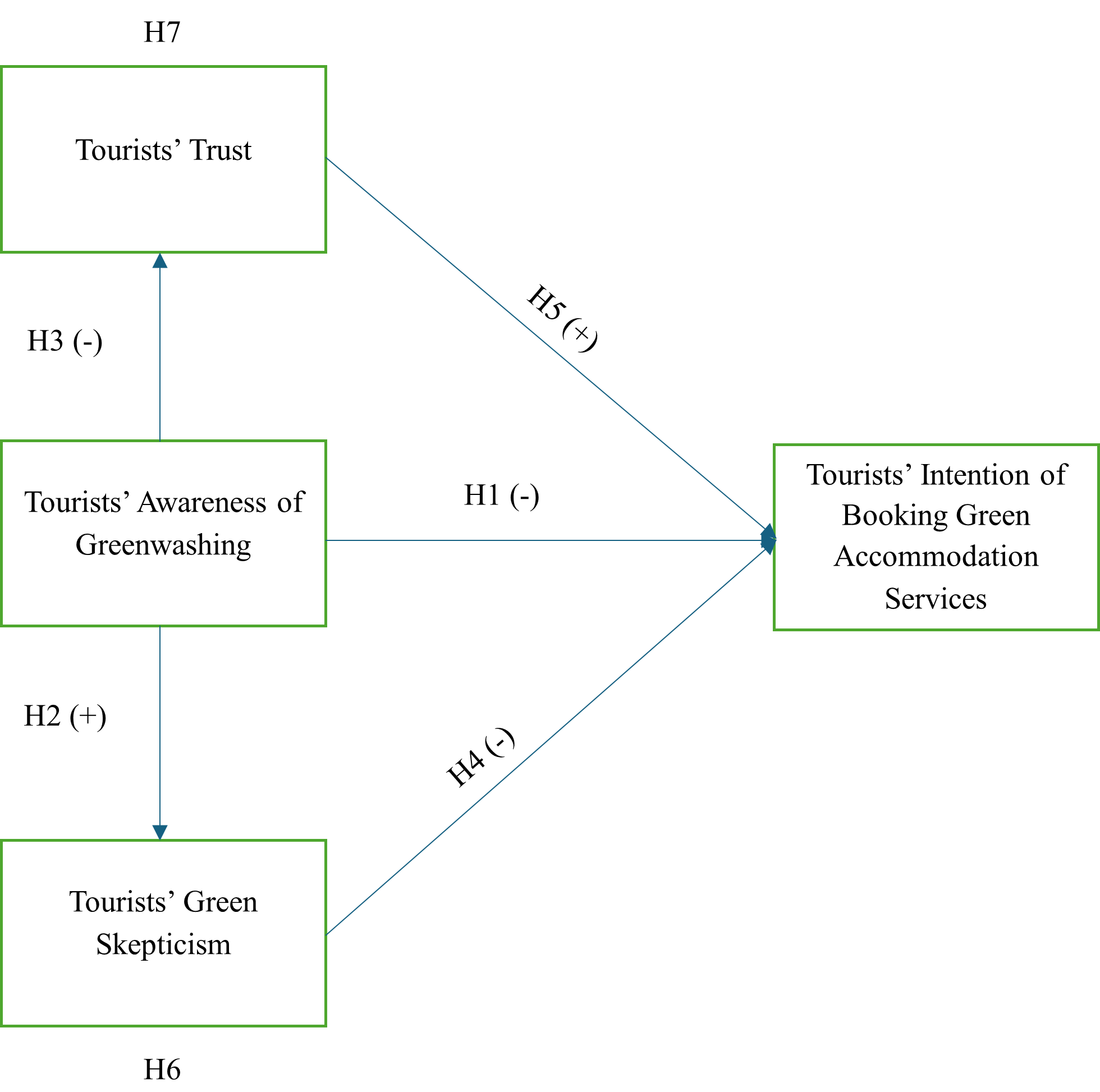
H1: Tourists’ awareness of greenwashing negatively affects tourists’ intention of booking green accommodation services.
Green skepticism
Green skepticism refers to the consumer’s tendency to scrutinize the veracity, reliability, or transparency of environmental claims made by corporations (Ellen, 1998; Nyilasy et al., 2014). In hospitality industry, this skepticism is evident in tourists’ hesitation to adopt sustainability messaging uncritically, particularly when indicators of greenwashing, such as ambiguous, inflated, or deceptive environmental claims, are apparent.
Green skepticism is not only a negative or contemptuous response; it embodies a cognitive alertness designed to safeguard against manipulation and disinformation (Ferrón-Vílchez et al., 2021). The elaboration likelihood hypothesis (Cacioppo and Petty, 1986) posits that tourists exposed to potentially misleading green signals are inclined to engage in systematic information processing, thoroughly examining the message content, thus increasing the probability of skeptical reactions. Furthermore, tourists with heightened environmental awareness are more proficient at identifying discrepancies between stated and actual environmental behaviors, demonstrating greater skepticism (Majeed and Kim, 2023). From a micro-level trust standpoint, greenwashing undermines faith in the organization’s honesty and objectives (Gustafsson et al., 2005), a crucial precursor to skepticism. Emotional responses are essential; as (Antonetti and Maklan, 2014) contend, customers may experience moral emotions such as wrath or betrayal when they perceive corporations misusing ethical norms for selfserving purposes. These emotional reactions strengthen defensive skepticism, which is motivated by cognitive evaluations and a need to safeguard moral identity. Consequently, it is reasonable to anticipate that awareness of greenwashing engenders increased suspicion.
H2: Tourists’ awareness of greenwashing positively affects tourists’ green skepticism.
Tourists’ Trust
Trust in eco-friendly accommodation providers refers to tourists’ willingness to rely on the environmental claims made by these providers, assuming that such claims are both genuine and substantiated (Morgan and Hunt, 1994; Chen and Chang, 2013). Trust is pivotal in influencing tourists’ favorable perceptions and behavioral intentions regarding sustainable tourism offerings. Trust is naturally delicate and particularly vulnerable to perceived discrepancies between stated principles and visible behaviors.
Awareness of greenwashing, where corporations misrepresent or overstate their environmental initiatives, directly undermines the legitimacy of green claims, consequently eroding tourists’ faith (Rahman et al., 2015; Alyahia et al., 2024). According to Attribution theory (Kelley, 1973), when tourists see environmental messages as manipulative rather than sincere, it results in a substantial decline in trust. This erosion is cognitive and emotional, eliciting feelings of betrayal and dishonesty that are challenging to overcome. Moreover, green skepticism, characterized as the inclination to question or critically evaluate environmental assertions (Ellen, 1998), is a psychological impediment to establishing trust. As skepticism rises, tourists are increasingly inclined to scrutinize the authenticity of green messaging and the integrity of accommodation providers, even when claims are valid (Pham et al., 2024). This corresponds with the affect-as-information concept (Schwarz and Clore, 2007), indicating that skeptical emotional states distort cognitive assessments, hindering the development of trust. Consequently, both cognitive recognition of greenwashing and the affective-cognitive disposition of skepticism collectively undermine tourists’ faith in the reliability of green accommodations. The dynamics substantiate the assertions that awareness of greenwashing has a considerable detrimental impact on trust:
H3: Tourists’ awareness of greenwashing negatively affects tourists’ trust in green accommodation.
H4: Tourists’ green skepticism negatively affects tourists’ intention to book green accommodation services.
Tourists’ intention to book accommodation services
The intention to book green accommodations is widely recognized as a fundamental outcome variable in sustainable tourism research, as it reflects tourists’ motivational preparedness and inclination to engage in pro-environmental purchasing behaviors (Ajzen, 1991). Prior studies consistently emphasize behavioral intention toward green hotels as a central dependent construct linking environmental attitudes and actual consumer decisions. For instance, han2010application demonstrated that tourists’ pro-environmental attitudes significantly predict their intention to stay in green hotels, while rahman2016predicting confirmed booking intention as a critical outcome of tourists’ environmental commitment. Similarly, chen2013greenwash highlighted the role of green trust and perceived quality in shaping consumers’ willingness to engage in environmentally responsible consumption.
Nonetheless, scholars have repeatedly cautioned that, despite its widespread use, intention is not always a reliable proxy for actual sustainable behavior, due to the well-documented intention-behavior gap. kollmuss2002mind highlighted that even strong environmental awareness and concern often fail to translate into consistent pro-environmental behavior, as various internal and external barriers intervene. Similarly, vermeir2006sustainable showed that positive attitudes toward sustainable products do not automatically generate strong behavioral intentions, pointing to structural and situational constraints. These insights remind us that in light of the well-known intention-behavior gap (ElHaffar et al., 2020; Conner and Norman, 2022; Wut et al., 2023; Bernardes et al., 2018), intention must be interpreted with caution in sustainable consumption research and future studies should complement its use with direct behavioral outcome measures.
One important factor shaping this gap is the way tourists evaluate the credibility of green marketing claims, which directly affects their willingness to act on stated intentions. When visitors see green claims as overstated or insincere, they become wary, hesitant, and less inclined to respond to such claims, resulting in a diminished intention to book (Doosti-Irani et al., 2023; Alyahia et al., 2024). Signaling theory supports this notion, asserting that when signals (e.g., green claims) are deemed untrustworthy, the signal receiver (the tourist) adopts a risk-averse stance and refrains from the desired conduct.
Moreover, green skepticism, seen as skepticism or mistrust towards environmental communications, intensifies this disengagement. Skeptical visitors are prone to interrogate the authenticity of eco-labels, green certifications or green claims, and if these apprehensions remain unaddressed, they may entirely eschew environmentally marketed accommodations (Majeed and Kim, 2023). According to the theory of reasoned action, skepticism diminishes positive views, lowering intention. In contrast, confidence in eco-friendly lodging establishments markedly improves tourists’ behavioral intentions. Trust diminishes perceived risk, fortifies emotional connections with service providers, and cultivates trust in the legitimacy of claims, all of which are essential precursors to action (Rahman et al., 2015; Chen and Chang, 2013). Trust corresponds with the theory of planned conduct as an enabling condition that converts intention into action. These findings collectively demonstrate that:
H5: Tourists’ trust positively affects tourists’ intention of booking green accommodation services.
The mediating role of green skepticism and trust
Although perceived greenwashing can directly reduce tourists’ desire to reserve eco-friendly accommodations, this effect is neither linear nor immediate. Instead, it manifests through a sequence of interrelated psychological processes that illustrate a cognitive-affective-behavioral pathway. Within this approach, awareness of greenwashing serves as a cognitive trigger that elicits evaluative and emotional responses, specifically green skepticism, which then erodes trust, a vital affective-behavioral determinant of intention (Guerreiro and Pacheco, 2021).
Furthermore, the mediation framework corresponds with persuasion theory, indicating that the efficacy of a message relies not only on exposure but also on internal processing, encompassing skepticism and credibility assessments (Petty and Cacioppo, 1986).
The absence of trust substantially diminishes the motivational foundation for pro-environmental behavior, irrespective of the consumer’s environmental consciousness. The dual mediating roles of green skepticism and trust are crucial for comprehensively elucidating the influence of greenwashing awareness on tourists’ behavioral intentions, indicating an indirect pathway where cognition and emotion collaboratively influence eco-friendly decision-making (Guerreiro and Pacheco, 2021). Therefore, the following hypothesis is proposed:
H6: Tourists’ green skepticism mediates the relationship between tourists’ awareness of greenwashing and tourists’ intention of booking green accommodation services.
H7: Tourists’ trust mediates the relationship between tourists’ awareness of greenwashing and tourists’ intention of booking green accommodation services.
Figure illustrated the proposed research model developed on the basis of the above hypotheses.
Research Methodology
Research Methods
In the preliminary phase of the study, five expert interviews were conducted to refine the research framework. These interviews helped validating the conceptual model, developing survey items, and providing contextual insights into the real-world application of the study’s constructs.
In the next phase of collecting data for model testing, the study employed a structured survey approach to examine the impact of tourists’ awareness of greenwashing on their intention to book accommodation services, with trust and green skepticism serving as mediating variables.
Measurement items are derived from validated scales in previous green marketing and tourism research and modified for contextual relevance (See Table 1). The awareness of greenwashing is evaluated using measures that assess tourists’ capacity to identify deceptive or overstated environmental assertions.
| Measures | Definitions | Sources | Item Statements |
|---|---|---|---|
| Tourists’ awareness of greenwashing | Tourists’ ability to recognize and understand false claims, exaggerations, misrepresentations by accommodation service providers. | (N. et al., 2025) & author | I can recognize misleading sustainability claims from hotels. |
| I am aware that some hotels exaggerate their environmental protection efforts. | |||
| I can distinguish between truly green accommodations and those engaging in greenwashing. | |||
| I know how to assess the authenticity of sustainability claims made by accommodations. | |||
| I often look for signs of greenwashing when booking green accommodations. | |||
| Tourists’ green skepticism | Tourists’ inclination to doubt the veracity of environmental claims made by accommodation service providers about their products or practices. | (Goh and Balaji, 2016; Syadzwina and Astuti, 2021; Uddin et al., 2023; Nyilasy et al., 2014; Ellen, 1998) | I am skeptical of most environmental claims made by accommodations. |
| I doubt that the sustainable efforts of accommodations are as effective as they claim. | |||
| I believe many accommodations claim to be eco-friendly but do not follow through in practice. | |||
| I think many accommodations use sustainability strategies to deceive customers. | |||
| I am cautious when reviewing the green claims of accommodations. | |||
| Tourists’ trust in green accommodation services | Tourists’ willingness to rely on the environmental claims made by accommodation service providers. | (Hashish et al., 2022; Morgan and Hunt, 1994; Chen and Chang, 2013) | I believe that green accommodations genuinely care about the environment. |
| I trust accommodations with reliable environmental certifications more. | |||
| I feel confident that the green claims of accommodation are trustworthy. | |||
| I believe that staying at green accommodation helps reduce negative environmental impacts. | |||
| I believe that green accommodation operates in an environmentally responsible manner. | |||
| Tourists’ intention of booking green accommodation services | The desire to choose accommodations that have demonstrated environmental consciousness, which is perceived as credible evidence of sustainable practices. | (Hashish et al., 2022; Tavitiyaman et al., 2024) | I intend to book green accommodation in the future. |
| I prefer to book green accommodation over non-sustainable ones. | |||
| I am willing to pay more to stay at a green accommodation. | |||
| I actively search for green accommodation when planning my trips. | |||
| I am likely to recommend green accommodation to friends and family. |
Green skepticism is assessed via respondents’ critical perspectives and skepticism regarding the veracity of green marketing assertions. The evaluation of trust in accommodation services is conducted through the criteria of perceived honesty, reliability, and integrity. The intention to book is assessed using measures that indicate the probability and readiness to reserve ecologically labeled accommodations. All constructs were assessed utilizing a 5-point Likert scale, with responses ranging from "strongly disagree" (1) to "strongly agree" (5). A pilot test was conducted with 30 participants to confirm clarity and reliability, and necessary refinements were made before full-scale deployment.
After testing the research model, five additional interviews were implemented to clarify and interpret the results from the quantitative analysis, offering a deeper understanding of how certain constructs might interact in the context of domestic tourist market in Vietnam.
Data Collection and Analysis
To ensure a diverse sample, this study adopted a mix of online and offline data collection strategies. Online surveys were shared via Google Forms across various social media platforms and travel-related forums. In parallel, face-to-face surveys were conducted at five prominent tourist destinations in Vietnam, covering urban hubs and nature-focused sites. Altogether, these efforts yielded 303 valid responses.
For analysis, the study utilized AMOS 24.0 and applied Covariance-Based Structural Equation Modeling to examine the model’s measurement and structural components. Before proceeding to hypothesis testing, checks were conducted for reliability, convergent validity, and discriminant validity. Mediation effectsparticularly those involving green skepticism and trust-were tested using a bootstrapping technique. To enrich the interpretation of the quantitative results, in-depth interviews were conducted with five experts in sustainable tourism and green marketing, offering valuable qualitative context.
Results
Respondents’ Characteristics
Table describes the respondents’ characteristics, categorized by age, gender, education level, and income. According to the statistical data, the largest group of participants (25.08%) is between 35 and 44 years old. The smallest group (14.85%) consists of individuals aged 55 and older. Other notable age groups include 18-24 years (22.11%) and 25-34 years (20.79%). Most participants (53.80%) are female, while 45.21% are male, and a small percentage (0.99%) chose not to disclose their gender. Additionally, most respondents (67%) hold a bachelor’s degree, while a significant portion (28.38%) have an education below a bachelor’s degree, and fewer participants hold a master’s degree (2.97%) or a doctorate (1.65%). Regarding the respondents’ income, the income distribution shows that the largest group of participants earns between 20 million and 30 million VND, accounting for 24.09%. The second-largest group earns between 10 million and 20 million VND, representing 20.79%. Smaller groups earn from 30 million to below 40 million VND (18.15%), 40 million to below 50 million VND (15.51%), below 10 million VND (14.85%), and 50 million VND and above (6.60%).
| Variables | Responses | Frequency | Percent |
| Age | |||
| 18 – 24 years | 67 | 22.11% | 22.11% |
| 25 – 34 years | 63 | 20.79% | 42.90% |
| 35 – 44 years | 76 | 25.08% | 67.99% |
| 45 – 54 years | 52 | 17.16% | 85.15% |
| 55 years and older | 45 | 14.85% | 100.00% |
| Gender | |||
| Male | 137 | 45.21% | 45.21% |
| Female | 163 | 53.80% | 99.01% |
| Prefer not to disclose | 3 | 0.99% | 100.00% |
| Education level | |||
| Below Bachelor’s degree | 86 | 28.38% | 28.38% |
| Bachelor’s degree | 203 | 67.00% | 95.38% |
| Master’s Degree | 9 | 2.97% | 98.35% |
| Doctorate Degree | 5 | 1.65% | 100.00% |
| Annual Income | |||
| Below 10 million VND | 45 | 14.85% | 14.85% |
| 10 million to below 20 million VND | 63 | 20.79% | 35.64% |
| 20 million to below 30 million VND | 73 | 24.09% | 59.74% |
| 30 million to below 40 million VND | 55 | 18.15% | 77.89% |
| 40 million to below 50 million VND | 47 | 15.51% | 93.40% |
| 50 million VND and above | 20 | 6.60% | 100.00% |
| Note: 1VND = 0.000039 USD at 9:26 April 14th 2025 | |||
Common Method Bias Assessment
To evaluate the potential impact of common method bias (CMB) on the data, the study utilized two methods: Harman’s single-factor test and Common latent factor (CLF). First, Harman’s singlefactor test was conducted using Principal Component Analysis. The results are summarized in the Total Variance Explained table. The first principal component has an eigenvalue of 7.377 and accounts for 40.98% of the total variance. This percentage is below the commonly accepted threshold of 50%, indicating that no single factor overwhelmingly accounts for the variance in the dataset (Podsakoff et al., 2003). Additionally, the cumulative variance explained by the first four components is 67.49%, suggesting a multi-factor structure consistent with the theoretical constructs of the study.
Secondly, the CLF method was conducted. A common latent factor was add to the model to account for the shared variance in the observed variables, helping determine whether CMB significant influences the results. The result showed that when a comon latent factor was added to the model, it explained 10,9% of the total variance in the observed variables. Given that this percentage is less than 15%, the influence of the common latent factor on the overall model is considered to be relatively small. This suggests that although some degree of CMB is present, it does not account for a significant portion of the variance in the observed variables.
Combining the results from both methods, it could be concluded that while there is a slight presence of CMB, it is not large enough to significantly alter the study’s findings.
Measurement Model Assessment
4.3.1 Data Normality and Estimation Method.
To test for multivariate normality, Mardia’s skewness and kurtosis statistics were examined in AMOS. The results indicated that Mardia’s multivariate skewness was 14.62 (p>0.5), suggesting no significant departure from multivariate symmetry. Similarly, Mardia’s multivariate kurrtosis was 1.92 (C.R.= 0.85), indicating no significant deviation from multivariate normality. Together, these results suggest that the data approximate multivariate normality, supporting the use of maximum likelihood estimation (Kline, 2016; Hair et al., 2019).
4.3.2 Confirmatory Factor Analysis
The results presented in Table indicate that constructs in the measurement model demonstrate satisfactory measurement properties. First, reliability and convergent validity were confirmed. The Cronbach’s Alpha coefficients range from 0.850 to 0.872, exceeding the recommended threshold of 0.70, thereby confirming strong internal consistency reliability. The Composite Reliability (CR) values range between 0.868 and 0.910, which are well above the minimum criterion of 0.70, further supporting construct reliability. Finally, the Average Variance Extracted (AVE) values range from 57.0% to 67.1%, surpassing the 50% benchmark, and thus confirming satisfactory convergent validity.
| Code | Factors | Cronbach’s Alpha | CR | AVE |
| AW | Awareness of Greenwashing | 0.850 | 0.887 | 61.2% |
| GS | Green Skepticism | 0.854 | 0.868 | 57.0% |
| TR | Trust | 0.872 | 0.876 | 58.6% |
| IB | Intention of Booking | 0.856 | 0.910 | 67.1% |
Second, discriminant validity was established. The HTMT values for all construct pairs are below 0.85, meeting the strict threshold (See Table ). Therefore, discriminant validity is sufficiently supported based on the HTMT ratio. Moreover, both the Fornell-Larcker and HTMT criteria confirm that all constructs are empirically distinct. No significant multicollinearity or construct overlap exists, and the measurement model achieves satisfactory discriminant validity.
| AW | GS | TR | IB | |
| Awareness of Greenwashing (AW) | ||||
| Green Skepticism (GS) | 0.668 | |||
| Trust (TR) | 0.602 | 0.659 | ||
| Intention of Booking (IB) | 0.826 | 0.701 | 0.645 |
Finally, the overall measurement model fit was evaluated. The CFA model shows a reasonably good fit with the observed data across several key fit indices. The chi-square statistic is 384.924 with 146 degrees of freedom, yielding a significant p-value (p = 0.000); however, this is typical in large samples and does not necessarily indicate a poor fit. The chi-square to degrees of freedom ratio stands at 2.636, which falls within the acceptable range, indicating a reasonable model fit. The Goodness-of-Fit Index (GFI) is 0.873, just below the preferred cutoff of 0.90, indicating a moderate fit. In contrast, the Tucker-Lewis Index (TLI) and Comparative Fit Index (CFI) are 0.907 and 0.921, respectively, both exceeding the recommended 0.90 threshold and indicating a good fit with notable improvement over the null model. Moreover, the Root Mean Square Error of Approximation is 0.074, which is below the 0.08 benchmark, indicating an acceptable level of approximation error between the model and the data.
In sum, the CFA results demonstrate that the measurement model is reliable, valid, and reasonably well-fitting, thereby providing a sound basis for proceeding with the structural model analysis.
4.3.3 Structural Equation Model
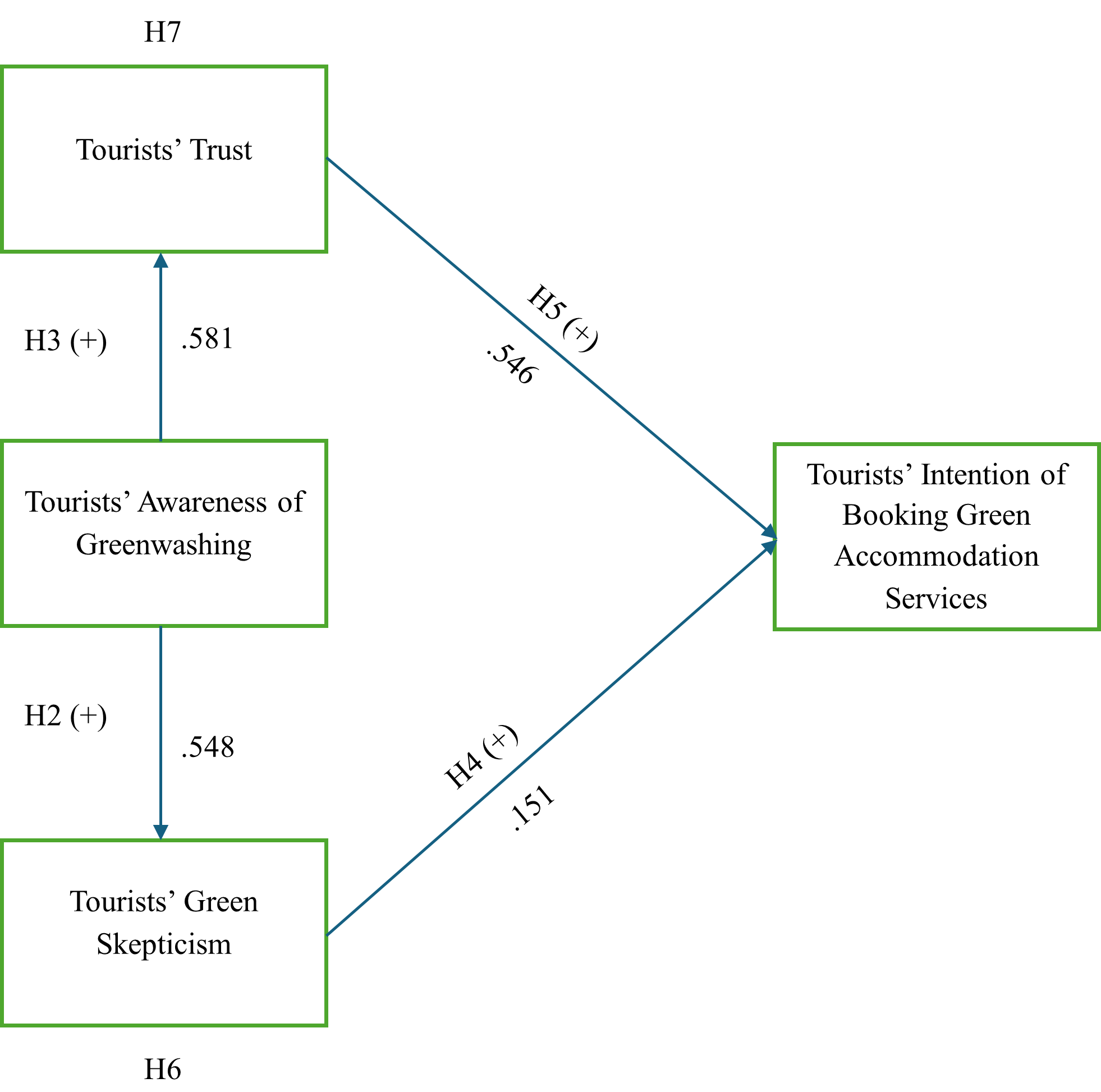
In this study, the SEM model tests theory-based relationships between hypothesized latent constructs. The latent variables that are measured through the corresponding observed variables. The SEM model below illustrates the structure of the relationships between variables in the study, including paths indicating the direction and level of influence between factors (See Figure ).
Through this model, we conduct a test of the model’s suitability to actual data, and at the same time evaluate the research hypotheses related to the impact of the variables. Applying SEM helps to analyze the whole, while controlling measurement error and evaluating the complex relationships between variables in the model more accurately and objectively.
4.3.4 Structural Model Fit
The structural equation model demonstrates an overall good fit to the data, with fit indices indicating acceptable to strong model adequacy. The chi-square to degrees of freedom ratio (χ2/df) is 2.702, falling within the commonly accepted range, while the Goodness of Fit Index (GFI) is 0.869, slightly below the ideal threshold but still indicating moderate fit. Both the Tucker-Lewis Index (TLI) at 0.904 and the Comparative Fit Index (CFI) at 0.917 exceed the 0.90 benchmark, reflecting good model performance. The Root Mean Square Error of Approximation is 0.075, which is below the 0.08 cutoff, suggesting an acceptable level of approximation error. Additionally, the Standardized Root Mean Square Residual (SRMR) is 0.077, indicating a good fit as it falls below the commonly accepted threshold of 0.08, further supporting the model’s adequacy. The measurement model exhibits strong factor loadings, with values mostly above 0.70, indicating that the observed variables reliably measure their respective latent constructs. Structurally, awareness has a positive influence on both trust (0.55) and green skepticism (0.58), which in turn affect booking intention, with trust having a stronger effect (0.41) compared to green skepticism (0.1). These results provide empirical support for the hypothesized relationships within the model.
4.3.5 Structural Model Results
The direct effect of Tourists’ Awareness of Greenwashing on Intention to Book Green Accommodation Services (IB) was not statistically significant (β = 0.157, t = 1.996, p = 0.067) (See Table ). Accordingly, H1 is not supported.
| Hypothesis | Path | β | t-value | p-value | Result |
| H1 | AW → IB | 0.157 | 1.996 | 0.067 | Not Supported |
The results of the indirect and mediating paths are summarized in Table and illustrated in Figure . Tourists’ Awareness of Greenwashing had a significant positive effect on both mediators: Trust (β = 0.581, p ≤ .001) and Green Skepticism (β = 0.548, p ≤ .001).
Regarding the first mediation pathway, Green Skepticism was expected to negatively influence booking intention (H4), but the results instead showed a small positive and significant effect (β = 0.151, p ≤ .05), leading to the rejection of H4. This suggests that rather than discouraging booking, higher skepticism may motivate tourists to scrutinize green claims more carefully, thereby producing a slight positive association with booking decisions.
In contrast, the second pathway demonstrated that Trust exerted a strong positive effect on Intention (β = 0.546, p ≤ .001), supporting H5 and confirming the central role of trust in shaping tourists’ behavioral responses. As noted earlier, the direct path from Awareness of Greenwashing to Booking Intention (H1) was not statistically significant. When considered jointly, the total indirect effect of Awareness of Greenwashing on Intention was positive and statistically significant (β = 0.400, p ≤ .001). Following zhao2010reconsidering, this pattern corresponds to indirect-only mediation (full mediation), as the direct path was non-significant while both indirect paths were significant. The positive overall coefficient indicates that, although Green Skepticism behaved differently than expected, the mediating influence of Trust was dominant, resulting in a net positive effect on tourists’ booking intention.
| Hypothesis | Path | β | p-value | Interpretation | Result |
| H2 | AW → GS | 0.548 | ≤ .001 | Significant (positive) | Supported |
| H3 | AW → TR | 0.581 | ≤ .001 | Significant (positive, contrary to expectation) | Not Supported |
| H4 | GS → IB | 0.151 | 0.020 | Significant (positive, contrary to expectation) | Not Supported |
| H5 | TR → IB | 0.546 | ≤ .001 | Significant (positive) | Supported |
| H6 | AW → GS → IB | — | ≤ .001 | Significant mediation | Supported |
| H7 | AW → TR → IB | — | ≤ .001 | Significant mediation | Supported |
| — | AW → IB (Indirect Total) | 0.400 | ≤ .001 | Significant mediation | Confirmed Full Mediation |
Discusion
The empirical divergence observed in hypotheses 1, 3, and 4 -where greenwashing awareness and green skepticism were expected to negatively influence trust and behavioral intention but instead produced different patterns -suggests the need for careful theoretical reconsideration.
Established frameworks such as attribution theory (Kelley, 1973) and the affect-as-information perspective (Schwarz and Clore, 2007) posit that heightened awareness of deceptive practices typically reduces trust and discourages engagement. The present results, however, indicate the possibility of more nuanced dynamics that may be context-specific to Vietnam and should be interpreted with caution.
Prior studies generally suggest that greenwashing awareness discourages eco-friendly booking due to perceived deception and the fear of being misled, often described as "perceived greenwash fear," which negatively affects tourists’ attitudes and behavior (Srisathan and Naruetharadhol, 2025; Kavitha and Kumar, 2023; Alyahia et al., 2024). Yet, in this study, awareness did not exert a direct negative effect. Instead, it appears to operate indirectly through mediators such as trust and skepticism. This divergence may reflect Vietnam’s distinctive cultural and socio-economic context. With a deep-rooted agricultural heritage, strong cultural respect for nature (Khanh, 2022; Trang, 2025), and increasing environmental awareness in urban areas, especially among younger and more educated individuals, awareness of greenwashing may be framed as a challenge to overcome rather than a deterrent. In addition, government policies promoting sustainable tourism and eco-friendly growth (Khanh, 2024) have raised expectations of authenticity, empowering tourists to seek verifiable green practices rather than avoiding eco-accommodations altogether. These interpretations remain tentative but suggest that, in Vietnam, awareness may function as a stimulus for more critical evaluation rather than as a direct inhibitor of booking intentions. H3 predicted a negative association between awareness of greenwashing and trust, yet the results revealed a significant positive effect (β = 0.581, p ≤ .001). Contrary to theoretical predictions, greater awareness appeared to strengthen trust when tourists were able to distinguish authentic sustainability efforts from superficial claims. In Vietnam, transparency and authenticity are increasingly valued, and consumers critically evaluate environmental claims, rewarding hotels that demonstrate credible actions (Nguyen and Bui, 2021). Empirical evidence also suggests that once aware of greenwashing, tourists demand stronger proof of sustainability, such as certifications or detailed environmental reports (Mai et al., 2020). Social networks further amplify this process, as communal knowledge-sharing helps tourists identify trustworthy providers (Quang et al., 2023). One tentative explanation for this counterintuitive finding is that awareness may operate as a form of green literacy. Beyond simply recognizing deceptive practices, green literacy encompasses the ability to critically process sustainability information and act accordingly. From this perspective, awareness does not necessarily erode trust but can empower tourists to distinguish genuine practices, thereby reinforcing confidence in accommodations that withstand scrutiny. This interpretation is exploratory. Yet it highlights the value of examining awareness as part of a broader skillset rather than solely as a perception of deception. Future research should explicitly test the role of green literacy as a mediating or moderating mechanism in consumer responses to greenwashing. H4 proposed a negative relationship between skepticism and booking intention. However, the results showed a small but significant positive effect (β = 0.151, p = 0.020). Traditional perspectives argue that skepticism reduces willingness to book by heightening concerns over misleading claims (Yoon and Chen, 2017; Chung-Ming et al., 2024). Yet, in this study, skepticism appeared to function differently: rather than deterring behavior, the positive association suggests that it may encourage tourists to actively verify and seek accommodations that could credibly demonstrate sustainable practices. As a result, skepticism appears to encourage more informed decision-making and selective booking of authentic green accommodations. Although promising, this interpretation remains tentative and requires further validation across contexts.
Taken together, the results suggest that awareness of greenwashing in Vietnam may not exert the expected negative effects on trust and booking intentions. Instead, through the dual mediating pathways of trust and skepticism, awareness may indirectly shape behavior in a positive manner, with trust emerging as the stronger mediator. Following zhao2010reconsidering, this reflects an indirect-only (full) mediation pattern. The positive overall indirect effect (β = 0.400, p ≤ .001) appears driven primarily by trust, though skepticism also contributed positively.
These findings should be interpreted with caution. The study is limited by its single-country, cross-sectional design, and reliance on self-reported measures. The counterintuitive directions observed may reflect unique cultural, social, and policy dynamics in Vietnam, and generalizability remains uncertain. In addition, the possibility of demand effects cannot be ruled out. Hence, future research should incorporate behavioral outcome measures (e.g., incentivized booking choices or revealed-preference data) to provide additional evidence regarding the validity of indirect effects identified here. Future research should replicate these analyses in other cultural and market settings, apply longitudinal and experimental designs, and refine the measurement of greenwashing awareness -potentially conceptualizing it more explicitly as green literacy -to better understand its role in shaping consumer trust and behavior.
Conclustion
This study contributes to the growing body of research on sustainable tourism by examining how tourists’ awareness of greenwashing, trust, and skepticism interact to shape booking intentions for green accommodations. Contrary to theoretical expectations, awareness of greenwashing did not directly discourage booking but instead exerted indirect effects through trust and skepticism. While trust emerged as the dominant positive mediator, skepticism also demonstrated a small but unexpected positive influence. These results suggest that awareness may function not only as recognition of deception but also as a cognitive resource that enables more critical evaluation of sustainability claims.
At the same time, these conclusions must be interpreted with caution. The study’s crosssectional design, reliance on self-reported measures, and single-country context limit the generalizability of the findings. Given their counterintuitive nature, the results should be viewed as tentative evidence that raises important questions for further investigation rather than as definitive confirmation of new theoretical relationships. Future research should replicate these findings across diverse cultural and market settings, adopt longitudinal and experimental designs, and consider alternative conceptualizations of awareness-such as green literacy-to clarify when and how these effects emerge. By doing so, subsequent studies can more fully explore the complex dynamics between greenwashing awareness, consumer psychology, and sustainable tourism behavior.
Funding Statement
This study was funded by project “The impact of tourists’ awareness of greenwashing on their trust and intention of booking accommodation services” code MHN2025 – 01.52 from Hanoi Open University, Hanoi, Vietnam.
Conflict of Interest
The authors declare that there is no conflict of interest regarding the publication of this paper.
References
- The theory of planned behavior. Organizational Behavior and Human Decision Processes 50 (2), pp. 90020–90020. 10.1016/0749-5978(91)90020-t[CrossRef], [Google Scholar] .
- Greenwashing behavior in hotels industry: the role of green transparency and green authenticity. Sustainability 16 (3), pp. 1050. 10.3390/su16031050[CrossRef], [Google Scholar] .
- Feelings that make a difference: how guilt and pride convince consumers of the effectiveness of sustainable consumption choices. Journal of Business Ethics 124 (1), pp. 117–134. 10.1007/s10551-013-1841-9[CrossRef], [Google Scholar] .
- “Do as i say, not as i do” - a systematic literature review on the attitude-behaviour gap towards sustainable consumption of generation y. IOP Conference Series: Materials Science and Engineering 459 (1). 10.1088/1757-899x/459/1/012089[CrossRef], [Google Scholar] .
- The elaboration likelihood model of persuasion. Advances in Experimental Social Psychology 19, pp. 123–205. 10.1016/S0065-2601(08)60214-2[CrossRef], [Google Scholar] .
- Greenwash and green trust: the mediation effects of green consumer confusion and green perceived risk. Journal of Business Ethics 114 (3), pp. 489–500. 10.1007/s10551-012-1360-0[CrossRef], [Google Scholar] .
- Greenwashing: deceptive marketing practices, trends and facts. E3S Web of Conferences 537. 10.1051/e3sconf/202453702007[CrossRef], [Google Scholar] .
- Exploring the online hotel reviews on travelers’ green psychological cognition. Journal of Tourism and Services 15 (28), pp. 116–142. 10.29036/jots.v15i28.607[CrossRef], [Google Scholar] .
- Understanding the intention-behavior gap: the role of intention strength. Frontiers in Psychology 13. 10.3389/fpsyg.2022.923464[CrossRef], [Google Scholar] .
- The effect of perceived greenwashing on achieving green marketing goals (case study: isfahan province eco-lodges). Journal of Environmental Studies 49 (3), pp. 279–296. 10.22059/JES.2023.352468.1008374[CrossRef], [Google Scholar] .
- Towards closing the attitude-intention-behavior gap in green consumption: a narrative review of the literature and an overview of future research directions. Journal of Cleaner Production 275, pp. 122556–122556. 10.1016/j.jclepro.2020.122556[CrossRef], [Google Scholar] .
- The development and testing of a measure of skepticism toward environmental claims in marketers’ communications. Journal of Consumer Affairs 32 (1), pp. 30–55. 10.1111/j.1745-6606.1998.tb00399.x[CrossRef], [Google Scholar] .
- How does greenwashing influence managers’ decision-making? an experimental approach under stakeholder view. Corporate Social Responsibility and Environmental Management 28 (2), pp. 860–880. 10.1002/csr.2095[CrossRef], [Google Scholar] .
- Linking green skepticism to green purchase behavior. Journal of Cleaner Production 131, pp. 629–638. 10.1016/j.jclepro.2016.04.122[CrossRef], [Google Scholar] .
- How green trust, consumer brand engagement and green word-of-mouth mediate purchasing intentions. Sustainability 13 (14), pp. 13–14. 10.3390/su13147877[CrossRef], [Google Scholar] .
- The effects of customer satisfaction, relationship commitment dimensions, and triggers on customer retention. Journal of Marketing 69 (4), pp. 210–218. 10.1509/jmkg.2005.69.4.210[CrossRef], [Google Scholar] .
- When to use and how to report the results of pls-sem. European Business Review 31 (1), pp. 2–24. 10.1108/EBR-11-2018-0203[CrossRef], [Google Scholar] .
- Impact of the quality of green practices, green brand image, and green satisfaction on green trust, and behavioral intention. International Journal of Contemporary Hospitality Management 31 (3), pp. 1012–1031. 10.1108/IJCHM-05-2018-0360[CrossRef], [Google Scholar] .
- The nexus between green perceived quality, green satisfaction, green trust, and customers’ green behavioral intentions in eco-friendly hotels: a structural equation modeling approach. International Journal of Environmental Research and Public Health 19 (23), pp. 19–19. 10.3390/ijerph192316195[CrossRef], [Google Scholar] .
- The influence of greenwashing on sustainable behaviour: the mediators of green perceived risk and green scepticism. Journal of Environmental Biology 44 (5), pp. 719–727. 10.22438/jeb/44/5/MRN-5112[CrossRef], [Google Scholar] .
- The processes of causal attribution.. American Psychologist 28 (2), pp. 107–128. 10.1037/h0034225[CrossRef], [Google Scholar] .
- Policy for modern agricultural development by ho chi minh thought. Res Militaris 12 (2), pp. 1304–1313. .
- Sustainable tourism development in vietnam: current challenges, government initiatives and pathways for long-term sustainability. International Journal of Humanities, Social Sciences and Education. 10.20431/2349-0381.1111008[CrossRef], [Google Scholar] .
- Consumer responses to greenwashing in the hospitality industry: the role of trust and perception. Sustainability 16 (3), pp. 1050. 10.3390/su16031050[CrossRef], [Google Scholar] .
- Principles and practice of structural equation modeling. 4th edition, Guilford Press, New York, NY. .
- The mechanism of awareness of life meanings in light of the cultural-activity approach. Note: ResearchGate .
- Factors influencing on tourism sustainable development in vietnam. Management Science Letters 10, pp. 1737–1742. 10.5267/j.msl.2020.1.006[CrossRef], [Google Scholar] .
- A reflection of greenwashing practices in the hospitality industry: a scoping review. International Journal of Contemporary Hospitality Management 35 (3), pp. 1125–1146. 10.1108/IJCHM-04-2022-0495[CrossRef], [Google Scholar] .
- International tourists’ awareness and attitude about environmental responsibility and sustainable practices. GLOBAL BUSINESS FINANCE REVIEW 21 (2), pp. 132–146. 10.17549/gbfr.2016.21.2.132[CrossRef], [Google Scholar] .
- The commitment-trust theory of relationship marketing. Journal of Marketing 58 (3), pp. 20–38. 10.1177/002224299405800302[CrossRef], [Google Scholar] .
- Conceptualization of greenwashing in the hospitality industry. International Journal of Hospitality Management 131, pp. 131–131. 10.1016/j.ijhm.2025.104255[CrossRef], [Google Scholar] .
- Green marketing strategy as a sustainable solution to tourism development in vietnam. Webology 18 (Special Issue 04). 10.14704/web/v18si04/web18118[CrossRef], [Google Scholar] .
- Perceived greenwashing: the effects of green marketing on environmental and product perceptions. Journal of Business Ethics 125 (4), pp. 693–707. 10.1007/s10551-013-1944-3[CrossRef], [Google Scholar] .
- Communication and persuasion: central and peripheral routes to attitude change. Springer-Verlag. .
- The consequences of dishonesty—a mediation—moderation praxis of greenwashing, tourists’ green trust, and word—of—mouth: the role of connectedness to nature. Business Ethics, the Environment & Responsibility 34 (3). 10.1111/beer.12670[CrossRef], [Google Scholar] .
- Common method biases in behavioral research: a critical review of the literature and recommended remedies.. Journal of Applied Psychology 88 (5), pp. 879–903. 10.1037/0021-9010.88.5.879[CrossRef], [Google Scholar] .
- Toward sustainable community-based tourism development: perspectives from local people in Nhon Ly coastal community, binh dinh province, vietnam. PLOS ONE 18 (10). 10.1371/journal.pone.0287522[CrossRef], [Google Scholar] .
- Consequences of “greenwashing”. International Journal of Contemporary Hospitality Management 27 (6), pp. 1054–1081. 10.1108/ijchm-04-2014-0202[CrossRef], [Google Scholar] .
- Ecotourism or greenwashing? a study on the link between green practices and behavioral intention of eco-tourists. Journal of Ecotourism 21 (3), pp. 247–267. 10.1080/14724049.2021.1954904[CrossRef], [Google Scholar] .
- Feelings and phenomenal experiences. In Social psychology: Handbook of basic principles, E. T. Higgins and A. W. Kruglanski (Eds.), pp. 385–407. .
- Greenwashing – the dark side of eco-friendly marketing. a case study from slovakia. Studia Ecologiae et Bioethicae 22 (1), pp. 83–95. 10.21697/seb.5800[CrossRef], [Google Scholar] .
- Exploring moral hazard and adverse selection in the context of greenwashing and organic product consumption. Journal of Retailing and Consumer Services 84. 10.1016/j.jretconser.2024.104203[CrossRef], [Google Scholar] .
- Linking green skepticism to green purchase behavior on personal care products in indonesia. IOP Conference Series: Earth and Environmental Science 716 (1). 10.1088/1755-1315/716/1/012045[CrossRef], [Google Scholar] .
- Impact of environmental awareness and knowledge on purchase intention of an eco-friendly hotel: mediating role of habits and attitudes. Journal of Hospitality and Tourism Insights 7 (5), pp. 3148–3166. 10.1108/jhti-08-2023-0580[CrossRef], [Google Scholar] .
- An experimental test of a greenwashing inoculation intervention in ireland: effects of ‘pre-bunking’ on identification, consumer trust and purchase intentions. Sustainable Production and Consumption 47, pp. 318–328. 10.1016/j.spc.2024.03.030[CrossRef], [Google Scholar] .
- Vietnam’s agricultural policy across various phases (post–1976). Research on World Agricultural Economy 6 (2), pp. 140–156. 10.36956/rwae.v6i2.1610[CrossRef], [Google Scholar] .
- Demystifying the green purchasing behavior of young consumers: moderating role of green skepticism. Journal of Global Scholars of Marketing Science 33 (2), pp. 264–284. 10.1080/21639159.2022.2163415[CrossRef], [Google Scholar] .
- Does attitude or intention affect behavior in sustainable tourism? a review and research agenda. Sustainability 15 (19). 10.3390/su151914076[CrossRef], [Google Scholar] .
- A green shadow: the influence of hotel customers’ environmental knowledge and concern on green marketing skepticism and behavioral intentions. Tourism Analysis 22 (3), pp. 281–293. 10.3727/108354217x14955605216032[CrossRef], [Google Scholar] .
About contributors

Huong Giang Vu
Faculty of Tourism, Hanoi Open University, Hanoi, Vietnam
Vietnam