





Abstract
The successful implementation of sustainable business strategies necessitates a well-aligned communication concept for conveying product sustainability to consumers. However, communicating product sustainability is challenging due to the high-noise environment filled with complex information. Although companies typically use signal portfolios (i.e., sets of multiple signals) to communicate product sustainability, prior research has mainly examined the effects of individual signals on consumers. Signal portfolios can vary in how holistically they cover different sustainability-related product attributes. While research indicates that the greatest improvements in a company's actual sustainability performance can be achieved through holistic sustainability strategies, it remains unclear whether consumers recognize and value signal portfolios that reflect such approaches. Across three studies, we find that consumers perceive holistic signal portfolios as more sustainable than selective portfolios. This has positive downstream effects on purchase-related variables. Our research advances the understanding of holistic sustainability signal portfolios as a crucial component of sustainable marketing and business strategies.
Introduction
In response to the rising consumer interest in sustainability, companies increasingly try to convey positive social and/or environmental attributes of their products as part of their sustainable business strategies (Rathee and Milfeld, 2023; Steenis et al., 2022). The range of such product attributes is broad and extends, for example, from reducing the use of hazardous chemicals in the extraction of raw materials, respecting human rights and avoiding child labor on production sites to ensuring a circular economy at the end of a product’s life-cycle (Marcon et al., 2022).
Companies typically send a multitude of sustainability signals about their products toward consumers to highlight their sustainability. These signals typically differ in their scope and content. They can include, for example, information on a varying number of lifecycle phases or sustainability domains. For instance, one product may be made with environmentally responsibly sourced raw materials, another may be produced under fair working conditions, and yet another may reflect environmental and social practices across the entire life cycle. As a result, the degree of sustainability of these products can vary considerably. While some are selectively sustainable, others are holistically (i.e., comprehensively) sustainable.
The literature on corporate sustainability management defines holistic sustainability as the comprehensive implementation of social and environmental sustainability along the entire value chain and states that this form of sustainability generates the greatest positive sustainability impact (Kapitan et al., 2019; Nikolaou and Tsalis, 2018; Nilsson–Lindén et al., 2019). Extensive research has been conducted on the impact of individual sustainability claims (Haws et al., 2013; Magnier and Schoormans, 2015; Marcon et al., 2022; Rathee and Milfeld, 2023), demonstrating that even single, selective sustainability cues have positive effects on consumers’ sustainability perceptions. However, it is unclear whether holistically sustainable products – covering sustainability throughout several sustainability domains and/or lifecycle phases – are not only technically more sustainable than selectively sustainable products but also more effective at reaching and convincing consumers (Steigenberger and Wilhelm, 2018). Thus, the current work is guided by the following research question: How does signaling holistic sustainability information affect consumers’ sustainability perceptions and consequently, a product’s market success, reflected by purchase-related consumer responses, such as purchase intention or willingness-to-pay?
To answer this question, we rely on signaling theory and follow a multi-stage, integrative research approach: We first conducted a factorial survey experiment to investigate the influence of a varying number of sustainability signals on consumers’ sustainability perception. To verify and validate the results of the factorial survey experiment with more realistic stimuli in a different cultural context, and to test the role of sustainability perceptions in driving purchase-related variables, we then conducted two between-subjects experiments.
Our research makes several contributions to the literature on sustainability communication and signaling theory: From a theoretical perspective, we conceptualize holistic sustainability signals and signal portfolios as encompassing multiple sustainability domains and life-cycle phases. This extends beyond the typical focus on isolated claims, offering a more comprehensive understanding of sustainability communication (Waites et al., 2024). We connect to under-researched facets of signaling theory (i.e., signal portfolios and consumers’ perceptions thereof), thereby generating insights into the receiver’s perspective on sustainability signals and the joint effect of multiple signals to communicate holistic sustainability. From an empirical perspective, we identify holistic sustainability signaling as an effective communication approach. We quantify effects on variables such as purchase intention, willingness to pay, and word-of-mouth, offering insights into the magnitude of these impacts.
From a practical perspective, our research provides guidance in strategic sustainability-related decision-making by revealing that signaling approaches that reflect holistic sustainability can be rewarding. In addition, it shows that educational measures about holistic sustainability holds potential to further enhance sustainable consumption choices.
Holistic Sustainability Communication through the Lens of Signaling Theory
Consumers today are exposed to different and oftentimes complex informational signals about a product’s sustainability. While many other product attributes are directly observable and can be evaluated without additional information, sustainability information usually represents a credence attribute that cannot be verified solely by personal experience or use (Atkinson and Rosenthal, 2014). For example, in contrast to the observable attributes color, fit, or style of jeans, the sustainability attribute carbon footprint cannot be verified by consumers themselves, as it is not tangible or observable. Instead, to evaluate credence attributes, consumer typically need to rely on information provided by the company itself (or third parties). With regard to the jeans example, consumers might be confronted with claims of the producing company stating the carbon-footprint of the product. They then have to trust and process these claims in order to assess the jeans' sustainability(Atkinson and Rosenthal, 2014). Compared to the jeans-producing company, they are therefore in an information deficit and have to rely on the information provided (Atkinson and Rosenthal, 2014; Connelly et al., 2010b; Majer et al., 2022).
This scenario is an example of an information deficit as outlined by signaling theory (Spence, 1973). According to signaling theory, an information deficit of the signal receiver regarding unobservable product attributes leads to a situation in which consumers need to assess goods and services based on imperfect (e.g., incomplete or even misleading) information sent by companies (Connelly et al., 2010a). Hence, especially with regard to the sustainability of products, many markets can be characterized by asymmetric information, as actors outside the company are in an information deficit due to the non-observability of sustainable product attributes (Atkinson and Rosenthal, 2014; Connelly et al., 2010b). Consumers as signal receivers must therefore rely on the signals sent by companies as senders (Connelly et al., 2010a, b).
Such signals can be defined as “a marketer-controlled, easy-to-acquire informational cue … that consumers use to form inferences about the quality or value of that product” ([)p. 59]Bloom & Reve (1990). Accordingly, a sustainability signal represents information about sustainability-related attributes of the product sent by the company, which consumers can use to form their product sustainability perception. This includes direct components of the product but also process-related and supplementary aspects, which are not necessarily visible in the final product.
Companies often implement a multiple signal approach to communicate the multifaceted topic of sustainability (Connelly et al., 2010b). For example, producers of sustainable jeans, such as nudie jeans or Armed Angels, communicate various sustainable aspects of their product (e.g., origin of materials, energy and water consumption during production, working conditions in different parts of the manufacturing process, recyclability of materials) jointly on labels or in their web stores. As a result, consumers are increasingly exposed to signal portfolios (i.e., sets of various, simultaneously communicated sustainability signals; (Zerbini, 2015).
These signal portfolios can vary in the number of different sustainability attributes they cover. For example, a signal portfolio for sustainable jeans can consist of several different signals on the same sustainable product attribute (e.g., multiple signals on energy consumption during production). In contrast, a signal portfolio can also include several different signals on different sustainability attributes of the jeans (e.g., energy consumption, organic cultivation of cotton for the jeans, ethical working conditions, etc.). The signal portfolios therefore vary in terms of the degree to which they reflect a holistic approach to sustainability.
In conclusion, holistic sustainability approaches encompass a comprehensive and integrative strategy regarding two aspects frequently discussed in the sustainability management literature: sustainability domain and lifecycle thinking. Companies implementing a holistic sustainability approach consider all three domains of the Triple Bottom Line (environmental, social, and economic sustainability; Nikolaou & Tsalis (2018)) throughout a product’s entire life-cycle (Marcon et al., 2022). In line with this, we define a holistic sustainability signal portfolio based on the two dimensions of sustainability domains and life-cycle phases. Building on the work of Vieira et al. (2023), we suggest that signal portfolios can either include information on a specific sustainability domain and life-cycle phase, which we refer to as selective signal portfolio, or to multiple sustainability domains and life-cycle phases, which we term holistic.
Sustainability measures related to different phases of the product life cycle generally concern product-inherent sustainability characteristics. Sustainability activities, however, can also include activities that are not aligned with the core products and processes (Reppmann et al., 2024). These non-aligned, external sustainability factors include cause-related marketing (a marketing strategy based on the support of social causes), which is often communicated to signal a company’s sustainability engagement in addition to product-inherent features (Barone et al., 2000). Cause-related marketing allows companies to complement sustainable product attributes and thus expand the degree of comprehensiveness in the sustainability approach. Thus, cause-related marketing may be considered an additional component of a holistic signal portfolio. Prior research shows that consumers tend to view external sustainability activities as weaker signals of a companies’ sustainability engagement with less impact on environment and society (Reppmann et al., 2024). Whether the integration of cause-related marketing signals in a holistic signal portfolio with regard to the inherent attributes regarding sustainability domains and life cycle phases offers additional value therefore remains an open question.
Signaling theory provides two perspectives explaining why holistic signal portfolios are expected to have a more positive impact on consumers’ sustainability perceptions than selective portfolios. The first perspective traditionally relies on costly signals as a key element (Connelly et al., 2010a, b). In this perspective, a signal transmits credence for receivers if it is costly to implement for the sender (Connelly et al., 2010a; Spence, 1973). Based on this assumption, a sustainability signal would therefore be considered by the receiver in their decisions if the efforts to send the signal are costly to implement. Holistic signal portfolios contain information on a set of coordinated environmental and social sustainability efforts along the entire product life-cycle. Such holistic sustainability engagements can be expected to be more costly to implement than a few isolated initiatives (Gao and Bansal, 2012). For example, a manufacturer of jeans made from organically grown cotton and recycled polyester, produced under fair conditions with low emissions and offering a recycling program to return them to a circular economy can be expected to invest more financial resources in their sustainability efforts than a manufacturer that focuses solely on using less water to produce the jeans. According to this perspective, costly holistic signal portfolios should have a more positive effect on consumers’ sustainability perceptions than selective signal portfolios.
Notably, most consumers are not sustainability experts and thus cannot estimate the true costs behind a specific sustainability portfolio. Consumers will thus usually not be able to distinguish the numerical cost difference between the two jeans manufacturers described above. However, we assume that they recognize that comprehensive measures incur greater expenses compared to singular initiatives. This may lead consumers to perceive a holistic signal portfolio as indicative of substantial financial commitment (Connelly et al., 2010b).
Second, we include the perspective of valuable signals which conceptually extends the idea of costly signals. Hahn et al. (2021) posit that valuable signals transmit information not only through their costliness. Instead, the information itself carries meaning for the receiver in the sense that valuable signals include the perceived appropriateness of a signal as non-economic element. Signal receivers derive the appropriateness of a signal mainly through psychological arguments. They weigh up the signals’ content to determine the value of a signal, which is why this process is shaped by the receiver’s perspective. If, for example, fair working conditions are very important to a consumer when buying jeans, a signal referring to this aspect has great significance for them and is perceived as appropriate for signaling the jeans’ sustainability. If a company, conversely, signals a sustainable aspect that is irrelevant to consumers, the signal likely contributes little to the consumers’ sustainability perceptions due to its insignificance for the receiver.
Consumers as signal receivers understand that sustainability encompasses a variety of relevant aspects (Luchs and Miller, 2015) and prior research shows that consumers exhibit a particularly positive response to products that are holistically sustainable, as opposed to products featuring only single sustainable attributes (Reppmann et al., 2024; Steenis et al., 2022). Therefore, from a consumer perspective, a holistic signal portfolio is likely to be more effective in conveying the complex nature of (product) sustainability. It provides a more compelling case by supporting diverse sustainability attributes indicating that the product offers a vast range of sustainability benefits and thus strengthening the impression of a genuinely sustainable product (Carter et al., 2021; Nikolaou and Tsalis, 2018; Reppmann et al., 2024).
Based on the concept of costly as well as valuable signals, we therefore hypothesize:
H1. Holistic sustainability signal portfolios influence consumers’ product sustainability perceptions more positively compared to selective sustainability signal portfolios.
Individual perceptions influence how consumers think and behave (Mothersbaugh et al., 2020). Research on sustainable consumer behavior demonstrates that initial (product) sustainability perceptions critically shape sustainability-related (purchase) decisions (Gershoff and Frels, 2015). These sustainability perceptions act as an important mediator between sustainability signaling and purchase-related consumer responses (McDonald and Oates, 2006; Steenis et al., 2022), which ultimately drive market success.
Many consumers nowadays feel positive about products and behaviors that foster sustainability (Park and Lin, 2020). Holding other product characteristics, such as quality, constant, product sustainability is thus regarded as an incremental benefit by most consumers (Sigurdsson et al., 2022). If consumers’ sustainability perceptions increase through effective sustainability signaling, this should, in turn, have a positive effect on variables more closely related to the purchase decision. For example, if a consumer generally values sustainability, higher sustainability perceptions can lead to increased purchase intentions (Steenis et al., 2022).
In this context, sustainability perception represents a managerially relevant construct, as it is not temporally stable but can be situationally influenced, for example, by providing information or by engaging in consumer education. As an influenceable precursor to intentions and behavior towards sustainable products, understanding perceptions therefore enables a better understanding of reactions to sustainable products in research and helps to promote positive behaviors toward them in practice (McDonald and Oates, 2006). We hypothesize:
H2. Increased sustainability perception will positively mediate the impact of holistic signal portfolios on (a) purchase intention, (b) product evaluation, (c) intention to engage in positive word-of-mouth, (d) relative willingness-to-pay, and (e) a behavioral proxy.
Finally, the effectiveness of a specific signal portfolio also partly depends on individual receiver characteristics (Connelly et al., 2010a). That is, their individual attitudes and values determine how information is processed (Sigurdsson et al., 2022). In the context of sustainable consumer behavior, biospheric (i.e., valuation of the environment) and altruistic (i.e., valuation of the well-being of others) value orientations are among the most relevant individual characteristics (Bouman et al., 2018). They represent stable guiding principles in the lives of people who (unconsciously) align their thoughts and decisions with them (Bouman et al., 2018). Although not the main focus of this paper, these values are integrated as control variables into our empirical approach as they have been found to influence consumers’ (sustainability) perceptions (Mothersbaugh et al., 2020).
In the following sections, we present three studies to examine our hypotheses. In Study 1, we conducted a factorial survey with the main goal of assessing whether holistic signal portfolios covering a larger number of lifecycle phases and sustainability domains positively influence consumers’ sustainability perceptions. This methodological approach involves representation of the complex reality of signal portfolios in hypothetical product descriptions, which enables us to analyze the relative influences of the individual signals in the portfolio. Studies 2a and 2b were experimental studies designed to test the positive effects of holistic signal portfolios again with more realistic stimuli (i.e., labels on a pair of jeans). In addition, these studies investigated the mediating effects of sustainability perception on purchase-relevant variables, such as purchase intention, willingness-to-pay or a behavioral proxy.
Study 1
Procedure
The aim of this study was to investigate the influence of a varying number of sustainability signals and the degree of holistic signaling on consumers’ product sustainability perceptions. Signal portfolios and the high-noise environment with many simultaneously occurring sustainability signals represent a complex reality that needs to be reflected in the research approach. To map this, we applied an experimental vignette study in the form of a factorial survey experiment.
Factorial survey experiments aim to approximate complex, multidimensional attitudes and perceptions (Hainmueller et al., 2015). Vignettes are the central component of such experiments and represent descriptions of a hypothetical object, person, or situation. The descriptions experimentally vary with regard to multiple dimensions with different levels (Auspurg and Hinz, 2015). By including a wide range of different dimensions, complex information environments or judgment situations can be captured (Oll et al., 2016).
Additionally, factorial survey experiments offer the opportunity to include respondent-specific characteristics to investigate their interactions with the vignette dimensions (Atzmüller and Steiner, 2010). Thus, by combining elements of experimental and survey research, factorial survey experiments are well-suited to deal with the interplay of different factors in a multidimensional topics of business research such as sustainability perceptions (Hahn et al., 2019; Oll et al., 2016).
In the present study, each vignette represented a signal portfolio that consisted of different sustainability signals relating to a pair of jeans. The number and composition of the individual signals determined the degree to which the signal portfolio was holistically sustainable. Holistic product sustainability was defined as encompassing as many distinct sustainability domains and product life-cycle phases as possible (Kapitan et al., 2019; Nikolaou and Tsalis, 2018). Therefore, we systematically varied the dimensions (a) environmental sustainability addressed (yes, no), (b) social sustainability addressed (yes, no), (c) number of life-cycle phases addressed (none, one, two, or three phases), and (d) cause-related marketing addressed (yes, no).
Whereas all three domains of the Triple Bottom Line are relevant to a holistic sustainability approach, economic sustainability is primarily considered as a managerial concern. Consumers are increasingly confronted with information on the environmental and social sustainability of products (Eisingerich et al., 2023), which we therefore included as sustainability domains in our research design. The more holistic vignette included information on both environmental and social sustainability, while the less holistic vignette only described one sustainability domain.
In terms of life-cycle phases, we adhered to prior research and identified three levels based on key phases that are relevant for consumers, and at the same time, can be actively shaped by companies: the sourcing of raw materials, production processes, and the end-of-life phase, including recycling or disposal (Luchs and Miller, 2015). Based on our definition of holistic sustainability, a signal portfolio is more holistic the more life-cycle phases are covered.
Last, we complemented our design with cause-related marketing as a strategy to achieve marketing objectives through the support of social causes (Barone et al., 2000). This enabled us to map a holistic approach that covers many aspects, even beyond product-inherent attributes. To operationalize cause-related marketing, we included signals for a frequently covered form: for each purchase of a company’s products or services, the company supports a designated social cause (Tucker et al., 2012).
All dimensions and levels combined yielded a 2 (environmental sustainability: yes, no) × 2 (social sustainability: yes, no) × 4 (number of life-cycle phases: none, one, two, three) × 2 (cause-related marketing: yes, no) design. The resulting vignette universe consisted of 2 × 2 × 4 × 2= 32 combinations which were each represented by one vignette. After eliminating illogical combinations from the vignette universe, a total of 21 vignettes remained. Illogical combinations occurred, for example, in cases where the number of life-cycle phases addressed was “none” and no cause-related marketing existed. In such a case, it would not have been possible to report on environmental or social sustainability issues. For example, a combination of “number of life-cycle phases addressed: none” with “environmental sustainability addressed: yes” was not possible and thus excluded from the vignette universe. Table displays two exemplary vignettes.
Table 1. Two Exemplary Vignettes (Study 1)
| Vignette example 1 (selective) | Vignette example 2 (holistic) | |||
| Environmental aspects | Social aspects | Environmental aspects | Social aspects | |
| Sourcing | The organic sourcing of cotton complies with the highest environmental standards. | No information available. | The organic cultivation of cotton complies with the highest environmental standards. | The small farmers receive a fair wage for growing the cotton. |
| Production | No information available. | No information available. | The production is with 100% renewable energy. | Production creates well-paid jobs in emerging and developing countries. |
| End-of-life | No information available. | No information available. | The materials are fully degradable at the end of their life and can be composted. | When returned via the retailer, the refurbishment of the used jeans creates jobs in social institutions. |
| Donation | For every purchase of these jeans a donation is made to an environmental project. | No information available. | For every purchase of these jeans a donation is made to an environmental project. | For every purchase of these jeans a donation is made to a social project. |
By definition, the non-holistic signal portfolios did not include signals on all life-cycle phases. Therefore, we tripled the design. Specifically, we multiplied vignettes that did not cover all life-cycle phases to vary which specific life-cycle phase was described. For example, if the portfolio included signals for only one life-cycle phase, this portfolio appeared three times in our vignette universe, corresponding to sourcing, production, or end-of-life. This way, we ensured that choosing a particular life-cycle phase did not have an uncontrolled influence. To compensate for any confounding effects of text length, we opted for a tabular format to present the sustainability information, including a statement that no information was available where the combination of dimensions and levels made it necessary.
We divided the 63 vignettes into nine sets (Aguinis and Bradley, 2014). Each participant was randomly assigned to rate seven vignettes, well below the recommended maximum of 20 (Auspurg and Hinz, 2015). Within a vignette set, the vignette order was randomized to prevent order effects. To avoid confounding effects due to the specific composition of the vignette sets, we chose a d–efficient blocking procedure in which algorithms try to find an optimal efficient solution between perfect balance and orthogonality (Atzmüller and Steiner, 2010; Auspurg and Hinz, 2015).When determining the necessary sample size, we opted for a conservative approach, with each vignette rated at least 15 times, yielding a minimum sample of 135 participants (Aguinis and Bradley, 2014).
To test H1, we recruited German consumers from a consumer panel provider. In a global comparison (N = 10,281), German consumers exhibited a moderate stance regarding the importance and role of sustainability for consumption (Simon-Kucher & Partners, 2021). Therefore, no influences stemming from specific German circumstances on sustainability are expected.
To maintain high data quality standards, we implemented two attention checks (in addition to the safeguards installed by the panel provider, e.g., Captcha solutions to avoid fake answers from bots, or compliance with ESOMAR standards). Within multi-item grids, we placed an item instructing the participants to select a specific scale option (e.g., “completely disagree”). Participants who failed to select this option were screened out and prevented from completing the survey.
The final sample of 251 consumers (Mage= 47.70, SD = 16.53; 50.6% female, education: 21.1% low (International Standard Classification of Education (ISCED) 0-2), 51.8% middle (ISCED 3-4), 27.1% high (ISCED 5-8) reflected the structure of the German population in terms of gender, age, and education. After providing informed consent and demographic data, participants saw the seven vignettes and rated each on the dependent variable product sustainability perceptions (single item: "How sustainable do you perceive this product?", (Gershoff and Frels, 2015). This variable was measured on an 11-point scale, which is recommended to allow for linear modeling (Oll et al., 2016). This procedure resulted in 1,757 vignette ratings. After the experiment, respondents answered questions related to their sustainable consumption behavior (i.e., biospheric and altruistic value orientations). Appendix A provides an overview of all measures.
Results
We used a multilevel regression approach, which is recommended when outcomes are not independent (i.e., multiple ratings by one participant; Heck (2013)). We followed recommendations for mixed models and applied grand mean centering for the dependent and metric control variables (Heck, 2013). We specified an unconstrained baseline model including the dependent variable and random intercepts for each participant. The baseline model had an intraclass correlation coefficient of 17.2%, justifying multilevel analysis (Heck, 2013). Following a stepwise approach, we extended the baseline model (see Table ): First, we estimated Model 1, including only the vignette dimensions depicting different sustainability signals (level 1). Second, we added respondent-specific characteristics (level 2), individual-level controls, and (cross-level) interactions, yielding Model 2.
Table 2. Results (Study 1)
| Model 1 | Model 2 | |||||
| Beta | SE | t | Beta | SE | t | |
| Vignette dimensions (L1) | ||||||
| Environmental sustainability domain (env) | ||||||
| No (ref.) | ||||||
| Yes | 2.23*** | .11 | 20.18 | 1.20*** | .20 | 5.93 |
| Social sustainability domain (soc) | ||||||
| No (ref.) | ||||||
| Yes | 1.20*** | .11 | 10.81 | .15 | .18 | .79 |
| Life-cycle phase (LCP) | ||||||
| No phase (ref.) | ||||||
| One phase | 1.74*** | .15 | 11.27 | 1.68*** | .22 | 7.80 |
| Two phases | 3.28*** | .15 | 21.34 | 3.12*** | .26 | 11.94 |
| Three phases | 4.50*** | .15 | 29.41 | 4.20*** | .32 | 13.12 |
| Cause-related marketing (CM) | ||||||
| No (ref.) | ||||||
| Yes | .70*** | .10 | 7.18 | .89*** | .25 | 3.62 |
| Respondent-specific characteristics (L2) | ||||||
| Biospheric values (bio) | -.14 | .12 | -1.14 | |||
| Altruistic values (altr) | -.03 | .14 | -.19 | |||
| (Cross-level) interactions | ||||||
| LCP × env ×sust | .62*** | .09 | 6.80 | |||
| LCP × CM | -.11 | .11 | -.99 | |||
| Env × bio | .26* | .10 | 2.58 | |||
| Soc × altr | .19* | .09 | 2.00 | |||
| Controls | ||||||
| Sex (Male, ref.) | .01 | .21 | .06 | |||
| Age | -.01 | .01 | -1.20 | |||
| -2LL | 6699.62 | 7445.95 | ||||
| Covariance Structure | VC | UN | ||||
| N (participants) | 251 | 251 | ||||
| N (vignette ratings) | 1,757 | 1,757 | ||||
The results showed significant main effects of all four dimensions on product sustainability perceptions (Model 1). If environmental sustainability signals were presented, this increased consumers’ sustainability perceptions by 2.23 scale points, whereas the presentation of social sustainability signals increased the dependent variable by 1.20 scale points (βenv = 2.23, p < .001; βsoc = 1.20, p < .001). Because all vignette dimensions were binary (0 = not present, 1 = present) and independently varied in an orthogonal design, their coefficients can be interpreted on the same metric and therefore directly compared. Thus, the results indicate that the effect of environmental sustainability information is almost twice as large as that of social sustainability information (Auspurg and Hinz, 2015). Furthermore, sustainability information referring to multiple phases (e.g., sustainable sourcing, production, and end-of-life versus only sustainable sourcing), had a positive influence on sustainability perceptions. The more signals on different life-cycle phases were available, the more positive this effect was (β1phase = 1.74, p < .001; β2phases = 3.28, p < .001; β3phases = 4.50, p < .001). Finally, the presence of information on cause-related marketing also showed a positive effect on perceived sustainability (βCRM = 0.70, p < .001).
Model 1, therefore, indicated a positive effect of holistic sustainability portfolios (in terms of positive main effects due to covering several life-cycle phases). However, an investigation of interactions provided deeper insights considering all life-cycle phases and both sustainability domains as relevant factors for a holistic sustainability approach.
In Model 2, we found a significant three-way interaction between life-cycle phases, environmental, and social sustainability signals (βLCP×env×soc = 0.62, p < .001). Thus, presenting a signal portfolio covering not only more life-cycle phases but also both sustainability domains had a positive effect on sustainability perceptions. However, the two-way interaction between life-cycle phases and cause-related marketing was not significant (βLCP×CM = -0.11, p > .05). This indicates that if a product is perceived as inherently sustainable, information about cause-related marketing does not further enhance sustainability perceptions. These results are in line with previous findings showing that non-aligned, external sustainability activities are perceived as contributing less to sustainability compared to product-inherent ones.
When including respondent characteristics and cross-level interactions in Model 2, the influence of social sustainability signals becomes insignificant (βsoc = 0.15, p > .05). However, we found a significant cross-level interaction between altruistic value orientations and the social sustainability domain (βsoc×alt = 0.19, p < .05). The same was present for biospheric value orientations and environmental sustainability signals (βenv×bio = 0.26, p < .05). This indicates that consumers react more positively to sustainability signals that closely correspond to their value orientations. Neither biospheric nor altruistic value orientation had a significant direct effect on perceived sustainability (βbio = -0.14, p > .05; βalt = -0.03, p > .05).
In sum, Study 1 altered the absolute number of signals within a signal portfolio and showed that providing more sustainability signals increases consumers’ sustainability perceptions. The findings align with hypothesis H1, which anticipates a favorable impact of holistic sustainability information on perceptions of sustainability.
This positive impact of holistic portfolios may be due to the fact that an increased number of signals allows consumers to form a holistic impression of sustainability across the entire product life-cycle (Steigenberger and Wilhelm, 2018; Zerbini, 2015). Similarly, adding both environmentally and socially sustainable information had a significant positive effect. Notably, the non-significant effect of adding cause-related marketing as an external activity to a holistic product-inherent signal portfolio covering several sustainability domains and life-cycle phases supports the idea that, compared to several product-inherent sustainability signals, the addition of merely a symbolic sustainability signal might be ineffective (Hahn et al., 2021; Reppmann et al., 2024; Waites et al., 2024). This indicates that not only does the number of sustainability signals increase sustainability perceptions, but that the inclusion of various product-inherent sustainability attributes drives the positive effect. Finally, signals that match consumers’ value orientations lead to higher sustainability perceptions.
Study 2a
Study 1 suggests that more holistic portfolios lead to higher sustainability perceptions compared to those that only cover sustainability to some degree; however, the study design leaves several questions unanswered. It did not allow us to conclusively determine whether this effect was indeed due to the fact that consumers recognized that signal portfolios holistically covered several sustainability domains and life-cycle phases or whether they merely used the number of signals as a heuristic.
In Study 1, we opted to present the signal portfolios in a table to initially establish the hypothesized effect, using an easy-to-process information format and avoiding varying text lengths as confounders. This presentation format, however, may have pointed to the absence of some signals in non-holistic portfolios, which could potentially have led to a heuristic in the sense of “the more information available, the better.” Therefore, we complemented our empirical inquiry with an experimental between-subjects design in our Studies 2a and 2b to bundle the dimensions and levels of the experiment and manipulate the degree to which a signal portfolio is holistic as a single experimental factor.
In addition, factorial survey experiments are very well suited to depicting complex scenarios to measure perceptions and attitudes. However, sustainability attitudes often do not fully translate into purchasing behavior (attitude-behavior gap; Park & Lin (2020)). Since (sustainability) perceptions theoretically shape further intentions, purchasing and consumption behavior (Mothersbaugh et al., 2020), we also investigate in Study 2a whether the increased sustainability perceptions due to a holistic signal portfolio subsequently affect purchase-related variables (i.e., purchase intention, product evaluation, positive word-of-mouth [WOM] intention, relative willingness-to-pay [WTP], and a behavioral proxy).
Study design
The aim of Study 2a was to replicate the effects of holistic sustainability signaling on sustainability perceptions and investigate their impact on purchase-related variables. The study design followed a three-cell (sustainability approach: holistic vs. selective environmental vs. selective social) experimental between-subjects design. To rule out that the mere number of signals served as a heuristic, the number of signals was held constant across all experimental groups. The presented signal portfolio varied in the number of sustainability domains and life-cycle phases addressed (i.e., both environmental and social sustainability domains and all life-cycle phases addressed vs. only one sustainability domain and one life-cycle phase addressed). To create realistic stimuli and increase external validity, we opted for a product label attached to a pair of jeans.
Stimuli development and pre-testing
Based on the experimental design, three versions of product labels were designed. Across all three experimental conditions, participants saw information on the addressed sustainability domains and life-cycle phases. Additionally, they saw six bullet points including specific sustainability information (e.g., “made from 100% recyclable materials,” or “fair working conditions”). In the holistic context, the label presented an approach that addressed both sustainability domains and all life-cycle phases. It displayed a list of six bullet points, one environmental and one social for each of the three life-cycle phases. In non-holistic conditions, the labels indicated that one life-cycle phase (i.e., production) was either environmentally sustainable or socially responsible. The six bullet points referred to either environmental or social aspects of one specific life-cycle phase. As a result, product sustainability was described more selectively (only in relation to one sustainability domain and one life-cycle phase) while the number of bullet points remained the same. Figure 1 shows all stimuli.
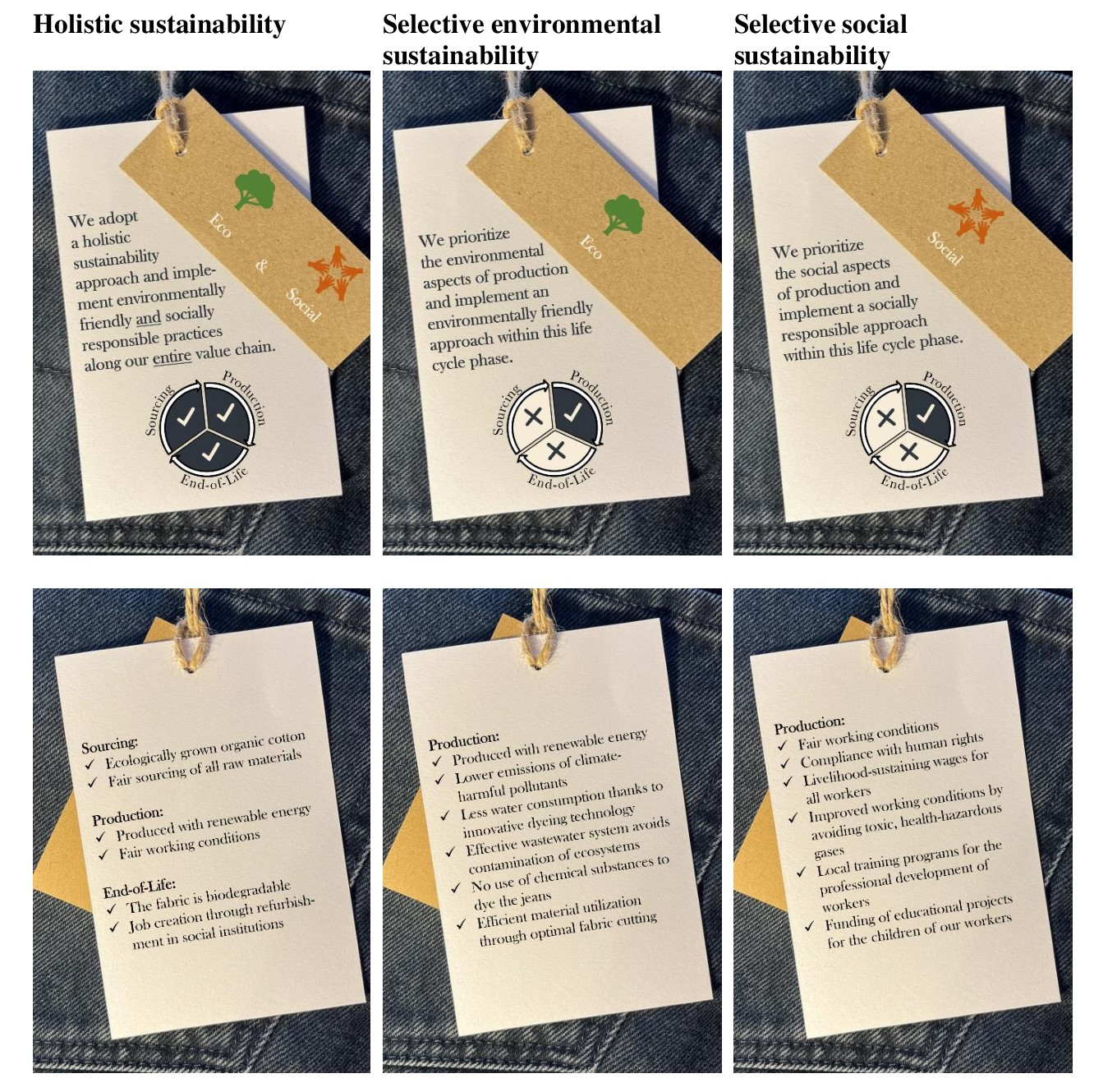
Note: Participants from Germany (Study 2a) were exposed to the translated version of the stimulus materials.
When designing the labels, the following challenge occurred. The general “look” of the label had to be kept constant. That is, the holistic version had to show that the sustainability efforts are encompassing and relate to the environmental as well as the social dimension while also covering several life-cycle phases. On the other hand, the selective versions had to clearly show that not all dimensions and life-cycle phases were (yet) addressed in the company’s sustainability efforts. Visually, the information on dimensions was supported by icons, and the life-cycle information was illustrated using a cycle that highlighted all the steps covered. This created a challenge for the perception of our stimuli. A company communicating transparently that their products are not (yet) holistically sustainable, however, might be perceived as unrealistic by consumers. At the same time, there is growing evidence that consumers actually value transparent communication in terms of progress toward more sustainable products (Jung et al., 2024). Consumers may appreciate when companies openly acknowledge their current limitations as a reference point while also sharing their ongoing progress toward more sustainable practices (Petersen et al., 2021).
To validate the designed stimuli and ensure their suitability with respect to the research goals, we conducted a pretest using the same survey population as in the main study. We recruited 302 consumers from Germany (Mage= 33.69, 37.1% female, 61.6% male, 1.3% non-binary) on Prolific. The participants were randomly assigned to one of the three stimuli versions (i.e., between-subjects design) and rated them on several validity criteria.
To test whether the challenges described limited the effectiveness of our stimuli, we measured whether consumers perceived the company as being “on the way” to greater sustainability when the jeans are advertised with the selective stimulus versions. This was intended to ensure that the information is perceived not as indicating a shortcoming, but as signaling progress toward more sustainability. Specifically, participants responded to five items that we developed for this study (i.e., (1) The company has taken initial steps to become more sustainable, (2) The company is not yet a leader in sustainability, but is working on it , (3) The company has already achieved some, but not all of its sustainability goals, (4) The company is making efforts to become more sustainable, even if it has not yet reached its objective, (5) I get the impression that this company is in a development process toward greater sustainability;α = .75). We also used one item developed for this study to assess whether participants value these incipient efforts (i.e., “I appreciate it if a company communicates that it currently meets some sustainability goals, even if not all of them have been achieved”). All items were rated on seven-point scales, with higher values indicating stronger agreement.
The results revealed relatively high mean values across all three groups (Mholistic = 5.01, Menv = 5.64, Msoc = 5.45), each significantly above the scale midpoint of four (all ps <.001). Hence, in all conditions, participants perceived the state of being on the way toward more sustainability to a high extent. One-way ANOVA results indicate significant differences [F = 11.276 p < .001]. Post-hoc tests identified two homogenous groups: While the company is perceived less as being on the way in the holistic condition compared to the other conditions (environmental: p = <.001; social: p = .005), there are no significant differences between the selective sustainability groups (p = .327). Additionally, the results reveal that consumers indeed value the aspect of being on the way towards sustainability, which is reflected by relatively high mean values (Mholistic = 5.97, Menv = 6.08, Msoc = 5.82, F = 1.411, p = .245). As there are no significant differences between the groups, consumers who see the selective labels do not seem to focus on the fact that the company is not yet comprehensively sustainable. This suggests that the labels containing selective sustainability information do not inherently undermine the sustainability perception of a product by focusing on the incompleteness of sustainability activities.
Furthermore, we tested whether consumers perceived the labels as realistic using five items (i.e., (1) The depicted label looks realistic and could also be found in a real store, (2) I think it is credible that a fashion brand would use a sustainability label designed in that way, (3) I can imagine a label like this on a real pair of jeans in everyday life, (4) The label looks authentic to me, (5) Labels like this fit in with the way companies present themselves in terms of sustainability these days; α = .92). The results do not show a statistically significant difference between the perceived realism between the holistic and the selective labels (Mholistic = 5.98, Menv = 5.73, Msoc = 5.39, F = 6.989, p < .001. However, post-hoc Games-Howell tests showed a significant difference between the holistic and the social selective condition (p < .001) and no significant difference between the holistic and the environmental selective condition (p >.18). However, all three mean values were well above the scale mean, indicating that consumers perceive the stimuli as realistic. Taken together, these results illustrate that the stimuli are well- suited for a study on the perceived sustainability of jeans, as the labels realistically reflect the holistic vs. selective sustainability communication and simultaneously prevent negative implications arising from the selective information.
We recruited 303 consumers from Germany (Mage= 30.64, 48.8% female) for an online survey on Prolific. The participants were randomly assigned to one of the three conditions (nholistic= 103, nenv = 99, nsoc = 101). We implemented the same attention checks as in Study 1. After providing informed consent and their demographic data, participants were asked to imagine that they were looking for a pair of jeans and had found one that fitted them. Next, participants saw the label with the sustainability information and responded to various attitude- and purchase-related items. The participants indicated their purchase intention, product evaluation, and intention to engage in positive WOM on seven-point scales. Additionally, they provided information on their relative WTP on a seven-point scale ranging from 70€ to 190€. We used the same scale as in Study 1 to measure product sustainability perceptions (Gershoff and Frels, 2015).
To additionally examine the impact of sustainability perceptions on a behavioral proxy, we asked participants whether they would like to receive more information about the presented jeans before finishing the survey (e.g., where the jeans can be purchased). Participants could opt in or out and were explicitly informed that this was a voluntary option. This choice of receiving and reading additional information (paid with the participants’ time) is a behavioral consequence and demonstrates a higher level of interest and willingness to engage with the product, which is a better proxy for purchases than the mere intent (Hulland and Houston, 2021). Afterwards, a six-item manipulation check (e.g., the brand that offers the presented jeans implements a comprehensive and holistic sustainability approach) recorded the extent to which participants perceived the sustainability of the jeans as holistic or selective (see Appendix A).
Results
The manipulation worked as intended. The signal portfolio was perceived as more holistically sustainable in the holistic condition than in both non-holistic conditions (Mholistic = 5.76, Menv = 3.13, Msoc = 3.13, F = 124.34, p < .001; Post-hoc Scheffé tests showed a significant difference between the holistic and both other conditions, with p < .001). Comparison of the mean values for product sustainability perceptions revealed significantly higher product sustainability perceptions for the holistic condition compared to both other conditions (Mholistic = 6.15, Menv = 5.39, Msoc = 5.08, F = 19.67, p < .001; post-hoc Scheffé tests with p < .001). The results are thus consistent with H1, predicting the positive effect of holistic sustainability information on sustainability perceptions.
In H2, we additionally hypothesized a positive indirect effect of holistic sustainability information on several purchase-related dependent variables via increased sustainability perceptions. Mediation models (PROCESS bootstrapping macro, model 4) revealed a significant indirect effect of sustainability perceptions on purchase intention (IE = .52, SE = .11, CI95%[.32, .75]), product evaluation (IE = .50, SE = .09, CI95%[.33, .70]), positive WOM intention (IE = .52, SE = .10, CI95%[.34, .73]), and relative WTP (IE = .12, SE = .04, CI95%[.05, .20]). The indirect effect on the behavioral proxy was not significant (IE = .13, SE = .10, CI95%[-.04, .36]). We additionally measured environmental knowledge (Mohr et al., 1998). The effects of all models remained stable when environmental knowledge was included as covariate.
Study 2b
Procedure
To further generalize our findings, we validated and replicated our approach with US consumers using 300 online panel members from Prolific (Mage = 38.30, 49.0% female). We employed identical stimulus material (double-back translated to English), study design, and procedure as in Study 2a (nholistic = 99, nenv = 99, nsoc = 102).
Results
The manipulation worked as intended (Mholistic = 5.61, Menv = 3.33, Msoc = 3.87, F = 59.71, p < .001; Post-hoc Scheffé tests showed a significant difference between the holistic and both other conditions with p < .001). We again compared the mean values for product sustainability perceptions. In line with H1, we identified higher product sustainability perceptions for the holistic condition compared to the others (Mholistic = 6.16, Menv = 5.67, Msoc = 5.30, F = 11.72, p < .001. Post-hoc Scheffé tests showed a significant difference between the holistic and both other conditions with p = .023 and p < .001. Sustainability perceptions in the selective environmental information versus social condition did not significantly differ (p>.12).
Regarding H2, mediation models (PROCESS bootstrapping macro, model 4) revealed indirect effects of sustainability perceptions on purchase intention (IE = .38, SE = .08, CI95%[.11, .54]), product evaluation (IE = .35, SE = .08, CI95%[.21, .51]), WOM intention (IE = .44, SE = .09, CI95%[.27, .62]), relative WTP (IE = .08, SE = .04, CI95%[.02, .17]), and the behavioral proxy (IE = .17, SE = .11, CI95%[.01, .43]). Although the effect of the behavioral proxy reached statistical significance, it was relatively weak and, therefore, should be interpreted with caution. Aside from that, the effects of all models remained stable when environmental knowledge was included as covariate.
General Discussion
Theoretical Implications
This paper offers several contributions that advance our understanding of effective sustainability communication as a major success factor for sustainable business strategies. First, signaling theory has so far mainly focused on isolated signals, which are uncommon in high-noise environments, such as the market for sustainable products (Connelly et al., 2010b). We extend this previous focus of signaling theory by investigating sustainability signal portfolios that better map the complex reality of sustainability communication (Connelly et al., 2010b; Zerbini, 2015). We conceptualized holistic sustainability signal portfolios and tested their effects on consumer perceptions of product sustainability. Our approach showed that consumers recognize a product as more sustainable when its sustainable attributes cover different sustainability domains and life-cycle phases.
Hence, our findings imply that using multiple sustainability signals in a bundle can enhance signal effectiveness (Connelly et al., 2010a). Given that the number of signals within a portfolio (and thus, the amount of information) was held constant in Study 2a and 2b, the results do not suggest that the heuristic “the more the better” universally applies. Rather, higher effectiveness appears to be achieved only when different signals complement each other to underpin a holistic sustainability strategy (Waites et al., 2024; Zerbini, 2015). Holistic signal portfolios therefore lead to a larger joint effect than selective portfolios and thus seem to be useful to distinguish genuinely sustainable products from partially sustainable products (Steenis et al., 2022; Steigenberger and Wilhelm, 2018).
Importantly, our findings also reveal that adding external, non-product-related sustainability activities, such as cause-related marketing, does not further enhance perceived sustainability once a product is already communicated as holistically sustainable. This nuance contributes to signaling theory by showing that the value of additional signals may depend on their alignment with the core product. It suggests that consumers differentiate between product-inherent and symbolic signals and that ‘more’ sustainability information is not always better when signals lack perceived authenticity or relevance.
We follow calls to further expand signaling theory by integrating the signal receivers’ perspective (Connelly et al., 2010b; Zerbini, 2015). Receivers’ attention is theorized to depend on their individual characteristics, for example, the attention particular receivers pay to specific information (Connelly et al., 2010a, b). In this regard, we confirm prior evidence on the influence of consumers’ value orientations (biospheric and altruistic) on perceptions of sustainability signals. Our results from Study 1 show that value-aligned information has a greater impact on sustainability perceptions than signals that do not resonate with individual receivers' values. This implies that consumers are likely to pay the most attention to signals that match their values (Sigurdsson et al., 2022). Thus, addressing consumers’ value orientations with a signal portfolio can also increase its effectiveness (Eisingerich et al., 2023).
As outlined above, the effectiveness of holistic sustainability portfolios may partly stem from their ability to meet diverse expectations of what constitutes “true” sustainability. However, since the effect of holistic portfolios persisted even after controlling for individual value orientations, it appears that comprehensiveness itself carries additional meaning—signaling greater organizational commitment and credibility beyond mere relevance-matching. Future research could build on this by qualitatively examining how consumers conceptualize sustainability and how these interpretations shape their responses to different signaling strategies.
From a theoretical standpoint, our findings enrich the literature on sustainability signaling by identifying how consumers form perceptions and intentions in response to holistic versus selective signals. Although behavioral confirmation remains an important next step, understanding these underlying perceptual mechanisms is vital, as they constitute the cognitive and affective pathways through which sustainability communication can eventually shape real-world behavior. Thus, our study complements behavioral research by clarifying the conditions under which sustainability efforts are psychologically effective.
Finally, our work goes beyond the perceptual level by investigating the effects of increased sustainability perceptions on additional purchase-related variables, which will ultimately drive product market success. The positive impact of sustainability perceptions on purchase intention, product evaluation, WOM intention, and relative WTP indicates that financial investments in holistic sustainability strategies and signaling can be worthwhile (Vieira et al., 2023; Rahman and Nguyen–Viet, 2022). Although evidence for the behavioral proxy is weaker, which is not surprising, as attitudinal variables are often more strongly influenced by sustainability information than behavioral variables (White et al., 2019), potential still exists for holistic sustainability signal portfolios to improve behavioral variables, as demonstrated in the US sample.
However, our findings also underline that the translation of such perceptions into actual purchase behavior is not straightforward. The weaker results for our behavioral proxy (compared to attitudinal measures) align with prior research showing a persistent gap between sustainability-related attitudes, intentions, and real behavior e.g., Auger and Devinney (2007); Johnstone and Tan (2014). Thus, while holistic sustainability signaling effectively enhances perceived sustainability and purchase intentions, its impact on actual behavior likely depends on contextual moderators such as price sensitivity, habit strength, or perceived trade-offs. Our results therefore provide an important but necessarily preliminary step toward understanding how comprehensive sustainability communication might shape downstream behavioral outcomes.
Managerial Implications
Companies are increasingly confronted with the need to design sustainable business and product strategies (Zerbini, 2015). Our results offer practical implications to guide this process. During decision-making, managers consider the costs of different sustainability measures to remain profitable in the long term (Gao and Bansal, 2012). In doing so, they additionally need to communicate their sustainability efforts in a way that resonates with consumers and leads them to perceive their products as sustainable (Steenis et al., 2022).
Typically, holistic sustainability efforts across the entire product life-cycle, with an environmental as well as social orientation, incur high costs (Nikolaou and Tsalis, 2018). However, our results confirm what has been presumed before (Vieira et al., 2023; Waites et al., 2024) - investments in holistic sustainability can be rewarding because consumers recognize them as more sustainable, which may positively affect purchase-related variables.
Given the abundance of information on sustainable products, marketers also need to consider how their sustainability signals can reach consumers in a high-noise environment (Steigenberger and Wilhelm, 2018). The study shows that holistic signal portfolios are perceived as more sustainable by consumers. They are therefore more compelling and are likely to stand up better to isolated signal portfolios that are perceived as less sustainable.
Genuinely sustainable companies with holistic strategic approaches to sustainability face the challenge that greenwashing businesses that deceive consumers regarding their sustainability performance undermine the general trust in sustainability communication (Kapitan et al., 2019). In a market where greenwashing is prevalent, the insights from our research help differentiate genuinely sustainable companies from those that only appear sustainable (Rahman and Nguyen–Viet, 2022). Genuinely sustainable companies can use holistic signal portfolios as a communication tactic to strengthen their sustainability perception on the market and clearly differentiate themselves from greenwashing companies. This differentiation is crucial for building consumer trust and promoting truly sustainable practices (Atkinson and Rosenthal, 2014). Authentically communicating holistic sustainability can help companies stand out in a high-noise environment and effectively convey their sustainability efforts to consumers. Thus, our findings provide actionable recommendations for businesses to justify investments in holistic sustainability approaches to stakeholders and guide strategic decision-making.
Finally, from an educational perspective, our research highlights the potential benefits of educating consumers about holistic sustainability. Holistically sustainable products are those that have the greatest positive impact on the environment and society and, thus, are most conducive to sustainable development (Nikolaou and Tsalis, 2018). We observed that consumers were already responding particularly well to holistic sustainability communication. Educating them further about the benefits of holistic sustainability approaches can enhance consumer recognition and appreciation of comprehensive sustainability efforts, potentially leading to more informed and sustainable purchase decisions (Majer et al., 2022; White et al., 2019).
Limitations and avenues for future research
This research examined signal portfolios containing information on sustainable clothing. Even though previous research has also shown a positive effect of holistic product sustainability in the food sector (Steenis et al., 2022) and of holistic sustainability management in various product categories (Vieira et al., 2023), insights into other product categories would be valuable to further validate the presented insights. The same applies to the cultural contexts in which the impact of holistic sustainability portfolios was examined. While we have increased the generalizability by examining a US sample in addition to two German samples, future research can further benefit from investigating the impact of holistic sustainability on consumers from more diverse cultural backgrounds or living in less developed economies.
Furthermore, prior research has indicated that the specific wording or presentation format of sustainability information has variable impacts on consumers e.g., Janssen et al. (2022); Tucker et al. (2012). We accommodated this by using different formats in a step-wise process (i.e., an easy-to-process table to test the effect in Study 1 and a more complex label with visual and verbal elements to verify in a more realistic context in Studies 2a and 2b). In addition, different verbal signals were included to minimize the effect of the specific wording of individual signals. A targeted manipulation of wording or format may nevertheless be helpful for future studies to investigate potential interactions between (non-)holistic signal portfolios and these factors.
Studies 2a and 2b aimed to validate our assumptions with more realistic stimuli. Compared to a real purchase decision, however, purchase-related aspects such as price information were still excluded. In the context of sustainable consumer behavior, prior research has repeatedly shown that attitudes and intentions do not necessarily translate into real purchases due to various external factors (Carrington et al., 2014; Park and Lin, 2020). Accordingly, the real-world validity of the findings is constrained, as the dependent variable in Studies 2a and 2b serves as a behavioral proxy rather than actual purchase behavior. When faced with the actual cost of purchasing a sustainable product, stated preferences often fail to materialize. Nevertheless, our research provides valuable insights into the perceptual and attitudinal mechanisms that precede behavior and are critical for understanding how consumers interpret and respond to holistic sustainability communication. Future studies should extend this line of research by incorporating more direct behavioral data, such as field experiments or point-of-sale observations, to assess how the observed perceptual effects translate into real purchase actions. Such work would help to further clarify under which contextual conditions holistic sustainability signaling leads to actual behavioral change.
With regard to theoretical considerations, our results point toward a complementary effect of information on different sustainability domains and life-cycle phases. This is due to consumers recognizing the signals as holistically sustainable. We relied on corporate environmental management literature to define holistic sustainability in a top-down manner. Future research could explore the factors that specify a holistic signal portfolio from a bottom-up consumer perspective. As extant research has warned that providing more signals can overload consumers (Steigenberger and Wilhelm, 2018), it is imperative to understand the conditions under which consumers perceive a sustainability signal portfolio as holistic and not redundant.
Funding Statement
This research received no external funding.
Conflict of Interest
The authors declare that there is no conflict of interest regarding the publication of this paper.
Appendix A Appendix
Table 3. Overview of measures
| Construct | Items | Source |
| Product sustainability perceptionsa, b, c | How sustainable do you perceive these jeans? (11-point scale; 0 = not at all; 10 = very much) | Gershoff & Frels (2015) |
| Purchase intentionb, c | How likely would you be to buy these jeans? | Schroll et al. (2018) |
| Product evaluationb, c |
Please evaluate these jeans on the following dimensions:
Dislike – Like Unappealing – Appealing Unfavorable – Favorable |
Schroll et al. (2018) |
| Word-of-mouth (WOM)b, c |
I would recommend these jeans to someone who seeks my advice.
I would say positive things about these jeans to other people. I would recommend these jeans to others. |
Price & Arnould (1999) |
| Relative willingness-to-pay (WTP)b, c | How much would you be willing to pay for these jeans? (Seven-point scale; from 670 to 6190) | Schmidt & Bijmolt (2020) |
| Biospheric value orientationa |
Please indicate the extent to which each portrayed person is like you.
It is important to that person to prevent environmental pollution. It is important to that person to protect the environment. It is important to that person to respect nature. It is important to that person to be in unity with nature. |
Bouman et al. (2018) |
| Altruistic value orientationa |
It is important to that person that every person has equal opportunities.
It is important to that person to take care of those who are worse of. It is important to that person that every person is treated justly. It is important to that person that there is no war or conflict. It is important to that person to be helpful to others. |
Bouman et al. (2018) |
| Manipulation check (holistic sustainability)b, c |
The brand that offers the presented jeans implements a comprehensive and holistic sustainability approach.
The sustainability of this jeans covers both environmental and social aspects. All phases of the life-cycle from sourcing over production to the end-of-life of the jeans are designed sustainably. The brand that offers the presented jeans only covers some aspects of sustainability and therefore follows a selective sustainability approach. Only one phase of the jeans (production) is designed sustainably. The sustainability of this jeans covers only one dimension of sustainability (either environmental or social). |
References
- . Best practice recommendations for designing and implementing experimental vignette methodology studies. Organizational Research Methods, 17 (4), pp. 351–371. 10.1177/1094428114547952CrossRef | Google Scholar .
- . Signaling the green sell: the influence of eco-label source, argument specificity, and product involvement on consumer trust. Journal of Advertising, 43 (1), pp. 33–45. 10.1080/00913367.2013.834803CrossRef | Google Scholar , .
- . Experimental vignette studies in survey research. Methodology, 6 (3), pp. 128–138. 10.1027/1614-2241/a000014CrossRef | Google Scholar , .
- . Do what consumers say matter? the misalignment of preferences with unconstrained ethical intentions. Journal of Business Ethics, 76 (4), pp. 361–383. 10.1007/s10551-006-9287-yCrossRef | Google Scholar .
- . Factorial survey experiments. SAGE Publications, Inc., 2455 Teller Road, Thousand Oaks California 91320 United States. 10.4135/9781483398075CrossRef | Google Scholar , .
- . The influence of cause-related marketing on consumer choice: does one good turn deserve another?. Journal of the Academy of Marketing Science, 28 (2), pp. 248–262. 10.1177/0092070300282006CrossRef | Google Scholar , .
- . Measuring values in environmental research: a test of an environmental portrait value questionnaire. Frontiers in Psychology, 9, pp. 564–564. 10.3389/fpsyg.2018.00564CrossRef | Google Scholar .
- . Lost in translation: exploring the ethical consumer intention–behavior gap. Journal of Business Research, 67 (1), pp. 2759–2767. 10.1016/j.jbusres.2012.09.022CrossRef | Google Scholar .
- . Building a sustainable shelf: the role of firm sustainability reputation. Journal of Retailing, 97 (4), pp. 507–522. 10.1016/j.jretai.2021.03.003CrossRef | Google Scholar .
- . Signaling theory: a review and assessment. Journal of Management, 37 (1), pp. 39–67. 10.1177/0149206310388419CrossRef | Google Scholar , .
- . Toward a “theoretical toolbox” for sustainability research in marketing. Journal of the Academy of Marketing Science, 39 (1), pp. 86–100. 10.1007/s11747-010-0199-0CrossRef | Google Scholar , .
- . Do csr efforts that focus on helping the environment influence brand purchase more than other forms of csr?. Journal of Business Research, 168, pp. 114240–114240. 10.1016/j.jbusres.2023.114240CrossRef | Google Scholar , .
- . Instrumental and integrative logics in business sustainability. Journal of Business Ethics, 112 (2), pp. 241–255. 10.1007/s10551-012-1245-2CrossRef | Google Scholar , .
- . What makes it green? the role of centrality of green attributes in evaluations of the greenness of products. Journal of Marketing, 79 (1), pp. 97–110. 10.1509/jm.13.0303CrossRef | Google Scholar , .
- . “I like it, but i don’t use it”: impact of carsharing business models on usage intentions in the sharing economy. Business Strategy and the Environment, 29 (3), pp. 1404–1418. 10.1002/bse.2441CrossRef | Google Scholar .
- . Legitimation strategies as valuable signals in nonfinancial reporting? effects on investor decision-making. Business & Society, 60 (4), pp. 943–978. 10.1177/0007650319872495CrossRef | Google Scholar .
- . Validating vignette and conjoint survey experiments against real-world behavior. Proceedings of the National Academy of Sciences, 112 (8), pp. 2395–2400. 10.1073/pnas.1416587112CrossRef | Google Scholar .
- . Seeing the world through green–tinted glasses: green consumption values and responses to environmentally friendly products. Journal of Consumer Psychology, 24 (3), pp. 336–354. 10.1016/j.jcps.2013.11.002CrossRef | Google Scholar .
- . Multilevel and longitudinal modeling with ibm spss. Routledge. 10.4324/9780203701249CrossRef | Google Scholar .
- . The importance of behavioral outcomes. Journal of the Academy of Marketing Science, 49 (3), pp. 437–440. 10.1007/s11747-020-00764-wCrossRef | Google Scholar .
- . Is a specific claim always better? the double-edged effects of claim specificity in green advertising. Journal of Business Research, 151, pp. 435–447. 10.1016/j.jbusres.2022.07.005CrossRef | Google Scholar .
- . Exploring the gap between consumers’ green rhetoric and purchasing behaviour. Journal of Business Ethics, 132 (2), pp. 311–328. 10.1007/s10551-014-2316-3CrossRef | Google Scholar .
- . Sustainable threads: analyzing the impact of corporate social performance. Vol. 11. 10.1186/s40691-024-00379-7CrossRef | Google Scholar .
- . Sustainably superior versus greenwasher: a scale measure of b2b sustainability positioning. Industrial Marketing Management, 76, pp. 84–97. 10.1016/j.indmarman.2018.08.003CrossRef | Google Scholar , .
- . Consumer responsibility for sustainable consumption. Edward Elgar Publishing. 10.4337/9781783471270.00027CrossRef | Google Scholar , .
- . Consumer reactions to sustainable packaging: the interplay of visual appearance, verbal claim and environmental concern. Journal of Environmental Psychology, 44, pp. 53–62. 10.1016/j.jenvp.2015.09.005CrossRef | Google Scholar .
- . The effects of visual sustainability labels on consumer perception and behavior: a systematic review of the empirical literature. Sustainable Production and Consumption, 33, pp. 1–14. 10.1016/j.spc.2022.06.012CrossRef | Google Scholar , .
- . Exploring green product attributes and their effect on consumer behaviour: a systematic review. Sustainable Production and Consumption, 32 (3), pp. 76–91. 10.1016/j.spc.2022.04.012CrossRef | Google Scholar , .
- . Sustainability: consumer perceptions and marketing strategies. Business Strategy and the Environment, 15 (3), pp. 157–170. 10.1002/bse.524CrossRef | Google Scholar , .
- . The development and testing of a measure of skepticism toward environmental claims in marketers’ communications. Journal of Consumer Affairs, 32 (1), pp. 30–55. 10.1111/j.1745-6606.1998.tb00399.xCrossRef | Google Scholar .
- . Consumer behavior: building marketing strategy. 14 edition, Dubuque: McGraw-Hill Education. , .
- . A framework to evaluate eco- and social-labels for designing a sustainability consumption label to measure strong sustainability impact of firms/products. Journal of Cleaner Production, 182, pp. 105–113. 10.1016/j.jclepro.2018.02.042CrossRef | Google Scholar , .
- . Product chain collaboration for sustainability: a business case for life cycle management. Business Strategy and the Environment, 28 (8), pp. 1619–1631. 10.1002/bse.2388CrossRef | Google Scholar .
- . Tackling complexity in business and society research: the methodological and thematic potential of factorial surveys. Business & Society, 57 (1), pp. 26–59. 10.1177/0007650316645337CrossRef | Google Scholar , .
- . Exploring attitude–behavior gap in sustainable consumption: comparison of recycled and upcycled fashion products. Journal of Business Research, 117, pp. 623–628. 10.1016/j.jbusres.2018.08.025CrossRef | Google Scholar , .
- . Worse is worse and better doesn’t matter?: the effects of favorable and unfavorable environmental information on consumers’ willingness to pay. Journal of Industrial Ecology, 25 (5), pp. 1338–1356. 10.1111/jiec.13141CrossRef | Google Scholar .
- . Towards sustainable development: coupling green marketing strategies and consumer perceptions in addressing greenwashing. Business Strategy and the Environment, 32 (4), pp. 2420–2433. 10.1002/bse.3256CrossRef | Google Scholar , .
- . Sustainability advertising: literature review and framework for future research. International Journal of Advertising, 43 (1), pp. 7–35. 10.1080/02650487.2023.2175300CrossRef | Google Scholar , .
- . Activating the sustainable consumer:the role of customer involvement in corporate sustainability. Journal of the Academy of Marketing Science, 53 (2). 10.1007/s11747-024-01036-7CrossRef | Google Scholar , .
- . The importance of relative customer-based label equity when signaling sustainability and health with certifications and tags. Vol. 154, Center for Open Science. 10.31234/osf.io/b4p5wCrossRef | Google Scholar , .
- . Global sustainability study 2021: initial insights. Simon-Kucher & Partners. .
- . Job market signaling. The Quarterly Journal of Economics, 87 (3), pp. 355–374. 10.2307/1882010CrossRef | Google Scholar , .
- . Partially green, wholly deceptive? how consumers respond to (in)consistently sustainable packaged products in the presence of sustainability claims. Journal of Advertising, 52 (2), pp. 159–178. 10.1080/00913367.2022.2047841CrossRef | Google Scholar , .
- . Extending signaling theory to rhetorical signals: evidence from crowdfunding. Organization Science, 29 (3), pp. 529–546. 10.1287/orsc.2017.1195CrossRef | Google Scholar , .
- . Consumer receptivity to green ads: a test of green claim types and the role of individual consumer characteristics for green ad response. Vol. 41. 10.1080/00913367.2012.10672454CrossRef | Google Scholar , .
- . What makes the corporate social responsibility impact on customer-company identification stronger? a metaanalysis. Vol. 40. 10.1016/j.ijresmar.2022.09.002CrossRef | Google Scholar , .
- . Good people good planet: investigating the interconnection between social and environmental sustainability. Journal of Business Research, 184, pp. 114897–114897. 10.1016/j.jbusres.2024.114897CrossRef | Google Scholar , .
- . How to shift consumer behaviors to be more sustainable: a literature review and guiding framework. Journal of Marketing, 83 (3), pp. 22–49. 10.1177/0022242919825649CrossRef | Google Scholar , .
- . CSR initiatives as market signals: a review and research agenda. Journal of Business Ethics, 146 (1), pp. 1–23. 10.1007/s10551-015-2922-8CrossRef | Google Scholar , .
About contributors

Melina Burkert
Institute of Marketing and Management, University of Hohenheim, Stuttgart, Germany
Germany
Rüdiger Hahn
Institute for Sustainability Management, Heinrich Heine University of Düsseldorf, Düsseldorf, Germany
Germany
Verena Hüttl-Maack
Institute of Marketing and Management, University of Hohenheim, Stuttgart, Germany
Germany
Stefanie Fella
Institute for Sustainability Management, Heinrich Heine University of Düsseldorf, Düsseldorf, Germany
Germany