





Abstract
This study examines how exposure to sustainability-related messages shapes university students’ stated job preferences using a randomized information treatment followed by a choice-based conjoint experiment (N = 506). Three frames—economic–functional (business-case sustainability; “shared value”), accountability–transparency (credibility scrutiny; anti–greenwashing), and crisis–urgency (imminent global risk; collective action)—precede job choices that vary in traditional job attributes and sustainability attributes aligned with the United Nations Sustainable Development Goals (SDGs). Across conditions, traditional job factors (job enjoyment, work–life balance, salary) remain the strongest predictors of job choice. Sustainability attributes exert smaller effects: employer-level SDG efforts (the organization’s stated SDG-aligned initiatives) are modestly positive on average, and role-level opportunities to contribute to SDGs through one’s own work become more influential for some respondents under the accountability–transparency frame. Interpreted cautiously, these patterns suggest that credibility concerns may shape when accountability-oriented sustainability messaging translates into employer attractiveness in this context.
Introduction
Sustainability has become a critical priority for organizations striving to align their operations with global challenges such as climate change, resource depletion, and social inequality. The Sustainable Development Goals (SDGs) adopted by the United Nations serve as a universal framework for achieving equitable and sustainable development (United Nations, 2015). In this context, the integration of sustainability into organizational practices in many companies has moved beyond corporate social responsibility (CSR) initiatives to include core strategies that influence internal and external stakeholders, including potential employees (Kim, 2018; Rosati & Faria, 2019; Rothenhoefer, 2019). Sustainable marketing, which encompasses practices that promote sustainability-oriented values and behaviors, plays a vital role in shaping perceptions of organizations as socially responsible and attractive employers.
Young job seekers, particularly university students, represent a critical cohort in the labor market, and as future leaders, their values and preferences significantly influence organizational strategies and sustainability transitions (Yamane & Kaneko, 2021). Previous studies suggest that younger cohorts are more likely to pursue employment in organizations that demonstrate pro-social and pro-environmental commitments (Hicklenton et al., 2021; Nguyen et al., 2022). However, evidence regarding the relative importance of sustainability-oriented attributes, such as CSR initiatives and SDG contributions, compared to traditional job attributes (e.g., salary and work-life balance) remains mixed (Bustamante et al., 2020). This highlights the critical need to better understand how sustainability messaging influences job preferences and to identify the conditions under which sustainability-oriented attributes enhance employer attractiveness.
In Japan, the SDGs have become widely recognized in public discourse, making “SDG contribution” (i.e., SDG-aligned sustainability efforts) a plausible and interpretable employer attribute for university students. A national consumer survey reported an SDG awareness rate of 91.6% and found that 79.3% of respondents reported a more favorable impression of companies proactively engaged in SDG initiatives (Dentsu Inc., 2023). Consistent with this broader visibility, a survey of university and graduate student job seekers reported near-universal recognition of the SDGs (98.5%); 51.7% indicated that they consider firms’ SDG efforts when choosing jobs; and 70.2% reported increased interest in a company when they learn it is working on the SDGs (Mori, 2023).
Message framing theory provides a valuable lens for exploring how sustainability-related messages can shape perceptions and behaviors (Spence & Pidgeon, 2010). Frames that emphasize the business case for sustainability (economic–functional), credibility and scrutiny of sustainability claims (accountability–transparency), or urgent collective risk (crisis–urgency) have been shown to resonate with different audience segments depending on their values and motivations (Florence et al., 2022). However, the effectiveness of these frames in promoting sustainability-oriented employer branding remains underexplored, particularly when combined with traditional job attributes. Moreover, recent research underscores the importance of congruency and emotional resonance in message framing, suggesting that tailored multidimensional approaches may be more effective than single-frame strategies in engaging diverse audiences (Song et al., 2024).
To address these gaps, this study examines whether exposure to three SDG-related communication frames—economic–functional, accountability–transparency, and crisis–urgency—shifts the relative importance students attach to sustainability-related and traditional job attributes in stated job choices. We employ an information-treatment experiment followed by a choice-based conjoint design to estimate Average Marginal Component Effects (AMCEs) and compare attribute weights across framing conditions. A key distinction in the design is between sustainability at the employer level (company initiatives) and at the role level (opportunities to contribute through one’s own work). In addition, we explore heterogeneity using reaction-based subgroups (favorable, neutral, critical) derived from brief open-ended comments collected immediately after message exposure. As the study is exploratory, this study poses research questions rather than formal hypotheses.
Literature Review
This study draws on message framing theory, research on personal norms in sustainable behavior, and work on employer attractiveness to examine how sustainability-oriented messages relate to job preferences among university students. It also incorporates insights on how sustainability and socially responsible attributes may complement traditional job factors such as salary and work–life balance.
Message Framing Theory and SDG-Related Frames
Message framing theory, originally grounded in Kahneman & Tversky's (1979) prospect theory, examines how the presentation of equivalent outcomes—framed as gains or losses—can significantly affect judgments, attitudes, and behaviors. Early research on framing effects focused on illustrating how seemingly trivial changes in wording (e.g., highlighting benefits versus costs) led individuals to make different choices (Tversky & Kahneman, 1981). Following these foundational studies, scholars later applied it to health communication and, more recently, to sustainable behavior and social marketing. For instance, emphasizing environmental gains (e.g., energy savings and reduced carbon footprint) over losses (e.g., ecological damage and financial penalties) can influence individuals’ motivation to adopt greener practices or support eco-friendly policies (Grappi et al., 2024; Mahasuweerachai & Suttikun, 2023).
Common framing dimensions include positive vs. negative, abstract vs. concrete, and self- vs. other-focused, targeting distinct cognitive and emotional processes (Florence et al., 2022). However, single-frame approaches have shown inconsistent effects on promoting sustainable behaviors (Florence et al., 2022). Recent evidence suggests that combinations of framing dimensions (e.g., valence, concreteness, and self–other focus) may shape engagement more consistently than single-dimension frames.
Building on this literature, the present study examines how SDG-related frames may shift the weight placed on sustainability-related job attributes in job-choice trade-offs. These studies underscore the importance of how sustainability messages are framed—whether emphasizing gains, accountability, or urgency—in shaping audiences’ perceptions and emotional responses. However, accountability- and transparency-oriented messages may not uniformly increase trust, and reactions can vary across audiences. This underscores the importance of examining framing effects in contexts where individuals trade off sustainability considerations against traditional job attributes. Against this background, the present study examines how exposure to distinct SDG-related frames (economic–functional, accountability–transparency, crisis–urgency) changes the importance students attach to sustainability-related job attributes relative to traditional job features.
Norm Activation and Sustainable Decision-Making
Norm activation theory (Schwartz, 1977) provides a framework for understanding how personal norms influence sustainable decision-making. It emphasizes two key elements: Awareness of Consequences, which refers to recognizing the societal or environmental implications of one's actions or inaction; and the Ascription of Responsibility, which involves accepting personal accountability to address these identified issues.
Prior research suggests that frames highlighting consequences and responsibility can activate personal norms and, in turn, support sustainable behavior. These insights imply that individual values may shape how young jobseekers respond to SDG-related messages, which motivates our exploratory analysis of heterogeneity in the conjoint results.
Employer Attractiveness and Sustainability Attributes
Prior work offers mixed evidence regarding the influence of sustainability-oriented attributes on employer attractiveness. Intangible features such as a supportive social environment (Hicklenton et al., 2021) and meaningful CSR commitments (Nguyen et al., 2022) may increase job pursuit intentions among younger cohorts. Organizational values can also shape employer appeal, including both internal CSR (e.g., employee well-being) and external CSR (e.g., environmental initiatives) (Song et al., 2024; Story et al., 2016). At the same time, tangible job attributes such as wages, career opportunities, and work–life balance frequently outweigh sustainability-oriented factors (Bustamante et al., 2020).
Because prior work rarely examines how sustainability-related attributes are weighted relative to core job factors when individuals make explicit trade-offs, this study embeds sustainability-related attributes alongside traditional job attributes in a conjoint design to assess their relative importance in stated job choices.
Research Question Development
We use a conjoint design to examine how SDG-related frames shift the relative importance of sustainability-related versus traditional job attributes. As this study is exploratory, it poses research questions rather than formal hypotheses. Based on the preceding theoretical and empirical discussion, the following research questions are proposed:
-
RQ1: How do traditional job attributes (e.g., salary, work–life balance, job enjoyment) and SDG-related job attributes influence students’ stated job preferences in a conjoint experiment?
-
RQ2: How does exposure to distinct SDG-related information frames (economic–functional, accountability–transparency, crisis–urgency) change the relative importance of these job attributes?
-
RQ3 (exploratory): Do these framing effects differ across respondents who react favorably, neutrally, or critically to the SDG-related information?
Materials and Methods
This study employed an exploratory experiment to examine how sustainability-related information influences job preferences among university students. Figure 1 presents the overall experimental design. To maintain a clear focus on the conjoint experiment, detailed materials are reported in the Supporting Information (SI) and supplementary analyses—including coding procedures for open-ended responses and additional pre-treatment analyses—are available upon request. The main text summarizes only those elements directly relevant for interpreting the conjoint results.
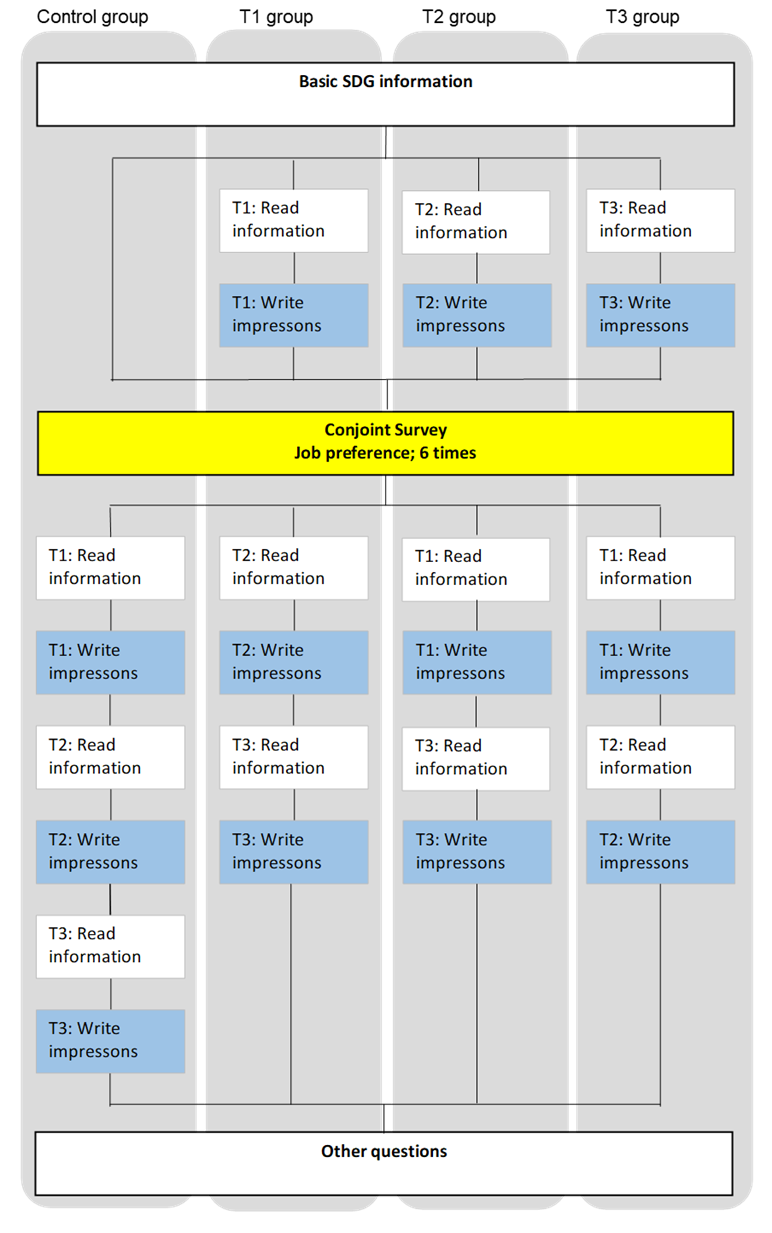
Information treatment experiment
Respondents were randomly assigned to a control group or one of three treatment groups representing sustainability frames commonly encountered in general media (e.g., news, social media). As summarized in Table 1, these treatments include T1 (economic-functional), emphasizing shared value (Porter & Kramer, 2011); T2 (accountability-transparency), addressing SDG-washing risks (Delmas & Burbano, 2011); and T3 (crisis-urgency), highlighting global challenges (United Nations, 2021). Table 1 maps these thematic labels onto established framing dimensions (Florence et al., 2022).
Table 1. Summary of SDG-related message treatments
| Treatment | Core message (1–2 lines) | Key emphasis | Tone / time horizon |
| T1 Shared value (Economic–Functional) | Sustainability is compatible with business success; SDGs can create value for firms and society. | Profitability + win-win logic | Positive; longer-term |
| T2 Accountability–Transparency | Warns about SDG-washing; emphasizes scrutiny, evidence, and accountability for SDG claims. | Credibility + verification | Skeptical; near-term |
| T3 Crisis–Urgency | Sustainability framed as an urgent global challenge requiring action and collective responsibility. | Urgency + efficacy | Mixed; immediate/near-future |
After reading their assigned framing message, respondents were asked to provide a brief, open-ended reaction. These responses were coded into three broad categories—favorable, neutral, and critical—based on their overall evaluative tone. Because the accountability–transparency (T2) message is framed as a warning about SDG-washing, the meaning of ‘favorable’ differs from the other frames: in T2, favorable reactions indicate agreement with the anti–SDG-washing message, whereas critical reactions indicate skepticism toward that warning (i.e., more tolerance of SDG-washing claims). These categories are used solely to define exploratory subgroups in the conjoint analysis. A detailed description of the coding procedure and examples of responses are provided upon request.
Conjoint Experiment Design
Following exposure to (or absence of) the information treatment, respondents completed a choice-based conjoint task to evaluate trade-offs in hypothetical choices (Hainmueller et al., 2013). The conjoint experiment constitutes the primary empirical component of this study, allowing us to estimate the relative importance of job attributes and how these weights vary across information treatment conditions. Respondents were shown pairs of hypothetical jobs, each randomized across seven attributes (Table 2). Information shown to all respondents before the conjoint task is provided in SI-2, and the original conjoint scenario is provided in SI-3. These attributes were selected to capture the balance between SDG-specific elements and traditional job selection factors.
For the sustainability-related attributes, the conjoint distinguishes between role-level opportunities to contribute to the SDGs (whether the job enables the employee to contribute through their own work) and employer-level SDG efforts (the organization’s stated SDG-aligned initiatives). This distinction separates job-level opportunities for contribution from organizational claims and initiatives when evaluating sustainability in job choice. Traditional job selection factors were based on longstanding national surveys of job-seeking attitudes (Career Research Lab, 2021), which highlight the importance of distinct priorities such as enjoyment at work and work–life balance among Japanese university graduates. This design allows for a direct comparison of SDG-related attributes with established job selection criteria.
Table 2. Conjoint Survey Design
| AttributeLevel | 1 | 2 | 3 | 4 | 5 |
| I can enjoy working. | No | Yes | |||
| I can achieve work-life balance. | No | Yes | |||
| I can work on a job I want. | No | Yes | |||
| I can contribute to the SDGs through work. | No | Yes | |||
| Company or organization’s SDG contribution | Negative impact | Positive impact | |||
| Company or organization’s performance | Bad | Good | |||
| Average annual income (age of 30) | 2 million yen | 4 million yen | 6 million yen | 10 million yen | 20 million yen |
To execute this, respondents viewed randomly generated job pairs side-by-side and selected their preferred profile six times. Because the attribute levels were independently randomized across profiles and choice tasks, causal effects of job attributes on respondents’ choices are identified by design rather than by modeling assumptions about the underlying utility function. In line with recent work on conjoint survey experiments, we interpret the effects of attributes in terms of AMCEs, which estimate the average change in the probability of choosing a profile when a given attribute level is changed, averaging over the joint distribution of all other attributes (Bansak et al., 2020; Hainmueller et al., 2013). This design-based framework reduces concerns that are common in non-experimental survey research, such as unobserved confounding or common-method variance in self-reported attitudes, because the key outcomes of interest—hypothetical job choices—are experimentally induced by the randomized profiles rather than solely by respondents’ pre-existing beliefs.
Data Collection
A broader SDG awareness survey targeting Hiroshima University, Japan, was conducted between February and March, 2022. The students were invited to participate in the optional conjoint experiment. The survey was administered online in two languages (Japanese and English). To encourage participation, respondents could enter a prize draw for gift cards. A total of 506 valid responses were collected from the university students, yielding the final analytic sample. Ethical guidelines were followed, and participation was voluntary.
Table 3 summarizes the demographic characteristics of the 506 respondents. Of the students, 48.62% were identified as female and 51.38% were male. In terms of the survey language, 469 respondents (92.69%) completed the questionnaire in Japanese, while 37 (7.31%) chose the English version. The survey was originally developed in Japanese and translated into English, following standard translation and back-translation procedures, to ensure clarity. Although the respondents’ native language was not explicitly asked, 446 out of 506 respondents identified themselves as domestic students. This suggests a predominantly native Japanese-speaking sample, though the group may include some students with diverse linguistic backgrounds.
Table 3. Descriptive Statistics of Respondents
| Category/Sub-category | Count | Percentage |
| Language of Survey | ||
| Japanese | 469 | 92.69% |
| English | 37 | 7.31% |
| Gender | ||
| Female | 246 | 48.62% |
| Male | 260 | 51.38% |
| International Status | ||
| International Student | 60 | 11.86% |
| Domestic Student | 446 | 88.14% |
| Student Level | ||
| Undergraduate | 349 | 68.97% |
| Graduate | 157 | 31.03% |
Empirical Strategies
This study analyzed the conjoint data by modeling respondents’ choices as a binary outcome (1 = job profile chosen, 0 = not chosen) and estimating AMCEs for each attribute level. Following standard practice in conjoint survey experiments, we used a linear probability model using ordinary least squares (OLS) with respondent-clustered standard errors, which yields unbiased estimates of AMCEs under random assignment of attribute profiles and facilitates direct interpretation of coefficients as changes in choice probabilities (Bansak et al., 2020; Bansak et al., 2021; Hainmueller et al., 2013). In this framework, each AMCE reflects the average difference in the probability of choosing a job when a given attribute level is present rather than the baseline level, averaging over the joint distribution of all other attributes. To explore heterogeneity in job preferences, AMCEs are also estimated separately for respondents classified as favorable, neutral, or critical in their reactions to the information treatments.
Choice Task. The binary outcome variable indicates whether respondent chose job profile (1) or not (0). Task was repeated 6 times.
Attributes. Attributes, including salary, work-life balance, company SDG contributions, and so forth, were independently randomized to mitigate ordering effects and ensure full orthogonality.
Assumptions. It is assumed no carryover effects between consecutive choice tasks, no influence from attribute ordering, and full randomization of the profiles themselves.
The following linear probability model is estimated:
-
is a vector of attribute levels (excluding the baseline),
-
represents the causal effect,
-
is the intercept, and
-
is the error term.
Results
To explore how exposure to different SDG-related information treatments (T1, T2, and T3) influences stated job preferences, this study conducted conjoint experiments to gauge respondents’ preferences in hypothetical job-seeking scenarios. This design allows us to identify which job attributes most strongly influence the likelihood of choosing a particular position. Table 4 presents the AMCEs across information treatment groups, and Table 5 subsequently subdivides respondents into those who exhibit neutral, favorable, or critical reactions. Reaction categories were derived from coded open-ended comments collected immediately after the information treatment; detailed coding procedures and analysis results are available upon request. Effect sizes are reported as percentage-point changes in job-choice probability, facilitating comparison with traditional job attributes such as salary and work—life balance.
Overall Job-Seeking Preferences
This subsection examines how intrinsic, extrinsic, and SDG-related job attributes influence preferences in the baseline (no-information) scenario (Column 1 of Table 4). The results help us to understand the general factors that shape university students’ job choices before considering the effects of SDG-related messages.
In the baseline scenario, extrinsic motivations, particularly salary, were the dominant drivers of job choice. The AMCE for income, relative to a JPY 2m baseline, was the largest of any attribute, increasing from 0.184 for JPY 4m to 0.452 for JPY 10m. The premium for the highest salary level (JPY 20m) was also substantial (see Table 4). Intrinsic motivations were also highly important drivers. Respondents placed a high value on jobs they found enjoyable (AMCE = 0.181), resulting in an 18.1 percentage points increase in the likelihood of selection compared to a job that was not enjoyable. This effect is comparable in magnitude to a two- to three-level salary increase. Jobs that aligned with what respondents personally wanted to do increased the likelihood of selection by 12.9 percentage points (AMCE = 0.129), and work–life balance was similarly important (AMCE = 0.158, p ¡ 0.01). These patterns are consistent with prior evidence that personal interest and non-monetary job attributes are key drivers of career decision-making (Career Research Lab, 2021), alongside financial incentives posited by classic labor market theories.
By comparison, the SDG-related job attributes had a statistically significant but practically modest impact. Notably, whether the role enabled respondents to contribute to the SDGs through their work (role-level SDG contribution) did not significantly boost job choice in the control group (no-information baseline). In contrast, the employer’s SDG efforts (employer-level SDG contribution) (AMCE = 0.079) yielded a 7.9 percentage points increase in choice probability. This effect, while relevant, was less than half the magnitude of work-life balance (0.158). Taken together, these results indicate that traditional job factors, such as enjoyment, salary, and work-life balance, remain the most important drivers of job choice. However, even in the absence of additional framing, organizational sustainability efforts exert a modest but measurable influence on preferences.
These findings address RQ1, which explores the relative importance of sustainability-oriented attributes compared with traditional job factors. While tangible job attributes, such as salary and work-life balance, exert the strongest influence on job selection, the results indicate that company-level SDG contributions independently increase job attractiveness. This suggests that sustainability considerations are already relevant to job seekers even without explicit framing, although they do not outweigh core employment concerns. The role of framing in shifting these trade-offs is examined in subsequent sections.
Table 4. Average Marginal Component Effects (AMCEs) by Information Treatment (Control, T1-T3)
| VARIABLES | (1) Control | (2) T1 | (3) T2 | (4) T3 |
| I can enjoy working. = 1, Yes | 0.181*** | 0.141*** | 0.152*** | 0.156*** |
| (0.025) | (0.024) | (0.027) | (0.027) | |
| I can achieve work-life balance. = 1, Yes | 0.158*** | 0.146*** | 0.164*** | 0.123*** |
| (0.025) | (0.025) | (0.026) | (0.023) | |
| I can work on a job I want. = 1, Yes | 0.129*** | 0.114*** | 0.084*** | 0.112*** |
| (0.026) | (0.026) | (0.023) | (0.024) | |
| I can contribute to the SDGs through work = 1, Yes | -0.002 | 0.031 | 0.056** | 0.070** |
| (0.022) | (0.026) | (0.025) | (0.027) | |
| Company or organization’s SDG contribution = 1, Positive | 0.079*** | 0.082*** | 0.096*** | 0.108*** |
| (0.025) | (0.024) | (0.024) | (0.024) | |
| Company or organization’s performance = 1, Good | 0.072*** | 0.113*** | 0.030 | 0.114*** |
| (0.022) | (0.024) | (0.021) | (0.025) | |
| Average annual income (age of 30) = 2, 4M JPY | 0.184*** | 0.212*** | 0.228*** | 0.206*** |
| (0.029) | (0.031) | (0.036) | (0.034) | |
| Average annual income (age of 30) = 3, 6M JPY | 0.364*** | 0.370*** | 0.328*** | 0.326*** |
| (0.035) | (0.040) | (0.043) | (0.038) | |
| Average annual income (age of 30) = 4, 10M JPY | 0.452*** | 0.414*** | 0.428*** | 0.436*** |
| (0.043) | (0.043) | (0.057) | (0.048) | |
| Average annual income (age of 30) = 5, 20M JPY | 0.308*** | 0.466*** | 0.436*** | 0.464*** |
| (0.089) | (0.104) | (0.087) | (0.077) | |
| Constant | -0.030 | -0.048 | -0.032 | -0.069* |
| (0.032) | (0.036) | (0.038) | (0.038) | |
| Observations | 1,668 | 1,428 | 1,440 | 1,536 |
| R-squared | 0.167 | 0.155 | 0.134 | 0.153 |
Treatment Effects on Overall Preferences
In line with RQ2, this subsection now examines how different message frames (columns 2–4 in Table 4) influence job-seeking preferences by shifting the relative importance of various job attributes. The introduction of these information treatments resulted in modest but interpretable shifts compared to the control group, suggesting that framing affects how job seekers evaluate sustainability alongside traditional job factors.
Role-level SDG contribution gained modest but meaningful importance under the accountability–transparency (T2) and crisis–urgency (T3) frames (approximately +6 and +7 percentage points, respectively). In contrast, role-level SDG involvement did not significantly affect the control or T1 groups. These patterns suggest that accountability-transparency (T2) and crisis-urgency (T3) frames increase the weight placed on role-level opportunities when making career decisions.
The influence of a company’s SDG contribution also increased, though the absolute effect remained modest. In the control group, jobs in companies that actively contributed to the SDGs were 7.9 percentage points more likely to be chosen. This increased slightly at T1 (8.2 percentage points), more noticeably at T2 (9.6 percentage points), and peaked at T3 (10.8 percentage points).
The importance of intrinsic motivations, such as enjoyment of work, declined slightly when SDG-related messages were introduced. In the control group, ”enjoy working” increased job selection by 18.1 percentage points, but this dropped to 14.1 percentage points in T1, 15.2 percentage points in T2, and 15.6 percentage points in T3. A similar decline occurred for the attribute ”job I want,” which decreased from 12.9 percentage points in the control group to 11.4 percentage points in T1, 8.4 percentage points in T2, and 11.2 percentage points in T3. These shifts suggest that when sustainability considerations are emphasized, personal job satisfaction becomes slightly less dominant in decision-making.
A company’s financial performance also showed varied effects. In the control group, strong company performance increased job choice by 7.2 percentage points. This effect was more substantial in T1 (11.3 percentage points) and T3 (11.4 percentage points) but was smaller in T2 (AMCE = 0.030, SE = 0.021) and not statistically significant at conventional levels. This pattern aligns with the framing effects: T1, which links profitability to sustainability, reinforces the importance of financial performance, whereas T2’s emphasis on SDG-washing was weaker and statistically insignificant, indicating a weaker association between company performance and job choice under the accountability–transparency frame.
Overall, T1 frames sustainability as profitable, whereas T2 and T3 make SDG-related job attributes more influential. The accountability-transparency frame (T2) encourages job seekers to value direct engagement with sustainability, whereas the urgency frame (T3) strengthens the appeal of companies with strong SDG commitments. These findings suggest that how sustainability is communicated can alter the weight job seekers place on traditional job attributes versus sustainability-related factors.
Job Preferences by Reaction Category
This subsection addresses RQ3 (exploratory) by examining heterogeneity in AMCEs across reaction categories (neutral, favorable, and critical) within T1, T2, and T3. Reaction categories were constructed by coding respondents’ brief open-ended comments provided immediately after exposure to the assigned framing message; detailed coding procedures and examples are available upon request.
To capture these differences, respondents were divided into three groups based on their reactions to the information treatments: neutral, favorable, and critical. Table 5 illustrates the AMCEs for each subgroup across the three treatments, providing insights into how reactions influence job selection decisions. The preference for a company based on its contribution to the SDGs appears to be influenced by the framing of information. For respondents in the favorable and neutral categories, the likelihood of selecting a company with a positive SDG contribution generally increased compared with the control group. Specifically, in the favorable category, preference increased by approximately 11.8 percentage points for T1 and T3. The neutral categories showed a similar, although slightly smaller, increase of 8.3 percentage points in T1, 10.1 percentage points in T2, and 8.9 percentage points in T3.
A notable exception was observed in T2. (For T2, ‘favorable’ reflects anti–SDG-washing agreement; ‘critical’ reflects disagreement with the SDG-washing warning.) For the T2 favorable group, a company’s proclaimed SDG contribution did not significantly affect preference. Instead, this group showed a heightened interest in making a role-level contribution to the SDGs through their work, with the AMCE for this attribute increasing to 0.117 (an 11.7 percentage point effect), a statistically significant increase from the non-significant effect in the control group (AMCE = -0.002). This pattern is consistent with a clear shift in preference, making this attribute a relevant, secondary consideration for this group.
Conversely, T2 critical respondents showed a 15.1 percentage-point increase in their preference for employers with positive SDG efforts. One interpretation is that, under T2, favorable respondents placed relatively greater weight on role-level contribution than on company-level claims, whereas critical respondents showed a stronger response to stated company SDG contributions. Simultaneously, those with a more critical view may perceive any corporate action on SDGs, even if potentially superficial, as a positive step.
Regarding salary, preferences were highly sensitive to both the amount and informational framing. For neutral respondents under the economic–functional frame (T1), salary effects increased sharply across levels, with especially large premiums at the highest salary level (Table 5). However, among neutral respondents in the T3 crisis–urgency frame, the premium for the highest salary level (20M JPY) was not statistically significant, suggesting that urgency cues may reduce the valuation of exceptionally high pay.
For respondents with a critical perspective, the demand for financial compensation was considerably higher across all the treatments. The AMCE for a 20 million JPY salary reached 0.809 in T1, 0.600 in T2, and 0.750 in T3. These figures are substantially larger than the control group’s AMCE of 0.308 (see Table 5), indicating substantially larger salary premiums among critical respondents across treatments. Among the respondents in the favorable category, pay preferences were strong and consistent up to the 10 million JPY level. Interestingly, for the T1 favorable group, the AMCE for the 20 million JPY salary (0.286) was slightly lower than that of the control group (0.308). This pattern suggests diminishing marginal utility at very high salaries, given that the informational frame already emphasizes corporate profitability and stability. Overall, salary and enjoyment remain the dominant determinants, with framing mainly redistributing modest weight among sustainability and profitability attributes.
Table 5. Average Marginal Component Effects (AMCEs) by Reaction Subgroup and Information Treatment
| VARIABLES | (1) T1-neutral | (2) T1-Favorable | (3) T1-Critical | (4) T2-Neutral | (5) T2-Favorable | (6) T2-Critical | (7) T3-neutral | (8) T3-Favorable | (9) T3-Critical |
| I can enjoy working. = 1, Yes | 0.094** | 0.146** | 0.274** | 0.128** | 0.191** | 0.137** | 0.134** | 0.182** | 0.114 |
| (0.037) | (0.038) | (0.062) | (0.039) | (0.044) | (0.065) | (0.052) | (0.034) | (0.073) | |
| I can achieve work-life balance. = 1, Yes | 0.151** | 0.140** | 0.127** | 0.148** | 0.152** | 0.222** | 0.094** | 0.143** | 0.103 |
| (0.043) | (0.039) | (0.052) | (0.035) | (0.055) | (0.049) | (0.040) | (0.032) | (0.063) | |
| I can work on a job I want. = 1, Yes | 0.115** | 0.112** | 0.093 | 0.077** | 0.115** | 0.067 | 0.040 | 0.141** | 0.200** |
| (0.043) | (0.041) | (0.063) | (0.035) | (0.039) | (0.059) | (0.035) | (0.034) | (0.058) | |
| I can contribute to the SDGs through work = 1, Yes | 0.039 | 0.049 | -0.047 | 0.040 | 0.117** | 0.025 | 0.079 | 0.058 | 0.059 |
| (0.039) | (0.040) | (0.077) | (0.040) | (0.034) | (0.054) | (0.050) | (0.037) | (0.060) | |
| Company or organization’s SDG contribution = 1, Positive | 0.083* | 0.118** | -0.025 | 0.101** | 0.057 | 0.151** | 0.089** | 0.118** | 0.116 |
| (0.043) | (0.034) | (0.048) | (0.036) | (0.039) | (0.055) | (0.040) | (0.032) | (0.087) | |
| Company or organization’s performance = 1, Good | 0.058* | 0.143** | 0.189** | 0.003 | 0.019 | 0.111** | 0.124** | 0.113** | 0.089 |
| (0.031) | (0.035) | (0.087) | (0.034) | (0.034) | (0.043) | (0.052) | (0.030) | (0.077) | |
| Average annual income (age of 30) = 2, 4M JPY | 0.193** | 0.245** | 0.181** | 0.218** | 0.209** | 0.287** | 0.208** | 0.214** | 0.128 |
| (0.051) | (0.051) | (0.071) | (0.049) | (0.075) | (0.069) | (0.060) | (0.046) | (0.089) | |
| Average annual income (age of 30) = 3, 6M JPY | 0.338** | 0.383** | 0.449** | 0.328** | 0.273** | 0.436** | 0.280** | 0.352** | 0.312** |
| (0.062) | (0.067) | (0.093) | (0.066) | (0.086) | (0.067) | (0.063) | (0.054) | (0.094) | |
| Average annual income (age of 30) = 4, 10M JPY | 0.338** | 0.497** | 0.333** | 0.343** | 0.504** | 0.513** | 0.573** | 0.360** | 0.540** |
| (0.075) | (0.061) | (0.120) | (0.088) | (0.101) | (0.108) | (0.076) | (0.066) | (0.146) | |
| Average annual income (age of 30) = 5, 20M JPY | 0.709** | 0.286* | 0.809** | 0.330** | 0.522** | 0.600** | 0.304 | 0.423** | 0.750** |
| (0.054) | (0.156) | (0.139) | (0.127) | (0.140) | (0.140) | (0.215) | (0.084) | (0.101) | |
| Constant | 0.014 | -0.120** | -0.008 | 0.026 | -0.050 | -0.166* | 0.008 | -0.112** | -0.060 |
| (0.063) | (0.049) | (0.080) | (0.051) | (0.075) | (0.083) | (0.058) | (0.051) | (0.123) | |
| Observations | 576 | 624 | 228 | 672 | 468 | 300 | 492 | 864 | 180 |
| R-squared | 0.128 | 0.186 | 0.238 | 0.112 | 0.160 | 0.197 | 0.136 | 0.166 | 0.248 |
Summary of Conjoint Findings
The conjoint results show that framing conditions are associated with modest shifts in the relative importance of job attributes. In addition, AMCEs vary across reaction-based subgroups (neutral, favorable, and critical), indicating heterogeneity in stated job preferences. Neutral respondents placed greater weight on employer-level SDG contributions than on role-level opportunities to contribute. Favorable respondents placed greater weight on SDG-related attributes in the accountability–transparency (T2) and crisis–urgency (T3) frames than in the control condition. Critical respondents exhibited larger salary premiums across treatments, while their valuation of employer-level SDG contribution was strongest under the accountability–transparency (T2) frame. Under the economic–functional frame (T1), the AMCE for company performance was larger than in the control group. Under the accountability–transparency frame (T2), performance effects were comparatively larger among critical respondents, whereas under the crisis–urgency frame (T3), performance effects were more pronounced for neutral and favorable respondents.
Salary remained the dominant driver across all groups, although its marginal effect varied by frame and reaction category. Overall, framing effects were modest and primarily redistributive rather than transformative: traditional job attributes—salary, work–life balance, and job enjoyment—remained the dominant determinants, while SDG-related attributes became more influential under T2 and T3 for some subgroups. Together, these findings address RQ2 and RQ3 by documenting modest average framing effects and heterogeneity across reaction-based subgroups.
Discussion
This study examined whether exposure to three sustainability communication frames—economic–functional (T1), accountability–transparency (T2), and crisis–urgency (T3)—shifts how students trade off sustainability-related and traditional job attributes in stated job choices. Overall, framing effects were modest but interpretable, and the reaction-based analyses indicate meaningful heterogeneity across respondent subgroups.
Interpreting Heterogeneity: Credibility and Role-Level Impact
A plausible interpretation of the observed heterogeneity is that credibility concerns affect how respondents evaluate sustainability-related job attributes. When employer-level SDG claims are perceived as harder to verify—particularly under the accountability–transparency frame—some respondents appear to place greater weight on role-level opportunities to contribute to the SDGs through one’s own work, rather than relying on organizational claims. This interpretation is offered as a working explanation and is not directly measured in the present design. Consistent with this pattern, favorable respondents under T2 place greater weight on role-level contribution, while employer-level SDG contribution is not a significant driver for that subgroup (Table 5).
Implications for Theory and Practice
The findings suggest that sustainability framing can modestly reallocate attention across job attributes rather than fundamentally reshaping job-choice priorities. The study extends the existing literature (e.g., Grappi et al., 2024; Song et al., 2024) by demonstrating that “internal CSR” (personal agency) becomes more attractive when “external CSR” (corporate claims) is viewed skeptically. Managerially, the results challenge the one-size-fits-all approach to communication. While traditional factors like salary and enjoyment remain dominant (Career Research Lab, 2021), strategic framing can tip the scales for specific segments. From a practical perspective, the results suggest that accountability–transparency and crisis–urgency frames may increase the salience of sustainability-related attributes for some audiences, particularly when accompanied by concrete role-level opportunities for contribution. However, because effects are modest and heterogeneous, broad claims about “best” messaging strategies should be made cautiously.
Limitations and Future Research
As exploratory research, this study has limitations. First, the hybrid design of the frames, while ecologically valid, limits the isolation of specific causal dimensions (e.g., valence versus temporality). Second, the study did not include standard closed-ended manipulation check items designed to isolate specific framing dimensions; therefore, claims about why framing matters remain tentative. Third, measurement constraints–including single-item indicators and modest reliability in some measures–require caution in interpretation. Finally, the single-university sample limits generalizability. Future research should directly measure perceived credibility of employer claims and perceived role-level impact using validated multi-item scales, factorial framing designs, and broader samples.
Conclusion
This study finds that exposure to SDG-related messages is associated with modest shifts in how students weight sustainability-related and traditional job attributes in stated job choices. Traditional job factors—especially salary, work–life balance, and job enjoyment—remain dominant, but accountability–transparency and crisis–urgency frames can increase the influence of SDG-related attributes for some subgroups. Overall, the results suggest that sustainability communication may shape employer attractiveness in contingent and heterogeneous ways, underscoring the potential importance of credible information and role-level opportunities for contribution.
Acknowledgments
AI was used to refine the language and structure of the manuscript. All analyses, interpretations, and conclusions were developed and validated by the author, with AI being limited to supporting mechanical or organizational tasks.
Author Contributions Statement
Tomomi Yamane is the sole author of this manuscript and has made significant contributions to all aspects of the research and manuscript preparation. Specifically, the author was responsible for conceptualizing the study, designing the methodology, collecting and analyzing the data, interpreting the results, and writing and revising the manuscript. The author affirms that this work constitutes original research and adheres to the Journal of Sustainable Marketing's guidelines and standards. The author is grateful to Miyabi Imase and Shu Takahashi for their assistance in coding the open-ended responses, which supported the reliability of the reaction-category measures used in this study. Any remaining errors are the author’s own.
Ethical approval
The research protocol was approved by the Ethics Committee of the Graduate School for survey on February 22, 2022. All respondents provided informed consent before commencing the questionnaire.
Supplementary Materials
Supplementary material for this article is available online via https://doi.org/10.51300/JSM-2025-160.
Funding Statement
This work was supported by the Japan Society for the Promotion of Science (JSPS) KAKENHI, Grant Number [22K01463].
Conflict of Interest
The author declares that there is no conflict of interest regarding the publication of this paper.
References
- . Using Conjoint Experiments to Analyze Elections: The Essential Role of the Average Marginal Component Effect (AMCE). SSRN Electronic Journal, . https://doi.org/10.2139/ssrn.3588941. CrossRef | Google Scholar
- . Conjoint Survey Experiments. In Advances in Experimental Political Science (pp. 19-41). Cambridge University Press. https://doi.org/10.1017/9781108777919.004. CrossRef | Google Scholar
- . The Effect of Values on the Attractiveness of Responsible Employers for Young Job Seekers. Journal of Human Values, 27(1), 27-48. https://doi.org/10.1177/0971685820973522. CrossRef | Google Scholar
- . The Drivers of Greenwashing. California Management Review, 54(1), 64-87. https://doi.org/10.1525/cmr.2011.54.1.64. CrossRef | Google Scholar
- . Message framing effects on sustainable consumer behaviour: a systematic review and future research directions for social marketing. Journal of Social Marketing, 12(4), 623-652. https://doi.org/10.1108/jsocm-09-2021-0221. CrossRef | Google Scholar
- . The effect of message framing on young adult consumers’ sustainable fashion consumption: The role of anticipated emotions and perceived ethicality. Journal of Business Research, 170, 114341-114341. https://doi.org/10.1016/j.jbusres.2023.114341. CrossRef | Google Scholar
- . Causal Inference in Conjoint Analysis: Understanding Multidimensional Choices Via Stated Preference Experiments. SSRN Electronic Journal, 22(01), 1-30. https://doi.org/10.2139/ssrn.2231687. CrossRef | Google Scholar
- . The impact of CSR on corporate reputation perceptions of the public--A configurational multi-time, multi-source perspective. Business Ethics, 28(2), 141-155. https://doi.org/10.1111/beer.12207. CrossRef | Google Scholar
- . Business contribution to the Sustainable Development Agenda: Organizational factors related to early adoption of SDG reporting. Corporate Social Responsibility and Environmental Management, 26(3), 588-597. https://doi.org/10.1002/csr.1705. CrossRef | Google Scholar
- . How personal values shape job seeker preference: A policy capturing study. PLOS ONE, 16(7), 1-15. https://doi.org/10.1371/journal.pone.0254646. CrossRef | Google Scholar
- . Can Creating Shared Value (CSV) and the United Nations Sustainable Development Goals (UN SDGs) Collaborate for a Better World? Insights from East Asia. Sustainability, 10(11), 4128-4128. https://doi.org/10.3390/su10114128. CrossRef | Google Scholar
- . The Power of Personal Norms and Green Message Framing Persuade Consumers’ Willingness to Pay Premium Prices at Eco-friendly Restaurants. Journal of International Food \& Agribusiness Marketing, 36(4), 714-738. https://doi.org/10.1080/08974438.2023.2192198. CrossRef | Google Scholar
- . Over 70% of job-hunting students report higher interest in companies engaged in the SDGs. . https://news.mynavi.jp/techplus/article/20230608-2699397/.
- . Generation Z job seekers' expectations and their job pursuit intention: Evidence from transition and emerging economy. International Journal of Engineering Business Management, 14, 184797902211125. https://doi.org/10.1177/18479790221112548. CrossRef | Google Scholar
- . The Big Idea: Creating Shared Value. Harvard Business Review, 89(1-2), 62-77.
- . Mynavi Job-Seeking Attitude Survey of Year 2022 Graduates. . https://career-research.mynavi.jp/reserch/20210426_8553/.
- . Transforming Our World: The 2030 Agenda for Sustainable Development. . https://sustainabledevelopment.un.org/content/documents/21252030%20Agenda%20for%20Sustainable%20Development%20web.pdf.
- . Our Common Agenda. . https://www.un.org/en/content/common-agenda-report/assets/pdf/Common_Agenda_Report_English.pdf.
- . Diagnosticity of CSR Events in the Formation of Public Reputation – a Configurational Perspective. Academy of Management Proceedings, 2017(1), 141-155. https://doi.org/10.5465/ambpp.2017.14303abstract. CrossRef | Google Scholar
- . Corporate social responsibility and job pursuit intention: the role of job seekers’ perception on employer prosocial orientation, value congruence and employer attractiveness. Social Responsibility Journal, 20(9), 1809-1831. https://doi.org/10.1108/srj-04-2023-0235. CrossRef | Google Scholar
- . Framing and communicating climate change: The effects of distance and outcome frame manipulations. Global Environmental Change, 20(4), 656-667. https://doi.org/10.1016/j.gloenvcha.2010.07.002. CrossRef | Google Scholar
- . Corporate social responsibility and organizational attractiveness: implications for talent management. Social Responsibility Journal, 12(3), 484-505. https://doi.org/10.1108/srj-07-2015-0095. CrossRef | Google Scholar
- . The Framing of Decisions and the Psychology of Choice. Science, 211(4481), 453-458. https://doi.org/10.1126/science.7455683. CrossRef | Google Scholar
- . Dentsu conducts sixth consumer survey on the Sustainable Development Goals (SDGs). . Accessed: 2025-12-24. https://www.dentsu.co.jp/en/news/release/2023/0512-010609.html.
- . Prospect Theory: An Analysis of Decision under Risk. Econometrica, 47(2), 263-291.
- . Is the younger generation a driving force toward achieving the sustainable development goals? Survey experiments. Journal of Cleaner Production, 292, 125932-125932. https://doi.org/10.1016/j.jclepro.2021.125932. CrossRef | Google Scholar
- . Normative Influences on Altruism. In Berkowitz, Leonard (Ed.), Advances in Experimental Social Psychology (pp. 221-279). Academic Press.
About contributors

Tomomi Yamane
College of Sustainability and Tourism, Ritsumeikan Asia Pacific University, Beppu, Oita, Japan
Japan