




Abstract
This study examines how upstream institutional rigidity in EU-funded waste-management interventions shapes downstream municipal outcomes through macro-social marketing dynamics. Using a mixed-methods design, the study combines propensity score matching across 100 Croatian municipalities, within-treatment heterogeneity analysis, and in-depth interviews with project managers. The findings show that while interventions generate short-term improvements in waste sorting, these gains diminish over time. Within-treatment heterogeneity analysis further indicates that recommended (non-mandatory) interventions are more closely associated with improved waste-sorting outcomes than mandatory measures. Qualitative evidence traces this pattern to institutional rigidity at the upstream level, which increases misalignment between policy design and local implementation by constraining co-design, market segmentation, and adaptation to heterogeneous municipal infrastructures. This misalignment weakens both the level and persistence of downstream waste-management outcomes. By integrating institutional theory with macro-social marketing, the study advances understanding of how upstream rigidity undermines long-term policy effectiveness and offers implications for the design of more sustainable marketing-oriented public interventions. Policymakers and practitioners are encouraged to adopt more holistic, user-centered approaches that enhance institutional flexibility, cross-level collaboration, and contextual responsiveness to improve intervention performance.
Introduction
Recent supranational strategic documents highlight the importance of waste prevention and sorting as crucial stages in the waste management process, aligned with the Sustainable Development Goals (SDGs) (United Nations Economic Commission for Europe, 2022). These practices offer environmental, social, and economic benefits. However, waste prevention and recycling still lag behind, with significant amounts of municipal solid waste being landfilled (Sharma & Jain, 2020). EU statistics show annual waste generation at around 2.5 billion tonnes, with each person responsible for half a tonne of municipal waste annually (European Comission, 2021).
To promote proper waste management behaviors, national governments have introduced various interventions to assist local governments. Several systematic reviews have examined the impact of these interventions on waste prevention, sorting, and recycling (Knickmeyer, 2020; Varotto & Spagnolli, 2017; Geiger et al., 2019). The social marketing literature has explored the effectiveness of interventions using social marketing benchmark criteria (Sewak et al., 2021). However, findings on their impact remain inconsistent (Ling & Xu, 2021; Matiiuk & Liobikienė, 2021; Wang et al., 2021), with the discrepancies often attributed to insufficient application of social marketing criteria in designing and evaluating interventions (Kim et al., 2019; Kim et al., 2020).
Both literatures suggest that for interventions to be fully effective, there must be a shift from individual to systemic behavior change (Kim et al., 2020; Mathew et al., 2023; Tian et al., 2022; Varotto & Spagnolli, 2017).For example, an individual-level change targets households with nudges through prompts or leaflets to sort waste, whereas a system-level change coordinates collection infrastructure, pricing, and procurement rules to make sorting convenient and norm-congruent and to ensure sorted waste is actually processed
.Thus, the system-level changes require alignment across multiple actors: upstream policy, midstream service providers, and downstream households.
This shift is explored in social marketing under the concept of macro-social marketing, which targets societal-level change and addresses “wicked problems” through large-scale interventions (Kennedy & Parsons, 2012).While traditional social marketing focuses on individual behavior, macro-social marketing emphasizes change across all levels of the social marketing system, including upstream and midstream (Dibb, 2014; Cherrier & Gurrieri, 2014; French & Gordon, 2015)
.Upstream social marketing seeks to influence social structures that affect downstream behaviors (Gordon, 2013).
Although the literature acknowledges the need for alignment between upstream and downstream social marketing, empirical studies on this front are scarce (Newton et al., 2016; Schmidtke et al., 2021). In waste management, this alignment refers to how upstream policies and frameworks contribute to micro-level behaviors (Sewak et al., 2021). This paper argues that variations in effectiveness stem from upstream rigid institutional frameworks governing waste management interventions and from the lack of integration between upstream and downstream processes. Given that these interventions are often funded by national or supranational institutions, addressing this gap is crucial for both social marketing scholars and policymakers.
This study uses a dataset of 100 city- and municipal-level waste management intervention projects funded through EU grants in Croatia.We combine this with municipal waste data three years post-intervention
.Using mixed methods, we test intervention effectiveness using propensity score matching (PSM), comparing cities with and without interventions.
Results show that the positive impact of interventions on waste prevention and sorting fades over time, and within-treatment analysis indicates that interventions have a contrasting effect on sorting outcomes.Post-hoc interviews with 11 project officers reveal three key reasons for the diminishing effects: lack of knowledge about social marketing benchmark criteria, misalignment between upstream and downstream actors, and institutional rigidity in the funding framework
.This research offers new insights into macro-social marketing by identifying these challenges and offering recommendations to improve waste management interventions.
Conceptual Development
Waste Management: Social Marketing Perspective
Prior insights on the effectiveness of waste management interventions are, at best, equivocal, although, in general, they show a positive correlation with recycling and sorting behaviors (Miafodzyeva & Brandt, 2013). Some recent studies (Tian et al., 2022; Ng, 2020) show that implementing a waste management policy promotes higher waste-sorting outcomes by enhancing users’ knowledge. While some studies find a positive association between informational and educational interventions and waste-sorting outcomes (Page & Sharp, 2012; Xia et al., 2023), some authors directly question the effectiveness of such interventions (Varotto & Spagnolli, 2017). For instance, in her meta-analysis, Bernstad (2014) found that informational interventions modestly increased waste sorting. In their meta-analysis, Osbaldiston & Schott (2012) show that convenience and financial incentives are the most effective interventions for increasing recycling and sorting. In contrast, informational and educational interventions have a smaller effect. Matiiuk & Liobikienė (2021) find that informational interventions did not significantly affect the level of waste sorting. Henceforth, based on the initial literature review, the findings regarding how informational and educational interventions affect waste sorting remain mixed.
Waste prevention, sorting, and recycling are “wicked problems” that often prompt decision-makers to use social marketing (Kim et al., 2019). Social marketing is a strategic method for fostering behavioral change and advancing social good by applying marketing principles beyond commercial settings (Issock Issock et al., 2021). It focuses on improving societal well-being through behavior change (Andreasen, 1994; Thaler & Helmig, 2013). Consequently, social marketing literature has examined how to promote positive waste-management behaviors, particularly through informational and educational interventions (Kim et al., 2019; Donovan, 2011).
However, many interventions fail due to a lack of rigor in meeting social marketing benchmark criteria (behavior, customer orientation, theory, insight, exchange, competition, segmentation, and methods mix), which directly affects their effectiveness (Kim et al., 2019; Kim et al., 2020; Sewak et al., 2021). Some social marketing literature argues that success isn’t solely about fulfilling social marketing benchmark criteria but also about producing social value (e.g., societal well-being via durable infrastructure-behavior fit, reduced environmental burden, reduced administrative frictions) through relationship-building and exchange (French & Russell-Bennett, 2015). Both the waste management and social marketing literature emphasize the need to focus on the broader context and system in which interventions operate (Gordon et al., 2016). This has led to calls for greater use of macro-social marketing, which aims for systemic, societal change rather than individual-level change (Truong, 2017; Kennedy, 2016). Macro-social marketing, often synonymous with systems social marketing, involves co-designing interventions with multiple stakeholders to address “wicked problems” like improper waste management (Flaherty et al., 2020). Macro-social marketing focuses on streamlining institutional settings and societal contexts to maximize the effectiveness of interventions (Kennedy & Parsons, 2012). It requires alignment between upstream, midstream, and downstream levels for greater effectiveness (Cherrier & Gurrieri, 2014; French & Russell-Bennett, 2015). Upstream and downstream actors in the social marketing system are interdependent, with actions at the downstream level influencing behavior at the upstream level (Newton et al., 2016).
Beyond macro-social marketing, literature indicates that other sustainable behavior frameworks, such as SHIFT emphasize levers at the individual and social interface (e.g., social proof, habit disruption, affect, tangibility; White et al. (2019)). These are necessary but not sufficient levers when upstream design imposes significant constraints on midstream and downstream actors. For instance, Andrade & Vieites (2025) synthesize cross-level obstacles and opportunities, complementing macro-social marketing system orientation.
However, centralized decision-makers often develop generalized policies without field-level insights, resulting in ineffective interventions (Schmidtke et al., 2021). Hierarchical structures within the social marketing system need further scrutiny to identify weaknesses and improve outcomes (Gordon et al., 2016). Behavioral change can be hindered by institutional and regulatory systems, inadequate infrastructure, and user behavior (Kemper & Ballantine, 2017). Policymakers use interventions to institutionalize behavioral change at the societal level, ensuring downstream actors have the resources and infrastructure needed for success (Brennan et al., 2014). Expanding interventions to consider social and institutional factors is recommended (Mathew et al., 2023). One solution is upstream social marketing, which influences behavior change at the highest decision-making levels by interacting with policymakers (Gordon, 2013). Upstream social marketing aims to shape policy through proactive engagement, informing policymakers of what works (French & Russell-Bennett, 2015). This approach is especially relevant to waste management systems (Kennedy & Smith, 2022; Al-mosa et al., 2017). The institutional setting plays a key role in waste prevention and sorting, with scholars calling for more innovative thinking (Trischler et al., 2019; Reschovsky & Stone, 2017). “Wicked problems” require proactive institutional involvement, and social marketing may help resolve these challenges. However, societal and political needs often conflict, leading to institutional resistance to change (Acemoglu & Robinson, 2008). Despite this, little research critically evaluates the institutional settings guiding social marketing interventions in waste management behaviors. This paper explores waste management interventions through the lens of institutional theory to address this gap.
An Institutional Perspective on Waste Management
Institutions are both formal and informal rules that organize social, political, and economic relations, shaping behavior through norms, regulations, and structures (Hodgson, 2006). Formal institutions are codified laws, contracts, and government structures, while informal institutions include customs, values, and beliefs (North, 1990). The regulatory pillar of institutions comprises laws and rules that constrain behavior, with this paper focusing on formal institutions. Formal institutions reassure societal members about the “rules of the game” and simplify behavior (North, 1990), but their persistence can be detrimental if they fail to adapt to societal changes (Thelen, 2009). Institutional rigidity refers to a stable but inflexible institutional setting that cannot meet evolving societal needs (Hodgson, 1989). This rigidity often stems from excessive formalization, overregulation, and bureaucratization (Andina-Díaz et al., 2021), leading to inefficiencies and stifling innovation (Gratton et al., 2021). Institutional rigidity can result from bureaucratic elites fearing the loss of power if change occurs, even though change might benefit society (Acemoglu & Robinson, 2006; Robinson & Acemoglu, 2006). Rigid institutions serve the interests of elites, creating a ”local maximum” that prevents optimal societal outcomes (Lustick, 2011).
In waste management, expert-driven policies often lack a user-centric approach, hindering innovation and positive behavior (Sewak et al., 2021). Similarly, rigidity can result from upstream actors’ fear of policy change and high perceived transaction costs (Khayame & Abdeljawad, 2020; Jagadale & Kemper, 2022). This study examines the EU's formal waste management framework, which sets measurable goals for waste prevention, sorting, recycling, and re-use by 2020, 2025, 2030, and 2035 (Parliament & Union}, 2008). Member States create plans, policies, and incentives to meet these goals within the EU framework.
Building on a macro-social marketing approach, we frame institutional rigidity as an upstream mechanism that reduces the efficiency with which upstream policy designs translate into downstream behavioral outcomes. We conceptualize a pathway in which institutional rigidity increases upstream-downstream misalignment, constrains co-design potential, segmentation, and adaptation to local infrastructure, thereby attenuating both the level and persistence of municipal waste prevention and sorting outcomes at the downstream level. Our mixed-methods evidence provides an empirical probe of this mechanism in a waste management intervention scaled at the national level. In Table 1, we showcase how macro-social marketing and its sub-dimensions operate across levels in the waste management context, mapping each to concrete manifestations in our study.
Table 1. Conceptual differentiation of downstream, upstream, and macro-social marketing in waste management interventions
| Analytical dimension | Downstream social marketing | Upstream social marketing | Macro-social marketing |
| Primary locus of change | Individual / household behavior | Policy design and institutional rules | System-wide alignment across levels |
| Typical actors | Citizens, households | Ministries, funding bodies, regulators | Policymakers, service providers, municipalities, citizens |
| Core intervention logic | Inform and persuade individuals to sort/prevent waste | Enable or constrain downstream action through rules and funding | Coordinate structures, incentives, and behaviors across the system |
| Degree of local adaptation | High in principle, constrained in practice | Low (standardized rules, compliance-driven) | High (co-design and contextual fit are central) |
| Role of flexibility | Limited by predefined intervention templates | Structurally constrained by funding and reporting rules | Essential for alignment and persistence |
| Manifestation in this study | Mandatory vs. recommended activities implemented by municipalities | Funding call requirements, mandatory activity lists, monitoring rigidity | Institutional rigidity →misalignment →attenuation of outcomes |
| Empirical evidence used | PSM and within-treatment heterogeneity | Interviews with project managers | Integration of Study 1 and Study 2 |
Method
Research Context
Our study focuses on waste management in Croatia, an EU member state since 2013. Between 2018 and 2019, the Ministry of Economy and Sustainable Development (MESD) launched a public call for grants under the title “Implementing informational and educational programs for sustainable waste management.” The EU’s Cohesion Fund allocated €6.26 million for this initiative. Eligible applicants were local self-government units (cities or municipalities) with populations over 10,000, aiming to implement educational interventions for sustainable waste management. Both individual and consortium applications were accepted, and funding awards were determined based on compliance with the rules, the proposal’s quality, and available funds.
The funding call included mandatory and recommended interventions. Mandatory activities were: 1) leaflets, 2) brochures, 3) posters, 4) specialized radio and TV shows, 5) website creation, and 6) public roundtables. Recommended activities included: 1) workshops and events for children (school and kindergarten), 2) environmental celebrations, 3) media ads, 4) mobile apps, 5) internet banners, 6) paid ads, 7) contests, and 8) leaflets for tourists. Applicants had to choose a set number of mandatory and recommended activities based on population size. For example, municipalities with populations between 10,000 and 40,000 were required to select at least three mandatory and two recommended activities. These interventions were outlined in the Programme of Informational and Educational Activities for Sustainable Waste Management published by MESD.
Methodological Strategy
We applied a mixed-methods approach to gain a more comprehensive understanding of the effectiveness of informational and educational interventions for waste sorting and prevention (Tashakkori & Teddlie, 2010). The mixed-methods approach combines quantitative and qualitative research strategies to provide more detailed insights into the problem under investigation within a single study setting (Johnson & Onwuegbuzie, 2004). Compared to single-use approaches, the mixed-methods perspective is pragmatic and draws on both interpretivist and positivist approaches to research (Morgan, 2007). It enables higher data accuracy and allows for data triangulation. Consequently, researchers can gain a deeper understanding of the phenomena under investigation, thus increasing the validity of inference and making it more relevant for practitioners (Creswell & Plano Clark, 2007). We follow a procedure in which we conduct quantitative analysis (study 1) and then proceed to qualitative analysis (study 2) to gain a deeper understanding of the quantitative findings.
Data and Measures
Surveys have been commonly used to explore waste management behaviors, but are often criticized for lacking objectivity. Previous studies emphasize the importance of measurable behavioral outcomes in waste prevention (Kim et al., 2019; Rundle-Thiele et al., 2019). For this reason, we used secondary data on waste sorting and prevention outcomes. The MESD provides comprehensive waste-sorting statistics at the city and municipal levels, including total waste and sorted waste percentages. Data on the interventions were gathered through the Waste Prevention Portal (http://sprjecavanjeotpada.azo.hr/index.htm), which lists funded projects.
Outcome data are annual administrative statistics curated by MESD’s Directorate, standardized across years following national waste management reporting protocols. This allowed us to match project characteristics with waste sorting outcomes (prevention and sorting) from 2018-2021, addressing calls for a long-term perspective in evaluating pro-environmental interventions (Allcott & Rogers, 2014). Projects funded through earlier calls (e.g., 2016-2018) were excluded due to the limited number of funded projects, heterogeneity in calls, and incomplete documentation.
Table 2 provides critical information on these projects. Waste sorting data was sourced from the MESD’s Directorate for Environmental and Natural Protection (https://www.haop.hr/hr/tematska-podrucja/otpad-registri-oneciscavanja-i-ostali-sektorski-pritisci/gospodarenje-otpadom). Published yearly, this data includes municipal waste production and sorted waste percentages for each city and municipality in Croatia. Outcomes are annual administrative measures. Sorted waste percentage denotes the share of separately collected streams of waste in total municipal waste as reported by municipal systems (e.g., sorted plastics). We define short-term change as 2019–2018 and long-term change as 2021–2018.
Table 2. Statistics regarding the funded projects
| Indicator | |
| Average funded amount | 90.056,97 EUR |
| The average duration of the project | 17 months |
| Applicants (city/municipality) | Cities = 69, Municipalities = 31 |
| Average size of funded cities/municipalities (number of full-time residents) | 23.942 |
| The average number of mandatory activities | 7,02 |
| The average number of recommended activities | 7,88 |
| Single applicants or consortia | Single = 41, Consortia = 59 |
Analysis and Findings
Study 1: Evaluating the Impact of Interventions Through Propensity Score Matching
We used the PSM technique to evaluate the impact of interventions. The role of PSM is to determine the efficacy of the applied treatment and to help remove selection and endogeneity biases. PSM is an extensively used method to estimate treatment effects in observational settings by improving covariate balance between treated and control units (Rosenbaum & Rubin, 2022). Using PSM, researchers compare outcomes between a treatment and a control group by ensuring that the two groups have similar observable characteristics. In our case, using PSM, we can evaluate the effects of informational and educational interventions by treating the cities and municipalities that received funding as the treated group and those that did not as the control group.
4.1.1 Findings
In our dataset, 289 cities and municipalities implemented interventions, while 267 did not. Due to a limited pool for the control group (after matching and enforcing PSM using caliper and observables), we focused on 100 grant-leading cities/municipalities funded in 2018-2019 as the treatment group. Grant-leading municipalities directly select, budget, and implement activities and are the accountable unit for outputs, whereas consortia members may share exposure without clear attribution.
Preselected covariates for matching included municipal waste volume, the percentage of waste sorted in the base year, and region (tourist or non-tourist). We used a Python-based PSM extension for SPSS that operates in two stages: calculating propensity scores for each unit and comparing outcomes (waste sorting increases) between matched cities/municipalities in the treatment and control groups.
The PSM procedure generated propensity scores via logistic regression, with a caliper width set to 0.1. Of the 100 cases, 85 were successfully matched to control-group counterparts, whereas 15 were not matched, primarily because they were located in large cities and therefore excluded. The logistic regression model achieved a mean accuracy of 77.1% in predicting group membership. The baseline characteristics of cities and municipalities across key covariates (size, waste-sorting status, and regional affiliation) before and after PSM are presented in Table 3. To validate, we box-plotted propensity score distributions before and after matching (see Figure 1).
Table 3. Baseline Characteristics for Cities and Municipalities Before and After PSM Application
| Before PSM | After PSM | |||||||
| Treatment (N = 100) | Control (N = 267) | t-test | p-value | Treatment (N = 85) | Control (N = 85) | t-test | p-value | |
| Amount of municipal waste (base year = 2018) | 6832,96 | 1332,98 | 0.000 | 5018,75 | 2341,53 | 0.298 | ||
| Status of waste sorting (base year = 2018) | 12,83% | 5,83% | 0.000 | 12,09% | 10,78% | 0.437 | ||
| Regional affiliation | 0.25 | 0.27 | 0.766 | 0,42 | 0,38 | 0.346 | ||
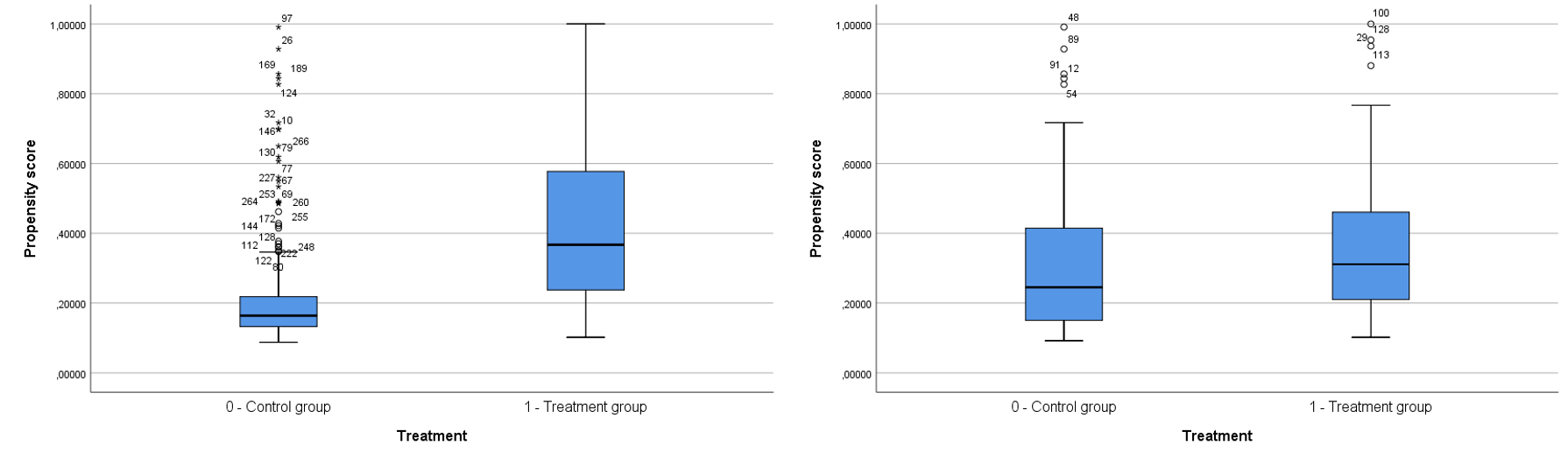
After applying PSM, differences between treatment and control groups on covariates were insignificant, suggesting satisfactory matching. To test differences in outcomes (short- and long-term waste sorting and prevention), we used the t-test for independent samples (see Table 4), comparing results before and after PSM to neutralize self-selection bias.
Table 4. Impact of Interventions on Waste Sorting Outcomes Before and After PSM Application
| Before PSM | After PSM | |||||||
| Treatment (N = 100) | Control (N = 267) | t-test | p-value | Treatment (N = 85) | Control (N = 85) | t-test | p-value | |
| Short-term change in total waste (2019-2018) | 2.87 | 0.004** | 1.76 | 0.079 | ||||
| Long-term change in total waste (2021-2018) | 2.89 | 0.004** | 0.74 | 0.456 | ||||
| Short-term change in waste sorting (2019-2018) | 2.76% | 1.06% | 0.002** | 2.91% | 1.08% | 0.038* | ||
| Long-term change in waste sorting (2021-2018) | 8.83% | 6.11% | 2.54 | 0.011* | 8.95% | 6.04% | 0.061 | |
Table 4 shows that before PSM, the treatment group performed better in both short- and long-term waste sorting and prevention. However, after PSM, the treatment group showed superior results only in short-term waste sorting. The impact on short-term waste prevention and long-term sorting was marginally significant, while long-term waste prevention was insignificant.
Post-hoc analysis
Beyond average effects, we also examined whether the composition of interventions within treated municipalities relates to persistence in waste-sorting outcomes. Specifically, the count (and share) of recommended activities (e.g., workshops in schools, digital media/banners/ads, contests) positively predicts long-term change in sorted waste percentage (2021–2018), while mandatory activities e.g., (e.g., leaflets, brochures, posters, project website, broadcast shows, public roundtables) shows negative associations with sorted waste percentage. The coefficient remains statistically significant with baseline covariates (the percentage of people with higher education degrees living in the city/municipality, the amount of budget spent on environmental management (county-level data), the level of economic development (GDP pc, county-level), the number of funds spent in the project and the project duration (see Table 5).
Table 5. The Impact of Interventions on Waste Sorting Outcomes in Long-term
| DV = Waste sorting (long-term) | ||
| Predictors | Model 1 | Model 2 |
| Controls | ||
| % people with an HE degree | ||
| Environmental budget | .01 | |
| GDP pc | ||
| Project funds | .17 | .18 |
| Project duration | .23* | .25* |
| Main effects | ||
| Mandatory interventions | ** | |
| Recommended interventions | .30* | |
| R2 | .07 | .17 |
| R2 | .07 | .09** |
| F-value | 1.45 | 2.53 |
| F | 1.45 | 4.89** |
This pattern is consistent with the macro-social marketing mechanism: more flexible, insight-driven recommended activities enable local tailoring and upstream-downstream alignment, supporting persistence, whereas rigid mandatory items constrain the realization of social marketing benchmark criteria and attenuate long-run effects. We therefore turn to Study 2 to unpack how flexibility and local fit shape alignment and persistence.
Study 2: Reflection of Cities/Municipalities on Implemented Interventions and the Project Framework
We conducted follow-up interviews to explore reasons for the significant differences in effectiveness between mandatory and recommended interventions. We emailed 20 purposively selected municipalities (diverse baseline waste, sorting status, and region), and 11 project managers (one per municipality) eventually participated (55% response rate). They provided informed consent, and their responses were kept confidential. The interviews were held via videoconferencing and lasted about 30 minutes. All interviews were recorded, transcribed, and analyzed. Table 6 shows the informants' profiles, which reflect high diversity, ensuring theoretical representativeness. The semi-structured interview guide was derived from Study 1's patterns (attenuation in waste outcomes over time; heterogeneity in treatment groups based on the effectiveness of mandatory vs. recommended interventions). Two coders independently performed open coding, reconciled a shared codebook, and applied axial coding to aggregate themes; disagreements were resolved through adjudication. Coding was managed manually.
Table 6. Profile of the Informants
| Informant # | City/municipality area | Amount of municipal waste (000 tonnes) | Status of waste sorting in 2018 (%) | Status of waste sorting in 2021 (%) | Mandatory/ Recommended activities |
| A | Coastal | 4022 | 10,5 | 18,4 | 10/0 |
| B | Continental | 2037 | 13,7 | 28,7 | 7/3 |
| C | Island | 1066 | 0 | 1,0 | 5/5 |
| D | Coastal | 10852 | 17,0 | 41,0 | 7/11 |
| E | Continental | 9507 | 35,8 | 55,4 | 5/9 |
| F | Continental | 16351 | 9,6 | 14,5 | 7/10 |
| G | Coastal | 6580 | 3,6 | 11,5 | 5/8 |
| H | Continental | 1865 | 8,3 | 5,7 | 11/1 |
| I | Continental | 3431 | 16,4 | 43,9 | 7/11 |
| J | Island | 6038 | 0 | 44,3 | 6/5 |
| K | Coastal | 4150 | 8,32 | 2,4 | 6/6 |
The informants were asked to assess the effectiveness of mandatory and recommended interventions in their areas and to share their experiences with the project's institutional setup, including the clarity of funding calls, project reporting, and flexibility. The data collection focused on two main questions, simplifying the analysis. We used thematic analysis (Clarke & Braun, 2016) to analyze the transcripts. The process began with initial coding, followed by reviewing and grouping the codes into broader themes. Two main themes emerged: 1) the effectiveness of interventions and 2) the role of the project funding framework, each with two sub-themes.
4.3.1 Findings
Theme 1: Effectiveness of interventions
Sub-theme 1: The effectiveness of mandatory vis-à-vis recommended interventions
The informants diverged in their answers. While some saw utility in both types of interventions, the majority found that recommended interventions yielded much better effects in the field because they can be effectively and creatively designed to address local needs and thus achieve target goals. Another benefit of the recommended interventions is their diversity, which could complement the city/municipality's current activities. Also, the informants questioned the standardization of interventions across the entire implementation area because the infrastructure was not equally developed.
“As a project manager responsible for implementing the interventions, I believe that mandatory and recommended activities jointly contributed to the increase in the waste separation rate and made reaching a larger number of our fellow citizens possible. Some mandatory activities, such as the project website, radio shows, TV shows, roundtables in all city quarters, and local committees, were exceptionally popular and effective and, as I mentioned, reached many of our fellow citizens.” (Informant F)
”I assume this is because the recommended activities leave the possibility of adjusting or selecting exactly those activities that can better impact the specific environment in which they are carried out, i.e., the end users in that environment. The program's users can best recognize this, i.e., people who live and work in that (local) environment.” (Informant A)
“From our perspective, I can say that the recommended interventions were most effective. Here, I would outline the activities that targeted the younger population (kindergartens and schools), considering that they became curious about the culture of waste sorting and recycling.” (Informant D)
“It was difficult to standardize certain activities for the entire area of project implementation since the infrastructure on the ground is not the same in the entire area (e.g., somewhere there is a door-to-door system, somewhere there are semi-underground tanks)” (Informant I)
Sub-theme 2: The interventions’ return on investment
On the other hand, the utility of mandatory interventions was highly questioned since they left little room for creativity. In some ways, they yielded counterproductive results (e.g., paper materials generated more unnecessary waste). It was also noteworthy that informants questioned the return on investment for specific mandatory interventions, which could be easily achieved by alternative recommended interventions. By being forced to choose interventions that didn’t fit the local context, informants assessed some mandatory interventions as redundant, as recommended interventions yielded better effects in the field.
“Mandatory activities that included the ”promotional materials” (flyers, guides, brochures) were money waste and contributed to creating additional waste (I hope they at least threw them in the paper bin). I firmly believe that if applicants could freely choose their interventions, most would certainly not choose to make leaflets and brochures or make TV shows.” (Informant B)
“Now, considering that we are an island municipality, we, therefore, have a specific population, and I believe each municipality tries to choose interventions according to the knowledge of the psychology of its community. Radio or TV content for the islanders makes no sense because it is an older population and is too expensive, so there would be no funds left for other activities.” (Informant C)
“A big plus for the recommended interventions is that some of them are very effective, such as radio advertising, because they are more frequent and more straightforward than radio broadcast shows (paradoxically, ads are recommended, and the broadcast shows are mandatory, that is, for example, wrong) and per today's times, banners and articles on Internet portals are also a better option. Communication through them is far more effective than with many other interventions. Let us take the brochures, for example. We sent one to each household, and the question was who in the household found it in the mailbox and whether they read it and gave it to other household members to read. On the other hand, most people surf the Internet individually and will come across banners and articles by themselves, even without the assistance of others. The same applies to campaigns on social networks, which are easily spread. In summary, brochures and television broadcast shows on prominent channels are undoubtedly excellent but costly. Similarly, postal services, when sending brochures, are also costly, while a few hundred euros does wonders on Facebook. Thus, we have beneficial but questionable measures even among the mandatory and recommended measures.” (Informant I)
“So, the printed materials (leaflets, brochures, and posters) are unnecessary and outdated and do not reach the target groups even though they may physically reach them. That is why the recommended activities were more useful because we could be more creative following local needs, and that local moment is the most important - it is okay to have TV shows in big cities, but not on islands. Alternatively, in the sense of billboards, posters do not have space to be placed on the island.” (Informant J)
The posters and flyers were superfluous because the public was constantly informed about the activities through traditional and social media networks. In the end, many posters and leaflets were left unallocated. (Informant G)
Theme 2: The role of the project funding framework
Sub-theme 1: The rigidity in the project funding call setup
Informants questioned the project framework and funding call propositions that predefined the number and type of interventions they could use. Such an approach prevented participants from choosing interventions that fit their context infrastructure and aligned with their area's current waste management culture. Informants saw rigidity in the funding call, detecting discrepancies between the project's requirements and the actual field realities when the interventions needed to be implemented.
“It was great and useful that we were offered an exhaustive list of interventions from which we could choose what we wanted to implement, but I think that all that division on mandatory and recommended interventions with limitation of how much we can choose from each group was not a wise idea.” (Informant J)
” Of all the interventions, I believe that public meetings and roundtables were the best way to ensure that our target population gets answers to everything they are interested in and that you explain how your project will work. However, I had a tiny budget for organizing the public roundtables and meetings, and we are talking about 11 settlements on the island, so I had a problem at the start because, in nature, I would need to go to each settlement personally. I do not have the funds for that. With the fact that in some settlements you have only around 20 inhabitants. That is why I made only three public roundtables in three settlements, two in the south of the island in larger settlements and one in the north where the number of inhabitants is smaller.” (Informant C)
“I think we did not have a good foundation for implementing this project, so we would not have succeeded in raising awareness and waste separation. That is why I think there is a big difference in the results precisely because each city and municipality is not the same in terms of development, people's habits, educational system, level of waste sorting, etc. That is why recommended interventions could generate a better impact. We could choose needed and currently lacking activities, or in which we have deficiencies, or else we know that the population would recognize that activity as useful.” (Informant H)
Sub-theme 2: The rigidity in the pre- and post-funding phase
Also, rigidity emerged in all phases of the funding cycle. In the pre-funding phase, informants outlined that expert feedback was rarely used to improve the tenets of the funding call. During and post-funding phases, informants also outlined the inflexible project control, a source of many burdens and stress that exploited their resources, time, and effort during implementation. This was especially evident when trying to justify the effectiveness of some mandatory interventions.
”All EU funding is strictly programmed, with little room for flexibility. The funding call itself has been very confusing in certain parts. Although the Ministry representative consulted with users in the field, only a few initiatives have been accepted and used to improve the funding call. Here is the core problem how I see it since bureaucrats and not experts design these funding calls” (Informant K)
”We did not have special contacts with Ministry officials in terms of consulting, more in terms of strict monitoring of project implementation. I do not remember having any support from them; it was more about control. I remember this whole project causing me quite a stress.” (Informant J)
“From our standpoint, the mandatory interventions were seen as less effective. For instance, printing paper leaflets and brochures was a waste of money since much of it remained in the stock because, realistically, what are you going to do with it - the citizens are not interested in it. It is a must; that is where the biggest financial corrections occurred. Not because of the users themselves, but because of questionable controllers obliged to authorize every output document due to mandatory visibility elements.” (Informant E)
General Discussion
Drawing on the macro-social marketing framework and institutional theory, this research explores the effectiveness of informational and educational interventions in promoting positive waste management behaviors. Using a mixed-methods approach, we found that waste sorting and prevention outcomes are directly linked to the upstream institutional framework governing waste management through funding. Evidence from two studies showed that while some interventions worked well, others faced obstacles due to a mismatch between users' needs and available options. Although beneficial in certain contexts, mandatory interventions across all areas failed. The funding call included both mandatory and recommended interventions, with the latter offering cities more flexibility. This setup helped us analyze the link between upstream and downstream levels in macro-social marketing. Our study is the first to connect local performance outcomes to upstream institutional arrangements in waste management policy.
Our study uses PSM to estimate average treatment-on-the-treated effects under observed covariate balance, contrasting with previous studies that rely on self-reported data (Sharp et al., 2010; Truong, 2017), acknowledging that unobserved confounding cannot be fully ruled out in observational designs. The PSM model showed that the long-term effects of these interventions were insignificant, supporting earlier findings that such interventions need to be complemented with others, such as economic incentives (Bernstad, 2014; Czajkowski et al., 2014; Li et al., 2020; Stoeva & Alriksson, 2017). These findings align with the social marketing perspective, emphasizing the integrated value proposition of convenience, infrastructure, and price in waste sorting (Kim et al., 2019; Kim et al., 2020).
Our study also revealed that the effectiveness of interventions depends on how users perceive their appropriateness, mirroring project managers’ accounts, which recommended that recommended activities were adaptable, better targeted, and more cost-effective, while several mandatory items were poorly aligned with local needs. For instance, different demographic segments react differently to educational content (Li et al., 2020) and develop distinct attitudes toward waste sorting (De Feo & De Gisi, 2010). Interviews indicated that a “one size fits all” approach in the funding call didn’t address the specific needs of users in different contexts. Remote and coastal areas, for example, faced unique challenges compared to urban regions, supporting previous insights that expert and user perspectives often diverge (Kim et al., 2020; Schmidtke et al., 2021). These insights amplify the importance of user involvement in the design stage of waste management policies (Kim et al., 2020) and the need to bridge upstream and downstream perspectives in macro-social marketing (Flaherty & Domegan, 2023; Newton et al., 2016; Jagadale & Kemper, 2022). Though we didn’t fully explore the social marketing benchmark criteria, informants suggested that effectiveness depends on aligning interventions with principles such as insight, customer orientation, and segmentation (Flaherty et al., 2020; Sewak et al., 2021).
Lastly, our study highlighted how upstream policy arrangements, such as EU funding calls, impact intervention effectiveness. The rigidity of the funding call, with predetermined rules for selecting mandatory and recommended interventions, impaired waste management outcomes. The inflexible design of the funding mechanism created challenges for users, confirming that rigid public contracts can burden users (Spiller, 2009). Our findings echo previous concerns that addressing “wicked problems” requires simultaneous influence on both upstream (policy frameworks) and downstream (citizen behavior) levels (Mesiranta et al., 2021). The case in our study reveals institutional rigidity in the upstream macro-social marketing system, suggesting the need for a more nuanced upstream social marketing approach to align decision-makers with actual problems at the micro level (Kennedy et al., 2018). Indirectly, qualitative evidence indicates that upstream decision-makers failed to apply the social marketing benchmark criteria, resulting in a misalignment between the funding framework and the needs of local communities (Kim et al., 2020).
On the whole, our study on the effectiveness of waste management interventions refines the macro-social marketing framework by specifying institutional rigidity as a first-order upstream constraint and by reducing upstream-downstream alignment, which limits the realization of social marketing benchmark criteria, thereby attenuating both the level and persistence of waste prevention and sorting outcomes. We propose that upstream flexibility and co-design capacity are necessary conditions for downstream behavior-change persistence in wicked-problem contexts.
Conclusion
Theoretical and Policy Implications
Our study contributes to macro-social marketing literature by exploring the interactions between upstream, midstream, and downstream actors, emphasizing the importance of stakeholders in addressing “wicked problems” (Flaherty & Domegan, 2023; Dibb, 2014; Kemper & Ballantine, 2017; Kennedy et al., 2018; McHugh et al., 2018; Wymer, 2021). It extends prior macro-social marketing research in areas like health, well-being, education, and violence prevention (Bastos et al., 2021; Hamby et al., 2017; Huff et al., 2017; Truong, 2017). While previous studies focused on the role of upstream stakeholders in implementing programs, our research highlights how resource allocation at the upstream level of waste management policy can significantly affect intervention effectiveness at the downstream level. Our study bridges social marketing and waste management perspectives, revealing a lack of coherence in current waste management policies due to upstream actors' limited knowledge of social marketing benchmark criteria, limited downstream involvement in framework design, and rigidity in upstream policy frameworks.
Our findings provide key guidance for policymakers designing waste management interventions. First, they emphasize the need for co-designed interventions with users to ensure they meet the target population’s needs. Policymakers should involve users in the design process, fostering participatory approaches that enable users to help create interventions that promote behavioral change in their communities (Kim et al., 2019; Kubacki & Rundle-Thiele, 2016; Sewak et al., 2021). Formative research on users' attitudes, beliefs, and behaviors should be conducted before implementation to better inform intervention tailoring (Truong, 2017). Second, our study suggests that the problem may not lie in the interventions themselves but in the upstream framework that dictates which interventions should be implemented. Even well-designed social marketing interventions can fail if there’s misalignment between upstream and downstream elements of the macro-social marketing system. A potential recommendation for policymakers is to introduce more flexibility into the institutional framework governing waste management. This could involve evaluating interventions’ effectiveness at the institutional level, shifting interventions between mandatory and recommended categories, removing underperforming ones, and adding new suggestions. Our findings also question the value of the current institutional structure for waste management funding, proposing innovative solutions such as autonomous governance that allow users to design context-specific interventions (Mathew et al., 2023).
Limitations and Suggestions for Future Research
While our study provides valuable insights, it also has several limitations. First, our research focuses on a single case study from Croatia, meaning the results should be interpreted with contextual caution. Additionally, while PSM improves comparability between treated and control subjects in our study, the analysis relies on observable covariates available at the municipal and city levels. Data constraints limited the inclusion of additional characteristics such as income distribution at municipality/city level beyond waste volume and regional affiliation. As with all observational designs, unobserved heterogeneity cannot be fully ruled out, and estimated effects should be interpreted as associations under observed balance rather than definitive causal impacts. Second, the literature suggests that more holistic waste management programs should combine informational and educational interventions with other strategies (e.g., convenience and economic incentives) to achieve greater effectiveness (Kim et al., 2019). While our study supports the need for complementary interventions, further research is needed to explore this relationship in depth. Third, we only touched on potential imbalances between upstream social marketing and downstream social marketing. Future studies should collect data from downstream actors, such as waste management staff, community leaders, and residents, to conduct a comparative analysis of perspectives. This would help identify more nuanced barriers to effective intervention implementation and improve framework design. Finally, while we emphasize the importance of upstream social marketing for more effective waste management interventions, future research could assess upstream actors' knowledge and awareness of waste management strategies. Addressing the gap between their understanding and downstream realities could lead to targeted training or knowledge-sharing programs, ultimately bridging the gap between upstream goals and field-level outcomes.
Supplementary Materials
Supplementary material for this article is available online via https://doi.org/10.51300/JSM-2025-161.
Funding Statement
No external funding was received
Conflict of Interest
The author declares that there is no conflict of interest regarding the publication of this paper.
References
- . Economic Backwardness in Political Perspective. American Political Science Review, . National Bureau of Economic Research, 100, 115--131. https://doi.org/10.3386/w8831. CrossRef | Google Scholar
- . Institutional flexibility, political alternation, and middle-of-the-road policies. Journal of Public Economics, 204, 204--204. https://doi.org/10.1016/j.jpubeco.2021.104532. CrossRef | Google Scholar
- . Obstacles and opportunities for sustainable consumption: A comprehensive conceptual model, literature review, and research agenda. Journal of Consumer Psychology, 35(4), 637--662. https://doi.org/10.1002/jcpy.70003. CrossRef | Google Scholar
- . Social Marketing: Its Definition and Domain. Journal of Public Policy \& Marketing, 13(1), 108--114. https://doi.org/10.1177/074391569401300109. CrossRef | Google Scholar
- . Leveraging macro-social marketing to achieve sustainable development goals: a city-wide intervention addressing obesity in Brazil. Journal of Social Marketing, 12(1), 29--48. https://doi.org/10.1108/jsocm-09-2020-0187. CrossRef | Google Scholar
- . Household food waste separation behavior and the importance of convenience. Waste Management, 34(7), 1317--1323. https://doi.org/10.1016/j.wasman.2014.03.013. CrossRef | Google Scholar
- . Social Marketing and Behaviour Change: Models, Theory and Applications. Edward Elgar Publishing. https://doi.org/10.4337/9781782548157. ISBN: 9781782548140. CrossRef | Google Scholar
- . Framing social marketing as a system of interaction: A neo-institutional approach to alcohol abstinence. Journal of Marketing Management, 30(7-8), 607--633. https://doi.org/10.1080/0267257x.2013.850110. CrossRef | Google Scholar
- . Thematic analysis. The Journal of Positive Psychology, 12(3), 297--298. https://doi.org/10.1080/17439760.2016.1262613. CrossRef | Google Scholar
- . An assessment of the influence of awareness of benefits and perceived difficulties on waste sorting intention in Beijing. Journal of Cleaner Production, 272, 272--272. https://doi.org/10.1016/j.jclepro.2020.123084. CrossRef | Google Scholar
- . We want to sort! Assessing households’ preferences for sorting waste. Resource and Energy Economics, 36(1), 290--306. https://doi.org/10.1016/j.reseneeco.2013.05.006. CrossRef | Google Scholar
- . Public opinion and awareness towards MSW and separate collection programmes: A sociological procedure for selecting areas and citizens with a low level of knowledge. Waste Management, 30(6), 958--976. https://doi.org/10.1016/j.wasman.2010.02.019. CrossRef | Google Scholar
- . Up, up and away: social marketing breaks free. Journal of Marketing Management, 30(11-12), 1159--1185. https://doi.org/10.1080/0267257x.2014.943264. CrossRef | Google Scholar
- . European Rigidity Versus American Flexibility? The Institutional Adaptability of Collective Bargaining. Work and Occupations, 32(2), 163--195. https://doi.org/10.1177/0730888405274537. CrossRef | Google Scholar
- . Macro-social Marketing. Springer International Publishing. https://doi.org/10.1007/978-3-030-14449-4_81-1. ISBN: 9783030144494. CrossRef | Google Scholar
- . Systems Social Marketing and Macro-Social Marketing: A Systematic Review. Social Marketing Quarterly, 26(2), 146--166. https://doi.org/10.1177/1524500420925188. CrossRef | Google Scholar
- . A hierarchical model of social marketing. Journal of Social Marketing, 5(2), 139--159. https://doi.org/10.1108/jsocm-06-2014-0042. CrossRef | Google Scholar
- . Unlocking the potential of upstream social marketing. European Journal of Marketing, 47(9), 1525--1547. https://doi.org/10.1108/ejm-09-2011-0523. CrossRef | Google Scholar
- . Social marketing: the state of play and brokering the way forward. Journal of Marketing Management, 32(11-12), 1059--1082. https://doi.org/10.1080/0267257x.2016.1199156. CrossRef | Google Scholar
- . From wage rigidity to labour market institution rigidity: A turning-point in explaining unemployment?. The Journal of Socio-Economics, 41(2), 189--197. https://doi.org/10.1016/j.socec.2011.12.001. CrossRef | Google Scholar
- . Application of Community-Based Social Marketing (CBSM) to Increase Recycling Behavior (RB) in Primary Schools. Social Marketing Quarterly, 26(4), 297--308. https://doi.org/10.1177/1524500420962789. CrossRef | Google Scholar
- . Solving Complex Problems: Enduring Solutions through Social Entrepreneurship, Community Action, and Social Marketing. Journal of Macromarketing, 37, 369--380. https://doi.org/10.1177/0276146716663797. CrossRef | Google Scholar
- . Addressing the wicked problem of American gun violence: consumer interest groups as macro-social marketers. Journal of Macromarketing, 37, 393--408.
- . Investigating the relevance of the traditional marketing mix across different stages of change: empirical evidence from household recycling. Journal of Social Marketing, 11(4). https://doi.org/10.1108/jsocm-11-2020-0221. CrossRef | Google Scholar
- . ‘Give It Up!’: A Macro-Social Marketing Approach to India's Clean Cooking Fuel Access. Journal of Macromarketing, 42(3), 433--453. https://doi.org/10.1177/02761467221107556. CrossRef | Google Scholar
- . Mixed Methods Research: A Research Paradigm Whose Time Has Come. Educational Researcher, 33(7), 14--26. https://doi.org/10.3102/0013189x033007014. CrossRef | Google Scholar
- . Socio-Technical Transitions and Institutional Change: Addressing Obesity through Macro-Social Marketing. Journal of Macromarketing, 37, 381--392. https://doi.org/10.1177/0276146717715746. CrossRef | Google Scholar
- . Macro-Social Marketing Research: Philosophy, Methodology and Methods. Journal of Macromarketing, 37, 347--355. https://doi.org/10.1177/0276146717735467. CrossRef | Google Scholar
- . Upstream social marketing strategy. Journal of Social Marketing, 8(3), 258--279. https://doi.org/10.1108/jsocm-03-2017-0016. CrossRef | Google Scholar
- . Socially Responsible (Macro-Social) Marketing. Journal of Macromarketing, 42(4), 572--582. https://doi.org/10.1177/02761467221087356. CrossRef | Google Scholar
- . Systems Thinking in Upstream Social Marketing: Using Soft Systems Methodology to Improve Midwifery Policy in Jordan. Social Marketing Quarterly, 26(2), 167--183. https://doi.org/10.1177/1524500420925810. CrossRef | Google Scholar
- . Systematic literature review of best practice in food waste reduction programs. Journal of Social Marketing, 9(4), 447--466. https://doi.org/10.1108/jsocm-05-2019-0074. CrossRef | Google Scholar
- . Consumer perspectives on household food waste reduction campaigns. Journal of Cleaner Production, 243, 243--243. https://doi.org/10.1016/j.jclepro.2019.118608. CrossRef | Google Scholar
- . Outcome Evaluation of an Empirical Study: Food Waste Social Marketing Pilot. Social Marketing Quarterly, 26(2), 111--128. https://doi.org/10.1177/1524500420918690. CrossRef | Google Scholar
- . Laying the foundations for success: co-creating sustainable marketing solutions. Journal of Strategic Marketing, 31(1), 267--295. https://doi.org/10.1080/0965254x.2021.1900341. CrossRef | Google Scholar
- . Social factors influencing household waste separation: A literature review on good practices to improve the recycling performance of urban areas. Journal of Cleaner Production, 245, 118605--118605. https://doi.org/10.1016/j.jclepro.2019.118605. CrossRef | Google Scholar
- . Formative research in social marketing: Innovative methods to gain consumer insights. . https://doi.org/10.1007/978-981-10-1829-9. CrossRef | Google Scholar
- . Social Marketing to Improve Academic Performance. Routledge. https://doi.org/10.4324/9781315525655-8. ISBN: 9781315525655. CrossRef | Google Scholar
- . The impact of mandatory policies on residents’ willingness to separate household waste: A moderated mediation model. Journal of Environmental Management, 275, 111226--111226. https://doi.org/10.1016/j.jenvman.2020.111226. CrossRef | Google Scholar
- . Incentivizing household recycling crowds out public support for other waste management policies: A long-term quasi-experimental study. Journal of Environmental Management, 299, 113675--113675. https://doi.org/10.1016/j.jenvman.2021.113675. CrossRef | Google Scholar
- . Taking Evolution Seriously: Historical Institutionalism and Evolutionary Theory. Polity, 43(2), 179--209. https://doi.org/10.1057/pol.2010.26. CrossRef | Google Scholar
- . A systematic literature review of voluntary behaviour change approaches in single use plastic reduction. Journal of Environmental Management, 336, 117582--117582. https://doi.org/10.1016/j.jenvman.2023.117582. CrossRef | Google Scholar
- . The impact of informational, social, convenience and financial tools on waste sorting behavior: Assumptions and reflections of the real situation. Journal of Environmental Management, 297, 297--297. https://doi.org/10.1016/j.jenvman.2021.113323. CrossRef | Google Scholar
- . Protocols for Stakeholder Participation in Social Marketing Systems. Social Marketing Quarterly, 24(3), 164--193. https://doi.org/10.1177/1524500418761626. CrossRef | Google Scholar
- . Framings of Food Waste: How Food System Stakeholders Are Responsibilized in Public Policy Debate. Journal of Public Policy \& Marketing, 41(2), 144--161. https://doi.org/10.1177/07439156211005722. CrossRef | Google Scholar
- . Recycling Behaviour Among Householders: Synthesizing Determinants Via a Meta-analysis. Waste and Biomass Valorization, 4(2), 221--235. https://doi.org/10.1007/s12649-012-9144-4. CrossRef | Google Scholar
- . Paradigms lost and pragmatism regained: Methodological implications of combining qualitative and quantitative methods. Journal of mixed methods research, 1, 48--76.
- . Evaluating social marketing’s upstream metaphor: does it capture the flows of behavioural influence between ‘upstream’ and ‘downstream’ actors?. Journal of Marketing Management, 32(11-12), 1103--1122. https://doi.org/10.1080/0267257x.2016.1186105. CrossRef | Google Scholar
- . Knowledge–intention–behavior associations and spillovers of domestic and workplace recycling. The Social Science Journal, 60(2), 1--20. https://doi.org/10.1080/03623319.2020.1735857. CrossRef | Google Scholar
- . 2008 on waste and repealing certain Directives. 2008 on waste and repealing certain Directives.
- . Environmental sustainability and behavioral science: Meta-analysis of proenvironmental behavior experiments. Environment and Behavior, 44, 257--299. https://doi.org/10.1177/0013916511402673. CrossRef | Google Scholar
- . The contribution of marketing to school-based program evaluation. Journal of Social Marketing, 2(3), 176--186. https://doi.org/10.1108/20426761211265177. CrossRef | Google Scholar
- . Market Incentives to Encourage Household Waste Recycling: Paying for What You Throw Away. Routledge, Vol. 13. https://doi.org/10.4324/9781315240091-15. ISBN: 9781315240091. CrossRef | Google Scholar
- . De Facto Political Power and Institutional Persistence. American Economic Review, 96, 326--330.
- . Propensity scores in the design of observational studies for causal effects. Biometrika, 110(1). https://doi.org/10.1093/biomet/asac054. CrossRef | Google Scholar
- . The role of norms in predicting waste sorting behavior. Journal of Social Marketing, 11(3), 224--239. https://doi.org/10.1108/jsocm-05-2020-0088. CrossRef | Google Scholar
- . Influencing household-level waste-sorting and composting behaviour: What works? A systematic review (1995–2020) of waste management interventions. Waste Management \& Research: The Journal for a Sustainable Circular Economy, 39(7), 892--909. https://doi.org/10.1177/0734242x20985608. CrossRef | Google Scholar
- . Municipal solid waste generation, composition, and management: the global scenario. Social Responsibility Journal, 16(6), 917--948. https://doi.org/10.1108/srj-06-2019-0210. CrossRef | Google Scholar
- . Influence of recycling programmes on waste separation behaviour. Waste Management, 68, 732--741. https://doi.org/10.1016/j.wasman.2017.06.005. CrossRef | Google Scholar
- . Editorial: Exploring the Nature of Research Questions in Mixed Methods Research. Journal of Mixed Methods Research, 1(3), 207--211. https://doi.org/10.1177/1558689807302814. CrossRef | Google Scholar
- . Can policy implementation increase public waste sorting behavior? The comparison between regions with and without waste sorting policy implementation in China. Journal of Cleaner Production, 363, 132401--132401. https://doi.org/10.1016/j.jclepro.2022.132401. CrossRef | Google Scholar
- . Co-design: from expert- to user-driven ideas in public service design. Public Management Review, 21(11), 1595--1619. https://doi.org/10.1080/14719037.2019.1619810. CrossRef | Google Scholar
- . Government-led Macro-social Marketing Programs in Vietnam: Outcomes, Challenges, and Implications. Journal of Macromarketing, 37, 409--425. https://doi.org/10.1177/0276146716660833. CrossRef | Google Scholar
- . Psychological strategies to promote household recycling. A systematic review with meta-analysis of validated field interventions. Journal of Environmental Psychology, 51, 168--188. https://doi.org/10.1016/j.jenvp.2017.03.011. CrossRef | Google Scholar
- . The moderating effect of perceived policy effectiveness on recycling intention. Journal of Environmental Psychology, 37, 55--60. https://doi.org/10.1016/j.jenvp.2013.11.006. CrossRef | Google Scholar
- . Getting Consumers to Recycle NOW! When and Why Cuteness Appeals Influence Prosocial and Sustainable Behavior. Journal of Public Policy \& Marketing, 36(2), 269--283. https://doi.org/10.1509/jppm.16.089. CrossRef | Google Scholar
- . Engagement factors for waste sorting in China: The mediating effect of satisfaction. Journal of Cleaner Production, 267, 122046--122046. https://doi.org/10.1016/j.jclepro.2020.122046. CrossRef | Google Scholar
- . Is it social marketing? The benchmarks meet the social marketing indicator. Journal of Social Marketing, 6(1), 2--17. https://doi.org/10.1108/jsocm-05-2014-0034. CrossRef | Google Scholar
- . How to SHIFT Consumer Behaviors to be More Sustainable: A Literature Review and Guiding Framework. Journal of Marketing, 83(3), 22--49. https://doi.org/10.1177/0022242919825649. CrossRef | Google Scholar
- . Developing more effective social marketing strategies. Journal of Social Marketing, 1(1), 17--31. https://doi.org/10.1108/20426761111104400. CrossRef | Google Scholar
- . Addressing complex social problems with a multi-environmental stakeholder coalition. International Review on Public and Nonprofit Marketing, 18(3), 403--418. https://doi.org/10.1007/s12208-021-00279-2. CrossRef | Google Scholar
- . Do behavioural interventions enhance waste recycling practices? Evidence from an extended meta-analysis. Journal of Cleaner Production, 385, 135695--135695. https://doi.org/10.1016/j.jclepro.2022.135695. CrossRef | Google Scholar
- . College students’ municipal solid waste source separation behavior and its influential factors: A case study in Beijing, China. Journal of Cleaner Production, 164, 444--454. https://doi.org/10.1016/j.jclepro.2017.06.224. CrossRef | Google Scholar
- . What keeps Chinese from recycling: Accessibility of recycling facilities and the behavior. Resources, Conservation and Recycling, 109, 176--186. https://doi.org/10.1016/j.resconrec.2016.02.008. CrossRef | Google Scholar
- . Nudging to promote household waste source separation: Mechanisms and spillover effects. Resources, Conservation and Recycling, 162, 105054--105054. https://doi.org/10.1016/j.resconrec.2020.105054. CrossRef | Google Scholar
- . A meta-analysis of factors related to recycling. Journal of Environmental Psychology, 64, 78--97. https://doi.org/10.1016/j.jenvp.2019.05.004. CrossRef | Google Scholar
- . Consumer perspectives on household food waste reduction campaigns. Journal of Cleaner Production, 243, 118608. https://doi.org/10.1016/j.jclepro.2019.118608. CrossRef | Google Scholar
- . Outcome Evaluation of an Empirical Study: Food Waste Social Marketing Pilot. Social Marketing Quarterly, 26(2), 111--128. https://doi.org/10.1177/1524500420918690. CrossRef | Google Scholar
- . Directive 2008/98/EC of the European Parliament and of the Council of 19 November 2008 on waste and repealing certain Directives. . Eur-Lex. Accessed December 1, 2022. https://eur-lex.europa.eu/legal-content/EN/TXT/?uri=CELEX:02008L0098-20180705.
- . Economic backwardness in political perspective. American Political Science Review, 100(1), 115--131. https://doi.org/10.1017/S0003055406062046. CrossRef | Google Scholar
- . Knowledge--intention--behavior associations and spillovers of domestic and workplace recycling. Social Science Journal, 00(00), 1--20. https://doi.org/10.1080/03623319.2020.1735857. CrossRef | Google Scholar
- . Recycling behaviour among householders: Synthesizing determinants via a meta-analysis. Waste and Biomass Valorization, 4(2), 221--235. https://doi.org/10.1007/s12649-012-9144-4. CrossRef | Google Scholar
- . Dealing with waste. . UNECE. https://unece.org/circular-economy/dealing-waste.
- . Waste statistics. . European Commission. https://ec.europa.eu/eurostat/statistics-explained/index.php?title=Waste_statistics.
- . Influencing household-level waste-sorting and composting behaviour: What works? A systematic review (1995--2020) of waste management interventions. Waste Management and Research, 39(7), 892--909. https://doi.org/10.1177/0734242X20985608. CrossRef | Google Scholar
- . Participate or not: Impact of information intervention on residents’ willingness of sorting municipal solid waste. Journal of Cleaner Production, 318, 128591. https://doi.org/10.1016/j.jclepro.2021.128591. CrossRef | Google Scholar
- . Macro-social marketing and social engineering: a systems approach. Journal of Social Marketing, 2(1), 37--51.
- . Strategic Social Marketing. SAGE Publishing.
- . A review of social marketing interventions in low-and middle-income countries (2010--2019). Journal of Social Marketing, 11(3), 240--258. https://doi.org/10.1108/JSOCM-10-2020-0210. CrossRef | Google Scholar
- . Theoretical Framework of Social Marketing Effectiveness: Drawing the Big Picture on its Functioning. Journal of Nonprofit \& Public Sector Marketing, 25(3), 211--236. https://doi.org/10.1080/10495142.2013.819708. CrossRef | Google Scholar
- . Social marketing's mythunderstandings. Journal of Social Marketing, 1(1), 8--16. https://doi.org/10.1108/20426761111104392. CrossRef | Google Scholar
- . European Green Deal: Commission adopts new proposals to stop deforestation, innovate sustainable waste management and make soils healthy for people, nature and climate. . https://ec.europa.eu/commission/presscorner/detail/en/ip_21_5916.
- . Macro-social Marketing. Journal of Macromarketing, 36(3), 354--365. https://doi.org/10.1177/0276146715617509. CrossRef | Google Scholar
- . Evaluating social marketing’s upstream metaphor: does it capture the flows of behavioural influence between ‘upstream’ and ‘downstream’ actors?. Journal of Marketing Management, 32(11--12), 1103--1122. https://doi.org/10.1080/0267257X.2016.1186105. CrossRef | Google Scholar
- . A Socioecological Examination of Observing Littering Behavior. Journal of Nonprofit and Public Sector Marketing, 29(3), 235--253. https://doi.org/10.1080/10495142.2017.1326354. CrossRef | Google Scholar
- . Persistence of power, elites, and institutions. American Economic Review, 98(1), 267--293. https://doi.org/10.1257/aer.98.1.267. CrossRef | Google Scholar
- . What Are Institutions?. Journal of Economic Issues, 40(1), 1--25. https://doi.org/10.1080/00213624.2006.11506879. CrossRef | Google Scholar
- . Institutions, Institutional Change and Economic Performance. Cambridge University Press.
- . Institutions and Organizations. Sage, Vol. 2.
- . Institutional change in advanced political economies. British Journal of Industrial Relations, 47(3), 471--498.
- . Institutional rigidities and economic growth. Cambridge Journal of Economics, 13(1), 79--101. https://doi.org/10.1007/978-1-349-21411-2_13. CrossRef | Google Scholar
- . From weber to kafka: Political instability and the overproduction of laws. American Economic Review, 111(9), 2964--3003. https://doi.org/10.1257/aer.20190672. CrossRef | Google Scholar
- . Designing and Conducting Mixed Methods Research. Sage.
- . Social marketing theory development goals: an agenda to drive change. Journal of Marketing Management, 35(1--2), 160--181.
- . The short-run and long-run effects of behavioral interventions: Experimental evidence from energy conservation. American Economic Review, 104(10), 3003--3037. https://doi.org/10.1257/aer.104.10.3003. CrossRef | Google Scholar
- . Methods to monitor and evaluate household waste prevention. Waste Management and Research, 28(3), 269--280. https://doi.org/10.1177/0734242X10361508. CrossRef | Google Scholar
- . Government-led Macro-social Marketing Programs in Vietnam: Outcomes, Challenges, and Implications. Journal of Macromarketing, 37(4), 409--425. https://doi.org/10.1177/0276146716660833. CrossRef | Google Scholar
- . Public opinion and awareness towards MSW and separate collection programmes: A sociological procedure for selecting areas and citizens with a low level of knowledge. Waste Management, 30(6), 958--976. https://doi.org/10.1016/j.wasman.2010.02.019. CrossRef | Google Scholar
- . ‘Give It Up!’: a macro-social marketing approach to India's clean cooking fuel access. Journal of Macromarketing, 42(3), 433--453.
- . An institutional theory of public contracts: Regulatory implications. In Regulation, Deregulation, Reregulation: Institutional Perspectives (pp. 45--66). https://doi.org/10.4337/9781848449282.00012. CrossRef | Google Scholar
- . Formative Research in Social Marketing: Innovative Methods to Gain Consumer Insights. . https://doi.org/10.1007/978-981-10-1829-9. CrossRef | Google Scholar
- . Economic Backwardness in Political Perspective. American Political Science Review, . National Bureau of Economic Research, 100, 115--131. https://doi.org/10.3386/w8831. CrossRef | Google Scholar
- . Institutional flexibility, political alternation, and middle-of-the-road policies. Journal of Public Economics, 204, 204--204. https://doi.org/10.1016/j.jpubeco.2021.104532. CrossRef | Google Scholar
- . Obstacles and opportunities for sustainable consumption: A comprehensive conceptual model, literature review, and research agenda. Journal of Consumer Psychology, 35(4), 637--662. https://doi.org/10.1002/jcpy.70003. CrossRef | Google Scholar
- . Social Marketing: Its Definition and Domain. Journal of Public Policy \& Marketing, 13(1), 108--114. https://doi.org/10.1177/074391569401300109. CrossRef | Google Scholar
- . Leveraging macro-social marketing to achieve sustainable development goals: a city-wide intervention addressing obesity in Brazil. Journal of Social Marketing, 12(1), 29--48. https://doi.org/10.1108/jsocm-09-2020-0187. CrossRef | Google Scholar
- . Household food waste separation behavior and the importance of convenience. Waste Management, 34(7), 1317--1323. https://doi.org/10.1016/j.wasman.2014.03.013. CrossRef | Google Scholar
- . Social Marketing and Behaviour Change: Models, Theory and Applications. Edward Elgar Publishing. https://doi.org/10.4337/9781782548157. ISBN: 9781782548140. CrossRef | Google Scholar
- . Framing social marketing as a system of interaction: A neo-institutional approach to alcohol abstinence. Journal of Marketing Management, 30(7-8), 607--633. https://doi.org/10.1080/0267257x.2013.850110. CrossRef | Google Scholar
- . Thematic analysis. The Journal of Positive Psychology, 12(3), 297--298. https://doi.org/10.1080/17439760.2016.1262613. CrossRef | Google Scholar
- . An assessment of the influence of awareness of benefits and perceived difficulties on waste sorting intention in Beijing. Journal of Cleaner Production, 272, 272--272. https://doi.org/10.1016/j.jclepro.2020.123084. CrossRef | Google Scholar
- . We want to sort! Assessing households’ preferences for sorting waste. Resource and Energy Economics, 36(1), 290--306. https://doi.org/10.1016/j.reseneeco.2013.05.006. CrossRef | Google Scholar
- . Public opinion and awareness towards MSW and separate collection programmes: A sociological procedure for selecting areas and citizens with a low level of knowledge. Waste Management, 30(6), 958--976. https://doi.org/10.1016/j.wasman.2010.02.019. CrossRef | Google Scholar
- . Up, up and away: social marketing breaks free. Journal of Marketing Management, 30(11-12), 1159--1185. https://doi.org/10.1080/0267257x.2014.943264. CrossRef | Google Scholar
- . European Rigidity Versus American Flexibility? The Institutional Adaptability of Collective Bargaining. Work and Occupations, 32(2), 163--195. https://doi.org/10.1177/0730888405274537. CrossRef | Google Scholar
- . Systems Social Marketing and Macro-Social Marketing: A Systematic Review. Social Marketing Quarterly, 26(2), 146--166. https://doi.org/10.1177/1524500420925188. CrossRef | Google Scholar
- . A hierarchical model of social marketing. Journal of Social Marketing, 5(2), 139--159. https://doi.org/10.1108/jsocm-06-2014-0042. CrossRef | Google Scholar
- . Unlocking the potential of upstream social marketing. European Journal of Marketing, 47(9), 1525--1547. https://doi.org/10.1108/ejm-09-2011-0523. CrossRef | Google Scholar
- . Social marketing: the state of play and brokering the way forward. Journal of Marketing Management, 32(11-12), 1059--1082. https://doi.org/10.1080/0267257x.2016.1199156. CrossRef | Google Scholar
- . From wage rigidity to labour market institution rigidity: A turning-point in explaining unemployment?. The Journal of Socio-Economics, 41(2), 189--197. https://doi.org/10.1016/j.socec.2011.12.001. CrossRef | Google Scholar
- . Application of Community-Based Social Marketing (CBSM) to Increase Recycling Behavior (RB) in Primary Schools. Social Marketing Quarterly, 26(4), 297--308. https://doi.org/10.1177/1524500420962789. CrossRef | Google Scholar
- . Solving Complex Problems: Enduring Solutions through Social Entrepreneurship, Community Action, and Social Marketing. Journal of Macromarketing, 37, 369--380. https://doi.org/10.1177/0276146716663797. CrossRef | Google Scholar
- . Addressing the wicked problem of American gun violence: consumer interest groups as macro-social marketers. Journal of Macromarketing, 37, 393--408.
- . Investigating the relevance of the traditional marketing mix across different stages of change: empirical evidence from household recycling. Journal of Social Marketing, 11(4). https://doi.org/10.1108/jsocm-11-2020-0221. CrossRef | Google Scholar
- . ‘Give It Up!’: A Macro-Social Marketing Approach to India's Clean Cooking Fuel Access. Journal of Macromarketing, 42(3), 433--453. https://doi.org/10.1177/02761467221107556. CrossRef | Google Scholar
- . Mixed Methods Research: A Research Paradigm Whose Time Has Come. Educational Researcher, 33(7), 14--26. https://doi.org/10.3102/0013189x033007014. CrossRef | Google Scholar
- . Socio-Technical Transitions and Institutional Change: Addressing Obesity through Macro-Social Marketing. Journal of Macromarketing, 37, 381--392. https://doi.org/10.1177/0276146717715746. CrossRef | Google Scholar
- . Macro-Social Marketing Research: Philosophy, Methodology and Methods. Journal of Macromarketing, 37, 347--355. https://doi.org/10.1177/0276146717735467. CrossRef | Google Scholar
- . Upstream social marketing strategy. Journal of Social Marketing, 8(3), 258--279. https://doi.org/10.1108/jsocm-03-2017-0016. CrossRef | Google Scholar
- . Socially Responsible (Macro-Social) Marketing. Journal of Macromarketing, 42(4), 572--582. https://doi.org/10.1177/02761467221087356. CrossRef | Google Scholar
- . Systems Thinking in Upstream Social Marketing: Using Soft Systems Methodology to Improve Midwifery Policy in Jordan. Social Marketing Quarterly, 26(2), 167--183. https://doi.org/10.1177/1524500420925810. CrossRef | Google Scholar
- . Systematic literature review of best practice in food waste reduction programs. Journal of Social Marketing, 9(4), 447--466. https://doi.org/10.1108/jsocm-05-2019-0074. CrossRef | Google Scholar
- . Consumer perspectives on household food waste reduction campaigns. Journal of Cleaner Production, 243, 243--243. https://doi.org/10.1016/j.jclepro.2019.118608. CrossRef | Google Scholar
- . Outcome Evaluation of an Empirical Study: Food Waste Social Marketing Pilot. Social Marketing Quarterly, 26(2), 111--128. https://doi.org/10.1177/1524500420918690. CrossRef | Google Scholar
- . Laying the foundations for success: co-creating sustainable marketing solutions. Journal of Strategic Marketing, 31(1), 267--295. https://doi.org/10.1080/0965254x.2021.1900341. CrossRef | Google Scholar
- . Social factors influencing household waste separation: A literature review on good practices to improve the recycling performance of urban areas. Journal of Cleaner Production, 245, 118605--118605. https://doi.org/10.1016/j.jclepro.2019.118605. CrossRef | Google Scholar
- . Formative research in social marketing: Innovative methods to gain consumer insights. . https://doi.org/10.1007/978-981-10-1829-9. CrossRef | Google Scholar
- . Social Marketing to Improve Academic Performance. Routledge. https://doi.org/10.4324/9781315525655-8. ISBN: 9781315525655. CrossRef | Google Scholar
- . The impact of mandatory policies on residents’ willingness to separate household waste: A moderated mediation model. Journal of Environmental Management, 275, 111226--111226. https://doi.org/10.1016/j.jenvman.2020.111226. CrossRef | Google Scholar
- . Incentivizing household recycling crowds out public support for other waste management policies: A long-term quasi-experimental study. Journal of Environmental Management, 299, 113675--113675. https://doi.org/10.1016/j.jenvman.2021.113675. CrossRef | Google Scholar
- . Taking Evolution Seriously: Historical Institutionalism and Evolutionary Theory. Polity, 43(2), 179--209. https://doi.org/10.1057/pol.2010.26. CrossRef | Google Scholar
- . A systematic literature review of voluntary behaviour change approaches in single use plastic reduction. Journal of Environmental Management, 336, 117582--117582. https://doi.org/10.1016/j.jenvman.2023.117582. CrossRef | Google Scholar
- . The impact of informational, social, convenience and financial tools on waste sorting behavior: Assumptions and reflections of the real situation. Journal of Environmental Management, 297, 297--297. https://doi.org/10.1016/j.jenvman.2021.113323. CrossRef | Google Scholar
- . Protocols for Stakeholder Participation in Social Marketing Systems. Social Marketing Quarterly, 24(3), 164--193. https://doi.org/10.1177/1524500418761626. CrossRef | Google Scholar
- . Framings of Food Waste: How Food System Stakeholders Are Responsibilized in Public Policy Debate. Journal of Public Policy \& Marketing, 41(2), 144--161. https://doi.org/10.1177/07439156211005722. CrossRef | Google Scholar
- . Recycling Behaviour Among Householders: Synthesizing Determinants Via a Meta-analysis. Waste and Biomass Valorization, 4(2), 221--235. https://doi.org/10.1007/s12649-012-9144-4. CrossRef | Google Scholar
- . Paradigms lost and pragmatism regained: Methodological implications of combining qualitative and quantitative methods. Journal of mixed methods research, 1, 48--76.
- . Evaluating social marketing’s upstream metaphor: does it capture the flows of behavioural influence between ‘upstream’ and ‘downstream’ actors?. Journal of Marketing Management, 32(11-12), 1103--1122. https://doi.org/10.1080/0267257x.2016.1186105. CrossRef | Google Scholar
- . Knowledge–intention–behavior associations and spillovers of domestic and workplace recycling. The Social Science Journal, 60(2), 1--20. https://doi.org/10.1080/03623319.2020.1735857. CrossRef | Google Scholar
- . 2008 on waste and repealing certain Directives. 2008 on waste and repealing certain Directives.
- . Environmental sustainability and behavioral science: Meta-analysis of proenvironmental behavior experiments. Environment and Behavior, 44, 257--299. https://doi.org/10.1177/0013916511402673. CrossRef | Google Scholar
- . The contribution of marketing to school-based program evaluation. Journal of Social Marketing, 2(3), 176--186. https://doi.org/10.1108/20426761211265177. CrossRef | Google Scholar
- . Market Incentives to Encourage Household Waste Recycling: Paying for What You Throw Away. Routledge, Vol. 13. https://doi.org/10.4324/9781315240091-15. ISBN: 9781315240091. CrossRef | Google Scholar
- . De Facto Political Power and Institutional Persistence. American Economic Review, 96, 326--330.
- . Propensity scores in the design of observational studies for causal effects. Biometrika, 110(1). https://doi.org/10.1093/biomet/asac054. CrossRef | Google Scholar
- . The role of norms in predicting waste sorting behavior. Journal of Social Marketing, 11(3), 224--239. https://doi.org/10.1108/jsocm-05-2020-0088. CrossRef | Google Scholar
- . Influencing household-level waste-sorting and composting behaviour: What works? A systematic review (1995–2020) of waste management interventions. Waste Management \& Research: The Journal for a Sustainable Circular Economy, 39(7), 892--909. https://doi.org/10.1177/0734242x20985608. CrossRef | Google Scholar
- . Municipal solid waste generation, composition, and management: the global scenario. Social Responsibility Journal, 16(6), 917--948. https://doi.org/10.1108/srj-06-2019-0210. CrossRef | Google Scholar
- . Influence of recycling programmes on waste separation behaviour. Waste Management, 68, 732--741. https://doi.org/10.1016/j.wasman.2017.06.005. CrossRef | Google Scholar
- . Editorial: Exploring the Nature of Research Questions in Mixed Methods Research. Journal of Mixed Methods Research, 1(3), 207--211. https://doi.org/10.1177/1558689807302814. CrossRef |
This article does not have any Crossref citation yet
This article does not have any Crossref citation yet
Licensing
https://creativecommons.org/licenses/by/4.0/
Copyright
Copyright © 2025 by authors. This is an open access article distributed under the Creative Commons Attribution License, which permits unrestricted use, distribution, and reproduction in any medium, provided the original work is properly cited.
Copyright Year
2025
Correction statement
About contributors

Dario Miočević
Faculty of Economics, Business & Tourism, University of Split, Split, Republic of Croatia
Republic of Croatia