





Abstract
In recent years, the fashion industry has increasingly integrated environmental sustainability strategies into its operations. Beyond reducing their environmental footprint, many brands have introduced initiatives such as clothing recycling programs and eco-friendly delivery options. At the same time, social sustainability has expanded to include not only supply chain issues, such as child labor and working conditions but also LGBTQ+ representation, body diversity, and inclusivity. This study adopts an exploratory, empirical approach guided by Grounded Theory to examine how fashion brands implement and communicate sustainability through their websites and mobile applications. A content analysis of 50 fashion brand websites and mobile applications was conducted, supported by a literature review and exploratory analysis. User reviews were also analyzed to assess consumer perceptions of these practices. Findings show that many brands still lack comprehensive sustainability strategies, particularly in the social dimension. The study proposes indicators to assess these practices and identifies patterns in how brands use digital touchpoints to operationalize sustainability. These results provide a foundation for future research, highlighting avenues for extending frameworks such as the Triple Bottom Line, Stakeholder Theory, Theory of Planned Behavior, and Contingency Theory, and offering practical insights for managers seeking to enhance environmental and social sustainability.
Introduction
The fast-fashion industry, characterized by short product life cycles, high volatility, and affordable prices, has led to significant environmental damage, including waste and greenhouse gas emissions (Abbate et al., 2023; Cesarina Mason et al., 2022), while also negatively impacting social well-being by eroding human values (Abbate et al., 2023; Beyer & Arnold, 2022). Consumers are becoming increasingly aware of these issues (Farzin et al., 2023; Rausch et al., 2021), and a growing number are demanding that fashion brands implement more robust social and environmental sustainability practices (Li et al., 2024; Rana et al., 2024).
The environmental dimension of sustainability encompasses implementing sustainable practices, such as reducing clothing consumption, adopting recycling initiatives, and using renewable and organic materials within the fashion industry (Armutcu & Tan, 2023; Henninger et al., 2019; Rausch et al., 2021). These practices have been applied in the industry over the last few years (Abbate et al., 2023; Quiles-Soler et al., 2022). Major brands such as H&M provide detailed information regarding the recycled materials utilized in their garments. This brand also allows consumers to bring their old clothing to stores, where the garments are recycled in various ways.
The social dimension of sustainability in the fashion industry has traditionally focused on mitigating negative social externalities within the supply chain, such as child labour and exploitative working conditions (Fernando et al., 2022; Li et al., 2024). However, this scope is increasingly expanding to encompass broader strategies that promote social inclusion (Lee et al., 2024; von Busch, 2018). This shift has given rise to what some scholars refer to as brand activism—a proactive stance by fashion brands to address social sustainability and inclusivity issues (Lee et al., 2024; McCormick & Ram, 2022). This expanded perspective encompasses elements such as size inclusivity (Clayton et al., 2017), gender-neutral fashion (Saha et al., 2021), LGBTQ+ representation (Chauhan et al., 2019), and disability inclusion (Lee et al., 2024; Rana et al., 2024). Recent consumer insights reveal a growing demand for more inclusive practices, prompting brands to demonstrate their commitment to diversity in appearance, ethnicity, gender, age, and sexual orientation (Joo & Wu, 2021). For example, Zara has introduced gender-inclusive cosmetic lines, while Mango has featured non-normative body types in its campaigns, including plus-size collections, and has featured models with diverse body types across its website and mobile application content (Figure 1). These developments mark a significant shift in the understanding of social sustainability, extending its relevance beyond production practices into the realm of consumption.
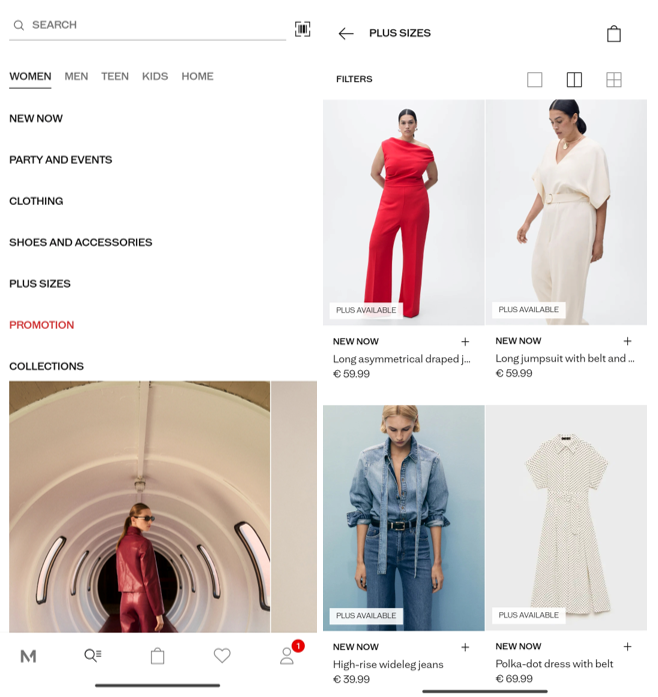
Source : Mango app.
Previous academic research has generally given limited attention to social sustainability in the fashion industry (McCormick & Ram, 2022; Schönborn et al., 2019). While there are notable exceptions (Lee et al., 2024), most existing studies focus on consumers' perceptions of sustainability practices (Li et al., 2024) rather than on how fashion brands themselves implement environmental and social sustainability in practice. To address this gap, the present exploratory study examines fashion brands' sustainability practices by focusing on two key consumer touchpoints—websites and mobile applications—which provide relevant data to analyze the prominence of social sustainability practices relative to environmental ones.
To this aim, this paper adopts an “empiric-first” approach (Golder et al., 2022; Haviv & Li, 2025), which refers to research grounded in a real-world observation, involving the collection and analysis of data, and producing marketing-relevant insights without necessarily testing theory. Consistent with this approach, the study follows a grounded theory-based, iterative process to inductively derive insights from the data. This approach is particularly appropriate for three reasons. First, limited research has addressed social sustainability beyond issues such as fair trade and supply chain externalities. Second, it is well-suited to contexts involving newly emerging data, such as the data extracted from fashion applications, enabling researchers to explore previously unexamined relationships, including comparisons between social and environmental sustainability practices. Third, the findings may have important implications for multiple stakeholders. As noted by Lim (2026), this approach translates empirical observations into generalizable, actionable knowledge.
Building on this approach, this study develops a set of indicators to compare the relative prominence of social versus environmental sustainability within the fashion industry. These indicators are applied to a sample of fashion brands operating across digital platforms. In addition, user reviews of the corresponding mobile applications are collected and analyzed to provide insights into how consumers engage with and discuss issues related to environmental and social sustainability.
This article makes several contributions to the field of fashion and sustainability.First, it provides a comprehensive assessment of the social and environmental sustainability practices currently being implemented by fashion brands across two key consumer touchpoints. This, in turn, enables a comparative analysis to provide an initial indication of which type of sustainability is more widely adopted across fashion brands. Second, the study extends the concept of social sustainability into the consumption sphere, addressing issues such as gender stereotypes and biases related to body weight, sexual orientation, and disability.Third, the study examines how sustainability practices are enacted through websites and mobile applications. While websites initially served as the primary platform for communicating sustainability-related information (Hesse & Rundau, 2023), mobile applications have emerged as critical touchpoints for fashion brands aiming to stay competitive (Azemi et al., 2022; Patel et al., 2023; Pop et al., 2023). Despite the growing relevance of this touchpoint, its role in advancing environmental and social sustainability remains largely underexplored.Finally, given the empiric-first approach used (Golder et al., 2022), the paper offers theoretical insights that may be useful for future research and for providing actionable advice to stakeholders.
Related Literature
Sustainability in the Fashion Industry
Sustainability, one of the most prevalent concepts in business and society over the past two decades, has become a well-established principle within the fashion industry (Hesse & Rundau, 2023). Traditionally, business sustainability concerns firms' actions regarding their economic, social, and environmental impacts on market and society (Svensson et al., 2016). This framework is known as the Triple Bottom Line (TBL), in which each dimension is considered a crucial component of sustainability (Andersson et al., 2022). The core principle of the Triple Bottom Line (TBL) is that business sustainability, along with its associated actions, must generate economic value by balancing profits with the implementation of social and environmental strategies (Svensson et al., 2016).
Given the growing significance of sustainability within the fashion industry, the concept of sustainable fashion has emerged as a counterpoint to fast fashion. Sustainable fashion refers to a range of practices that seek to benefit both people (i.e., social) and the planet (i.e., environmental) (Mukendi et al., 2020). In fact, these authors propose a definition of sustainable fashion as “the variety of means by which a fashion item or behavior could be perceived to be more sustainable, including (but not limited to) environmental, social, slow fashion, reuse, recycling, cruelty-free and anti-consumption and production practices” [p. 2874](Mukendi et al., 2020, p. 2874).
In the context of the fashion industry, the environmental and social dimensions of sustainability can be observed through various consumer touchpoints, such as social media (Castillo-Abdul et al., 2022), corporate websites (Hesse & Rundau, 2023; Ma et al., 2015), and mobile applications. In contrast, the economic dimension is less directly observable, as it relates to a company's capacity to achieve economic growth and financial performance (Andersson et al., 2022; Hesse & Rundau, 2023). The following sections, therefore, discuss the environmental and social aspects of sustainable fashion.
Environmental Sustainability in the Fashion Industry
Environmental sustainability has become a critical concern for businesses, and the fashion industry is no exception. It can be defined as a state of balance, resilience, and interconnectedness that enables human society to meet its needs without exceeding the regenerative capacity of supporting ecosystems or diminishing biological diversity (Morelli, 2011). The fashion industry is widely recognized as one of the most polluting sectors globally (Grazzini et al., 2021; Mohammed & Razé, 2023). It is notorious for its significant environmental footprint, including substantial water consumption, carbon emissions, the use of toxic chemicals, and waste generation (Islam et al., 2020). Processes such as dyeing and finishing consume vast amounts of water and release substantial textile effluents containing harmful contaminants (Kumar & Joshiba, 2020). In addition, the overproduction of garments and their subsequent disposal (Roberts et al., 2023), as well as the environmental impact of online shopping (Al-Mulali et al., 2015) and product returns (Rossolov et al., 2024), contribute to the industry's negative environmental footprint.
In response to this situation, academic research has increasingly focused on environmental sustainability issues within the fashion industry (Caniato et al., 2012; Goworek et al., 2020; Islam et al., 2020), analyzing both consumers perceptions and industry practices. On the one hand, consumers are becoming more aware of the environmental impact of clothing production. What was once a concern for an elite audience is now extending to a broader, evolving consumer base that is more interested in the origin and traceability of the garments they purchase (Abbate et al., 2023). As a result, fashion brands are increasingly adopting more environmentally friendly practices (Carfagna et al., 2014; Mukendi et al., 2020; Niinimäki et al., 2020), which can enhance competitiveness (Musova et al., 2021) and consumer loyalty (Egels-Zandén & Hansson, 2015; Strähle et al., 2015).
Among the practices that fashion brands are adopting to reduce their environmental impact are the use of recycled materials to produce more sustainable garments (Caniato et al., 2012; Leonas, 2016) and the recycling of clothing items (Bouzon & Govindan, 2015; Forlin & Scholz, 2020). A notable example is H&M's global Garment Collecting initiative, which allows consumers to drop off clothing or textiles at H&M stores in exchange for a discount voucher for future purchases. In partnership with I:CO, H&M assesses the condition of the returned items and either resells, reuses, or recycles them accordingly (Forlin & Scholz, 2020). Similarly, Zara has integrated its Zara Pre-Owned program directly into both its website and mobile application (Figure 2), allowing users to donate, resell, or repair garments. This initiative embeds sustainability messaging into a widely used platform, increasing exposure to circular fashion practices. Additionally, the growth of online fashion sales has prompted brands to implement strategies that reshape the delivery and returns experience in e-commerce, such as adopting electric vehicles (Siragusa et al., 2020) and establishing automated parcel lockers (Rossolov et al., 2024). As a result, environmental sustainability is becoming increasingly important in the fashion industry, with brands adopting practices to reduce their impact, driven by growing consumer awareness and demand for sustainability.
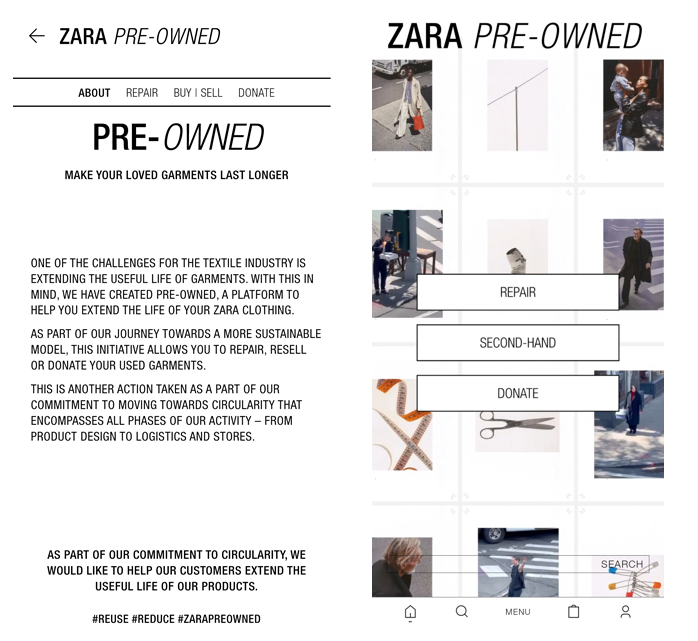
Source : Zara app.
Social Sustainability in the Fashion Industry
Fashion companies, particularly major brands, bear significant responsibility for the social impacts of their activities (Ritch et al., 2023). Social sustainability refers to business practices that prioritize societal well-being and the public good in corporate decision–making (Andersson et al., 2022). Accordingly, companies should create value for society by adopting socially responsible practices that go beyond profit generation (Farooq et al., 2021).
Compared with environmental sustainability, social sustainability has received relatively less attention (Klampfl, 2025), with existing research largely concentrated on the production stage of the apparel supply chain (Fernando et al., 2022). Issues such as child labor, inequality, excessive overtime, and poor working and living conditions in production have been widely recognized as major social externalities within the fashion industry (Fernando et al., 2022; Li et al., 2024). The concept of fair trade captures the local social impacts of fashion activities on producer communities and has traditionally served as a framework for addressing such concerns. However, while fair trade initiatives have achieved widespread adoption and consumer recognition in food and agricultural sectors (Eberhardt et al., 2020), their implementation within the fashion industry has been more limited and complex due to fragmented global supply chains and multi-tier production processes. Consequently, social sustainability in fashion has often been conveyed through brand-specific initiatives and proprietary labels, such as Zara's Join Life label, rather than through universally recognized fair trade certifications.
Although uncertainty remains regarding the specific social aspects relevant to consuming communities (Beyer & Arnold, 2022), it is widely accepted that social sustainability should promote inclusion, equity, dignity, and respect for diversity (Schoormann & Kutzner, 2020; Takhar, 2015). In fashion, issues such as gender representation, body diversity, and inclusivity have attracted increasing criticism and debate in recent years (Ritch et al., 2023), raising concerns about the industry's ability to respond effectively to societal shifts. This discourse raises questions about whether industry has fostered social progress or, conversely, impeded it by failing to adapt. Aligned with recent research (Beyer & Arnold, 2022; Lee et al., 2024; Schoormann & Kutzner, 2020), this study argues that the scope of social sustainability should explicitly consider dimensions such as inclusion, representation, and equality.
Fashion ideas and attitudes towards gender have undergone significant shifts (Dikkar, 2021; Ritch et al., 2023), with an increasing advocacy for a gender–neutral approach (Muller et al., 2024). Fashion brands are increasingly launching unisex clothing, designed to be suitable for both genders and worn by individuals of any sex (Bardey et al., 2020). In doing so, unisex collections challenge traditional gender boundaries, dismantling the binary structure of gender (Dikkar, 2021; Song, 2023). Unisex fashion is often viewed as a symbol of equality and freedom (Song, 2023), empowering individuals to express their personal style without constraints (Dikkar, 2021). Furthermore, unisex clothing can help mitigate pressures, stigma, or discrimination for not conforming to traditional gender norms (Bardey et al., 2020). Through such initiatives, the fashion industry is promoting gender equality (Muller et al., 2024).
The fashion industry is also increasingly evaluating the extent to which it embraces and respects social diversity, particularly regarding sexual orientation. In this context, the LGBTQ+ community has expressed a growing demand for fashion brands and products specifically designed to cater to their needs (Chauhan et al., 2019). Individuals within the LGBTQ+ community often express their identities through unique and varied fashion choices (Reddy-Best et al., 2024). As society becomes more inclusive and open (Song, 2023), fashion brands are responding by offering and promoting clothing styles and products that acknowledge and reflect the diverse identities and needs of the LGBTQ+ community (Khurana et al., 2017; Lennon et al., 2017; Reddy-Best et al., 2024).
In addition to gender issues, there is a wide range of body types and shapes among consumers, yet unrealistic body images are prevalent in the media and on brands' own channels. Previous research has shown that self-comparisons to unrealistic media portrayals can negatively impact mental health (Knobloch-Westerwick, 2014). As a result, the fashion industry has faced criticism for failing to promote consumer well-being and for perpetuating harmful stereotypes. Size-related concerns have also emerged as a significant issue, especially in online fashion shopping (Li & Zhao, 2024). In response, fashion brands are increasingly incorporating plus-size models (Clayton et al., 2017; Joo & Wu, 2021) and offering plus-size clothing (Romeo & Lee, 2015). According to (Joo & Wu, 2021), the inclusion of plus-size products in fashion lines signifies the incorporation of social sustainability practices in garment design.
More recently, disability inclusion has emerged as an important topic in the marketing literature (Lee et al., 2024; Wang & Wei, 2025). Representation of people with disabilities in the fashion industry remains limited, although some brands have begun to feature models with disabilities and develop adaptive apparel—clothing specifically designed or modified to meet the needs of people with disabilities (Lee et al., 2024; Rana et al., 2024). For instance, in January 2025, Primark partnered with Victoria Jenkins, founder of the adaptive fashion brand Unhidden, to launch a collection aimed at reducing barriers to inclusive apparel (Primark, 2025). Examples of adaptive garments include accessible openings, tube-friendly pockets, and bibs attached at side seams. In this context, several studies have examined how consumers perceive fashion brands that address disability. (Lee et al., 2024), for example, found that consumers tend to respond positively to luxury fashion campaigns featuring disabled models, particularly when the campaigns are perceived as engaging, credible, and authentic. Similarly, (Wang & Wei, 2025) showed that featuring people with disabilities (rather than non-disabled individuals) enhances marketing effectiveness by improving brand attitudes and brand choice. (Rana et al., 2024) further argued that the fashion industry should prioritize inclusivity and adaptability to foster broader societal acceptance and empower people with disabilities. Figure 3 illustrates how Kiabi has integrated its So Easy collection, which focuses on clothing for people with disabilities, into its mobile application.
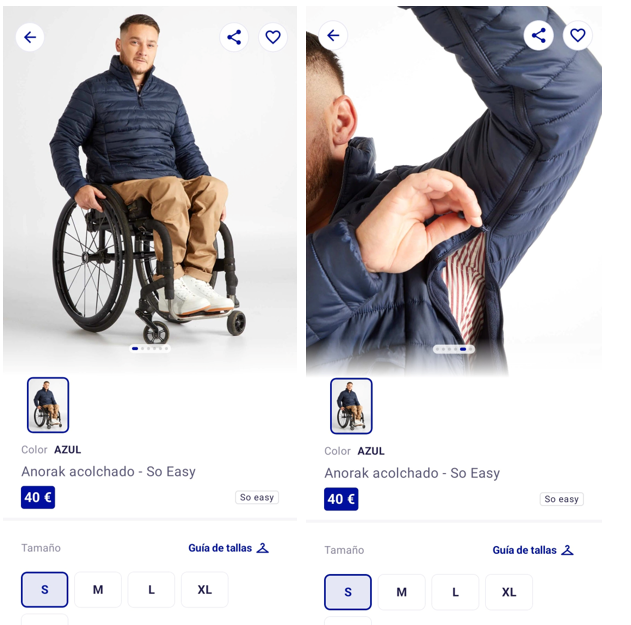
Source: Kiabi app.
In summary, two major dimensions of social sustainability can be identified: (1) the production side and (2) the consumption side. The production side encompasses the policies, programs, and operational practices that fashion brands implement to promote fair trade principles and ensure ethical, transparent supply chains. The consumption side, meanwhile, includes strategies aimed at fostering equality and inclusivity, such as the promotion of gender equality through unisex clothing collections (Saha et al., 2021), the inclusion of the LGBTQ+ community through the development of targeted fashion products (Chauhan et al., 2019; Reddy-Best et al., 2024), the expansion of plus-size offering to accommodate diverse body shapes (Clayton et al., 2017; Joo & Wu, 2021), and the advancement of disability inclusion through adaptive clothing (Lee et al., 2024; Wang & Wei, 2025). These initiatives are considered key strategies in this paper for social sustainability. It is therefore relevant to examine the extent to which the fashion industry is evolving to promote equality and inclusivity across these dimensions.
Research Questions
Websites have traditionally served as key consumer touchpoints for fashion brands, playing a crucial role in communicating sustainability information to consumers (Hesse & Rundau, 2023; Quiles-Soler et al., 2022). In recent years, mobile applications have also become increasingly important platforms for engaging consumers (Landim et al., 2021; Salvietti & Ieva, 2024), with growing integration of sustainability content across both digital channels. For instance, consumers are now accustomed to accessing information about product traceability and origin through these touchpoints when evaluating potential purchases.
Despite its growing focus, social sustainability has received comparatively less attention (Schoormann & Kutzner, 2020), and there remains uncertainty about which social aspects are most relevant for communication on these platforms (Beyer & Arnold, 2022). Identifying the social sustainability practices adopted by fashion brands across websites and mobile applications can provide valuable insights into how the concept is understood and applied within the industry. Furthermore, it is unclear whether social and environmental sustainability efforts are implemented with equal emphasis across these platforms, or whether one dimension is prioritized over the other. Likewise, little is known about how consumers perceive and discuss these practices. To address these gaps, this paper explores the following research questions:
-
RQ 1. Which social and environmental sustainability practices are most commonly implemented by fashion brands across their digital platforms?
-
RQ 2. Are fashion brands more likely to implement environmental or social sustainability practices?
-
RQ 3. Is there a relationship between fashion brands' environmental sustainability performance and their social sustainability performance?
-
RQ 4. To what degree is sustainability mentioned in customer reviews of fashion mobile applications?
-
RQ 5. What do customers express in their reviews regarding the social and environmental sustainability practices of fashion brands?
Methodology
The empirics–first approach (Golder et al., 2022) was adopted and implemented through a grounded theory–inspired content analysis (Charmaz, 2006; Glaser, 1978). This approach enabled the identification of relevant indicators and analytical patterns directly from the empirical material, allowing environmental and social sustainability practices to be inductively derived from the data. Such an empirically driven and inductively oriented approach is particularly suitable for research areas that remain underexplored (Charmaz, 2006; Hodkinson, 2008). The analysis began with inductive open coding, without the imposition of predefined theoretical categories, thereby allowing patterns to emerge naturally from the data.
Methodological rigor was ensured by drawing on established guidelines for content analysis (Castillo-Abdul et al., 2022; Krippendorff, 2019; Palazón et al., 2022; Sicilia et al., 2008). This method facilitates the systematic description of a phenomenon (Hsieh & Shannon, 2005) by interpretating the meaning embedded in textual and visual materials. Content analysis was initially conducted on fashion brands' mobile applications and subsequently extended to their corporate websites, which served as the units of analysis. In addition, the study was complemented by an exploratory analysis of consumer reviews to incorporate the consumer perspective.
Content Analysis of Fashion Brand Websites and Apps
During the initial observation phase, fashion brands' mobile applications were reviewed iteratively to identify features and content related to environmental and social sustainability practices. In line with grounded theory–inspired principles (Glaser, 1978), data collection and analysis proceeded concurrently, and additional applications were included until theoretical saturation was reached, that is, until no new sustainability-related themes or indicators emerged from the analysis.
The applications analyzed spanned a wide range of market contexts, including well-known and lesser-known brands, luxury and budget segments, apps targeting women and men, single-brand and multi-brand platforms, and applications from large retailers and those focused on specific clothing categories (e.g., sportswear). This iterative process resulted in the analysis of 80 mobile fashion applications.11 1 As mobile applications can be considered an extension of corporate websites, all the indicators derived from the observations are likewise observable on websites. All authors participated in the observation process to ensure analytical rigor.
The goal of this phase was to generate an initial set of indicators capturing environmental and social sustainability features and to identify emerging patterns and themes. Relevant literature was also consulted to support the interpretation and refinement of the empirically derived indicators, in line with the empirics-first approach, which encourages engagement with existing theory after initial patterns have emerged.
4.1.1 Proposal of indicators to assess social and environmental sustainability
For the environmental sustainability indicators, we aimed to systematically assess the extent to which fashion brands have incorporated environmental practices into their mobile applications and websites, spanning different stages of the value chain, from production (e.g., product traceability and origin) to delivery (e.g., the use of electric vehicles for transportation). Based on our observations, we categorized the indicators into four distinct groups: (1) Product & Production Process, (2) Delivery & Returns, (3) Recycling, and (4) Environmental Policy. The following lines provide a rationale for each of the identified indicators and explain their relationship to these four categories.
Regarding the Product & Production Process category, one key challenge faced by fashion brands is the complexity of their supply chain networks and the multitude of actors involved in the production process (Dikkar, 2021; Kumar et al., 2017). To effectively implement environmental sustainability in the fashion industry, brands must adopt traceability systems. A central aspect of product traceability is the origin of materials (Garcia-Torres et al., 2021; Kumar et al., 2017). Additionally, it is important for fashion brands to provide accurate information on organic fiber labels and environmental certifications that validate the sustainability of their products (Kumar et al., 2017). Communicating this information through digital channels signals that the brand is actively implementing environmentally sustainable practices.
Deliveries & Returns in e-commerce have generated several negative externalities, particularly regarding their environmental impact. To mitigate these effects, the fashion industry is increasingly adopting environmentally friendly alternatives. For deliveries, sustainable shipping practices, such as last-mile logistics optimization and the use of electric vehicles, are becoming increasingly common (Kokkinou et al., 2024; Rossolov et al., 2024). To reduce unnecessary trips, which are harmful to the environment, some retailers are implementing return fee policies; for example, Zara deducts €1.95 from the consumer's refund for home return requests (Bower & Maxham, 2012; Rossolov et al., 2024). Another environmentally friendly alternative for both returns and deliveries is the use of parcel lockers and/or pickup/drop-off points (Vakulenko et al., 2018).
Concerning the Recycling category, fashion brands are implementing programs to promote the circular economy, with closed-loop systems emerging in response to concerns over potential shortages of certain raw materials (Bouzon & Govindan, 2015). In this context, take-back programs (TBPs) have emerged as a circular business model (Forlin & Scholz, 2020) that is increasingly adopted by fashion retailers to minimize textile waste and prevent used clothing from ending up in landfills (McKie et al., 2023). To encourage consumer participation, retailers may offer financial incentives (McKie et al., 2023).
Finally, it is essential for fashion brands to communicate their environmental sustainability policies, as this can be a key differentiator. Including a dedicated section on environmental practices in both the website and mobile application can signal the importance a brand places on such efforts (Campopiano & De Massis, 2014), making it a valuable indicator of environmental sustainability. Since websites have traditionally been the primary platform for communicating such policies (Campopiano & De Massis, 2014; Hesse & Rundau, 2023), it is worthwhile to examine whether this communication is effectively extended to mobile applications, which can be considered an extension of corporate websites (Palazón et al., 2022).
Table 1 presents the analysis sheet used to assess environmental sustainability in both websites and fashion applications. Drawing on the grounded theory–inspired observations and the rationale for the four identified categories, a total of 10 indicators were developed. These indicators are detailed in Table 1, which outlines each indicator, its corresponding category, the coding scheme used for each indicator, and the references supporting the proposed indicators.
Table 1. Environmental Sustainability Analysis Sheet
| Category | Indicator | Measuring | Coding | Supporting references |
| Product & Production Process | (ES 01) Product traceability | Whether the entire production and distribution process of their products is tracked, from the sourcing of raw materials to the final customer receiving their purchase. |
No = 0
Yes = 1 |
(Dikkar, 2021; Garcia-Torres et al., 2021; Kumar et al., 2017) |
| (ES 02) Sustainable materials and production | Whether the website/app offers products made from environmentally friendly materials (e.g., items crafted from recycled fibers or sustainable materials), or if the production process is designed to minimize environmental impact (e.g., by reducing energy and water consumption) |
No = 0
Yes = 1 |
(Caniato et al., 2012; Sigaard & Laitala, 2023) | |
| (ES 03) Sustainable products section | Whether there is a dedicated section where products made with environmentally friendly materials (e.g., recycled fabrics) are grouped together. |
No = 0
Yes = 1 |
||
| Delivery & Returns | (ES 04) Sustainable shipping | Whether delivery options are offered using sustainable vehicles such as electric cars or scooters for order distribution. |
No = 0
Yes = 1 |
(Kokkinou et al., 2024; Rossolov et al., 2024) |
| (ES 05) Pick-up / drop-off points | Whether the website/app offers pickup and/or drop-off points for orders, reducing the environmental impact of home delivery and returns. |
No = 0
Yes = 1 |
(Vakulenko et al., 2018) | |
| (ES 06) Sustainable home-based returns | Whether the website/app offers sustainable options for home-based returns (e.g., bicycles, scooters, or electric cars). |
No = 0
Yes = 1 |
(Kokkinou et al., 2024; Rossolov et al., 2024) | |
| (ES 07) Return fee | Whether an additional charge is applied for home return services |
No = 0
Yes = 1 |
(Bower & Maxham, 2012; Rossolov et al., 2024) | |
| Recycling | (ES 08) Clothing recycling program | Whether the website/app provides information on the company’s clothing recycling initiatives |
No = 0
Yes = 1 |
(Bouzon & Govindan, 2015; Forlin & Scholz, 2020) |
| (ES 09) Recycling incentive | Whether the website/app offers an incentive (e.g., points or discounts) to encourage consumers to recycle clothes. |
No = 0
Yes = 1 |
(Forlin & Scholz, 2020; McKie et al., 2023) | |
| Environmental Policy | (ES 10) Environmental policy section | Whether the website/app includes a section detailing the company’s environmental sustainability policies. |
No = 0
Yes = 1 |
(Quiles-Soler et al., 2022) |
Similarly, for the social sustainability indicators, we aimed to systematically assess the extent to which fashion brands have incorporated social practices. Based on the analysis, the indicators were categorized into two groups: (1) Production Side and (2) Consumption Side.
Regarding the Production Side, fashion brands have demonstrated commitment to ethical and responsible production practices (Fernando et al., 2022; Goworek et al., 2020). Some brands have developed fair-trade labels to promote equitable trading relations, ensure fair remuneration for producers, safeguard human and labor rights, and enhance transparency across the supply chain (Naylor, 2013; Renard, 2005). Fair–trade certifications verify not only companies' practices but also those of their producers and manufacturers, ensuring equitable labor conditions, fair pricing, and positive social impacts throughout the fashion supply chain. Given that fair–trade certificates issued by independent organizations are relatively uncommon in the fashion industry, it is worth examining whether brands have developed their own certifications, whether this information appears in their Corporate Social Sustainability Programs, or whether their corporate websites and mobile applications include clear policies on child labor, labor conditions, human rights, community support, fair pricing and supply–chain monitoring practices.
Regarding the Consumption Side, major fashion brands have increasingly entered the unisex clothing segment (Dikkar, 2021). First, the presence of unisex products indicates a brand's basic commitment to social sustainability. Second, the range of unisex offerings reflects the extent of the brand's involvement in promoting gender equality, as previous studies have highlighted a growing demand for gender-neutral options (Chauhan et al., 2019). Third, a dedicated section on a website or mobile application can signal the importance a brand places on actively implementing and communicating its social sustainability initiatives (Campopiano & De Massis, 2014).
Second, regarding the inclusion of the LGBTQ+ Community, this community has expressed interest in LGBTQ+ focused fashion products (Chauhan et al., 2019; Reddy-Best et al., 2024) and faces challenges related to clothing fit (Chauhan et al., 2019). The presence of products tailored to this group indicates a brand's core commitment to social sustainability, while the range of LGBTQ+-focused offerings reflects the extent of its engagement with diversity and inclusion. Including a dedicated section on the website or mobile application can further signal a deeper commitment to social sustainability.
Third, regarding plus-size fashion, the availability of these products reflects the industry's commitment to inclusion through garment design Joo & Wu (2021). Research has shown that plus-size individuals are often dissatisfied with the limited options available (Greenleaf et al., 2019; Hudson & Hwang, 2020), and online platforms can provide selections that may not be found in physical stores (Romeo & Lee, 2015). Online platforms such as corporate websites and mobile applications therefore serve as ideal channels for offering plus-size products. The presence and range of these products indicate a brand's commitment to social sustainability, while a dedicated section can further signal its emphasis on inclusion.
Finally, regarding disability inclusion, the availability of adaptive garments on corporate websites and mobile applications reflects a brand's commitment to people with disabilities and/or impairments (Lee et al., 2024; Rana et al., 2024). Despite growing attention to diversity, the representation of disability remains significantly less common than that of gender, body inclusivity, or sexual orientation (Qayyum et al., 2023). Beyond mere representation, it is important to assess whether fashion brands design products tailored to this community's needs. The availability and range of adaptive garments, along with a dedicated section for these items, can therefore serve as key indicators of social sustainability.
The analysis sheet used to assess social sustainability on corporate websites and fashion applications is presented in Table 2. Following the observation method inspired by Grounded Theory, a set of 21 indicators was developed. The table details each indicator, its corresponding coding scheme, and the references supporting its inclusion. To ensure comparability between environmental and social sustainability assessments, both sets of indicators were given equal weight. Each brand could receive a maximum of 10 points for social sustainability and 10 for environmental sustainability, for a total possible score of 20.
Table 2. Social Sustainability Analysis Sheet
| Category | Indicator | Measuring | Coding | Supporting references |
| Production Side | (SS 01) Fair-trade certification | If the brand holds any official fair-trade certification listed on its website or app. |
No = 0
Yes = 1 |
(Jones & Williams, 2012; Naylor, 2013; Renard, 2005; Shaw et al., 2006) |
| (SS 02) Proprietary fair–trade certification | If the brand has established its own program addressing the social dimensions of fair trade, such as labor conditions and child labor prevention. |
No = 0
Yes = 1 |
||
| (SS 03) Child Labor Policy | If the brand implements policies to prevent the use of child labor. |
No = 0
Yes = 0.5 |
||
| (SS 04) Labor Conditions Policy | If the brand has policies promoting decent working conditions for employees. |
No = 0
Yes = 0.5 |
||
| (SS 05) Human Rights Policy | If the brand maintains policies to ensure human rights standards. |
No = 0
Yes = 0.5 |
||
| (SS 06) Community Support | If the brand implements initiatives aimed at supporting the social and economic development of the communities where its products are manufactured. |
No = 0
Yes = 0.5 |
||
| (SS 07) Supply Chain Monitoring | If the brand enforces policies to monitor and evaluate the working conditions within its supply chain. |
No = 0
Yes = 0.5 |
||
| (SS 08) Fair Pricing Policy | If the brand states that it pays a fair price to producers, cooperatives, or artisans. |
No = 0
Yes = 0.5 |
||
| Consumption Side | (SS 09) Unisex products | Whether the website/app offers products designed for all genders (unisex). |
No = 0
Yes = 0.5 |
(Chauhan et al., 2019; Dikkar, 2021; Song, 2023) |
| (SS 10) Unisex product range | Indicates whether the website/app offers a wide variety of unisex products. |
No = 0
Yes = 0.25 |
||
| (SS 11) Unisex products section | Whether there is a dedicated section on the website/app for unisex products. |
No = 0
Yes = 0.5 |
||
| (SS 12) LGBTQ+ products | Whether LGBTQ+ products are offered through the website/app. |
No = 0
Yes = 0.5 |
(Chauhan et al., 2019; Reddy-Best et al., 2024; Takhar, 2015) | |
| (SS 13) LGBTQ+ product range | Whether the website/app offers a wide variety of LGBTQ+ products. |
No = 0
Yes = 0.25 |
||
| (SS 14) LGBTQ+ products section | Whether there is a dedicated section for LGBTQ+ products on the website/app. |
No = 0
Yes = 0.25 |
||
| (SS 15) LGBTQ+ policy section | Whether there is information on the website/app explaining the company’s policies regarding the LGBTQ+ community |
No = 0
Yes = 0.25 |
||
| (SS 16) Plus-size products | Whether plus-size products are offered through the website/app. |
No = 0
Yes = 0.5 |
||
| (SS 17) Plus-size product range | Whether a large variety of plus-size products are offered through the website/app. |
No = 0
Yes = 0.25 |
(Greenleaf et al., 2019; Hudson & Hwang, 2020; Joo & Wu, 2021; Romeo & Lee, 2015) | |
| (SS 18) Plus-size products section | Whether there is a dedicated section for plus-size products on the website/app. |
No = 0
Yes = 0.5 |
||
| (SS 19) Adaptive products | Whether adaptive products are offered through the website/app. |
No = 0
Yes = 0.5 |
(Lee et al., 2024; Rana et al., 2024) | |
| (SS 20) Adaptive products range | Whether a variety of adaptive products are offered through the website/app. |
No = 0
Yes = 0.25 |
||
| (SS 21) Adaptive products section | Whether there is a dedicated section for adaptive products |
No = 0
Yes = 0.5 |
4.1.2 Sample selection for testing the proposed indicators
The proposed indicators were tested using a sample of 50 major fashion brands operating in Spain. To ensure consistency and comparability, the study focused exclusively on brands operating in a single country. Spain was selected due to its influential fashion industry (Escobar-Rodríguez & Bonsón-Fernández, 2016) and an increasingly aware consumer base (Blas Riesgo et al., 2022). A recent study found that 81% of respondents expressed concern about textile waste, while 37% indicated a willingness to pay more for sustainable fashion products (IBM, 2020). Limiting the scope to Spain allowed for a valid comparison of sustainability practices within a specific market.
Brands specializing exclusively in a single clothing category, such as sportswear, were excluded. The indicators were tested with major fashion brands that offer a broad range of products for several reasons: these brands are actively developing both social and environmental sustainability practices (Hesse & Rundau, 2023), are more likely to have mobile applications facilitating online purchases (Escobar-Rodríguez & Bonsón-Fernández, 2016), and typically provide offerings for both men and women, ensuring broader representational coverage. A total of 50 brands that met both the mobile application and website criteria were included in the study. The selected brands are listed in Appendix A.
4.1.3 Procedure
To collect data on the proposed indicators, established academic procedures were followed. Specifically, two trained coders—penultimate-year undergraduate students enrolled in a marketing course—performed the coding independently. When their assessments differed, a third trained coder reviewed the discrepancies and made the final decision (Fowler & Thomas, 2013).
Following recommendations from prior research (Palazón et al., 2022; To & Patrick, 2021), the coders were not involved in the study design and were unaware of its objectives. They received in-person training in a 2.5-hour session, during which the authors explained the coding process in detail, provided specific instructions for data collection, and conducted a live demonstration using the coding sheet. In line with the procedure described by Fowler & Thomas (2013), a coding manual was developed to support the coders throughout the process. The manual specifies where to locate relevant information within websites and mobile applications for each indicator and provides instructions for recording the findings on the coding sheet. The coding manual is included in Appendix B.
Data were collected independently in multiple phases over the course of the study, from mid-2023 to early 2026, due to requests arising during the review process. The final phase focused on production-side indicators. This approach ensured comprehensive coverage of all indicators across both mobile applications and websites. Inter-coder reliability was measured using Krippendorff's , with scores exceeding the recommended threshold for both environmental/social indicators (α= 0.941) and production-side indicators (α= 0.853), indicating consistent coding (Krippendorff, 1980).
Analysis of User Reviews
These reviews were examined to determine whether and how consumers address social and environmental issues in their comments on fashion brand mobile applications. The analysis of reviews is limited to mobile applications, as no dedicated review system exists for fashion brand websites. Thus, the consumer perspective was incorporated through a complementary analysis of customer reviews collected from the Apple and Google app stores.
To analyze the consumer perspective, user reviews of the mobile applications under study were collected. The goal of this analysis was not only to determine whether sustainability practices implemented by fashion brands were mentioned in reviews, but also to understand how they were discussed and what was said about them. Reviews were collected using Octoparse software from March 10th to July 31st, 2023.
From each consumer review, the following information was extracted: individual rating, review date, review title, and review text. After extracting and consolidating the data into a single database, the dataset comprised 2,519 reviews, of which 2,049 were from the Play Store (Google) and 470 from the App Store (Apple). Following the methodology of Borghi & Mariani (2021) for capturing customers' online discourse related to sustainability, the reviews were organized into two subsamples: one containing sustainability-related reviews and the other containing all other reviews. The keywords used to identify sustainability-related reviews covered both environmental and social sustainability, including terms such as sustainability, environment, materials, recycling, sustainable shipping, plastic, pollution, fair-trade, fair-trade certification, child labor, fair pricing, labor rights, human rights, social responsibility, ethics, community support, supply chain, certificate, inclusivity, sizes, plus-size, non-normative sizes, disability, and LGBTQ+ community. This process resulted in a database that distinguishes between reviews that mention sustainability and those that do not.
Results
The results are organized according to the proposed research questions. To address the first three research questions, we present the findings from the content analysis of websites and mobile applications. Specifically, the results include: (1) the implementation frequency of each social and environmental sustainability practice across websites and mobile applications, (2) the average implementation rates across brands for each sustainability dimension, and (3) the overall sustainability scores assigned to each brand, with a maximum of 10 points per category. The first set of findings identifies which specific practices are more or less commonly implemented by fashion brands. The second offers a comparative overview of the extent to which environmental and social sustainability practices are adopted across the sample. The third facilitates brand-level comparisons of sustainability performance. Finally, the results from the customer review analysis are discussed to address the last two research questions.
RQ 1. Which social and environmental sustainability practices are most widely implemented by fashion brands across their digital platforms?
Focusing on social sustainability, results are organized into production-side and consumption-side practices. On the production side, none of the analyzed fashion brands integrate a fair-trade certification (SS 01) on either their websites or mobile applications. Regarding proprietary fair-trade certification (SS 02), only 12% of the brands (6 in total) have implemented such initiatives across both websites and mobile applications. As for specific practices, the most widely adopted ones relate to child labor (SS 03), labor conditions (SS 04), and human rights (SS 05), whereas the least implemented practice is fair pricing (SS 08), present in only 18% of mobile applications and 22% of websites.
On the consumption side, the most commonly implemented practice is related to plus-size fashion (SS 16), with plus-size products available in 66% of mobile applications but only 36% of websites. Gender inclusivity is also gaining traction, with 38% of brands offering unisex products on mobile applications compared with 24% on websites (SS 09). Several other practices remain largely unadopted. For example, only 16% of mobile applications and 8% of brands on websites offer LGBTQ+-specific products (SS 12), while adaptive clothing for individuals with disabilities (SS 19) is included by just 2% of brands across both platforms. Figure 4 summarizes these results, displaying the implementation percentages for all twenty-one social practices (8 corresponding to Production Side and 13 to Consumption side) across both platforms.
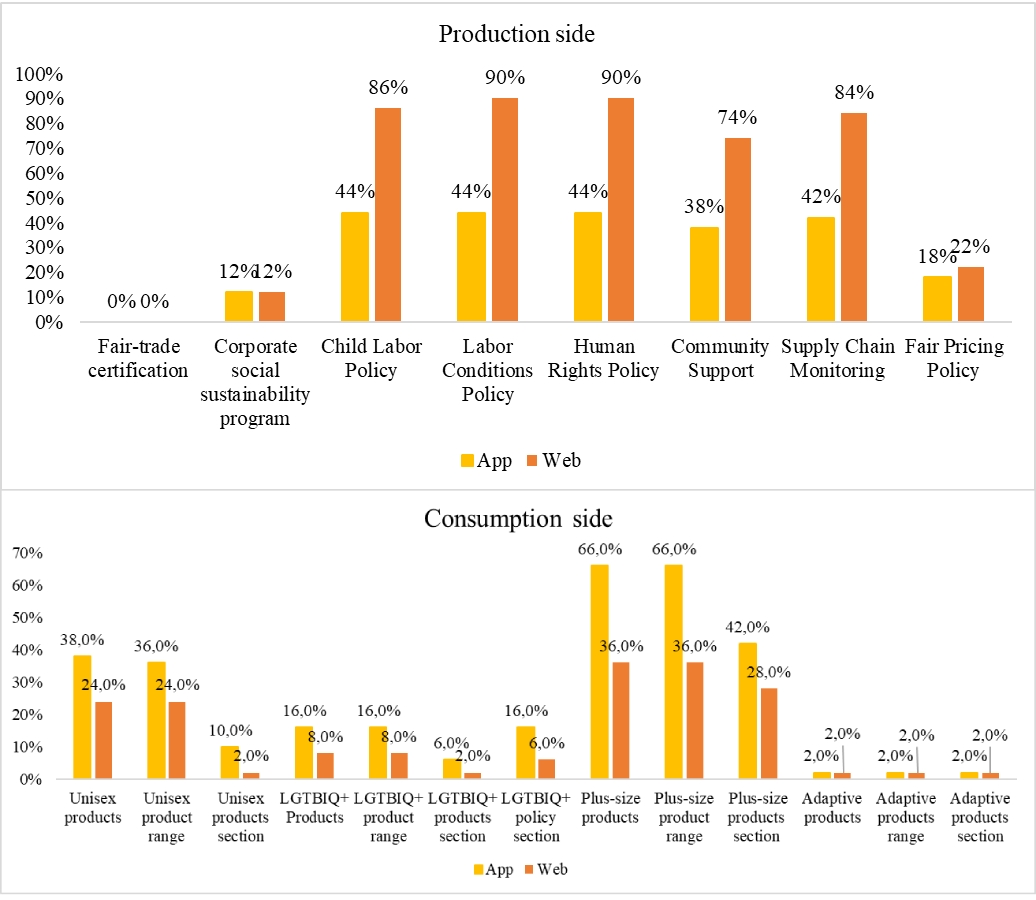
Source: Self-made.
Additionally, during Pride Month, coders were asked to observe whether brands adapted their logos to incorporate LGBTQ+ symbolism, such as the rainbow flag. Although this aspect was not part of the original set of indicators, only 10% of brands were found to have made such modifications in their mobile applications, further underscoring the limited engagement with LGBTQ+ representation.
Regarding environmental sustainability, the most widely adopted practice among the 50 analyzed brands is the provision of pickup/drop-off points (ES 05), implemented by 82% of brands on mobile applications and 56% on websites. The inclusion of environmental policy is also relatively common, appearing on 76% of websites and 54% of mobile applications. This finding aligns with previous research, as environmental sustainability information has traditionally been communicated through websites and has not yet been fully transferred to mobile applications. By contrast, sustainable shipping options (ES 04) are among the least implemented practices, adopted by only 6% of brands on mobile applications and 4% on websites. Overall, implementation rates for the ten environmental sustainability indicators range from 6% to 82% on mobile applications and from 0% to 76% on websites. Figure 5 summarizes these results, displaying the implementation percentages for all ten environmental practices across both platforms.
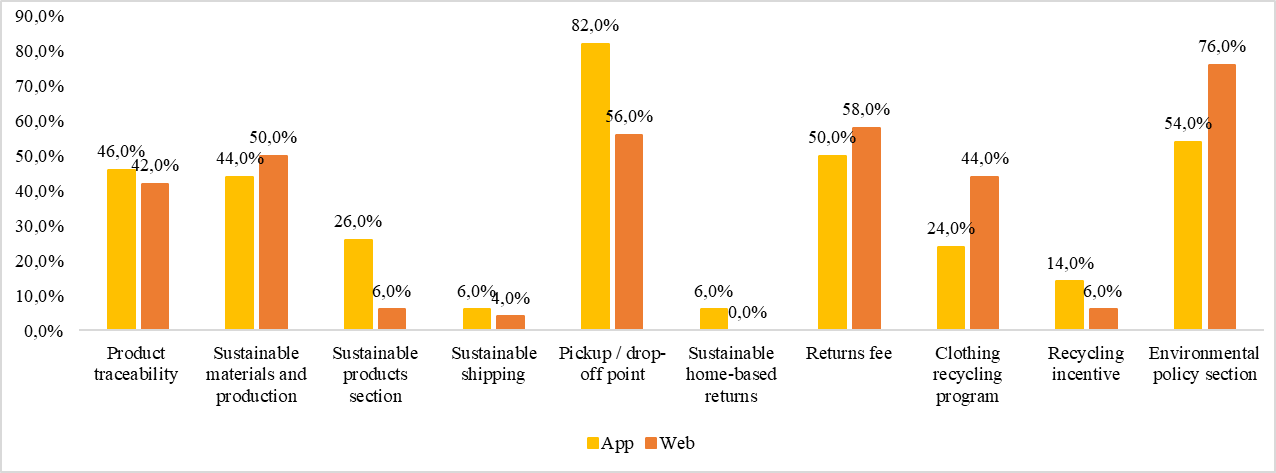
Source: Self-made.
RQ 2. Are fashion brands more likely to implement environmental or social sustainability practices?
To examine whether fashion brands are more likely to implement environmental or social sustainability practices, we compared the implementation rates of both dimensions across the sample. Each brand (N = 50) served as the unit of analysis, and the percentage of implemented practices was calculated separately for environmental and social categories. Shapiro–Wilk tests indicated that the assumption of normality was not consistently met across variables. Given the paired nature of the data and violations of normality in some variables, a Wilcoxon signed-rank test was employed as a nonparametric alternative to compare the two related samples for each platform.
For mobile applications, the mean implementation rate of environmental sustainability practices (M = 35.20%, SD = 20.43) was significantly higher than that of social sustainability practices (M = 11.93%, SD = 7.91). This difference was confirmed by the Wilcoxon signed-rank test (Z = -5.74, p < .001, r = 0.81), indicating a large effect size and demonstrating that environmental practices are more widely implemented than social practices in mobile applications. Similarly, on websites, environmental sustainability practices showed a substantially higher mean implementation rate (M = 34.2%, SD = 17.97) compared to social sustainability practices (M = 14.52%, SD = 6.59). This difference was also statistically significant (Z = -5.55, p < .001), with a large effect size (r = 0.56), suggesting that brands prioritize environmental sustainability over social sustainability on their websites.
When comparing the two digital touchpoints, environmental sustainability practices are generally more widely implemented than social sustainability practices. These findings, presented in Table 3, indicate that fashion brands prioritize environmental initiatives across both websites and mobile applications, while there remains substantial room for improvement in social sustainability.
Table 3. Environmental vs. Social Sustainability Implementation Rates
| Touchpoint | Mean Environmental (%) | Mean Social (%) | Wilcoxon Z | p-value | r (effect size) |
| Mobile Application | 35.20 | 11.93 | 5.74 | ¡0.001 | 0.81 |
| Website | 34.20 | 14.52 | 5.55 | ¡0.001 | 0.56 |
RQ 3. Is there a relationship between fashion brands' environmental sustainability performance and their social sustainability performance?
Based on the Social Sustainability Assessment, it is possible to identify which brands implement more social sustainability practices, as detailed in Appendix C. Out of a maximum score of 10, only six brands—Lefties, Kiabi, Levi's, Stradivarius, Pull&Bear, and Shein—scored at least five points on one of the platforms. However, performance in social sustainability remains low, with most brands scoring below five points across their mobile applications and/or websites. Notably, 4 brands did not implement any social sustainability practices in their mobile applications, and 3 did not implement them on their websites. These findings highlight that social sustainability remains largely underdeveloped across fashion brands' digital platforms, emphasizing the need for greater integration in this area.
In terms of environmental sustainability, the leading brands are H&M, NA-KD, and Silbon. Most brands scored five points or less across their mobile applications and/or websites (see Appendix D). Notably, one brand did not implement any environmental sustainability practices on its mobile application, while three brands showed no such practices on their websites. These findings highlight notable disparities in environmental sustainability across fashion brands' digital platforms, with some brands demonstrating considerable progress and others falling behind.
To address research question 3, Pearson correlation analyses were conducted to examine the relationship between environmental and social sustainability performance at each digital touchpoint. The results indicate a significant positive association between environmental and social sustainability practices on mobile applications (r = 0.34, p = .016) and on websites (r = 0.31, p = .031). These findings suggest that brands that perform well in environmental sustainability are also more likely to implement social sustainability practices within the same platform, highlighting a degree of alignment between the two dimensions at fashion brands' digital touchpoints.
RQ 4. To what degree is sustainability mentioned in customer reviews of fashion mobile applications?
Following the procedure outlined by Borghi & Mariani (2021), customer reviews were used to assess the relevance of sustainability practices in fashion applications. During the review collection period, 91 reviews mentioning sustainability were identified, compared to 2,428 reviews that did not. The average ratings of mobile applications were similar, with scores of 3.18 for sustainability-related and non-sustainability-related reviews. Among the reviews mentioning sustainability, only three discussed environmental sustainability, while 88 focused on social sustainability, and only one addressed both environmental and social sustainability. Notably, sustainability-related reviews were significantly longer than non-sustainability-related reviews, averaging approximately 214 characters, compared to around 95 for the latter. This difference in review length is significant. To compare the distributions of sustainability-related and non-sustainability-related app reviews, we used both the mean (t-test) and the median (Mann-Whitney-Wilcoxon test) tests. From these results, presented in Table 4, reviews addressing sustainability issues (primarily social sustainability) tend to be more detailed, suggesting greater customer concern.
Table 4. Comparison of Sustainability-Related vs. Not Sustainability-Related Reviews
| Total sample (N = 2,519) | No mention of sustainability (N = 2,428) | Mention of sustainability (N = 91) | Welch’s two-sample t-test (p) | Mann-Whitney-Wilcoxon test (p) | ||||
| Mean | SD | Mean | SD | Mean | SD | t | Wx107 | |
| Valence | 3.22 | 1.820 | 3.18 | 1.825 | 3.18 | 1.678 | 0.004 (0.997) | 0.866 (0.353) |
| Review Length (in characters) | 99.47 | 120.289 | 95.23 | 114.497 | 213.77 | 162.797 | 8.306 (¡0.001) | 62.971 (¡0.001) |
RQ 5. What do customers express in their reviews regarding the social and environmental sustainability practices of fashion brands?
Regarding the content of environmental sustainability-related reviews, it is worth noting that one review mentioned discounts offered for recycling clothes. For instance, one customer stated: “With the additional discounts for recycling clothes, plus the discounts for collecting points, it is very cost-effective”. Additionally, one consumer expressed dissatisfaction with a fashion brand's decision to remove the pickup point option, arguing that pickup points are an environmentally friendly choice. The review stated: “Why is the pickup point option no longer available? I find it unacceptable that, despite having nearby points – which save time, fuel, and reduce the risk of lost items – this option has been removed.”
A total of 88 reviews mentioned social sustainability, many of which criticized the lack of larger sizes. For instance, one customer wrote: “It's a pity that they have removed all the clothes for plump people; there are no large sizes left.” Similarly, another customer commented: “I do not like the new version. They have removed the size filters. I wear a size XXL, and not all models are available in this size. As a result, I don't feel like browsing through hundreds of models I can't purchase because they don't come in my size.” Another consumer noted, “There's never any size in XL or XXL; plus-sized people have the right to,” while another added, “It doesn't go beyond size XL, I can't buy clothes here.”
In contrast, one review praised Mango for being one of the few brands offering plus-size alternatives: “I use the Mango app a lot. For non-normative sizes, it's the only way to shop.” This highlights that larger sizes are increasingly expected, and brands that offer them are emphasizing their commitment to this social practice. Additionally, one customer highlighted Mango as a benchmark for inclusion, commending its adaptation of designs for different genders and age groups: “Mango is a fashion retailer for both men and women… In addition to the youngest, to even our mothers.”
Nevertheless, no customer reviews referred to fair-trade certifications or related policies. Most comments focused on personal experiences with the brand or its mobile application, rather than on social commitments or sustainability initiatives. Overall, these reviews indicate that consumers are more attentive to social sustainability issues, particularly regarding the availability of plus-size clothing. This observation aligns with the social sustainability assessment, which found that the plus-size category received the highest implementation scores across digital touchpoints.
Finally, only one review addressed both environmental and social sustainability. This review praised the brand's commitment to environmental awareness, the use of sustainable materials, and the wide range of sizes, with the customer stating: “I really like the design and quality of their garments. They offer a wide range of sizes for the whole family. Moreover, their concern for the environment and sustainability when selecting materials is evident. Top!.
Discussion
This paper, grounded in empirical first logic and guided by Grounded Theory, examines the implementation of social and environmental sustainability practices across the websites and mobile applications of 50 major fashion brands in Spain. The findings reveal distinct patterns in how sustainability is integrated across platforms. Overall, environmental sustainability practices are more widely implemented than social sustainability practices, with average implementation rates of approximately 35% for environmental initiatives compared with 12–15% for social initiatives, reflecting a stronger emphasis on environmental commitments within fashion brands' digital strategies. Nevertheless, across both dimensions of sustainability and both platforms, there remains considerable room for improvement.
For social sustainability, production-side initiatives, such as fair-trade policies, child labor safeguards, and labor conditions, are more consistently implemented on websites, whereas consumption-side initiatives, including plus-size and unisex fashion, are more widely adopted on mobile applications. For environmental sustainability, a similar pattern emerges. Websites emphasize policy-oriented initiatives, including publishing environmental policies, whereas mobile applications exhibit higher implementation rates for operational and consumer-facing features, such as pickup and drop-off points. This distinction reflects the complementary roles of the two digital touchpoints: websites primarily communicate formal sustainability commitments, whereas mobile applications offer practical options that directly impact the consumer experience. Overall, these findings highlight how fashion brands use complementary digital touchpoints to address sustainability, aligning specific initiatives with the functional strengths of each platform.
Theoretical implications and contributions to previous frameworks
Building on these findings, this study offers several theoretical contributions grounded in an empirical-first and inductive approach. Grounded theorists are committed to maintaining core theoretical principles, while also recognizing that these principles require reconsideration and redefinition to adequately reflect the realities of empirical, inductive inquiry and the complexity of the social phenomena under investigation (Corbin & Strauss, 1990). The findings derived from this study provide an exploratory framework for understanding how fashion brands implement and communicate sustainability through their websites and mobile applications.
From a social sustainability perspective, the findings contribute to expanding existing definitions by incorporating dimensions that have received limited attention in prior sustainability frameworks. The analysis identifies key parameters that can be understood across two complementary domains: the production and consumption sides. The production side includes fair trade certification, labor policies and conditions, human rights, community support, supply chain monitoring, and fair pricing policies. Importantly, this study highlights that social sustainability encompasses not only production communities but also the consuming communities that engage with brand offerings. The consumption side captures diversity and inclusion-oriented practices embedded in products and brand communication, representing a novel extension of the social sustainability domain. This domain includes unisex fashion, LGBTQ+ community inclusion, plus-size fashion, and adaptive fashion, all of which contribute to a broader understanding of social responsibility. Observed practices suggest that these consumption-oriented strategies operationalize social sustainability through tangible actions, such as gender-neutral products, inclusive sizing systems, and collections designed for underrepresented communities. Consequently, social sustainability emerges not merely as an ethical discourse but as a set of tangible design and communication practices that fashion brands integrate into their digital platforms, enabling consumers to recognize and engage with inclusivity as a core sustainability value.
From an environmental perspective, the findings extend traditional conceptualizations of sustainability in the fashion industry, which have primarily emphasized reducing environmental impact through resource efficiency, carbon emission reduction, and waste minimization. While previous research has highlighted practices such as product traceability as key indicators of environmental responsibility, the present study identifies a broader, more operational set of practices communicated through digital touchpoints. Specifically, four interrelated categories were inductively identified: (1) product and production practices, including traceability mechanisms; (2) sustainable delivery and return systems; (3) recycling initiatives; and (4) explicit environmental policies communicated through digital platforms. These categories suggest that environmental sustainability is not only defined by production processes but also by how sustainability practices are structured, operationalized, and made visible within brand digital ecosystems, highlighting the role of digital interfaces as key spaces where sustainability is communicated and experienced by consumers.
Building on these insights, the following outlines contributions to existing theoretical frameworks:
1) Triple Bottom Line (TBL)
This study builds on prior research using the TBL framework (Andersson et al., 2022), expanding its theoretical scope through an empirical-first, grounded perspective. One key contribution is the refinement of parameters defining environmental and social sustainability. While environmental sustainability has been widely studied (Abbate et al., 2023), social sustainability has received comparatively less attention (Ekström & Salomonson, 2014; Lee et al., 2024; Schönborn et al., 2019; Schoormann & Kutzner, 2020), with prior research focusing primarily on production-side practices (Fernando et al., 2022; Klampfl, 2025). This study highlights the consumption-oriented dimension as a tangible operational aspect, integrating both production and consumption perspectives to provide a more comprehensive conceptualization of social sustainability within TBL.
2) Stakeholder Theory
This study contributes to stakeholder theory (Freeman & McVea, 2001; Parmar et al., 2010), which posits that managers create value by aligning stakeholder interests and fostering mutual benefits (Hörisch et al., 2020). Findings expand the range of stakeholders fashion brands should consider. In the environmental domain, managers must account for production and delivery externalities, as last-mile e-commerce impacts cities and local communities. Recognizing these urban contexts as stakeholders broadens the understanding of sustainability and aligns organizational decisions with wider environmental and societal outcomes. In the social domain, consuming communities are emphasized as key stakeholders. Initiatives such as diversity strategies, gender-neutral offerings, inclusive sizing, and fair-trade certification demonstrate how firms respond to socially embedded stakeholders, reinforcing the idea that value creation encompasses inclusion, equity, and ethical responsibility. Stakeholder theory is thus extended to include both upstream and downstream social sustainability actions in the fashion industry.
3) Theory of Planned Behavior
Although our study does not directly measure managerial intentions, the Theory of Planned Behavior (TPB) (Ajzen, 1991) provides a useful lens to interpret these practices, as it emphasizes how attitudes, subjective norms, and perceived behavioral control shape intentions and behaviors. TPB has been previously applied to understand consumer intentions toward sustainable products (Vu et al., 2021) and to explain managerial adoption of sustainability initiatives in other industries, such as waste reduction in hospitality (Garay et al., 2018). This framework helps situate our findings within existing literature by highlighting the cognitive and social drivers behind the emergence of innovative sustainability practices in fashion brands. An increasingly diverse and inclusion-conscious society acts as a significant driver of change, shaping organizational decision-making and encouraging firms to adopt more socially sustainable practices.
4) Contingency Theory
Finally, our findings can also be interpreted through the lens of Contingency Theory, which posits that organizational effectiveness depends on the fit between internal structures, strategies, and external situational factors (Donaldson, 2001; Fiedler, 1964). In the context of fashion brands, the differential implementation of sustainability practices across digital touchpoints and between environmental and social dimensions suggests that there is no one-size-fits-all approach. Instead, the effectiveness of sustainability strategies appears contingent on the functional characteristics of each touchpoint, the type of sustainability initiative, and the expectations of diverse stakeholders. For instance, websites are primarily used to communicate formal sustainability commitments, whereas mobile applications are more oriented toward operational and consumer-facing practices. This situational adaptation underscores the relevance of contingency perspectives in understanding how fashion brands strategically tailor sustainability initiatives to different contexts. Our study thus contributes to contingency thinking by illustrating how structural and contextual factors shape the adoption and communication of sustainability practices, offering a basis for future research to test which contingencies most strongly influence effectiveness.
Practical implications
From a management perspective, our findings are particularly valuable, as they highlight significant opportunities for fashion brands to enhance both social and environmental sustainability. Identifying areas for improvement is crucial for companies, and our study provides managers with a clear framework to focus on specific indicators of social and environmental sustainability that may have been previously overlooked.
First, this study develops a set of indicators for companies to evaluate and monitor their sustainability efforts across both channels: websites and mobile applications. Previous research has examined how fashion brands communicate sustainability through corporate websites (Campopiano & De Massis, 2014; Hesse & Rundau, 2023), but little was known about the role of mobile applications in conveying environmental and social sustainability. Extending the analysis to mobile applications is particularly relevant given their growing role in bridging online and offline retail experiences (Li & Zhao, 2024). For example, brands can assess whether they are contributing to environmental sustainability by using electric vehicles for deliveries and whether they consistently provide the same information across their websites and mobile applications. In this regard, fashion brands should prioritize achieving greater alignment between their websites and mobile applications in terms of sustainability communication. While some consistency exists, our results show that mobile applications surpass websites in implementing several sustainability practices, indicating that managers should treat mobile applications as strategic touchpoints for sustainability engagement rather than secondary channels, capable of reaching consumers in personalized, interactive ways.
Second, since brand activism is an emerging strategy for promoting social sustainability in fashion (Lee et al., 2024), brands can also assess whether they are fostering inclusivity by offering products that reflect societal diversity. In this regard, there is considerable room for improvement in several social sustainability practices among fashion brands. In mobile applications, only 10% offer a dedicated unisex product section, 6% feature an LGBTQ+ product section, and just 2% include a section for adaptive fashion designed for individuals with disabilities. Moreover, these percentages decline to 2% on websites.
Third, the assessment tool we have developed can be used to analyze competitors' performance by identifying the key sustainability practices implemented within the fashion industry. This allows brands to assess which sustainability practices their competitors have adopted and which ones they have not. Understanding competitors' sustainability commitments is crucial, as they shape consumer behavior (Abbate et al., 2023; Blas Riesgo et al., 2022).
Fourth, the analysis identified opportunities for implementing social sustainability practices. Despite the limitations of the review analysis, most reviews focused on social sustainability concerns. Consumers are increasingly attentive to social inclusion (Ritch et al., 2023) and size-related issues were frequently mentioned, with customers criticizing the lack of larger sizes in many product collections. While 66% of brands offer plus-size products through mobile applications, this percentage drops to 36% on websites, indicating a gap in the consistency of social sustainability communication between channels. Moreover, the importance of addressing social inclusion and product accessibility is illustrated by Abercrombie & Fitch, which experienced a 17% quarterly drop in earnings after announcing that products would no longer be available in sizes larger than 10 (Monahan et al., 2017). This example underscores the business and reputational relevance of implementing inclusive practices within social sustainability strategies.
Overall, these insights provide actionable guidance for fashion managers to strategically enhance both social and environmental sustainability across digital touchpoints, ensuring alignment with evolving consumer expectations and societal norms.
Limitations and Future Research
The study presented here has some limitations. First, the proposed indicators are subject to change, as environmental and social sustainability practices may evolve, along with the strategies, information provided, and communication tactics used across digital touchpoints. Consequently, the indicators will require regular updates to remain relevant. For example, indicators related to disability inclusion were incorporated later in this research, reflecting evolving social expectations. Kiabi is a notable case, having since introduced a dedicated section for adaptive fashion. Future research could also examine charity-related initiatives, particularly as more brands adopt them, ensuring that these actions extend beyond seasonal or ad-hoc responses to specific catastrophes.
Additionally, the analysis did not include other important digital touchpoints, such as social media profiles. Brands may communicate sustainability-related information through these channels, which were not captured in the present study. Future research could include social media to explore similarities and differences across multiple brand touchpoints and provide a more complete picture of sustainability communication.
Another limitation of this study relates to the use of customer reviews from mobile applications to capture the consumer perspective. Although references to sustainability are beginning to appear in consumer discourse, it was not a dominant theme, with only 3.5% of reviews explicitly addressing sustainability-related issues, consistent with prior research (Li & Zhao, 2024). A longitudinal analysis will be necessary to track the evolution of sustainability-related mentions over time. When mentioned, sustainability mainly concerned social aspects such as size inclusivity or representation, but these references were sporadic. Therefore, app reviews provide only partial insight into consumers' sustainability perceptions. Thus, while app reviews provide some insight, they capture only part of consumers' perceptions. Future research should involve surveys, experiments, or interviews to more directly assess how consumers perceive the implementation of environmental and social sustainability strategies, complementing the insights derived from app reviews.
Similarly, the opinions of fashion managers were not considered in this study. Some strategies may be more cost-effective than others, and managers could offer valuable insights into which initiatives should be prioritized and which could be implemented later.
Finally, future research could further leverage the theoretical frameworks discussed in this study. For instance, the Theory of Planned Behavior could guide investigations into how managerial attitudes, norms, and perceived control shape sustainability decisions. At the same time, stakeholder theory could be used to examine how companies balance the expectations of both production and consumption communities in different contexts. Contingency theory could help identify which organizational and environmental conditions optimize sustainability practices across digital touchpoints. By integrating these theoretical lenses, subsequent studies could move beyond descriptive analysis to test hypotheses regarding the effectiveness of various environmental and social sustainability strategies, providing actionable guidance for managers and policymakers.
Appendix A. Fashion Brands Analyzed
Source: Self-made.
Appendix B. Instructions for Content Analysis of Fashion Apps and Websites
Table 5. Instructions for Content Analysis of Fashion Apps and Websites
| Indicator | Indicator | Information on Where to Find Each Indicator |
| (ES 01) | Product traceability | It is usually found in the product description section. |
| (ES 02) | Sustainable materials and production | To determine whether sustainable products are offered, coders had to search for the brand’s terminology indicating that the garment is made from sustainable materials. For example, Mango uses the term committed. |
| (ES 03) | Sustainable products section | In the main menu of the website/mobile application, along with the clothing and accessories sections. |
| (ES 04) | Sustainable shipping | This information is usually displayed in the Shipping Information section. It may also appear in the shipping method selection when you check out. |
| (ES 05) | Pick-up / drop-off points | It can usually be found in the return policy section. |
| (ES 06) | Sustainable home-based returns | It can usually be found in the return policy section. |
| (ES 07) | Returns fee | It can usually be found in the return policy section. |
| (ES 08) | Clothing recycling program | This information is usually available in the help section. |
| (ES 09) | Recycling incentive | This information is usually found in the help section or the loyalty programme information section. |
| (ES 10) | Environmental policy section | In the main menu of the website/mobile application, along with the clothing and accessories sections. |
| (SS 01) | Fair-trade certification | Coders checked for the presence of the following certifications: Fairtrade International, World Fair Trade Organization, Fair Trade USA, Naturland Fair, or Fair for Life. |
| (SS 02) | Proprietary fair-trade certification | Coders searched for brand-specific terminology indicating that social sustainability practices are organised under a distinct and identifiable programme. For example, the Inditex Group employs the term Join Life to refer to its corporate social sustainability initiatives. |
| (SS 03) | Child Labor Policy | Coders looked for brand–specific terminology commonly appearing in sections such as sustainability, social sustainability, codes of ethics, or CSR reports. |
| (SS 04) | Labor Conditions Policy | Coders looked for brand–specific terminology commonly appearing in sections such as sustainability, social sustainability, codes of ethics, or CSR reports. |
| (SS 05) | Human Rights Policy | Coders looked for brand–specific terminology commonly appearing in sections such as sustainability, social sustainability, codes of ethics, or CSR reports. |
| (SS 06) | Community Support | Coders looked for brand–specific terminology commonly appearing in sections such as sustainability, social sustainability, codes of ethics, or CSR reports. |
| (SS 07) | Supply Chain Monitoring | Coders looked for brand-specific terminology commonly appearing in sections such as sustainability, social sustainability, codes of ethics, or CSR reports. |
| (SS 08) | Fair Pricing Policy | Coders looked for brand–specific terminology commonly appearing in sections such as sustainability, social sustainability, codes of ethics, or CSR reports. |
| (SS 09) | Unisex products | First, if a unisex section is available, the corresponding products can be found within it. If no such section exists, users can utilize the search bar by entering the term ’unisex’. Should any relevant products be available, they will appear in the search results. |
| (SS 10) | Unisex product range | Depending on the app’s structure, coders were required to either document the number of search results for the term ‘unisex’, or report the number of items found in the product section. |
| (SS 11) | Unisex products section | In the main menu of the website/mobile application, along with the clothing and accessories sections. |
| (SS 12) | LGBTQ+ products | First, if an LGBTQ+ section exists, the products within that section can be identified. Second, if no LGBTQ+ section is available, the search bar can be used by entering the term LGBTQ+. If products matching this criterion are available, they will appear in the search results. |
| (SS 13) | LGBTQ+ product range | Depending on the app’s structure, coders were required to either document the number of search results for the term ’LGBTQ+’, or report the number of items found in the product section. |
| (SS 14) | LGBTQ+ products section | In the main menu of the website/mobile application, along with the clothing and accessories sections. It is usually called pride section/collection. |
| (SS 15) | LGBTQ+ policy section | The coder should first check if the brand has a dedicated section explaining its efforts to be more inclusive. This information may also be found in the help section. |
| (SS 16) | Plus-size products | This information is typically found in the size filter. It can be also found in the size guide. |
| (SS 17) | Plus-Size product range | Depending on the app’s structure, coders were required to either document the number of search results for the term ’plus-size’ or report the number of items found in the product section. |
| (SS 18) | Plus-Size products section | In the main menu of the website/mobile application, along with the clothing and accessories sections. |
| (SS 19) | Adaptive products | First, if an adaptive section is available, the corresponding products can be found within it. If no such section exists, users may use the search bar to enter the terms ’adaptive’ or ’disability’. Any relevant products will then appear in the search results. |
| (SS 20) | Adaptive products range | Depending on the app’s structure, coders were required to either document the number of search results for the term ’adaptive’ or ’disability’ or report the number of items found in the product section. |
| (SS 21) | Adaptive products section | In the main menu of the website/mobile application, the adaptive collection either appears alongside the clothing and accessories sections or is integrated within the clothing section. |
Appendix C. Social Sustainability Scores
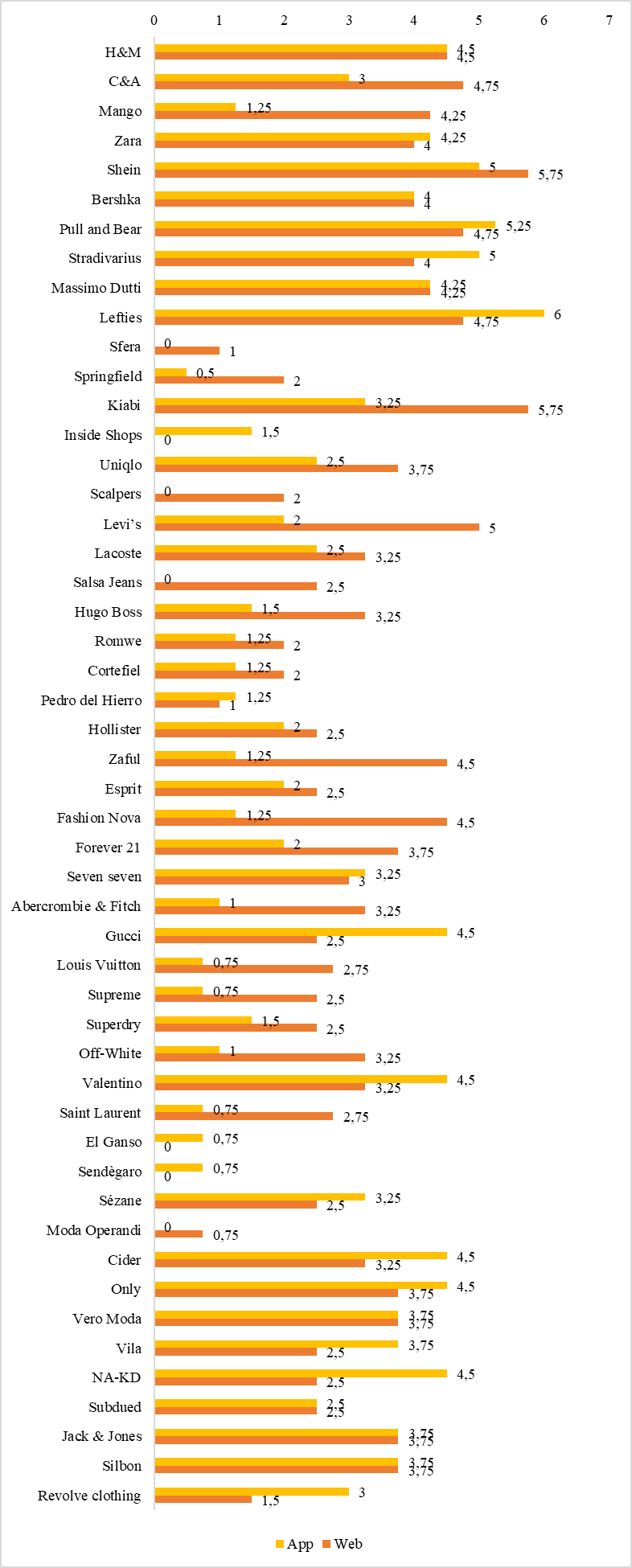
Source: Self-made.
Appendix D. Environmental Sustainability Scores
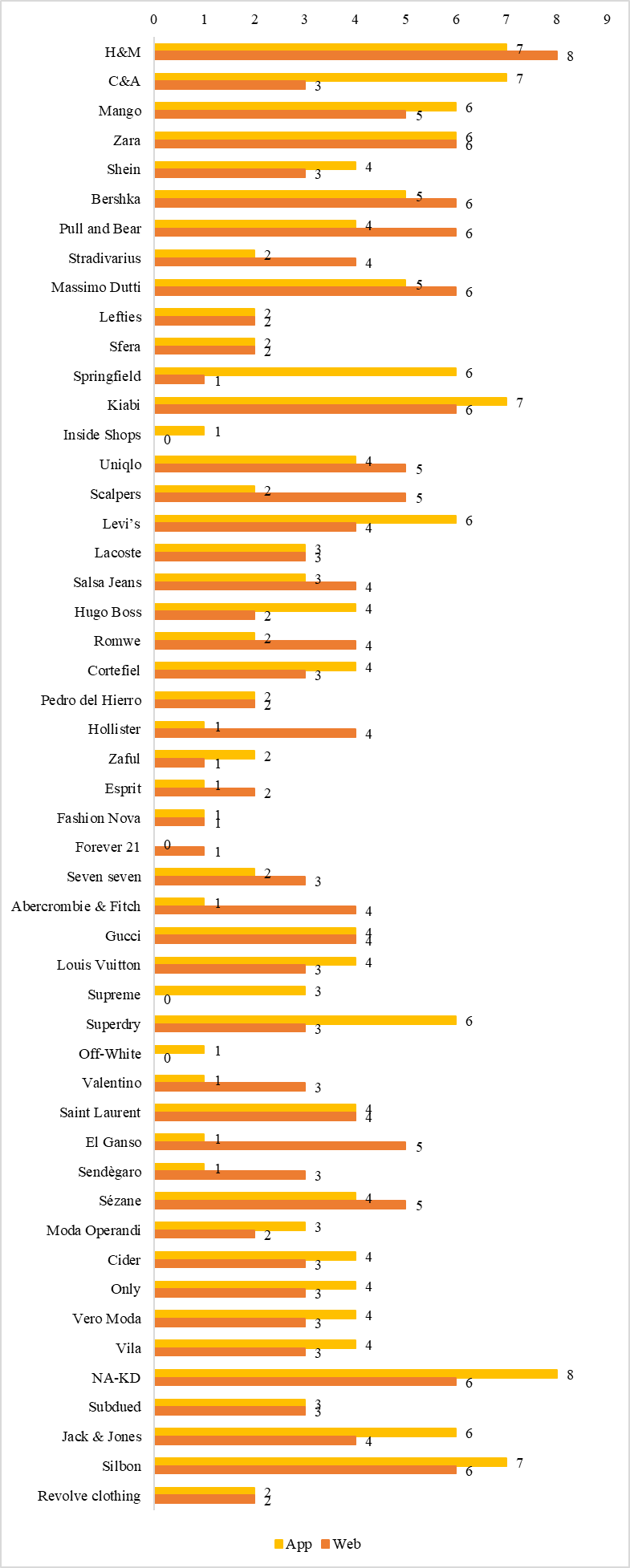
Source: Self-made.
Funding Statement
The authors received financial support from Grant PID (2022)-138564OA-I00 funded by MICIU/AEI/10.13039/501100011033 and by “ERDF/EU”.
Conflict of Interest
The authors declared no potential conflicts of interest with respect to the research, authorship, and/or publication of this article.
CRediT Authorship Contribution Statement
María Sicilia: Writing – Original Draft, Formal Analysis, Writing – Review & Editing; led the initial manuscript drafting, conducted the data analysis, and performed the final revision of the manuscript.
Mariola Palazón: Conceptualization, Theoretical Framework, Writing – Review & Editing; contributed primarily to the development of the theoretical framework and the study’s theoretical contributions.
Lorena Martínez-González: Data Curation, Investigation, Methodology, Visualization; contributed to coding, data collection, and the preparation of figures.
Supplementary Materials
Supplementary material for this article is available online via https://doi.org/10.51300/JSM-2026-168.
Publisher Disclaimer
The views expressed in this article are solely those of the author(s) and do not necessarily reflect those of their institutions, the publisher, editors, or reviewers. The publisher and editorial team make no warranties regarding the accuracy or completeness of the content and accept no responsibility for errors, omissions, or any consequences arising from its use. The publisher remains neutral regarding jurisdictional claims in maps and institutional affiliations.
References
- . Sustainability trends and gaps in the textile, apparel and fashion industries. Environment, Development and Sustainability, 26(2), 2837-2864. https://doi.org/10.1007/s10668-022-02887-2. CrossRef | Google Scholar
- . The theory of planned behavior. Organizational Behavior and Human Decision Processes, 50(2), 179-211. https://doi.org/10.1016/0749-5978(91)90020-T. CrossRef | Google Scholar
- . The global move toward Internet shopping and its influence on pollution: An empirical analysis. Environmental Science and Pollution Research, 22(13), 9717-9727. https://doi.org/10.1007/s11356-015-4142-2. CrossRef | Google Scholar
- . Sustainable development—Direct and indirect effects between economic, social, and environmental dimensions in business practices. Corporate Social Responsibility and Environmental Management, 29(5), 1158-1172. https://doi.org/10.1002/csr.2261. CrossRef | Google Scholar
- . A Study on Intentions of Generation Z Consumers to Buy Recyclable Products. Journal of Sustainable Marketing, 1-17. https://doi.org/10.51300/jsm-2023-109. CrossRef | Google Scholar | Luminous Insights
- . Luxury fashion brand customers’ perceptions of mobile marketing: Evidence of multiple communications and marketing channels. Journal of Retailing and Consumer Services, 66, 102944-102944. https://doi.org/10.1016/j.jretconser.2022.102944. CrossRef | Google Scholar
- . Exploring the Third Gender in Fashion: From Consumers’ Behavior to Designers’ Approach towards Unisex Clothing. Fashion Practice, 12(3), 421-439. https://doi.org/10.1080/17569370.2020.1816317. CrossRef | Google Scholar
- . Examining the social side of sustainability in the debate on business model innovations in the textile, clothing and fashion industry: a typology based on the value chain perspective. International Journal of Innovation and Sustainable Development, 16(3/4), 322-322. https://doi.org/10.1504/ijisd.2022.123908. CrossRef | Google Scholar
- . Drivers and barriers for sustainable fashion consumption in Spain: a comparison between sustainable and non-sustainable consumers. International Journal of Fashion Design, Technology and Education, 16(1), 1-13. https://doi.org/10.1080/17543266.2022.2089239. CrossRef | Google Scholar
- . Service robots in online reviews: Online robotic discourse. Annals of Tourism Research, 87, 103036-103036. https://doi.org/10.1016/j.annals.2020.103036. CrossRef | Google Scholar
- . Reverse Logistics as a Sustainable Supply Chain Practice for the Fashion Industry: An Analysis of Drivers and the Brazilian Case. Springer International Publishing, Vol. 1. https://doi.org/10.1007/978-3-319-12703-3_5. CrossRef | Google Scholar
- . Return Shipping Policies of Online Retailers: Normative Assumptions and the Long-Term Consequences of Fee and Free Returns. Journal of Marketing, 76(5), 110-124. https://doi.org/10.1509/jm.10.0419. CrossRef | Google Scholar
- . Corporate Social Responsibility Reporting: A Content Analysis in Family and Non-family Firms. Journal of Business Ethics, 129(3), 511-534. https://doi.org/10.1007/s10551-014-2174-z. CrossRef | Google Scholar
- . Environmental sustainability in fashion supply chains: An exploratory case based research. International Journal of Production Economics, 135(2), 659-670. https://doi.org/10.1016/j.ijpe.2011.06.001. CrossRef | Google Scholar
- . An emerging eco-habitus: The reconfiguration of high cultural capital practices among ethical consumers. Journal of Consumer Culture, 14(2), 158-178. https://doi.org/10.1177/1469540514526227. CrossRef | Google Scholar
- . Corporate social responsibility communication of male luxury fashion brands: analysis on Instagram, Facebook and TikTok. Management Decision, 62(2), 471-491. https://doi.org/10.1108/md-09-2022-1316. CrossRef | Google Scholar
- . Recycling habits and environmental responses to fast-fashion consumption: Enhancing the theory of planned behavior to predict Generation Y consumers’ purchase decisions. Waste Management, 139, 146-157. https://doi.org/10.1016/j.wasman.2021.12.012. CrossRef | Google Scholar
- . Constructing Grounded Theory A Practical Guide through Qualitative Analysis. London Sage Publications.
- . Apparel Consumption and Embodied Experiences of Gay Men and Transgender Women in India: Variety and Ambivalence, Fit Issues, LGBT-Fashion Brands, and Affordability. Journal of Homosexuality, 68(9), 1444-1470. https://doi.org/10.1080/00918369.2019.1698914. CrossRef | Google Scholar
- . Is plus size equal? The positive impact of average and plus-sized media fashion models on women’s cognitive resource allocation, social comparisons, and body satisfaction. Communication Monographs, 84(3), 406-422. https://doi.org/10.1080/03637751.2017.1332770. CrossRef | Google Scholar
- . Grounded Theory Research: Procedures, Canons and Evaluative Criteria. Zeitschrift für Soziologie, 19(6), 3-21. https://doi.org/10.1515/zfsoz-1990-0602. CrossRef | Google Scholar
- . Unisex Clothing, A Sustain Ale Way of Self Expression. International Journal of Textile and Fashion Technology, 11, 9-18.
- . The Contingency Theory of Organizations. SAGE Publications, Inc.. https://doi.org/10.4135/9781452229249. CrossRef | Google Scholar
- . The role of subjective knowledge and perceived trustworthiness in fair trade consumption for fashion and food products. Journal of Consumer Marketing, 38(1), 58-68. https://doi.org/10.1108/jcm-08-2019-3356. CrossRef | Google Scholar
- . Supply Chain Transparency as a Consumer or Corporate Tool: The Case of Nudie Jeans Co. Journal of Consumer Policy, 39(4), 377-395. https://doi.org/10.1007/s10603-015-9283-7. CrossRef | Google Scholar
- . Reuse and Recycling of Clothing and Textiles—A Network Approach. Journal of Macromarketing, 34(3), 383-399. https://doi.org/10.1177/0276146714529658. CrossRef | Google Scholar
- . Analysing online purchase intention in Spain: fashion e-commerce. Information Systems and e-Business Management, 15(3), 599-622. https://doi.org/10.1007/s10257-016-0319-6. CrossRef | Google Scholar
-
. Basics of macro to
microlevel corporate social responsibility and advancement in triple bottom line theory. Corporate Social Responsibility and Environmental Management, 28(3), 969-979. https://doi.org/10.1002/csr.2069. CrossRef | Google Scholar - . The determinants of eco-fashion purchase intention and willingness to pay. Spanish Journal of Marketing - ESIC, 27(3), 348-366. https://doi.org/10.1108/sjme-07-2022-0158. CrossRef | Google Scholar
- . Sustainable social supply chain practices and firm social performance: Framework and empirical evidence. Sustainable Production and Consumption, 32, 160-172. https://doi.org/10.1016/j.spc.2022.04.020. CrossRef | Google Scholar
- . A Contingency Model of Leadership Effectiveness. Elsevier, Vol. 1. https://doi.org/10.1016/s0065-2601(08)60051-9. CrossRef | Google Scholar
- . Strategic take-back programs when consumers have heterogeneous environmental preferences. Resource and Energy Economics, 60, 101150-101150. https://doi.org/10.1016/j.reseneeco.2020.101150. CrossRef | Google Scholar
- . A content analysis of male roles in television advertising: Do traditional roles still hold?. Journal of Marketing Communications, 21(5), 356-371. https://doi.org/10.1080/13527266.2013.775178. CrossRef | Google Scholar
- . A Stakeholder Approach to Strategic Management. SSRN Electronic Journal, . https://doi.org/10.2139/ssrn.263511. CrossRef | Google Scholar
- . Sustainability-Oriented Innovation in Tourism: An Analysis Based on the Decomposed Theory of Planned Behavior. Journal of Travel Research, 58(4), 622-636. https://doi.org/10.1177/0047287518771215. CrossRef | Google Scholar
- . Traceability and transparency for sustainable fashion-apparel supply chains. Journal of Fashion Marketing and Management: An International Journal, 26(2), 344-364. https://doi.org/10.1108/jfmm-07-2020-0125. CrossRef | Google Scholar
- . Theoretical sensitivity Advances in the methodology of grounded theory. Theoretical sensitivity Advances in the methodology of grounded theory.
- . Learning from Data: An Empirics-First Approach to Relevant Knowledge Generation. Journal of Marketing, 87(3), 319-336. https://doi.org/10.1177/00222429221129200. CrossRef | Google Scholar
- . Managing sustainability in the fashion business: Challenges in product development for clothing longevity in the UK. Journal of Business Research, 117, 629-641. https://doi.org/10.1016/j.jbusres.2018.07.021. CrossRef | Google Scholar
- . Solving the puzzle of sustainable fashion consumption: The role of consumers’ implicit attitudes and perceived warmth. Journal of Cleaner Production, 287, 125579-125579. https://doi.org/10.1016/j.jclepro.2020.125579. CrossRef | Google Scholar
- . “Fat People Exercise Too!”: Perceptions and Realities of Shopping for Women’s Plus-Size Exercise Apparel. Clothing and Textiles Research Journal, 38(2), 75-89. https://doi.org/10.1177/0887302x19878507. CrossRef | Google Scholar
- . Buy Now, Play Never: Why Consumers Purchase Things They Don't Use. SSRN Electronic Journal, (5735826). https://doi.org/10.2139/ssrn.5735826. CrossRef | Google Scholar
- . The clothes swapping phenomenon – when consumers become suppliers. Journal of Fashion Marketing and Management: An International Journal, 23(3), 327-344. https://doi.org/10.1108/jfmm-04-2018-0057. CrossRef | Google Scholar
- . Effects of Sustainable Marketing on Fast Fashion Shoppers’ Perception and Behavioral Inertia. Journal of Sustainable Marketing, 1-21. https://doi.org/10.51300/jsm-2023-114. CrossRef | Google Scholar | Luminous Insights
- . Grounded Theory and Inductive Research. SAGE Publications Ltd. https://doi.org/10.4135/9781036235109.n7. CrossRef | Google Scholar
- . Integrating stakeholder theory and sustainability accounting: A conceptual synthesis. Journal of Cleaner Production, 275, 124097-124097. https://doi.org/10.1016/j.jclepro.2020.124097. CrossRef | Google Scholar
- . Three Approaches to Qualitative Content Analysis. Qualitative Health Research, 15(9), 1277-1288. https://doi.org/10.1177/1049732305276687. CrossRef | Google Scholar
- . Application of 3D Prototyping to Promote Size-Inclusive Design Practices for Plus-Size Apparel. Fashion Practice, 14(1), 5-25. https://doi.org/10.1080/17569370.2020.1804152. CrossRef | Google Scholar
- . El 81\% de los españoles se preocupa por el desperdicio textil, según un estudio de IBM. . https://es.newsroom.ibm.com/announcements?item=122600.
- . Mapping environmentally sustainable practices in textiles, apparel and fashion industries: a systematic literature review. Journal of Fashion Marketing and Management: An International Journal, 25(2), 331-353. https://doi.org/10.1108/jfmm-07-2020-0130. CrossRef | Google Scholar
- . Perceptions of fair trade labelling and certification: three case studies. Journal of Fashion Marketing and Management: An International Journal, 16(2), 246-265. https://doi.org/10.1108/13612021211222851. CrossRef | Google Scholar
- . The impact of inclusive fashion advertising with plus-size models on female consumers: The mediating role of brand warmth. Journal of Global Fashion Marketing, 12(3), 260-273. https://doi.org/10.1080/20932685.2021.1905021. CrossRef | Google Scholar
- . LGBT: An Emerging Lucrative Market for Fashion and Lifestyle. International Journal of Management and Applied Science, 3, 1-3.
- . Child Labor Prevention and Supply Chain Sustainability: Evidence from German Outdoor Textile Companies. European Journal of Sustainable Development, 14(1). https://doi.org/10.14207/ejsd.2025.v14n1p39. CrossRef | Google Scholar
- . Thinspiration: Self-Improvement Versus Self-Evaluation Social Comparisons with Thin-Ideal Media Portrayals. Health Communication, 30(11), 1089-1101. https://doi.org/10.1080/10410236.2014.921270. CrossRef | Google Scholar
- . Should I wait or should I go? Encouraging customers to make the more sustainable delivery choice. Research in Transportation Economics, 103, 101388-101388. https://doi.org/10.1016/j.retrec.2023.101388. CrossRef | Google Scholar
- . Validity in Content Analysis. In Mochmann, Ekkehard (Ed.), Computerstrategien f{\"u}r die Kommunikationsanalyse (pp. 69-112). Campus.
- . Content Analysis: An Introduction to Its Methodology. SAGE Publications, Inc.. https://doi.org/10.4135/9781071878781. CrossRef | Google Scholar
- . Sustainability in Dyeing and Finishing. Springer International Publishing. https://doi.org/10.1007/978-3-030-38545-3_7. CrossRef | Google Scholar
- . Contribution of traceability towards attaining sustainability in the textile sector. Textiles and Clothing Sustainability, 3(1), 5-5. https://doi.org/10.1186/s40689-017-0027-8. CrossRef | Google Scholar
- . Chatbot design approaches for fashion E-commerce: an interdisciplinary review. International Journal of Fashion Design, Technology and Education, 15(2), 200-210. https://doi.org/10.1080/17543266.2021.1990417. CrossRef | Google Scholar
- . Breaking Barriers with Disability Inclusion: Brand Activism as a Catalyst for Social Sustainability in Fashion. Springer Nature Switzerland. https://doi.org/10.1007/978-3-031-69682-4_14. CrossRef | Google Scholar
- . Social Psychology of Dress. Bloomsbury Publishing Plc. https://doi.org/10.5040/9781501317491. CrossRef | Google Scholar
- . The Use of Recycled Fibers in Fashion and Home Products. Springer Singapore. https://doi.org/10.1007/978-981-10-2146-6_2. CrossRef | Google Scholar
- . How perceived sustainability influences consumers’ clothing preferences. Scientific Reports, 14(1), 28672-28672. https://doi.org/10.1038/s41598-024-80279-4. CrossRef | Google Scholar
- . Understanding fashion omnichannel experience through mobile application customer reviews. Journal of Global Fashion Marketing, 16(1), 90-108. https://doi.org/10.1080/20932685.2024.2417304. CrossRef | Google Scholar
- . Theory and theory development: Guidelines for establishing theoretical gaps, foundations, contributions, and implications. Journal of Business Research, 202, 115745-115745. https://doi.org/10.1016/j.jbusres.2025.115745. CrossRef | Google Scholar
- . Transparency of Global Apparel Supply Chains: Quantitative Analysis of Corporate Disclosures. Corporate Social Responsibility and Environmental Management, 23(5), 308-318. https://doi.org/10.1002/csr.1378. CrossRef | Google Scholar
- . ‘Take a Stand’: The Importance of Social Sustainability and Its Effect on Generation Z Consumption of Luxury Fashion Brands. Springer International Publishing. https://doi.org/10.1007/978-3-031-06928-4_11. CrossRef | Google Scholar
- . Does Less Result in More? The Role of Information and Rewards in Take-Back Programs for Clothing. SSRN Electronic Journal, . https://doi.org/10.2139/ssrn.4586713. CrossRef | Google Scholar
- . Towards Sustainable Fashion Consumption: An Exploratory Study of Consumer Behavior in a Developing Country. Journal of Sustainable Marketing, 1-21. https://doi.org/10.51300/jsm-2023-105. CrossRef | Google Scholar | Luminous Insights
- . Hate Does Not Have to Hurt: The Influence of Hate-Acknowledging Advertising on Positive Word of Mouth (An Extended Abstract). Springer International Publishing. https://doi.org/10.1007/978-3-319-45596-9_88. CrossRef | Google Scholar
- . Environmental Sustainability: A Definition for Environmental Professionals. Journal of Environmental Sustainability, 1(1), 1-10. https://doi.org/10.14448/jes.01.0002. CrossRef | Google Scholar
- . Sustainable fashion: current and future research directions. European Journal of Marketing, 54(11), 2873-2909. https://doi.org/10.1108/ejm-02-2019-0132. CrossRef | Google Scholar
- . Gender Influences at the Core of CSR Initiatives and Sustainable Fashion. Springer Nature Switzerland. https://doi.org/10.1007/978-3-031-61099-8_4. CrossRef | Google Scholar
- . Consumer Attitudes Towards New Circular Models in the Fashion Industry. Journal of Competitiveness, 13(3), 111-128. https://doi.org/10.7441/joc.2021.03.07. CrossRef | Google Scholar
- . “Some are more fair than others”: fair trade certification, development, and North–South subjects. Agriculture and Human Values, 31(2), 273-284. https://doi.org/10.1007/s10460-013-9476-0. CrossRef | Google Scholar
- . The environmental price of fast fashion. Nature Reviews Earth \& Environment, 1(4), 189-200. https://doi.org/10.1038/s43017-020-0039-9. CrossRef | Google Scholar
- . The customer journey: a proposal of indicators to evaluate integration and customer orientation. Journal of Marketing Communications, 28(5), 528-559. https://doi.org/10.1080/13527266.2022.2051584. CrossRef | Google Scholar
- . Stakeholder Theory: The State of the Art. Academy of Management Annals, 4(1), 403-445. https://doi.org/10.5465/19416520.2010.495581. CrossRef | Google Scholar
- . Understanding the impact of fashion app emotional attachment on consumer responses: the role of e-servicescape, customer experience and perceived value of online shopping. Journal of Fashion Marketing and Management: An International Journal, 28(3). https://doi.org/10.1108/jfmm-05-2023-0113. CrossRef | Google Scholar
- . Predicting consumers' purchase intention through fast fashion mobile apps: The mediating role of attitude and the moderating role of COVID-19. Technological Forecasting and Social Change, 186, 122111-122111. https://doi.org/10.1016/j.techfore.2022.122111. CrossRef | Google Scholar
- . Our adaptive clothing, nightwear \& lingerie collection | Primark. Our adaptive clothing, nightwear \& lingerie collection | Primark.
- . Inclusive advertising featuring disability on instagram: Effect on consumer well-being, brand engagement, and purchase intention. Journal of Retailing and Consumer Services, 75, 103515-103515. https://doi.org/10.1016/j.jretconser.2023.103515. CrossRef | Google Scholar
- . Fashion industry's environmental policy: Social media and corporate website as vehicles for communicating corporate social responsibility. Corporate Social Responsibility and Environmental Management, 30(1), 180-191. https://doi.org/10.1002/csr.2347. CrossRef | Google Scholar
- . Adaptive apparel for people with disabilities: A systematic literature review and future research agenda. International Journal of Consumer Studies, 48(3), 13057-13057. https://doi.org/10.1111/ijcs.13057. CrossRef | Google Scholar
- . Does sustainability really matter to consumers? Assessing the importance of online shop and apparel product attributes. Journal of Retailing and Consumer Services, 63, 102681-102681. https://doi.org/10.1016/j.jretconser.2021.102681. CrossRef | Google Scholar
- . Negotiating and Communicating LGBTQ+ Identities Through Dress and LGBTQ+-Focused Fashion Brands in the 21st Century. Routledge. https://doi.org/10.4324/9781003128151-25. CrossRef | Google Scholar
- . Quality certification, regulation and power in fair trade. Journal of Rural Studies, 21(4), 419-431. https://doi.org/10.1016/j.jrurstud.2005.09.002. CrossRef | Google Scholar
- . Pioneering New Perspectives in the Fashion Industry: Disruption, Diversity and Sustainable Innovation. Emerald Publishing Limited.
- . Product destruction: Exploring unsustainable production-consumption systems and appropriate policy responses. Sustainable Production and Consumption, 35, 300-312. https://doi.org/10.1016/j.spc.2022.11.009. CrossRef | Google Scholar
- . Exploring apparel purchase issues with plus-size female teens. Journal of Fashion Marketing and Management, 19(2), 120-135. https://doi.org/10.1108/jfmm-02-2014-0012. CrossRef | Google Scholar
- . Post-Purchase Trip Heterogeneity: Exploring the Impact of Free and Paid Return Deliveries on Shopping and Transport Mode Choices in the USA. Transportation Research Record: Journal of the Transportation Research Board, 2679(2), 03611981241270155-03611981241270155. https://doi.org/10.1177/03611981241270155. CrossRef | Google Scholar
- . Androgynous Fashion from the Concept to Consumers: An Empirical Study. Design for Tomorrow, . Springer, 1, 727-737. https://doi.org/10.1007/978-981-16-0041-8_60. CrossRef | Google Scholar
- . The Right Tool for the Right Job: Identifying Relevant Touchpoints to Achieve Seamlessness in the Fashion Sector. Springer International Publishing. https://doi.org/10.1007/978-3-031-35589-9_7. CrossRef | Google Scholar
- . Why social sustainability counts: The impact of corporate social sustainability culture on financial success. Sustainable Production and Consumption, 17, 1-10. https://doi.org/10.1016/j.spc.2018.08.008. CrossRef | Google Scholar
- . Towards Understanding Social Sustainability: An Information Systems Research-Perspective. In Towards Understanding Social Sustainability: An Information Systems Research-Perspective.
- . Fashion victim: the impact of fair trade concerns on clothing choice. Journal of Strategic Marketing, 14(4), 427-440. https://doi.org/10.1080/09652540600956426. CrossRef | Google Scholar
- . How do EU Cities Utilise their Websites? A Content Analysis and Suggestions for Improvement. Journal of Internet Business, (5).
- . Natural and Sustainable? Consumers’ Textile Fiber Preferences. Fibers, 11(2), 12-12. https://doi.org/10.3390/fib11020012. CrossRef | Google Scholar
- . Electric vehicles performing last-mile delivery in B2C e-commerce: An economic and environmental assessment. International Journal of Sustainable Transportation, 16(1), 22-33. https://doi.org/10.1080/15568318.2020.1847367. CrossRef | Google Scholar
- . The Development of Unisex Clothing. Journal of Education, Humanities and Social Sciences, 8, 2543-2547. https://doi.org/10.54097/ehss.v8i.5028. CrossRef | Google Scholar
- . Communication of sustainability at European fashion online shops. International journal of economics, commerce \& management, 3(7), 71-86.
- . A Triple Bottom Line Dominant Logic for Business Sustainability: Framework and Empirical Findings. Journal of Business-to-Business Marketing, 23(2), 153-188. https://doi.org/10.1080/1051712x.2016.1169119. CrossRef | Google Scholar
- . Sustainability, human rights, and sexuality: Making the right connections. Local Economy: The Journal of the Local Economy Policy Unit, 30(3), 256-264. https://doi.org/10.1177/0269094215580084. CrossRef | Google Scholar
- . How the Eyes Connect to the Heart: The Influence of Eye Gaze Direction on Advertising Effectiveness. Journal of Consumer Research, 48(1), 123-146. https://doi.org/10.1093/jcr/ucaa063. CrossRef | Google Scholar
- . What's in the parcel locker? Exploring customer value in e-commerce last mile delivery. Journal of Business Research, 88, 421-427. https://doi.org/10.1016/j.jbusres.2017.11.033. CrossRef | Google Scholar
- . Inclusive Fashion—an Oxymoron—or a Possibility for Sustainable Fashion?. Fashion Practice, 10(3), 311-327. https://doi.org/10.1080/17569370.2018.1507145. CrossRef | Google Scholar
- . Environmental corporate social responsibility initiatives and green purchase intention: an application of the extended theory of planned behavior. Social Responsibility Journal, 18(8), 1627-1645. https://doi.org/10.1108/srj-06-2021-0220. CrossRef | Google Scholar
- . Does Featuring People with Disabilities Help or Hurt Fashion Marketing Effectiveness?. Journal of Marketing Research, 62(4), 00222437241309310-00222437241309310. https://doi.org/10.1177/00222437241309310. CrossRef | Google Scholar
About contributors

María Sicilia
Department of Marketing, Faculty of Economics and Business, University of Murcia, Murcia, Spain
Spain
Mariola Palazón
Department of Marketing, Faculty of Economics and Business, University of Murcia, Murcia, Spain
Spain
Lorena Martínez-González
Faculty of Social Sciences, University of Castilla-La Mancha, Cuenca, Spain
Spain