





Abstract
Managing stakeholder expectations in corporate sustainability has become increasingly challenging as consumers grow skeptical of greenwashing, yet existing research offers limited insight into how message specificity can alleviate these concerns. Prior studies on corporate environmental communication often treat sustainability claims as homogeneous, overlooking how varying levels of informational detail influence perceptions of credibility and legitimacy. To address this gap, this study applies signaling and legitimacy theory to examine how varying levels of carbon label specificity shape consumer evaluations. Using a between-subjects experiment with 400 participants from New York State, four levels of carbon information specificity were examined. Results indicate that detailed carbon labels reduce perceptions of greenwashing and improve brand evaluations, with information specificity exerting a significant direct effect on both outcomes. The mediating role of carbon awareness was partial in that while carbon awareness did not significantly mediate the relationship between information specificity and greenwashing perceptions, it did mediate the relationship between information specificity and brand evaluations. Practical recommendations suggest that detailed, verifiable carbon labels should be prioritized over vague claims to mitigate perceptions of greenwashing and enhance brand evaluations.
Introduction
In an era of increasing environmental consciousness, consumers are becoming more discerning about companies’ sustainability claims. A 2025 survey conducted by Blue Yonder found that 74% of U.S (Blue Yonder, 2025). respondents consider sustainability somewhat or very important in purchasing decisions, yet only 23% believe brands accurately market their sustainability initiatives, highlighting rising discernment amid low trust in corporate claims. This heightened awareness of environmental issues and deceptive green marketing practices has led to a growing demand for transparency and authenticity in corporate social responsibility (CSR) communications (Marrucci et al., 2025; Seele & Lock, 2014). Perceptions of greenwashing, or the practice of making misleading or unsubstantiated environmental claims (Parguel et al., 2011), can shape brand trust and create a challenging landscape for both consumers and companies alike (Rahman et al., 2025).
Prior research reveals that companies primarily engage in greenwashing through vague, ambiguous environmental claims that lack explanatory statements or clear scope (e.g., product, component, or packaging), which confuse consumers.It stresses the need for unambiguous language, verifiable evidence, and explanations (Marrucci et al., 2025) .As corporate actors across industries adopt sustainability language, Neureiter et al. (2024) demonstrate how vague or symbolic environmental messaging can lead to greenwashing and performative promises of carbon neutrality goals, masking ongoing unsustainable practices. As a result, understanding how to communicate sustainability efforts effectively while maintaining consumer trust becomes an important topic of research.The decision to use general or specific claims within the sustainability messages can lead to perceptions of misleading or overwhelming information, which may ultimately influence how consumers respond and make purchase decisions. Recent research has explored how consumers navigate ambiguous messages and why they may still respond positively to them, even when aware of potential deception. Atkinson & Kim (2014) found that, while green advertising is widespread in consumer goods, the majority of claims were vague and often unsubstantiated, such as the use of phrases like “100% natural.” Despite recognizing these tactics as potentially misleading, environmentally conscious consumers do not always reject them but instead interpret the messages as shortcuts.
Prior greenwashing research has largely focused on identifying deceptive or vague environmental claims rather than systematically examining how the level of information specificity itself influences consumer judgment, despite advances. Because of this, what remains unclear is whether providing more detailed carbon information reduces skepticism by signaling transparency, or whether it overwhelms consumers and fails to improve credibility. The research to date lacks empirical evidence on how varying degrees of specificity in carbon labeling shape perceptions of greenwashing and, in turn, brand responses. Building on this understanding of consumer rationalization, it is important to investigate how the specificity of CSR, specifically labels that communicate carbon emissions, might influence perceptions of authenticity and trust.
This study aims to advance the field of sustainable marketing by empirically demonstrating how the specificity of carbon label information influences consumer responses to environmental claims and perceptions of greenwashing. By moving beyond generalized sustainability messaging to test the impact of detailed, transparent carbon disclosures, the research provides actionable insight into how marketing communication practices can either build or erode consumer trust in environmental CSR. Information specificity, or the degree to which a disclosure provides detailed, verifiable content, operationalizes transparency in the sense that an organization may signal its commitment to transparency through the provision of specific, concrete claims, whereas vague or ambiguous messaging undermines that signal regardless of intent. The present study focuses on information specificity as the measurable, message-level mechanism through which transparency is communicated to consumers via carbon labels.
Ultimately, the work contributes new evidence for marketers, policymakers, and researchers on the design of carbon labeling systems that support both environmental progress and stakeholder confidence in a crowded marketplace of sustainability claims. The theoretical foundation for this research draws upon two frameworks: signaling theory and legitimacy theory. Signaling theory posits that companies use CSR disclosures to bridge information asymmetries between themselves and their stakeholders, signaling their commitment to long-term environmental and social responsibility (Connelly et al., 2010; Hassan et al., 2020). Legitimacy theory, on the other hand, suggests that organizations must align their actions with societal values to maintain trust and legitimacy (Suchman, 1995; Fernando & Lawrence, 2014). By integrating these theoretical perspectives, we investigate how varying levels of information specificity influence consumer perceptions of greenwashing and overall brand evaluations. Specifically, we hypothesize that greater information specificity will lead to lower perceptions of greenwashing and more favorable brand evaluations.
This research builds on existing literature on CSR communication by: 1. examining the role of information specificity in mitigating greenwashing perceptions, 2. investigating the impact of detailed CSR information on brand evaluations, and 3. exploring the potential of digital technologies (e.g., QR codes) in enhancing the effectiveness of sustainability communications. By understanding how to optimize the level of detail in CSR messages, communicators can better align strategies with expectations, reducing skepticism and enhancing brand perceptions in an increasingly environmentally conscious marketplace.
Literature Review
In recent years, sustainability has become a critical factor in consumer decision-making, with an increasing number of individuals prioritizing environmentally friendly products and practices. Carbon labels have emerged as a key tool for communicating environmental impact, enabling consumers to make informed choices about the products they purchase (Loughlin, 2024). Carbon labels provide information on a product’s lifecycle carbon dioxide emissions. As sustainability expectations continue to rise, understanding how consumers perceive and respond to corporate CSR initiatives has become essential for businesses (Bar Am et al., 2023). Two theoretical frameworks that provide valuable insights into this phenomenon are signaling theory and legitimacy theory.
Consumers’ perceptions of environmental responsibility are often shaped not only by factual information but also by symbolic cues that evoke emotions or cultural associations. Larranaga et al. (2025) demonstrate that traditionality in product messaging can activate perceptions of greenness through feelings of groundedness via “tradition-washing,” even when there is no direct evidence of environmental benefit. This underscores the risk that emotionally resonant but substantively weak signals may influence consumer judgments about sustainability. Findings demonstrate that consumers may perceive products as more sustainable when traditional production methods are emphasized, due to the emotional response of “groundedness” this messaging evokes. Importantly, this perception is not based on the product's actual environmental impact but is mediated by feelings associated with authenticity, simplicity, or nostalgia. From another dimension, assessing the effect of information specificity in environmental communication on greenwashing and brand evaluations extends this lineage of research within sustainability communication, linking symbolic persuasion and informational transparency. Just as tradition-washing risks overreliance on emotionally resonant but unverified claims, the present study examines whether carbon labels can serve as effective, credible signals that enhance corporate legitimacy and guide consumers toward truly sustainable choices. To further explore how these dynamics interact, the current study examines whether carbon awareness serves as a mediating factor in the relationships among information specificity, perceptions of greenwashing, and brand evaluations.
Signaling Theory
In the context of CSR sustainability, signaling theory posits that companies disclose sustainability information to bridge the gap between themselves and stakeholders, signaling their commitment to long-term environmental and social responsibility (Hassan et al., 2020). Typically, the sender must choose how to communicate, or signal, specific information, and the receiver (i.e., stakeholders) chooses how to interpret the signal (Connelly et al., 2010). For example, environmental labeling, such as carbon labels, can signal individual benefits, such as health, or collective benefits, like societal protection from climate change. The benefits signaled by these labels likely vary depending on how familiar the message recipient is with the labeling system and how engaged they are with it, thereby influencing the signal’s effectiveness over time (Taufique et al., 2022). Additionally, by voluntarily disclosing information, organizations can alleviate information asymmetry, gain a competitive advantage, and mitigate risks associated with adverse selection (e.g., Clarkson et al., 2008). Adverse selections occur when one party (i.e., the sender) has more or better information than the other party (i.e., the receiver) and chooses not to disclose it; this causes the other party to make decisions based on incomplete or misleading information (Amin et al., 2022; Delmas & Burbano, 2011). In the context of CSR, disclosures that convey positive signals to the stakeholders must be perceived as trustworthy to avoid adverse selection, such as reduced perceptions of greenwashing and stakeholder decision-making (Uyar et al., 2020). For this reason, by voluntarily disclosing and signaling CSR information, organizations help reduce this asymmetry to support stakeholders in making informed decisions (Amin et al., 2022).
Legitimacy Theory
Legitimacy is the perception that a company’s actions are desirable or appropriate within a socially constructed system of norms and values (Suchman, 1995). Legitimacy theory has been used to explain environmental and sustainability disclosure as it provides a framework for understanding how organizations can align their actions with societal values to maintain trust and legitimacy (Campbell et al., 2003). According to this theory, an organization’s degree of legitimacy is vital for its survival, as societal approval is necessary for continued success (Fernando & Lawrence, 2014). Legitimacy is increasingly tied to a broader commitment to societal well-being, positioning CSR as a strategic tool for fostering positive public relationships and securing organizational legitimacy (Goss & Roberts, 2011; Schultz et al., 2013; Suchman, 1995).
Legitimacy theory also posits that organizations engage in a social contract with society, where their operations must align with the accepted norms and values of the community (Deegan, 2006; Deegan & Samkin, 2009; Fernando & Lawrence, 2014). Correspondingly, in the context of public relations and stakeholder perceptions of CSR, legitimacy is not only about complying with regulations but also about the perception of stakeholders regarding how well a company’s actions align with their expectations and societal norms. This social contract suggests an implicit agreement between an organization and society, where the public expects the organization to conduct its operations in accordance with societal values (Gray et al., 2009). If an organization’s activities do not align with or respect societal expectations, values, and norms, the implicit and explicit terms of the contract may be broken, resulting in a loss of legitimacy in the eyes of stakeholders (Fernando & Lawrence, 2014). Recent research, for example, has found that companies that communicate environmental, social, and governance activities with stakeholders convey a commitment to meeting their expectations (e.g., Abdul Rahman & Alsayegh, 2021; Seow, 2023).
There are three types of legitimacy organizations must maintain to build trust with their stakeholders: pragmatic, cognitive, and moral legitimacy (Scherer et al., 2013). Pragmatic legitimacy involves strategic and transactional approaches (i.e., companies engage in responsible practices to achieve favorable outcomes), cognitive legitimacy refers to normative acceptance based on stakeholders’ satisfaction of expectations (i.e., organizations align their initiatives with stakeholder perceptions to establish trust and acceptance), and moral legitimacy refers to whether an activity is morally right (Lock & Schulz-Knappe, 2019). CSR labeling strategies can be seen as an effort to maintain pragmatic legitimacy, such that it involves a strategic, transactional approach where organizations engage in responsible practices and communicate these through labels to achieve favorable outcomes. However, misalignment between stakeholders’ expectations and the actual behavior of an organization, such as during perceptions of greenwashing, can result in legitimacy gaps. Taglialatela et al. (2023) show how corporate boards influence discrepancies between talk (i.e., green communication) and walk (i.e., operational practices) with pragmatic legitimacy tied to stakeholder-driven actions. When actions are in alignment, effective reporting of sustainability efforts can strengthen relationships with stakeholders and enhance reputation (Shaban & Barakat, 2023; Nicolas & Schotanus, 2025) add that increasing the visibility of sustainability efforts through disclosures not only enhance legitimately but can also drive sustainability. Specifically, by connecting actions to third-party validated commitments, public organizations can use transparency to create internal pressure to behave in ways that substantively underpin their legitimacy.
CSR and Greenwashing
CSR refers to an organization’s voluntary efforts to address its responsible efforts regarding economic, legal, and ethical societal practices (Carroll, 1999). When an organization communicates about its social and environmental efforts, stakeholders are more inclined to grant it a license to operate in society, demonstrating more positive attitudes toward organizations with good reputations (Hur et al., 2014; Lock & Schulz-Knappe, 2019). For this reason, effective CSR communication plays an essential role in maintaining positive stakeholder perceptions and is often seen as a tool to secure legitimacy (Ashrafi et al., 2018; Rim & Ferguson, 2017).
However, while CSR can lead to positive outcomes, it may also trigger backlash when stakeholders perceive unmet expectations set by CSR communication and the organization loses legitimacy (Ouyang et al., 2024). Greenwashing is defined as “the act of misleading consumers regarding the environmental practices of a company or the environmental benefits of a product or service” [p. 489](Chen & Chang, 2012, p. 489). Actions can be seen as “greenwashing” anytime stakeholders believe the organization does not take meaningful actions to back up its symbolic or ethical CSR claims (Delmas & Burbano, 2011; Walker & Wan, 2011). This negative corporate strategy can lead to disgust from stakeholders and, when detected, does not increase potential benefits to the business (Can & Turker, 2024; Walker & Wan, 2011). It becomes particularly relevant when stakeholders process information on carbon labels, which can play a significant role in shaping stakeholders’ beliefs about the authenticity of CSR efforts and greenwashing perceptions. Authenticity remains a critical concern during evaluations of corporate environmentalism, as some efforts may be rooted in disingenuous or performative practices; however, dismissing these initiatives solely as corporate deception risks overlooking the genuine sense of care that they can foster and the meaningful support some communities may experience (Aronczyk, 2023). Previous research on how people cognitively process green claims has examined why some environmental messages are perceived as greenwashing, while others are considered credible. Keilmann & Koch (2023) investigated how discrepancies between a company’s environmental claims and its actual behavior affect corporate reputation and credibility. The experiment found that larger discrepancies between a green claim and actual practices led to significantly negative effects on corporate reputation and credibility, demonstrating the importance of transparency in this CSR and the consequences of overstating environmental efforts. Keilmann & Koch (2023) findings open the door for further research on strategic ambiguity in environmental claims, and the authors call for future studies to examine ambiguity, or abstractness, in green promises that broadly reference sustainable production. Responding to this call, the present study investigates the role of information specificity in shaping consumer perceptions of greenwashing and brand evaluations.
Sustainability labeling has emerged as a key tool for promoting sustainable consumption by providing consumers with reliable and transparent information about a product's environmental, ethical, or social performance (Majer et al., 2022). These labeling schemes can take the form of certifications, verifications, visual icons, written descriptions, or claims that aim to guide consumers toward more sustainable purchasing decisions (Majer et al., 2022). However, the effectiveness of sustainability labeling is context-dependent and influenced by various factors, such as the amount and specificity of information provided (Darnall et al., 2016; Testa et al., 2013). Comprehensive and specific labels, particularly those offering measurable details such as CO2 reduction metrics, have been shown to enhance consumer trust and increase their willingness to pay for sustainable products (Testa et al., 2020). In contrast, labels that lack specificity may generate skepticism about the product’s claims, potentially leading to perceptions of greenwashing. Specificity in sustainability labeling may also play a pivotal role in addressing the broader issue of climate change. Carbon footprint labels, which inform consumers about the greenhouse gas emissions associated with a product's lifecycle, have gained traction as a strategy for encouraging eco-friendly purchasing behaviors (Taufique et al., 2022; Yudhistira et al., 2023). For instance, the Taiwan Environmental Protection Administration introduced a carbon footprint label in 2010, seeking to steer consumers toward low-carbon products (Hu et al., 2019). While research demonstrates that labels with higher information specificity are more effective at encouraging sustainable consumption, the relationship between label specificity and perceptions of greenwashing remains underexplored. This study aims to address this gap by examining whether high information specificity in sustainability labeling reduces perceptions of greenwashing. Previous research has also demonstrated that the specificity of information in CSR communications can significantly influence consumer perceptions and brand evaluations. Skard & Thorbjørnsen (2013) explored the role of brand reputation in communicating CSR initiatives, measuring overall brand evaluation through a combination of semantic differential scales, word-of-mouth intentions, and purchase intentions. Accordingly, we build on prior research in the context of carbon labeling to hypothesize:
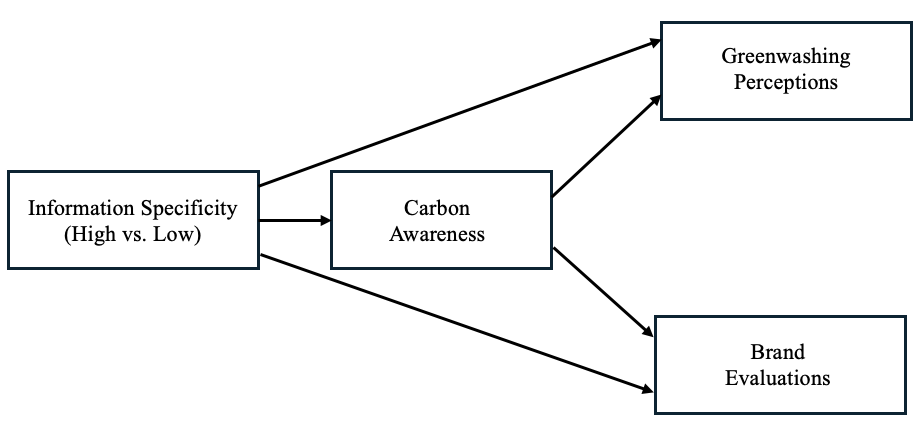
H1: High information specificity, compared to low, will generate lower perceptions of greenwashing.
H2: High information specificity, compared to low, will generate greater perceptions of brand evaluations.
Carbon Awareness
The growing concern over climate change has led to increased interest in sustainable transportation and low-carbon travel behaviors. Low-carbon awareness, which refers to people’s ecological worldview, has been recognized as a determinant of behavioral intentions and behavior (Jia et al., 2018; Barr, 2006) address the fundamental assumption that an individual’s awareness of environmental issues and sufficient knowledge about responsible actions can lead to positive behavioral decisions. Evidence suggests that consumers motivated by climate concerns are more likely to factor environmental impacts into their purchasing decisions, especially when labels provide clear and specific details about a product’s environmental benefits (Camilleri et al., 2018). Jia et al. (2018) study explored the role of digital technologies in promoting green transportation. Carbon-inclusive actions based on digital technology are becoming primary measures for promoting green transit in China, and the study found that digital tools provide innovative and engaging options for public participation in green mobility (Jia et al., 2018).
Considering the preceding research, consumers who are aware of or knowledgeable about climate concerns may be more likely to factor environmental impacts into their purchasing decisions. The moderating role of carbon awareness and environmental knowledge has been a topic of interest in consumer behavior, particularly in the context of greenwashing. Neureiter et al. (2024) tested the effects of concrete (e.g., recycling practices) and abstract green claims (e.g., investing in environmental projects) with environmental knowledge as a moderator. In the study, environmental knowledge did not moderate greenwashing perceptions, although it raised important questions for further research on how information specificity influences consumer perceptions of greenwashing and brand evaluations. Findings of this study underscore the need to examine how levels of environmental knowledge, particularly those focused on carbon emissions and climate change, might influence consumer decision-making in response to varying levels of information specificity in environmental communication. Building on signaling theory and legitimacy theory, the specificity of environmental information can be understood as a signal of credibility, with more detailed claims providing consumers with diagnostic cues that reduce ambiguity, thereby lowering perceptions of greenwashing and improving brand evaluations. Importantly, greenwashing is a perceptual judgment: consumers interpret claims subjectively, based on their own knowledge and orientation toward climate issues. Emerging evidence suggests that consumers with greater awareness of carbon-related issues perceive specific claims as more diagnostic and are, in turn, less likely to infer greenwashing (Camilleri et al., 2018; Jia et al., 2018). Thus, carbon awareness may function as a psychological mechanism through which claim specificity shapes consumer responses. Specifically, higher information specificity may enhance carbon awareness, which subsequently decreases greenwashing perceptions and improves brand evaluations. Although prior studies (e.g.,Neureiter et al., 2024)) have modeled environmental knowledge as a moderator, we argue that carbon awareness operates more appropriately as a mediator in the current context. Conceptualizing greenwashing as a perceptual phenomenon means that consumers’ judgments are shaped not only by message characteristics but also by the cognitive frames activated when processing those claims. Information specificity provides more concrete details about carbon impact, which can increase consumers’ awareness of carbon-related issues. In this sense, specificity drives carbon awareness, which then influences downstream evaluations, including greenwashing perceptions and brand attitudes. Although these hypotheses are theoretically grounded in signaling and legitimacy frameworks, direct empirical tests of carbon awareness as a mediator in this context remain limited. Conceptualizing greenwashing as a perceptual phenomenon shaped by the cognitive frames activated when processing claims, information specificity can be understood as a driver of carbon awareness rather than an interaction. In this view, more detailed carbon information raises consumers’ orientation toward carbon issues, which subsequently shapes evaluations. While prior research has modeled environmental knowledge primarily as a moderator, the present study advances a mediational account grounded in signaling and legitimacy theory. Although direct empirical tests of this mechanism remain limited, the theoretical logic supports examining carbon awareness as a pathway through which specificity influences consumer responses.
H3: Carbon awareness mediates the relationship between information specificity and perceptions of greenwashing, such that greater specificity increases carbon awareness, which, in turn, decreases greenwashing perceptions.
H4: Carbon awareness mediates the relationship between information specificity and brand evaluations, such that greater specificity increases carbon awareness, which, in turn, improves brand evaluations.
Materials and Methods
A between-subjects experiment tested hypotheses on information specificity effects on perceptions of greenwashing, brand evaluations, and carbon awareness mediation. To understand consumer perceptions among New York State residents, individuals aged 18 or older residing in the state were recruited via Prolific, a platform with a verified participant pool exceeding 200,000 active users (Prolific, 2025). The representative sample criteria were utilized to include factors of age, gender, and ethnicity. A G*power analysis using effect sizes informed by prior communication and sustainability research (e.g., Aeschbach et al., 2025; Green et al., 2019), estimated a recommended sample size of 70 participants per condition, with additional participants added to account for the potential of straight-lining, failed attention checks, or drop-outs. A New York state sample of 412 participants was recruited, with 12 removed due to failed attention checks and replaced to maintain equal sample sizes across conditions. For this research, each condition included 100 participants for a final sample of n = 400, and participant demographics are reported in Table 1.
Participants accessed the Qualtrics surveyed, viewed an IRB-approved consent form, and then were asked about their pre-existing knowledge of climate-smart commodities. Random assignment via Qualtrics balanced blocks provided each participant one of four conditions. All four conditions manipulated an oat label image with varying degrees of information specificity. Immediately following that, they were provided dependent measures of greenwashing and brand evaluations, the mediator measure of carbon awareness, and asked to answer demographic questions. Lastly, participants were debriefed on the nature of the study and were asked to confirm that they understood that the oat brand, label, and scenario were fictitious. Participants were compensated $1.50, which is a $9 hourly rate. It took an average of 10 minutes for participants to complete the survey, which was all collected in April 2024.
Table 1. Participant demographics
| Demographic | Subgroup | Percentage |
| Race/Ethnicity | White | 61.00% |
| Asian | 15.75% | |
| Black or African American | 15.75% | |
| Hispanic | 2.25% | |
| Other (incl. 2.75% Mixed) | 4.50% | |
| American Indian/Alaskan Native | 0.75% | |
| Education | Four-year degree | 46.75% |
| Professional degree | 19.25% | |
| Some college | 14.00% | |
| High school graduate | 8.75% | |
| Two-year degree | 8.25% | |
| Doctorate | 2.25% | |
| Less than high school | 0.75% | |
| Age Group | 25-34 years | 35.00% |
| 35-44 years | 20.00% | |
| 45-54 years | 18.25% | |
| 18-24 years | 11.75% | |
| 55-64 years | 9.50% | |
| 65-74 years | 5.00% | |
| 75-84 years | 0.50% | |
| Income Bracket | $100,000-$149,999 | 13.50% |
| $50,000-$59,999 | 10.50% | |
| $70,000-$79,999 | 10.50% | |
| ¡$10,000 | 9.25% | |
| $40,000-$49,999 | 9.50% | |
| $60,000-$69,999 | 8.75% | |
| ¿$150,000 | 8.25% | |
| $10,000-$19,999 | 7.25% | |
| $30,000-$39,999 | 6.25% | |
| $80,000-$89,999 | 6.00% | |
| $90,000-$99,999 | 5.50% | |
| $20,000-$29,999 | 4.75% | |
| Gender | Male | 52.75% |
| Female | 44.75% | |
| Non-binary/Third gender | 2.00% | |
| Other | 0.25% | |
| Prefer not to answer | 0.25% | |
| Location Type | Large city | 52.50% |
| Populated area | 37.50% | |
| Rural region | 10.00% | |
| County | Niagara | 8.00% |
| Lewis | 7.75% | |
| Rensselaer | 7.75% | |
| Broome | 5.50% | |
| Sullivan | 5.00% | |
| Albany | 4.90% | |
| Monroe | 4.90% | |
| Bronx | 4.90% | |
| Erie | 3.92% | |
| Tompkins | 2.94% | |
| 53 other counties | 44.44% |
Measures
Greenwashing. Perceptions of greenwashing were measured using a 7-point scale, from 1 (strongly disagree) to 7 (strongly agree), applying Chen & Chang (2012) greenwash measure. Items included “this product misleads with words in its environmental features”; “this product misleads with visuals or graphics in its environmental features”; “this product possesses a green claim that is vague or seemingly un-provable”; “this product overstates or exaggerates how its green functionality actually is,” and; “this product leaves out or masks important information, making the green claim sound better than it is” (M = 3.41; SD = 1.24; α= .89).
Brand evaluations.The overall brand evaluation was measured using three items applied in Skard & Thorbjørnsen (2013) article that measured perceptions of CSR. Items were adapted to the context of climate-smart commodities. On a 7-point scale, from 1 (strongly disagree) to 7 (strongly agree), participants were asked to respond to questions, such as “If I were going to tell a friend about climate-smart commodities, I would have said positive things” and “I have no objections against buying a climate-smart commodity” (M = 4.62; SD = 1.04; α= 0.71).
Carbon awareness. Using Jia et al. (2018) carbon awareness scale, carbon awareness was measured. On a 7-point scale, from 1 (strongly disagree) to 7 (strongly agree), items included: “To save energy and reduce carbon emissions is the necessary way to improve the environment”; “I think controlling environmental pollution is an urgent work”; “I think I should make efforts for environmental protection” and; “I am willing to save energy in everyday life, reducing carbon emissions” (M =5.42; SD=1.17; α = 0.89).
Pre-existing knowledge. One item was developed to measure pre-existing knowledge of climate-smart commodities. Even though the term was relatively new, it was used as a control in the analyses. An ANCOVA was selected as the primary analytical approach because the study employed an experimental design with pre-existing knowledge treated as a continuous covariate. This process is consistent with methodological recommendations for experiments in which individual differences may systematically influence dependent variables. Participants were asked about their current knowledge of climate-smart commodities on a scale from 0 (knowing nothing) to 100 (knowing everything they could possibly know about it) (M = 30.50; SD = 2.48, range = 0-100).
Manipulation
A fictitious oat brand was developed to host the label, which is an approach used to minimize biased responses based on prior brand perceptions. Brands across sectors, including oat products, have faced accusations of misleading environmental claims, making this stimulus applicable to test general perceptions. For example, the United Kingdom’s Advertising Standards Authority banned several Oatly ads following 109 complaints about misleading environmental claims, and while Oatly admitted needing more specificity in data, the company failed to substantiate broad claims (BBC News, 2022). Additionally, oats are a significant crop harvested in New York state, with 2.6 million bushels produced in 2024 (Usdanass, 2025), making it a relevant product category to host information for our New York sample. The label was developed and reviewed by the research team and, with the exception of information specificity, remained the same across conditions.
Information specificity.Information specificity in this study is operationalized as the degree of detail accessible through the carbon label, ranging from minimal (“Climate-smart Product”) to progressively richer informational cues, including a textual description and a QR code linking to additional content. At the lowest level, the label included the term “Climate-smart Product,” followed by “Climate-smart Product” with a message that said “For more information about climate-smart commodities, scan this QR code,” then “Climate-smart Product” with a description of the term, and then, at the highest level of information specificity, the label included the term “Climate-smart Product” with the description and the QR code. The description included the following: “This product is considered a Climate-smart Commodity, which means that we use practices such as low-till or no-till practices, nutrient management, and enhanced efficiency fertilizers to reduce greenhouse gas emissions in the agricultural sector.”
Although participants could not actively scan the QR code during the experiment, its presence served as a cue to enhanced information availability rather than direct content exposure. This approach aligns with signaling theory, suggesting that the presence of signals, such as labels or information formats, can provide important diagnostic cues to consumers about product credibility and environmental performance even when full information is not immediately accessible (Connelly et al., 2010). The QR code thus served as a signal of transparency and depth, implying that more concrete carbon information exists beyond the immediate label. Such implied availability can affect perceptions by invoking expectations of verifiability and detail, critical components of perceived information specificity.
The multi-level manipulation distinguishes both the content concreteness, or the explicit description of climate-smart practices, and the contextual format of the information. These manipulations capture complementary aspects of specificity as an informational environment construct, in which not only the level of detail but also how that information is presented and made available matter for consumer interpretation (Jia et al., 2018; Camilleri et al., 2018). To measure information specificity, participants were asked, “How detailed do you feel the information was?” on a scale from 1 (not at all detailed) to 7 (very detailed). Results from the manipulation check found that participants perceived the information specificity significantly differently, and each condition was perceived in accurate order from lowest to highest information specificity (F(3, 395) = 52.84, p < .001).
Results
An ANCOVA compared the effects of communication strategies on greenwashing, controlling for pre-existing knowledge, and the differences were statistically significantly different (F(3, 394) = 16.03, p < .001, η²p = .10). To further explore the differences, post-hoc comparisons indicated the greatest perceptions of greenwashing in the lowest information specificity (M = 5.03, SD = 1.01), followed by the label with the climate-smart description (M = 3.15, SD = 1.21), and the least perceptions for the highest specificity that included the QR and description (M = 3.02, SD = 1.15). Thus, greater information specificity led to lower perceptions of greenwashing. The assumptions were assessed and passed using a linearity test, the homogeneity of regression slopes, Shapiro-Wilk’s test of the normality of residuals, Breusch-Pagan’s test of homoscedasticity, and Cook’s distance plot to identify outliers.
To measure the effects of communication strategies on brand evaluations while controlling for pre-existing knowledge, an ANCOVA was conducted and found significance (F(3, 394) = 10.44, p < .001, η²p = .07). To further explore the differences, post-hoc comparisons indicated the highest brand evaluations for the label with the highest information specificity (M = 4.93, SD = 0.95), followed by the label with the climate-smart description (M = 4.83, SD = 0.94), the label with the QR code (M = 4.52, SD = 1.00), and the lowest evaluations were toward the lowest information specificity (M = 4.22, SD = 1.13). Thus, information specificity led to greater brand evaluations. The corresponding effect size (Cohen’s f = .28) further supports this effect.
The Mediating Role of Carbon Awareness
To examine whether carbon awareness mediates the relationship between information specificity and perceptions of greenwashing, as well as between information specificity and brand evaluations, two separate mediation analyses were conducted using bootstrapping with 5000 simulations. The first mediation analysis investigated the indirect effect of information specificity on greenwashing perceptions through carbon awareness. Results indicated that the average causal mediation effect was not significant (ACME = -0.01, 95% CI [-0.04, 0.00], p = .06). There was a significant average direct effect (ADE) of information specificity on greenwashing perceptions (ADE = -0.33, 95% CI [-0.43, -0.23], p < .001). The total effect was also significant (total effect = -0.34, 95% CI [-0.44, -0.24], p < .001). The proportion of the effect mediated by carbon awareness was not significant (prop. mediated = 0.04, 95% CI [-0.0008, 0.12], p = .06). Assumptions of linearity, normality of residuals, homoscedasticity, independence of errors, and multicollinearity were met.
The second mediation examined the indirect effect of information specificity on brand evaluations through carbon awareness. The ACME (0.024, 95% CI [0.0004, 0.06], p = .05), ADE of information specificity on brand evaluations (ADE = 0.22, 95% CI [0.13, 0.31], p < .001), and the total effect (total effect = 0.25, 95% CI [0.16, 0.34], p < .001) were significant. Overall, this was a small effect where the primary relationship was driven by the direct effect rather than the mediated pathway. The proportion of the effect mediated by carbon awareness was significant (prop. mediated = 0.10, 95% CI [0.002, 0.23], p = .05).
Discussion
The findings of this study provide compelling evidence for the impact of information specificity on consumer perceptions of greenwashing and their evaluations of brands in the context of sustainability communications. Responding to Keilmann & Koch (2023) call for future research on ambiguity in green claims, the following discussion unpacks the role of information specificity in shaping consumer perceptions of greenwashing and brand evaluations. The findings have important implications for both theory and practice in the fields of consumer behavior and environmental communication. It is important to note that the context of this research is limited to perceptions within the state of New York, so interpretations of the findings below should be considered with this in mind. The results of this study can be interpreted through the lenses of signaling theory and legitimacy theory, which provide frameworks for understanding the effects of carbon labels on stakeholder perceptions.
Firstly, the strong negative relationship between information specificity and perceptions of greenwashing suggests that providing more detailed and concrete information about sustainability efforts can effectively mitigate consumer skepticism. This aligns with previous research on the importance of transparency in corporate social responsibility communications (e.g., Yoon et al.,2006). The significant difference observed between the levels of information specificity underscores the role that detailed, accessible information plays in building consumer trust and credibility in sustainability claims. The gradual decrease in greenwashing perceptions across the different levels of information specificity (from the basic label to the climate-smart description and finally to the QR code with description) indicates a linear relationship between information detail and perceived authenticity. The positive relationship between information specificity and brand evaluations reinforces the notion that transparency and detailed communication about sustainability efforts can enhance overall brand perception. This finding is consistent with research on the positive effects of corporate social responsibility on consumer attitudes (e.g., Sen & Bhattacharya, 2001). The observed pattern, where brand evaluations improved with increasing levels of information specificity, suggests that consumers value and reward brands that provide comprehensive information about their sustainability initiatives.
From a legitimacy theory perspective, the results indicate that more specific CSR information can help companies maintain legitimacy. The improvement in brand evaluations with increasing information specificity aligns with pragmatic legitimacy, whereby consumers perceive direct, tangible benefits from the organization's transparency and reward it with more favorable brand attitudes. The reduction in greenwashing perceptions with more specific information reflects cognitive legitimacy, as detailed claims better satisfy stakeholder expectations of credibility, reducing the gap between what consumers expect and what the organization communicates. The findings do not directly speak to moral legitimacy, which concerns whether organizational actions are perceived as inherently right or ethical, as this study did not measure normative judgments of this kind. Future research might examine whether information specificity influences moral legitimacy perceptions in contexts where ethical dimensions of sustainability are more salient. Signaling theory posits that companies use CSR disclosures to bridge information asymmetries between themselves and their stakeholders, signaling their commitment to long-term environmental and social responsibility. The findings that information specificity led to lower perceptions of greenwashing and higher brand evaluations align with this theoretical perspective. By providing more detailed and concrete information about sustainability efforts, companies effectively mitigated consumer skepticism and enhanced brand evaluations. These findings build on prior research that has raised concerns about symbolic sustainability messaging and its potential to contribute to perceptions of greenwashing (Mattson, 2024; Atkinson & Kim, 2014). Specifically, the present study demonstrates that detailed information, such as descriptive claims, can mitigate perceptions of greenwashing while enhancing brand evaluations, which aligns with Keilmann & Koch (2023) findings that transparency reduces reputational risks associated with overstated or vague green claims. While previous work has shown that consumers often rationalize ambiguous environmental messaging (e.g., Atkinson & Kim, 2014), the current results suggest that increasing message specificity can generate more favorable brand assessments.
It is noteworthy that while both greenwashing perceptions and brand evaluations were significantly affected by information specificity, the effect sizes and patterns differed slightly. This suggests that while related, these constructs are distinct and may be influenced by information specificity through different mechanisms. The study’s results also highlight the potential of digital technologies, such as QR codes, in enhancing CSR communication effectiveness. This finding aligns with recent research on the effectiveness of interactive and technology-enabled sustainability communications (e.g., Ahn et al., 2015).
The mediation analyses yielded asymmetric results across the two outcomes. While carbon awareness did not function as a significant mediator for greenwashing perceptions, it did emerge as a significant, yet modest, mediator for brand evaluations. This asymmetry suggests that the cognitive pathway activated by specific carbon information operates differently depending on the evaluative task consumers are performing, with skepticism reduction driven primarily by the informational content itself, whereas brand judgment is additionally shaped by the carbon orientation specific claims activate. Thus, while specificity shapes brand attitudes, its persuasive potential is partly, though minimally, carried by the way it triggers or reinforces consumers’ orientations toward carbon issues, as reflected in the relatively small proportion of the effect mediated by carbon awareness.
These findings suggest that carbon awareness may function as a limited pathway in this context as the evidence supports only modest mediation and does not justify claims that it operates as a primary mechanism. The consistent direct effects suggest that specificity itself reduces skepticism and bolsters evaluations, but the asymmetry between outcomes indicates that the pathway through carbon awareness is present but limited in its contribution to overall brand attitudes. This advances prior work by Neureiter et al. (2024), who modeled environmental knowledge as a moderator, as our findings suggest that carbon awareness has a limited function as a mediator under certain conditions, particularly when consumers move beyond judging message credibility to forming evaluative judgments about the brand. By clarifying the distinct pathways through which claim specificity influences consumer perceptions, this study contributes to signaling theory and legitimacy theory by showing that detailed sustainability communication operates not only as a direct informational cue but can, in some cases, activate consumer awareness, which may contribute modestly to brand legitimacy. More broadly, the findings highlight that organizations seeking to reduce greenwashing perceptions may benefit from providing concrete information regardless of consumer awareness, whereas improving brand evaluations may partly relate to stronger climate-related orientations among message receivers, though this effect appears limited.
This effort to assess the viability of creating a premium market for sustainably produced agricultural products has implications for promoting upstream sustainable production practices. Validating the potential for premium markets, it highlights the possibility of providing an economic incentive for producers to adopt more sustainable practices. The findings of this study suggest that detailed, transparent communication about sustainability efforts not only reduces perceptions of greenwashing but also enhances brand evaluations. The connection between consumer trust and sustainability transparency underscores the potential of leveraging premium markets for systemic change. If consumers demonstrate a willingness to pay a premium for products associated with verified sustainable practices, it could send a market signal to producers, ranchers, and landowners. By aligning economic benefits with environmental goals, premium markets have the potential to create a feedback loop that enhances carbon awareness and mitigates greenwashing while contributing to long-term agricultural sustainability. As the results indicate, providing detailed and accessible information not only builds legitimacy and trust but also enhances consumer understanding of sustainability efforts. Translating these insights into practice could ultimately support a more sustainable agricultural value chain from producers to consumers.
Practical Implications
The findings offer several evidence-based recommendations for designing and deploying carbon labels. First, detailed and verifiable carbon labels should be prioritized over vague sustainability claims. The results consistently showed that higher information specificity reduced greenwashing perceptions and improved brand evaluations, suggesting that transparency may lead to greater trust and more favorable brand attitudes. Rather than listing sustainability practices exhaustively, which risks cognitive overload, labels should highlight the most impactful and verifiable practices in concrete terms, as moderate specificity may be sufficient to achieve these effects (e.g., “low-till practices reducing emissions by 20%” or “enhanced efficiency fertilizers capturing 15% more nitrogen”). The presence of QR codes as signals of additional information availability showed promise as an accessibility cue, particularly at the highest level of specificity. Brand managers may benefit from ensuring that QR-linked content is substantive and easily navigable, as the implied availability of deeper information appeared to reinforce perceived credibility.
Given that carbon awareness emerged as a modest mediator of brand evaluations but not greenwashing perceptions, efforts to build carbon awareness among consumers may be somewhat more relevant for brand-building objectives than for skepticism reduction. Targeting audiences with higher existing carbon awareness through pre-campaign segmentation may therefore yield stronger returns for brand evaluation outcomes specifically, though practitioners should note the small size of this indirect effect. Product category-specific tailoring may also be essential. For example, oats and grains might emphasize field-level practices, as in the present study, which generalize well to similar staples, but non-foods (e.g., apparel) may require different outcome metrics (e.g., lifecycle emissions reduced by 25%) rather than process details. While the findings demonstrate the benefits of information specificity for reducing greenwashing perceptions and enhancing brand evaluations, real-world implementation faces challenges such as reliable emissions measurements, third-party verification costs, and supply chain tracing, potentially addressed through partnerships, standardized protocols, and phased rollouts. Given that carbon awareness had some mediating effect on brand evaluations but not greenwashing perceptions, targeting high carbon awareness consumers may offer incremental benefits for brand-building objectives, though effects are likely modest.
Limitations and Future Research
While this study provides insights into the effects of information specificity on perceptions of greenwashing and brand evaluations, several limitations are acknowledged. The study was conducted with participants from New York state, which limits the generalizability of the findings to other geographical regions or cultural contexts. Future research could utilize a more diverse and representative sample. For instance, findings on specificity reducing greenwashing perceptions and elevating brand evaluations might weaken in more rural, conservative, or agriculturally dominant areas (e.g., Midwest or Southern U.S. states). Similarly, global markets with varying psychographic profiles, such as collectivist cultures that emphasize social norms or emerging economies that prioritize affordability, could alter signaling efficacy. Within the New York sample, there was also a lack of participant representation from downstate, which is a result of Proflic’s participant pool. With that said, the overall sample is proportionally representative: large city (52.5%), populated area (37.5%), rural region (10%).
The study used four levels of information specificity. While this multi-level manipulation of information specificity aimed to capture both content detail and accessibility cues, there are inherent limitations to this approach that may affect the generalizability of findings. In some conditions, the presence of a QR code symbolized the availability of additional carbon information; however, participants were unable to actively scan and engage with the QR code content during the experiment. This limits the ecological validity of the manipulation, as real-world consumers may behave differently when they can access supplementary information directly. Prior research suggests that QR codes function both as convenience tools and as trust signals, but their effectiveness depends on actual usage and context. Despite these constraints, the manipulation check confirmed participants perceived increasing levels of informational detail across conditions, suggesting that the intended differentiation in specificity was communicated to some extent. Nevertheless, caution is warranted in overgeneralizing from symbolic cues alone without corroborating behavioral engagement data. The study also focused on a specific product category (i.e., oats), which may not fully capture the complete picture of consumer responses across product types. While the study examined the direct effects of information specificity, there is an opportunity for future research to investigate other mediating mechanisms, like political ideology, to provide more explanations of how consumers process information.
Conclusion
In conclusion, this study provides strong evidence for the effectiveness of specific information on carbon labels in reducing perceptions of greenwashing and enhancing brand evaluations in the context of sustainability communications. These findings have practical implications for communicators, suggesting that investments in transparent identifiers and measures can yield benefits in terms of consumer trust and brand perception. Future research could build on these findings by exploring the long-term effects of such communication strategies on consumer behavior and brand loyalty.
Funding Statement
This work was partially supported by the U.S. Department of Agriculture’s Climate SMART Commodities grant - NYS Connects: Climate Smart Farms and Forests [PS Contract No. 05570].
Conflict of Interest
This research was supported by the U.S. Department of Agriculture under PS Contract No. 05570. It is partially funded by the USDA’s Climate SMART Commodities grant: NYS Connects: Climate Smart Farms and Forests. The authors declare that this funding source did not influence the study’s design, data collection, analysis, interpretation, or reporting. The authors have no other financial or non-financial competing interests to disclose. All authors confirm that there are no agreements or affiliations that might compromise the impartiality of this work.
Data Availability
The datasets generated during and/or analyzed during the current study are not publicly available due to data sharing and privacy guidelines presented but are available from the corresponding author on reasonable request.
Publisher Disclaimer
The views expressed in this article are solely those of the author(s) and do not necessarily reflect those of their institutions, the publisher, editors, or reviewers. The publisher and editorial team make no warranties regarding the accuracy or completeness of the content and accept no responsibility for errors, omissions, or any consequences arising from its use. The publisher remains neutral regarding jurisdictional claims in maps and institutional affiliations.
References
- . Determinants of Corporate Environment, Social and Governance (ESG) Reporting among Asian Firms. Journal of Risk and Financial Management, 14(4), 167-167. https://doi.org/10.3390/jrfm14040167. CrossRef | Google Scholar
- . Effectiveness of climate change education—a meta-analysis. Frontiers in Education, 10. https://doi.org/10.3389/feduc.2025.1563816. CrossRef | Google Scholar
- . A model of sustainable household technology acceptance. International Journal of Consumer Studies, 40(1), 83-91. https://doi.org/10.1111/ijcs.12217. CrossRef | Google Scholar
- . Corporate social responsibility disclosure on Twitter: Signalling or greenwashing? Evidence from the UK. International Journal of Finance &; Economics, 29(2), 1745-1761. https://doi.org/10.1002/ijfe.2762. CrossRef | Google Scholar
- . When Corporations Care: A Reassessment of the Debunking Paradigm in Environmental Communication. Environmental Communication, 18(1-2), 132-137. https://doi.org/10.1080/17524032.2023.2296836. CrossRef | Google Scholar
- . ‘How corporate social responsibility can be integrated into corporate sustainability: a theoretical review of their relationships’. International Journal of Sustainable Development &; World Ecology, 25(8), 672-682. https://doi.org/10.1080/13504509.2018.1471628. CrossRef | Google Scholar
- . “I Drink It Anyway and I Know I Shouldn't”: Understanding Green Consumers' Positive Evaluations of Norm-violating Non-green Products and Misleading Green Advertising. Environmental Communication, 9(1), 37-57. https://doi.org/10.1080/17524032.2014.932817. CrossRef | Google Scholar
- . Consumers care about sustainability--and back it up with their wallets. . https://www.mckinsey.com/industries/consumer-packaged-goods/our-insights/consumers-care-about-sustainability-and-back-it-up-with-their-wallets.
- . Environmental Action in the Home: Investigating the ‘Value-Action’ Gap. Geography, 91(1), 43-54. https://doi.org/10.1080/00167487.2006.12094149. CrossRef | Google Scholar
- . Consumers underestimate the emissions associated with food but are aided by labels. Nature Climate Change, 9(1), 53-58. https://doi.org/10.1038/s41558-018-0354-z. CrossRef | Google Scholar
- . Voluntary social reporting in three FTSE sectors: a comment on perception and legitimacy. Accounting, Auditing &; Accountability Journal, 16(4), 558-581. https://doi.org/10.1108/09513570310492308. CrossRef | Google Scholar
- . Institutional pressures and greenwashing in social responsibility: reversing the link with hybridization capability. Management Decision, 63(1). https://doi.org/10.1108/md-10-2023-1790. CrossRef | Google Scholar
- . Corporate Social Responsibility: Evolution of a Definitional Construct. Business & Society, 38(3), 268-295. https://doi.org/10.1177/000765039903800303. CrossRef | Google Scholar
- . How CSR Leads to Corporate Brand Equity: Mediating Mechanisms of Corporate Brand Credibility and Reputation. Journal of Business Ethics, 125(1), 75-86. https://doi.org/10.1007/s10551-013-1910-0. CrossRef | Google Scholar
- . Greenwash and Green Trust: The Mediation Effects of Green Consumer Confusion and Green Perceived Risk. Journal of Business Ethics, 114(3), 489-500. https://doi.org/10.1007/s10551-012-1360-0. CrossRef | Google Scholar
- . Revisiting the relation between environmental performance and environmental disclosure: An empirical analysis. Accounting, Organizations and Society, 33(4-5), 303-327. https://doi.org/10.1016/j.aos.2007.05.003. CrossRef | Google Scholar
- . Signaling Theory: A Review and Assessment. Journal of Management, 37(1), 39-67. https://doi.org/10.1177/0149206310388419. CrossRef | Google Scholar
- . Third-Party Certification, Sponsorship, and Consumers’ Ecolabel Use. Journal of Business Ethics, 150(4), 953-969. https://doi.org/10.1007/s10551-016-3138-2. CrossRef | Google Scholar
- . Legitimacy theory. In Hoque, Zahirul (Ed.), Methodological Issues in Accounting Research: Theories and Methods (pp. 161-181). Spiramus Press.
- . Financial Accounting Theory. Financial Accounting Theory. McGraw-Hill.
- . The Drivers of Greenwashing. California Management Review, 54(1), 64-87. https://doi.org/10.1525/cmr.2011.54.1.64. CrossRef | Google Scholar
- . A theoretical framework for CSR practices: Integrating legitimacy theory, stakeholder theory and institutional theory. Journal of Theoretical Accounting Research, 10(1), 149-178.
- . The impact of corporate social responsibility on the cost of bank loans. Journal of Banking &; Finance, 35(7), 1794-1810. https://doi.org/10.1016/j.jbankfin.2010.12.002. CrossRef | Google Scholar
- . Some theories for social accounting?: A review essay and a tentative pedagogic categorisation of theorisations around social accounting. Emerald Group Publishing Limited. https://doi.org/10.1108/s1479-3598(2010)0000004005. ISBN: 9781849507646. CrossRef | Google Scholar
- . A Meta-Analysis of Social Marketing Campaigns to Improve Global Conservation Outcomes. Social Marketing Quarterly, 25(1), 69-87. https://doi.org/10.1177/1524500418824258. CrossRef | Google Scholar
- . Voluntary assurance of sustainability reporting: evidence from an emerging economy. Accounting Research Journal, 33(2), 391-410. https://doi.org/10.1108/arj-10-2018-0169. CrossRef | Google Scholar
- . Carbon-Labeling Implementation in Taiwan by Combining Strength–Weakness–Opportunity–Threat and Analytic Network Processes. Environmental Engineering Science, 36(5), 257-268. https://doi.org/10.1089/ees.2018.0328. CrossRef | Google Scholar
- . Does customer engagement in corporate social responsibility initiatives lead to customer citizenship behaviour? The mediating roles of customer‐company identification and affective commitment. Corporate Social Responsibility and Environmental Management, 25(6), 1258-1269. https://doi.org/10.1002/csr.1636. CrossRef | Google Scholar
- . Influence of attitudinal and low-carbon factors on behavioral intention of commuting mode choice – A cross-city study in China. Transportation Research Part A: Policy and Practice, 111, 108-118. https://doi.org/10.1016/j.tra.2018.03.010. CrossRef | Google Scholar
- . When Environmental Claims are Empty Promises: How Greenwashing Affects Corporate Reputation and Credibility. Environmental Communication, 18(3), 266-284. https://doi.org/10.1080/17524032.2023.2267782. CrossRef | Google Scholar
- . The Risk of Tradition-Washing: Why Communicating Traditionality Increases Green Perceptions. Environmental Communication, 19(4), 1-21. https://doi.org/10.1080/17524032.2025.2458221. CrossRef | Google Scholar
- . Credible corporate social responsibility (CSR) communication predicts legitimacy: Evidence from an experimental study. Corporate Communications: An International Journal, 24(1), 2-20. https://doi.org/10.1108/CCIJ07-2018-0071. CrossRef | Google Scholar
- . The role of carbon labels in improving climate consciousness. . https://instituteofsustainabilitystudies.com/insights/guides/role-of-carbon-labels/.
- . The effects of visual sustainability labels on consumer perception and behavior: A systematic review of the empirical literature. Sustainable Production and Consumption, 33, 1-14. https://doi.org/10.1016/j.spc.2022.06.012. CrossRef | Google Scholar
- . Environmental Sustainability Award Winners: Do They Communicate Their Environmental Performance Without Potential Greenwashing?. Corporate Social Responsibility and Environmental Management, 32(2), 2783-2794. https://doi.org/10.1002/csr.3088. CrossRef | Google Scholar
- . Not Zero by 2050: BP and Quid Pro Quo Sustainability. Environmental Communication, 19(2), 129-144. https://doi.org/10.1080/17524032.2024.2376689. CrossRef | Google Scholar
- . Sustainable Flying? The Effects of Greenwashed Claims in Airline Advertising on Perceived Greenwashing, Brand Outcomes, and Attitudes Toward Flying. Environmental Communication, 18(7), 873-890. https://doi.org/10.1080/17524032.2024.2327060. CrossRef | Google Scholar
- . Oatly ads banned over `misleading' environmental claims. . https://www.bbc.com/news/business-60128075.
- . Broader and more intensive sustainable public procurement: a legitimacy theory perspective. Public Management Review, 28(6), 1-29. https://doi.org/10.1080/14719037.2025.2507943. CrossRef | Google Scholar
- . The use of corporate social responsibility in response to product‐harm crisis: How do stock market reactions matter?. Corporate Social Responsibility and Environmental Management, 31(4). https://doi.org/10.1002/csr.2739. CrossRef | Google Scholar
- . How Sustainability Ratings Might Deter ‘Greenwashing’: A Closer Look at Ethical Corporate Communication. Journal of Business Ethics, 102(1), 15-28. https://doi.org/10.1007/s10551-011-0901-2. CrossRef | Google Scholar
- . Academic Research. . https://www.prolific.com/academic-researchers.
- . Greenwashing vs green branding: the role of non-deception and brand nature experiences in green brand trust formation. Asia-Pacific Journal of Business Administration, 18(3), 1-23. https://doi.org/10.1108/apjba-06-2024-0336. CrossRef | Google Scholar
- . Proactive Versus Reactive CSR in a Crisis: An Impression Management Perspective. International Journal of Business Communication, 57(4), 545-568. https://doi.org/10.1177/2329488417719835. CrossRef | Google Scholar
- . Managing Legitimacy in Complex and Heterogeneous Environments: Sustainable Development in a Globalized World. Journal of Management Studies, 50(2), 259-284. https://doi.org/10.1111/joms.12014. CrossRef | Google Scholar
- . The communicative construction of CSR: A mediation perspective. Journal of Business Ethics, 15(4), 681-692. http://www.jstor.org/stable/42001893.
- . Instrumental and/or Deliberative? A Typology of CSR Communication Tools. Journal of Business Ethics, 131(2), 401-414. https://doi.org/10.1007/s10551-014-2282-9. CrossRef | Google Scholar
- . Does Doing Good Always Lead to Doing Better? Consumer Reactions to Corporate Social Responsibility. Journal of Marketing Research, 38(2), 225-243. https://doi.org/10.1509/jmkr.38.2.225.18838. CrossRef | Google Scholar
- . Determinants of environmental, social, and governance disclosure: A systematic literature review. Business Strategy and the Environment, 33(3), 2314-2330. https://doi.org/10.1002/bse.3604. CrossRef | Google Scholar
- . The impact of sustainability reporting on a company’s financial performance: Evidence from the emerging market. Journal of Governance and Regulation, 12(4, special issue). https://doi.org/10.22495/jgrv12i4siart10. CrossRef | Google Scholar
- . Is Publicity Always Better than Advertising? The Role of Brand Reputation in Communicating Corporate Social Responsibility. Journal of Business Ethics, 124(1), 149-160. https://doi.org/10.1007/s10551-013-1863-3. CrossRef | Google Scholar
- . Managing Legitimacy: Strategic and Institutional Approaches. The Academy of Management Review, 20(3), 571-610. https://doi.org/10.2307/258788. CrossRef | Google Scholar
- . Talk or walk? The board of directors and firm environmental strategies. Business Strategy and the Environment, 33(4), 2890-2910. https://doi.org/10.1002/bse.3628. CrossRef | Google Scholar
- . Revisiting the promise of carbon labelling. Nature Climate Change, 12(2), 132-140. https://doi.org/10.1038/s41558-021-01271-8. CrossRef | Google Scholar
- . Why Eco-labels can be Effective Marketing Tools: Evidence from a Study on Italian Consumers. Business Strategy and the Environment, 24(4), 252-265. https://doi.org/10.1002/bse.1821. CrossRef | Google Scholar
- . Drivers to green consumption: a systematic review. Environment, Development and Sustainability, 23(4), 4826-4880. https://doi.org/10.1007/s10668-020-00844-5. CrossRef | Google Scholar
- . Is corporate social responsibility reporting a tool of signaling or greenwashing? Evidence from the worldwide logistics sector. Journal of Cleaner Production, 253, 119997-119997. https://doi.org/10.1016/j.jclepro.2020.119997. CrossRef | Google Scholar
- . The Harm of Symbolic Actions and Green-Washing: Corporate Actions and Communications on Environmental Performance and Their Financial Implications. Journal of Business Ethics, 109(2), 227-242. https://doi.org/10.1007/s10551-011-1122-4. CrossRef | Google Scholar
- . Consumer Sustainability Survey [Infographic]. . https://blueyonder.com/resources/consumer-sustainability-survey.
- . The Effect of Corporate Social Responsibility (CSR) Activities on Companies With Bad Reputations. Journal of Consumer Psychology, 16(4), 377-390. https://doi.org/10.1207/s15327663jcp1604_9. CrossRef | Google Scholar
- . 2024 State Agriculture Overview: New York. . https://www.nass.usda.gov/Quick_Stats/Ag_Overview/stateOverview.php?state=NEW%20YORK.
- . Nonthermal technologies to maintain food quality and carbon footprint minimization in food processing: A review. Trends in Food Science &; Technology, 141, 104205-104205. https://doi.org/10.1016/j.tifs.2023.104205. CrossRef | Google Scholar
[title=References]
About contributors

Erika J. Schneider
S.I. Newhouse School of Public Communications, Syracuse University, New York, United States
United States
Jason Davis
S.I. Newhouse School of Public Communications, Syracuse University, New York, United States
United States
Regina Luttrell
S.I. Newhouse School of Public Communications, Syracuse University, New York, United States
United States
Victoria A. Kyriakopoulos
S.I. Newhouse School of Public Communications, Syracuse University, New York, United States
United States
Melissa Nare
Whitman School of Management, Syracuse University, Syracuse, New York, United States
United States