





Abstract
Sustainable branding increasingly depends on whether corporate social responsibility (CSR) is operationalized through digital infrastructures, not merely communicated. The right-to-repair (R2R) movement makes this shift visible by framing repairability as both a consumer right and an environmental responsibility. This manuscript contends that repairability attains legitimacy as a credible CSR initiative when embedded in infrastructures that facilitate practical repair, rather than advanced merely as a communicative assertion. Artificial intelligence reconfigures this capability by mediating diagnostics and guided repair while introducing tensions around opacity and dependence on proprietary data infrastructures. Self-service repair programs, platform partnerships, and predictive maintenance illustrate how ecosystem design enacts responsibility in practice. Yet these same infrastructures redistribute accountability, introduce gatekeeping through software locks and parts pairing, and expose brands to public contestation. Drawing on a composite vignette as a theory-building device, this conceptual manuscript develops a layered framework, a commitment–openness typology, and testable propositions for credible repairability-based sustainable branding. The framework reveals that brand legitimacy strengthens when access, intelligence, governance, and community layers align with responsibility claims and erodes when auditable inconsistencies trigger accusation dynamics in digital publics. For managers, repairability claims must be substantiated by repair infrastructures capable of withstanding public verification.
Introduction
Sustainable branding is increasingly adjudicated in hyperconnected markets where corporate responsibility is not only disclosed but also encountered, searched, compared, and contested in public. As CSR (corporate social responsibility) narratives circulate through platforms, responsibility claims become more visible and more vulnerable at the same time, because networked publics can rapidly mobilize counter-evidence, alternative interpretations, and accusations of inconsistency (Blazkova et al., 2023; Salimi et al., 2025). This shift matters for sustainability because it changes what credibility means: legitimacy is not achieved through reporting alone but through the ability of a firm’s practices to withstand ongoing scrutiny in environments where verification and contestation are routine (Blazkova et al., 2023; Salimi et al., 2025). Platform affordances further intensify these dynamics by structuring what becomes visible and how credibility is assessed, including whether stakeholders can interrogate claims through interaction, commentary, and peer validation (Liao & Mak, 2019; Go & Bortree, 2017).
Within this environment, repairability has emerged as a particularly consequential object of sustainability evaluation because it is unusually concrete, testable, and shareable. When products break, people and communities can quickly find out if they can be fixed, if they can get the right parts and tools, if the manuals are in a format that works, and if the software or warranty conditions limit what can be done (Boniface et al., 2023; Recker et al., 2024). Repairability, therefore, concentrates broader sustainability questions into everyday encounters: it reveals whether a firm enables product longevity and circular use in practice, or whether sustainability remains primarily communicative. This phenomenon is why the right-to-repair (R2R) movement matters for CSR. It redefines repairability as a prerequisite for responsible consumption and a consumer rights concern, rather than merely an after-sales service alternative (Roy & Sen, 2023; Boniface et al., 2023; Ozturkcan, 2023). In that reframing, responsibility shifts from corporate intention to material capability. If consumers cannot realistically repair what they own, sustainability claims become difficult to defend, especially under public scrutiny.
The R2R debate also makes visible the governance dimension of sustainability in digital and IoT products. As products become more software-defined, repair restrictions can be embedded in technological protection measures, authentication routines, parts pairing, and controlled access to diagnostic data, which means the ability to repair is increasingly shaped by permission structures rather than physical feasibility (Abrol, 2024; Recker et al., 2024; Boniface et al., 2023). These restrictions are frequently justified through safety, integrity, and liability arguments, but they also have competitive and reputational consequences because they constrain third-party repair and limit consumer autonomy (Abrol, 2024; Boniface et al., 2023). In a platformed economy, such restrictions are not peripheral. They are governance choices that configure what stakeholders can do. They also become focal points for legitimacy conflict when audiences interpret them as enclosure or gatekeeping that contradicts sustainability narratives (Recker et al., 2024; Salimi et al., 2025).
AI changes repairability from a question of access to a question of interpretation, because diagnostics and recommendations become the gate through which repair options are made legible, prioritized, or discouraged, thereby reshaping responsibility allocation and participation (Li et al., 2024; Maier et al., 2024; Mayer et al., 2025).
In this context, this manuscript puts forward a straightforward but important idea: repairability is not just a feature of a product; it is a CSR capability that is controlled and carried out through digital infrastructures. By treating repair infrastructures as boundary resources that configure agency, accountability, and legitimacy Ghazawneh2012Balancing, the manuscript argues that repairability is enacted through four layers: access infrastructures that determine whether parts, tools, manuals, and pricing transparency make repair practically possible; intelligence infrastructures in which AI-enabled diagnostics and guided repair reconfigure troubleshooting into structured service journeys; governance infrastructures where permissions and control points define what kinds of repair are legitimate, supported, or blocked; and community infrastructures where repair knowledge is co-produced and where credibility is continuously audited through digital publics and repair cultures (Ghazawneh & Henfridsson, 2012; Mayer et al., 2025; Kaczmarek, 2021).
Positioning repairability as a CSR capability elucidates the rationale behind the growing dependence of sustainable branding on ecosystem design rather than mere communication. In platform ecosystems, owners orchestrate participation through boundary resources such as documentation, interfaces, policies, and access regimes. These resources allow people from outside the platform to contribute while still keeping control of the platform, which creates a constant tension between openness and control (Ghazawneh & Henfridsson, 2012). In repair contexts, the same logic applies. Manuals, diagnostic interfaces, authorized parts pathways, and software authorizations function as boundary resources that determine who can repair and under what conditions, thereby turning sustainability into a governed capability rather than a purely ethical aspiration (Ghazawneh & Henfridsson, 2012; Boniface et al., 2023). AI intensifies this dynamic when it becomes a boundary resource itself by reshaping participation and redistributing capabilities across the ecosystem, including what users can do independently and what becomes dependent on proprietary systems (Mayer et al., 2025).
To develop this argument, the manuscript addresses three linked research questions. First, how does repairability operate as a CSR capability within digital ecosystems rather than as a product-level feature? This question directs attention to the infrastructures that make repairability actionable, including access to resources and the governance of participation (Ghazawneh & Henfridsson, 2012; Boniface et al., 2023). Second, how do AI-mediated service journeys reconfigure responsibility performance and brand legitimacy in repair contexts? This question focuses on how AI-enabled diagnostics and guided repair can lower knowledge barriers while raising new accountability tensions related to opacity, safety constraints, and the allocation of responsibility between user and system (Mayer et al., 2025; Li et al., 2024). Third, what legitimacy risks emerge when repairability claims are paired with restrictive governance, including software locks, parts pairing, constrained diagnostic access, and warranty steering? This question links repairability to symbolic versus substantive CSR and to backlash dynamics under digital scrutiny: when stakeholders perceive decoupling between responsibility narratives and enabling infrastructures, accusations of greenwashing or repairwashing become more likely and can escalate rapidly in digital publics (Donia & Tetrault Sirsly, 2016; Bothello et al., 2023; Blazkova et al., 2023).
This manuscript contributes to CSR and branding research by reframing sustainable branding as an infrastructural and governance problem in digital ecosystems. It defines repairability as a CSR capability that is put into action through the design of access, intelligence, governance, and community layers that determine whether consumers can be sustainable by repairing (Ghazawneh & Henfridsson, 2012; Boniface et al., 2023). It then develops a layered framework and a commitment–openness typology to explain predictable trust, innovation, and legitimacy trade-offs across ecosystem configurations (Recker et al., 2024; Mayer et al., 2025; Wessel et al., 2017; Jin et al., 2023). Finally, it advances proposition-ready mechanisms that specify when repairability strengthens sustainable brand credibility and when auditable inconsistencies intensify repairwashing risk and backlash dynamics in digital arenas (Blazkova et al., 2023; Salimi et al., 2025; Brugman et al., 2024).
Repairability as CSR Capability: Foundations, Framework, and Propositions
Section 2 develops the conceptual architecture: repairability as a governed CSR capability in AI-mediated ecosystems, formalized through a framework, typology, and proposition set.
Conceptual Foundations
2.1.1 CSR and sustainable branding in the digital era
In hyperconnected markets, CSR is increasingly enacted and evaluated through the communicative and infrastructural logics of digital platforms. Social media channels in particular have become prominent venues for CSR disclosure and stakeholder-facing sustainability narratives, enabling firms to communicate CSR activities continuously and directly to multiple audiences (Guruswamy & Babu, 2019; Valentini et al., 2022). This shift turns responsibility claims into circulating, searchable, and replicable content, while also intensifying the conditions for public scrutiny and reinterpretation (Arrigo et al., 2022; Valentini et al., 2022).
A key implication is that digital CSR becomes simultaneously more auditable and more fragile. Because CSR discourse is embedded in platforms that support feedback, commentary, and recirculation, stakeholders can challenge claims, compare firms, and generate counter-narratives at low coordination cost (Pennesi & Giuliani, 2025; Valentini et al., 2022). Evidence also suggests asymmetric reputational exposure: negative discussion can produce sharper downside effects than the upside generated by positive sentiment, increasing the penalty for inconsistency or overclaiming (Wang et al., 2025). This helps explain why sustainable branding in digital environments increasingly depends on verifiability rather than persuasion alone (Stanislavská et al., 2023; Pennesi & Giuliani, 2025).
Finally, platform environments are governed spaces rather than neutral carriers of CSR messaging. Algorithmic ranking, visibility dynamics, and moderation regimes shape what becomes salient and contested, limiting firms’ ability to control interpretation and amplification (Sander, 2021; Imana et al., 2023). As a result, CSR communication becomes co-produced with networked publics: firms can initiate narratives, but credibility increasingly depends on whether underlying practices are robust under scrutiny and remain consistent over time (Pennesi & Giuliani, 2025; Rabah et al., 2025).
2.1.2 Right-to-repair as responsibility infrastructure
The right-to-repair (R2R) movement reframes repairability as a matter of consumer rights and sustainability governance rather than a discretionary after-sales feature. At its core, R2R challenges manufacturer-imposed restrictions that limit access to the tools, components, and information required to maintain and modify products (Brooks et al., 2025; Kumar et al., 2025). It positions repairability as an infrastructural condition of responsible consumption: without practical repair capacity, longevity and circularity remain aspirational rather than actionable (Vítová, 2024).
Repairability functions as responsibility infrastructure because it determines whether circular economy ambitions can be enacted in everyday life. Community repair initiatives demonstrate that repairability yields both tangible results (e.g., prolonged product lifespans) and intangible benefits (e.g., skill enhancement, mutual assistance, and cultural resistance to disposability) (Bradley & Persson, 2022; Kaczmarek, 2021). However, design architectures and market incentives that favor replacement cycles often limit repairability. This makes access conditions, like spare parts, documentation, tools, and affordability, crucial for whether repair becomes a common practice (Saidani et al., 2023).
The legislative landscape surrounding repairability has matured considerably in recent years, most decisively within the European Union. The EU Ecodesign for Sustainable Products Regulation (ESPR) establishes a horizontal framework for setting repairability and durability requirements across product categories, encompassing access to spare parts, repair information, and software updates (Regulation (EU) 2024/1781, 2024). Complementing ESPR, the Right to Repair Directive, which EU Member States must transpose into national law by July 31, 2026, creates binding obligations for manufacturers to repair in-scope products at reasonable cost even after the legal guarantee period has expired, to maintain spare parts availability for defined post-sale periods, and to provide consumers with clear and accessible information on repair services and pricing (Directive (EU) 2024/1799, 2024). The Directive further incentivizes repair over replacement by extending the legal guarantee by twelve months when a consumer opts for repair during the warranty period and mandates the establishment of a European online platform connecting consumers with local repair services (Directive (EU) 2024/1799, 2024). Collectively, these provisions reposition repairability from voluntary corporate commitment to regulated producer responsibility. At the national level, France's repairability index (indice de réparabilité),
operational since 2021 and progressively evolving toward a broader durability index, represents an early implementation of scored, consumer-facing repairability transparency (Saidani et al., 2023). In the United States, legislative momentum has been predominantly state-driven, with R2R statutes enacted in several states targeting consumer electronics and agricultural equipment, though a comprehensive federal framework remains absent (Kumar et al., 2025). These converging developments carry two implications for the present manuscript. First, legislative mandates establish baseline access conditions that interact directly with the access and governance layers formalized in the framework below. Second, the gap between legislative intent and corporate implementation constitutes a new arena for legitimacy evaluation, because compliance with the letter of regulation does not necessarily produce the substantive repairability that stakeholders assess in practice (Vítová, 2024).
R2R also foregrounds the role of legal and technological controls in enabling or foreclosing repair. Intellectual property protections can restrict access to repair information, diagnostic tools, and compatible parts, thereby constraining repairability even when sustainability commitments are publicly endorsed (Ballardini et al., 2025; Rosborough et al., 2023). These tensions become more acute in software-embedded and IoT products, where repair capability depends on data access, diagnostic interfaces, and permissions embedded in software stacks (Abrol, 2024; Vítová, 2024). From a CSR and branding perspective, R2R therefore shifts the evaluative question from “Does the firm claim sustainability?” to “Does the firm enable sustainable practice through workable repair infrastructures?” (Brooks et al., 2025; Kumar et al., 2025).
2.1.3 Digital ecosystems as the locus of responsibility
A digital ecosystem perspective relocates CSR from a firm-level attribute to an interdependent configuration shaped by platform owners, complementors, service layers, and information flows (Schreieck et al., 2016). In such settings, responsibility is enacted through governance because platform owners define participation conditions and distribute agency through rules, access regimes, and technical interfaces (Ghazawneh & Henfridsson, 2012; Costabile, 2024). Repairability is therefore not only a design feature of products but also a governed capability that depends on which repair resources are exposed, to whom, and under what constraints (Ghazawneh & Henfridsson, 2012; Boniface et al., 2023). The next section formalizes this governance logic using the boundary resources lens to explain how repairability becomes enabled or foreclosed through documentation, interfaces, and access policies (Ghazawneh & Henfridsson, 2012; Schreieck et al., 2016).
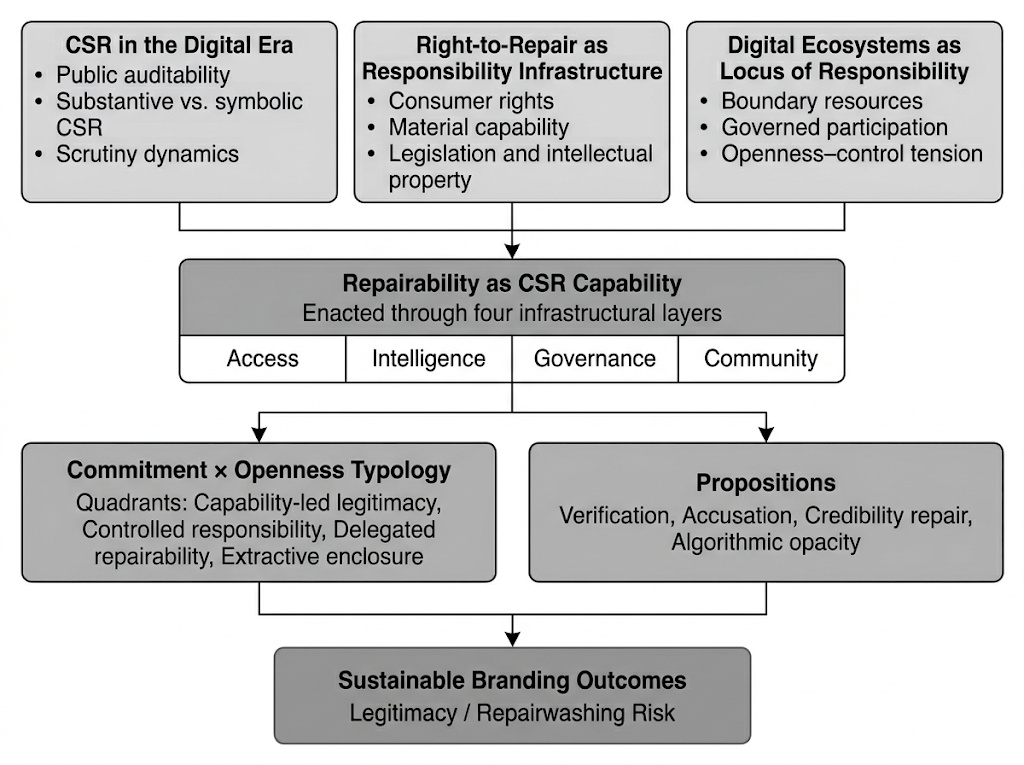
Source : Author's own illustration
Figure 1 maps the conceptual architecture that connects the foundational constructs developed in this section to the framework, typology, and propositions that follow. The three foundations, namely CSR in the digital era, R2R as responsibility infrastructure, and digital ecosystems as the locus of responsibility, converge on repairability as a governed CSR capability. This capability is then formalized through four infrastructural layers, differentiated by ecosystem strategy through the commitment–openness typology, and linked to legitimacy dynamics through proposition-level mechanisms.
Governing repairability and producing legitimacy in platform ecosystems
2.2.1 Ecosystem governance and boundary resources
To theorize repairability within digital ecosystems, it is necessary to foreground governance mechanisms that structure participation, agency, and control. The boundary resources lens explains how platform owners balance external contribution with platform integrity by selectively exposing technical interfaces (e.g., APIs and diagnostic tools), informational artifacts (e.g., documentation and manuals), and procedural arrangements (e.g., access policies and certification) (Ghazawneh & Henfridsson, 2012; Bianco et al., 2014). This model clarifies the core dilemma: ecosystems must resource participation while securing strategic control, and this balance is enacted materially through what is documented, what is accessible, and what is withheld (Ghazawneh & Henfridsson, 2012; Schreieck et al., 2016).
Boundary resources are especially relevant for repairability because they directly shape repair capacity. Documentation, parts specifications, diagnostic interfaces, and calibration routines function as governance instruments that define the practical boundaries of legitimate repair activity (Ghazawneh & Henfridsson, 2010; Buck & Watkowski, 2023). Moreover, boundary resources evolve through tuning, as platform owners adjust access in response to emerging risks, liability concerns, or strategic repositioning by making repairability a moving governance target rather than a fixed product attribute (Mohagheghzadeh & Rudmark, 2017; Costabile, 2024).
Recent literature further suggests that new technologies can themselves become boundary resources that reshape governance and participation. Work on generative AI as a boundary resource indicates how novel tools may reorganize who can contribute, how capabilities are distributed, and how openness/control tensions are recalibrated (Mayer et al., 2025). This issue matters for repairability because AI-mediated diagnostics and guided repair can expand consumer capacity while simultaneously increasing dependence on platform-controlled data, models, and interfaces (Mayer et al., 2025; Ghazawneh & Henfridsson, 2012). Boundary resources therefore provide a parsimonious bridge from ecosystem governance to CSR: repairability becomes a responsibility outcome when governance choices materially enable (rather than strategically restrict) repair agency (Schreieck et al., 2016; Boniface et al., 2023).
2.2.2 Legitimacy as a branding outcome of responsible performance
If repairability is conceptualized as a CSR capability enacted through ecosystem infrastructures, legitimacy becomes the construct linking responsibility performance to sustainable branding outcomes. CSR can enhance brand value via credibility and reputation mechanisms; however, the efficacy of these mechanisms is contingent upon the durability of responsibility signals under examination and over time (Hur et al., 2013; Moratis, 2015). In platform contexts, legitimacy is increasingly negotiated in public: stakeholders evaluate not only stated commitments but also whether infrastructures and practices render responsibility observable and verifiable (Pennesi & Giuliani, 2025; Imana et al., 2023).
Legitimacy is also shaped by the substantive–symbolic distinction. CSR research shows that stakeholders differentiate between substantive responsibility and symbolic signaling, with perceived decoupling increasing greenwashing interpretations and backlash risks (Donia & Tetrault Sirsly, 2016; Bothello et al., 2023). This distinction is particularly consequential for repairability because claims are unusually testable: parts availability, documentation usability, diagnostic access, and repair permissions can be evaluated by users and communities and rapidly circulated as evidence (Boniface et al., 2023).
Finally, legitimacy can be conferred and stabilized through assurance and classificatory infrastructures. Work on CSR claim credibility emphasizes the role of standards and taxonomies in making claims comparable and assessable (Moratis, 2015), while research on endorsements and assurance suggests that trusted external signals can shape stakeholder judgments of CSR credibility (Doh et al., 2009; Ernst et al., 2025). Under conditions of hyperconnectivity, however, credibility is increasingly infrastructural: legitimacy is sustained when visible ecosystem arrangements align with brand claims and erodes when publics observe systematic constraints that contradict responsibility narratives (Pennesi & Giuliani, 2025; Wang et al., 2025).
Methodological positioning: the composite vignette as a theory-building device
This manuscript advances a conceptual argument supported by a composite vignette. The vignette is used as a theory-building device to crystallize a recurring configuration in AI-mediated repair journeys: how access to repair resources, diagnostic mediation, governance restrictions, and community scrutiny combine to shape whether repairability is experienced as empowerment or as controlled responsibility (Bain, 2023; Tremblay et al., 2022). In this capacity, the vignette offers a concise, credible scenario that highlights the tensions posited by the manuscript and establishes the subsequent framework, typology, and propositions within a coherent repair sequence (Skilling & Stylianides, 2019).
The smartphone was selected as the vignette's focal product on the basis of four criteria. First, infrastructural completeness: smartphones are among the few consumer durables where all four layers of the proposed framework are simultaneously observable and well-documented, encompassing self-repair programs and parts catalogs at the access layer, AI-enabled diagnostics at the intelligence layer, software locks and parts pairing at the governance layer, and active repair forums and teardown channels at the community layer. Second, public salience: the smartphone repair domain has served as a focal point of R2R activism, legislative deliberation, and sustained media attention, rendering it a context where legitimacy dynamics are actively contested and
empirically traceable (Recker et al., 2024; Boniface et al., 2023). Third, software-hardware entanglement: smartphones exemplify the governance tensions that arise when repairability depends on permission structures embedded in software rather than on physical feasibility alone, which is central to the manuscript's argument about repairability as a governed capability (Abrol, 2024). Fourth, transferability: while the vignette is grounded in smartphone repair, the infrastructural layers and governance mechanisms it illustrates, including diagnostic mediation, parts authentication, and community verification, recur across other software-defined durable goods categories such as household appliances, automotive systems, and agricultural equipment, supporting the framework's applicability beyond the focal case (Saidani et al., 2023). These criteria guided selection toward a product category where the theoretical mechanisms are most densely observable, rather than toward a category chosen for convenience or familiarity.
To preserve analytical integrity, the vignette is regarded as a regulated conceptual simplification rather than as proof of prevalence or causal relationships (Eifler & Petzold, 2019). It is written for realism and recognizability, but the manuscript does not claim behavioral prediction or generalization from the vignette itself. Its contribution is proportional: it supports mechanism articulation and conceptual clarity by showing which governance choices make repairability actionable, which make it contestable, and how legitimacy is stabilized or disrupted in auditable digital arenas (Skilling & Stylianides, 2019).
Composite vignette
Digital service journeys increasingly enact repairability across consumer durables, combining self-repair documentation, community infrastructures, and AI-enabled diagnostics. Consider a composite but recognizable scenario involving a software-defined consumer device: a consumer’s smartphone begins to shut down unexpectedly after a battery health warning appears. Rather than visiting a repair shop immediately, the consumer enters the brand’s support ecosystem through an official app and is routed into a guided troubleshooting pathway. The interface requests permission to access device diagnostics, then translates sensor and usage data into a structured diagnosis: battery degradation is flagged, a replacement is recommended, and a set of safe next steps is presented. The journey is set up to be empowering, with clear steps and a focus on non-experts. However, it is also a governance sequence in which the platform decides what counts as a legitimate repair and what risks require limits (Sandez et al., 2023; Li et al., 2024).
The customer is given three official ways to get their device fixed: a self-repair kit, an appointment with an authorized service partner, or the option to send it in. Clicking the self-repair option reveals the access layer in practice: parts pricing, tool availability, and documentation format determine whether repairability is experienced as a realistic capability or as a nominal right. The consumer downloads an official guide and compares it to community-produced repair instructions circulating on repair forums and video platforms. These community infrastructures operate simultaneously as skill-building ecosystems and as auditing arenas: they translate repair from a private inconvenience into a civic sustainability practice, while also generating comparative judgments about whether the brand’s repairability claims are materially supported (Kaczmarek, 2021; Kalantidou & Brennan, 2024).
The consumer chooses an independent repair shop instead of the authorized pathway, motivated by cost, convenience, or a preference for local repair cultures. The repair succeeds physically; the battery is replaced, but a friction point emerges during calibration. The device issues a warning that the battery cannot be verified, a feature is disabled, or a service message persists. The repair shop explains that the component is functionally compatible but not cryptographically recognized due to parts pairing, authentication routines, or a required calibration step that is only available through proprietary diagnostic access. At this moment, repairability shifts from physical feasibility to permission-based feasibility: the product can be repaired, but the ecosystem decides whether the repair is legitimized and whether full functionality is restored (Recker et al., 2024; Boniface et al., 2023). The consumer faces the fundamental governance dilemma: controls rationalized as safety, integrity, or liability management simultaneously function as gatekeeping mechanisms that dictate who is permitted to perform repairs and under what circumstances (Abrol, 2024).
The episode moves quickly from individual experience to public verification. Searching the warning message, the consumer uncovers discussions that document similar frictions, compare them across models, and frame them through the discourse of R2R. In parallel, content creators and technical influencers dismantle devices on camera, test parts and tools, and demonstrate where repairs are blocked, degraded, or allowed. Their demonstrations do not merely inform; they function as third-party validation or falsification infrastructures that render claims about repairability auditable at scale. As the evidence circulates, which includes screenshots, teardown videos, and policy excerpts, stakeholders cluster around contested topics, accusations of repairwashing intensify, and the brand’s sustainability narrative becomes a public performance that must withstand scrutiny (Blazkova et al., 2023; Salimi et al., 2025; Zhang et al., 2025; Yang & Chuenterawong, 2025).
The brand responds within the same hyperconnected arena. It may update support pages, clarify safety rationales, announce expanded parts availability, or alter software behavior in a patch. Yet credibility repair is strategy-dependent: responses perceived as deflective or controlling can prolong backlash, whereas actions that increase transparency, expand legitimate repair options, and align governance choices with responsibility claims are more likely to stabilize legitimacy (Haigh & Brubaker, 2010; Len-Ríos et al., 2015). In this composite sequence, repairability is revealed not as a static product attribute but as an ecosystem capability: it is enacted through access infrastructures (parts, tools, documentation), intelligence infrastructures (AI diagnostics and guided repair), governance infrastructures (locks, pairing, diagnostic permissions), and community infrastructures (co-produced knowledge, verification, and contestation). The vignette therefore crystallizes the manuscript’s central claim: sustainable branding via repairability becomes credible only when enabling infrastructures and permission structures align with responsibility narratives under conditions of continuous public audit.
Core framework: Repairability as a CSR capability in AI-mediated ecosystems
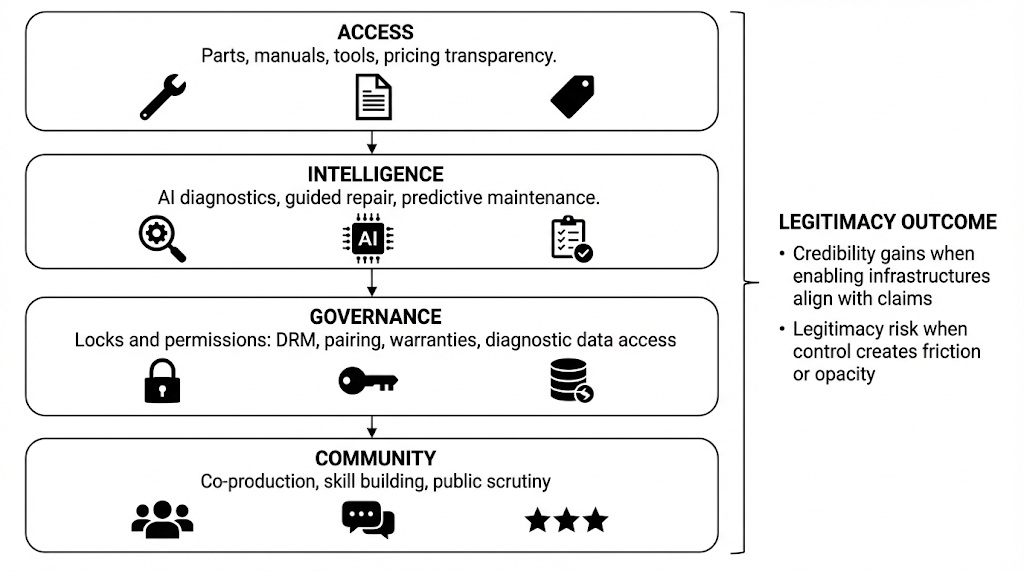
This section formalizes repairability as a CSR capability by specifying four infrastructural layers that jointly shape whether repair is practically enabled or strategically constrained in AI-mediated ecosystems (Boniface et al., 2023; Recker et al., 2024). The framework, illustrated in Figure 2, shows how legitimacy is strengthened when these layers align with sustainability claims and weakened when governance choices produce visible friction, opacity, or enclosure (Blazkova et al., 2023; Salimi et al., 2025).
2.5.1 Access layer: repairability conditions
The access layer captures material and informational prerequisites of repair: availability and affordability of spare parts, tools, and manuals; transparency of pricing; and the practical usability of repair documentation. Repairability indices and assessment systems formalize these conditions by operationalizing repairability through criteria such as spare-part availability and accessible documentation, thereby making repair a measurable capability rather than a rhetorical commitment (Hidalgo-Crespo & Maranzana, 2025). Research on self-repair facilitation further shows that documentation format affects whether non-expert users can successfully complete repairs, turning access into a lived capacity rather than a nominal right (Sandez et al., 2023).
2.5.2 Intelligence layer: AI mediation
The intelligence layer captures how AI reconfigures repair journeys through diagnostics, guided repair, and predictive maintenance. AI-assisted maintenance systems can translate uncertain failure conditions into structured diagnosis and prognosis pathways, shifting repair from a reactive event to an anticipatory service logic (Li et al., 2024). Reviews of AI in resilience and maintenance similarly position predictive monitoring as a mechanism that reduces downtime and improves reliability, and this can lower knowledge barriers when translated into consumer-facing support (Maier et al., 2024). At the same time, AI guidance introduces responsibility tensions: when systems prescribe recommended actions or define what counts as safe intervention, accountability becomes entangled with opacity, data access, and design choices that shape user agency (Ghazawneh & Henfridsson, 2012; Mayer et al., 2025; Li et al., 2024). Li et al. (2024) view this as system optimization, Mayer et al. (2025) caution that such AI tools function as boundary resources that can silently regulate ecosystem participation and user agency.
Algorithmic opacity poses a specific and underexamined barrier to substantive CSR within this layer. When AI-mediated diagnostics generate recommendations without furnishing interpretable reasoning, for instance, recommending authorized replacement over user-serviceable repair without disclosing the decision criteria, the repair journey becomes opaque to the very stakeholders whose trust it is meant to cultivate. The consumer cannot readily evaluate whether guidance reflects genuine safety considerations, cost optimization logics, or channel-steering incentives designed to direct repair activity toward proprietary service pathways. This opacity undermines the verifiability that distinguishes substantive from symbolic CSR: if stakeholders cannot audit the reasoning behind repair recommendations, they cannot ascertain that AI mediation serves sustainability objectives rather than commercial enclosure (Mayer et al., 2025; Li et al., 2024). Opacity therefore functions not merely as a diffuse trust risk but as a structural barrier to the credibility of AI-mediated repairability claims, precisely because it forecloses the kind of public verification that the community layer depends upon to confer and stabilize legitimacy.
A further tension warrants acknowledgment. AI systems are resource-intensive: training and operating large-scale models requires substantial computational energy and water inputs, raising legitimate questions about the net sustainability contribution of AI-mediated repair (Luccioni et al., 2024; Li et al., 2025). For some consumers, the environmental cost of AI infrastructure may conflict with the sustainability values that motivate repair in the first place, potentially diminishing willingness to engage with AI-enabled repair pathways. This tension does not invalidate AI's role in the intelligence layer. Extending the functional lifespan of durable goods through more accurate diagnostics and structured guidance may well offset the resource costs of AI operation over the product lifecycle. However, it does mean that the sustainability case for AI-mediated repair is conditional rather than self-evident. Brands that integrate AI into repair ecosystems without acknowledging or disclosing the resource implications of their AI infrastructure may encounter an additional vector of scrutiny, particularly from environmentally conscious stakeholders who evaluate sustainability holistically rather than at a single product-service boundary.
2.5.3 Governance layer: software locks/DRM/warranties/data access
The governance layer shows how repairability can be programmed by setting up technical and legal control points that decide who can repair, when, and with what parts, tools, and data. In digitally embedded and IoT products, restrictions are increasingly enacted through technological protection measures and software-based locks that function as gatekeeping mechanisms, often reinforced by intellectual property claims and liability risks (Abrol, 2024; Boniface et al., 2023). Parts pairing is a key part of the process: encryption, authentication routines, or proprietary calibration procedures connect parts to devices. Analysis of the iPhone repair aftermarket shows how authorization requirements can be embedded into the repair process, making third-party parts difficult to use or functionally degraded even when physically compatible (Recker et al., 2024).
Governance conflicts also surface around diagnostic and device data access. IoT and software-defined products rely on diagnostic interfaces and lifecycle data that are not always available to end users or independent repair providers, creating asymmetries of repair capability (Boniface et al., 2023). Translational design research proposes instruments such as Right to Repair Cards that convert legal obligations into design-relevant guidelines and foreground access, longevity, and serviceability as governance choices rather than afterthoughts (Urquhart et al., 2024). Sustainable IoT scholarship likewise stresses the need to align legal and design agendas so that product-service systems do not externalize repair burdens while withholding resources necessary for repair (Urquhart et al., 2024).
Warranty structuring and repair-channel steering further reinforce governance. In R2R debates, these mechanisms are frequently highlighted as constraints that undermine consumer autonomy and sustainability goals, particularly when paired with limits on parts and information access (Kumar et al., 2025; Roy & Sen, 2023). When firms claim sustainability while maintaining strong enclosure through locks, pairing, and restricted data access, exposure to repairwashing accusations increases, especially in contexts where constraints are rapidly documented and circulated (Saidani et al., 2023).
2.5.4 Community layer: co-production and scrutiny
The community layer captures repair as co-produced and publicly auditable. Repair cultures and place-based repair practices contribute to the circulation of repair knowledge, the development of practical skills, and the reframing of repair as a sustainability practice (Kaczmarek, 2021; Kalantidou & Brennan, 2024). Stakeholder engagement research indicates that participation and learning dynamics strengthen sustainable value creation, suggesting that community involvement can be capability-building as well as reputational (Alshukri et al., 2024). Communities also provide scrutiny: they compare claims to lived experience, expose friction points, and can trigger legitimacy spillovers across platforms, both positive and negative (Kaczmarek, 2021; Roy & Sen, 2023). This scrutiny is increasingly mediated by technical influencers and content creators who act as legitimacy brokers, dismantling devices to publicly verify claims before wider audiences (Zhang et al., 2025; Yang & Chuenterawong, 2025).
Source : Author's own illustration
Typology: repairability commitment × ecosystem openness
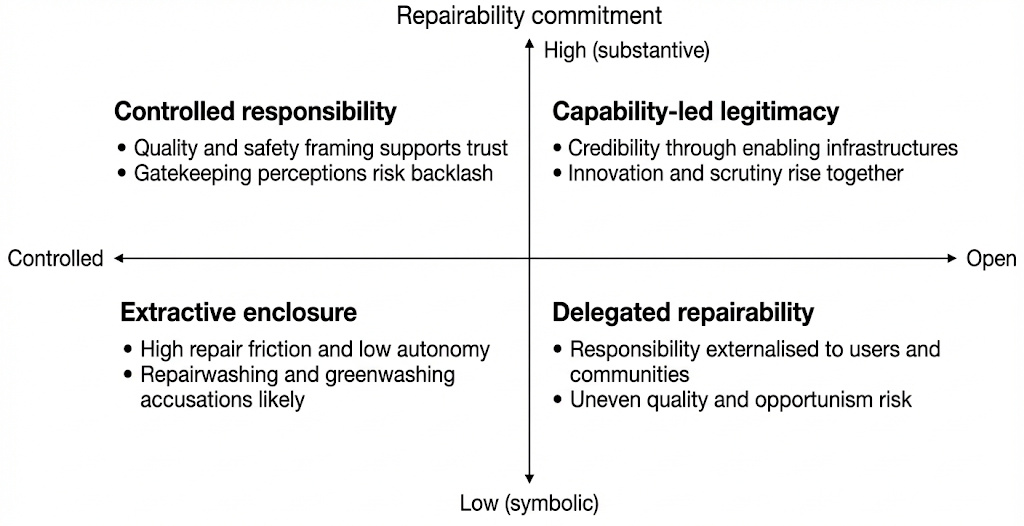
To connect repairability-as-CSR capability to ecosystem strategy, this manuscript proposes a 2×2 typology that crosses repairability commitment with ecosystem openness. The typology is motivated by platform ecosystem research showing that openness and control reshape trust, quality, innovation, and governance volatility (Wessel et al., 2017). It is also motivated by CSR scholarship demonstrating that stakeholders differentiate between substantive responsibility and symbolic CSR, with decoupling dynamics increasing perceived greenwashing and backlash risks (Bothello et al., 2023; Donia & Tetrault Sirsly, 2016; Wessel et al., 2017). These dynamics are especially salient for repairability because commitments are readily verifiable through parts access, documentation, diagnostic access, and repair permissions that can be tested and shared (Saidani et al., 2023).
Figure 3 illustrates the typology. Accordingly, the predicted branding outcome is that the legitimacy is strongest when commitment is substantive and constraints are transparently justified.
Quadrant 1: Capability-led legitimacy (high commitment, high openness). Firms make repairability materially actionable while enabling broad participation across repair communities and independent service ecosystems. Openness expands complementary repair knowledge and services, which can increase empowerment and innovation, but also increases exposure because claims are tested publicly (Donia & Tetrault Sirsly, 2016; Wessel et al., 2017). Governance remains necessary because openness without safeguards can reduce average quality and destabilize trust (Wessel et al., 2017; Jin et al., 2023).
Quadrant 2: Controlled responsibility (high commitment, low openness). Firms invest in repairability but retain strong control over the repair ecosystem through approved channels and restricted participation. Control can stabilize quality and limit uncertainty, yet it may narrow innovation and create perceptions of gatekeeping if constraints resemble enclosure (Jin et al., 2023). Legitimacy depends on whether control is experienced as safety and quality governance or as strategic restriction, especially in hyperconnected contexts where friction points can become reputational flashpoints (Bothello et al., 2023; Wessel et al., 2017).
Quadrant 3: Delegated repairability (low commitment, high openness). Firms rely on openness and third-party ecosystems to carry repair outcomes without investing strongly in repair infrastructures. Openness can partially compensate through ecosystem improvisation, but it externalizes responsibility onto consumers who must navigate uneven quality and risk (Jin et al., 2023; Saidani et al., 2023). In CSR terms, weak commitment increases skepticism if firms benefit from repair narratives while not providing enabling infrastructures (Donia & Tetrault Sirsly, 2016; Wessel et al., 2017).
Quadrant 4: Extractive enclosure (low commitment, low openness). Firms neither invest in repairability infrastructures nor allow open ecosystem participation, making repair difficult and alternatives constrained. Under such conditions, symbolic CSR is especially likely to trigger perceived greenwashing because stakeholders observe a disconnect between claims and practice (Bothello et al., 2023; Wessel et al., 2017). Evidence also suggests that decoupling can be associated with severe downstream risks, including credibility collapse and broader misconduct signals in some contexts (Saeed et al., 2025; Khanchel et al., 2023).
Source : Author’s own illustration
Propositions and mechanisms: verification, accusation, and credibility repair in digital CSR
Digital publics can turn CSR into an auditing arena where claims are tested, contested, and verified. Research on greenwashing debates on social media shows that accusations and counterclaims organize around identifiable stakeholder clusters and recurring topics, enabling rapid contestation and comparative evaluation (Blazkova et al., 2023; Salimi et al., 2025). These dynamics are amplified by visibility conditions that enable activism while also increasing escalation risks, including surveillance pressures that shape how contestation unfolds (Uldam, 2017).
Third-party validation depends on platform affordances that shape credibility assessment. Interactive elements like comments and engagement interfaces can serve as credibility infrastructure, allowing the public to express agreement, contest assertions, and evaluate trustworthiness through observable indicators (Liao & Mak, 2019; Go & Bortree, 2017). When affordances are constrained, stakeholders may interpret reduced interaction as lowered transparency, which can intensify suspicion in contexts where greenwashing accusations are salient (Liao & Mak, 2019; Salimi et al., 2025).
Backlash dynamics are also strategy-dependent. Image restoration research shows that post-crisis responses vary in how they affect perceived CSR, organization–public relationships, and source credibility, with some approaches improving evaluations and others failing in social media contexts (Haigh & Brubaker, 2010; Len-Ríos et al., 2015). In addition, experimental work on debunking CSR-washing indicates that public correction can reverse the persuasive effects of misleading CSR claims and produce measurable reputational penalties (Brugman et al., 2024). These mechanisms are consistent with influencer-focused research suggesting that credibility brokers can amplify CSR legitimacy but also intensify scrutiny and accelerate backlash diffusion when inconsistencies are highlighted (Zhang et al., 2025; Yang & Chuenterawong, 2025).
An additional mechanism concerns algorithmic opacity within the intelligence layer. When AI-mediated diagnostics lack interpretable reasoning, the gap between system recommendations and stakeholder understanding creates a structural impediment to substantive CSR. Unlike governance-layer restrictions, which are frequently visible and documentable through observable friction points such as parts pairing warnings or persistent service messages, opacity in diagnostic logic is considerably harder to detect and contest. This asymmetry renders algorithmic opacity a less conspicuous but potentially more corrosive threat to the credibility of repairability claims, because stakeholders may not recognize the barrier until comparative community evidence accumulates. Proposition P8 formalizes this mechanism.
Table 1 consolidates the core mechanisms and their proposition-level implications, linking platform-mediated verification, escalation, and credibility repair to auditable repairability-based CSR claims (Blazkova et al., 2023; Salimi et al., 2025).
Table 1. Mechanisms and propositions linking repairability-based CSR claims to verification, backlash, and credibility repair in hyperconnected digital ecosystems.
| Mechanism | Mechanism label | Mechanism statement | Propo-sition | Proposition text | Key sources |
|---|---|---|---|---|---|
| A | Social media as an auditing arena | CSR claims become testable in public; accusation and counter-accusation travel through identifiable stakeholder clusters, topics, and narrative patterns, turning CSR into an auditable performance. | P1 | In hyperconnected markets, CSR claims become publicly auditable; as stakeholders cluster around contested topics, verification and accusation dynamics intensify. | (Blazkova et al., 2023; Salimi et al., 2025) |
| A | Social media as an auditing arena (see above) | (see Mechanism A) | P4 | When CSR claims are perceived as greenwashing, emotional and discursive escalation on social media increases the probability and speed of backlash. | (Salimi et al., 2025; Blazkova et al., 2023) |
| B | Visibility asymmetry and escalation risk | Visibility enables activism and scrutiny, but it also increases exposure to surveillance and escalation; contestation intensifies when CSR claims conflict with lived experience and circulated evidence. | P2 | As CSR visibility increases on social media, downside reputational risk becomes asymmetric, because scrutiny and escalation intensify when responsibility claims conflict with lived experience and circulated evidence. | (Uldam, 2017) |
| C | Affordance-structured validation | Platform affordances such as commenting and interaction shape credibility assessment and third-party validation; restricting these affordances can reduce perceived trustworthiness and trigger suspicion. | P3 | Third-party validation depends on platform affordances; interactive features such as commenting function as credibility infrastructure that shapes perceived trustworthiness and the intensity of scrutiny. | (Liao & Mak, 2019; Go & Bortree, 2017) |
| F | Interactivity raises credibility and raises exposure | CSR fit and interactive CSR messaging can increase perceived credibility, but higher engagement also increases exposure to contestation if claims are weak or inconsistent. | P3∗ | Under higher message and modality interactivity, perceived credibility can increase, but exposure to contestation also rises if CSR claims are weak, inconsistent, or easily counter-evidenced. | (Go & Bortree, 2017; Blazkova et al., 2023) |
| D | Strategy-dependent credibility repair | Credibility repair depends on the chosen response strategy; some image restoration approaches improve CSR perceptions, organization–public relationship assessments, and credibility, while others fail and prolong backlash. | P6 | Following CSR-related controversy, credibility repair is contingent on response strategy; some image restoration approaches strengthen CSR perceptions and organization–public relationships, whereas others fail and prolong backlash. | (Haigh & Brubaker, 2010; Len-Ríos et al., 2015) |
| E | Debunking and reputational penalty | When CSR-washing is publicly debunked, corrective information can reverse prior persuasion and generate measurable penalties in brand attitudes and behavioral intentions. | P5 | Public debunking of CSR-washing reverses persuasion and yields measurable reputational penalties in brand evaluations and behavioral intentions. | (Brugman et al., 2024) |
| G | Influencers as legitimacy brokers and risk multipliers | Influencers can amplify CSR legitimacy when perceived as credible and public-serving, but amplification also accelerates scrutiny and can intensify backlash diffusion once inconsistencies are highlighted. | P7 | Influencers can act as legitimacy brokers that expand the reach and perceived legitimacy of CSR messages, while simultaneously accelerating scrutiny and backlash diffusion when inconsistencies are highlighted. | (Zhang et al., 2025; Yang & Chuenterawong, 2025) |
| H | Algorithmic opacity as a barrier to substantive CSR | When AI-mediated repair diagnostics operate without interpretable reasoning, stakeholders cannot verify whether recommendations serve sustainability, safety, or commercial objectives, undermining the substantive character of repairability-based CSR. | P8 | Algorithmic opacity in AI-mediated repair diagnostics weakens the substantive credibility of repairability-based CSR claims by preventing stakeholder verification of whether recommendations serve sustainability goals or commercial interests. | (Mayer et al., 2025; Li et al., 2024) |
| ∗ Boundary condition. | |||||
Source : Author's own synthesis
Conclusions
This manuscript set out to explain how repairability operates as a CSR capability inside digital ecosystems and how AI-mediated service journeys reshape the performance of responsibility and brand legitimacy. The central argument is that repairability is not a static product feature but an ecosystem capability that depends on infrastructures of access, intelligence, governance, and community scrutiny. Across these layers, repairability becomes actionable when consumers and third parties can obtain parts, tools, manuals, and pricing transparency, and when repair guidance is usable for non-experts, rather than existing only as nominal availability (Hidalgo-Crespo & Maranzana, 2025; Sandez et al., 2023). AI changes how we approach repairs by turning uncertainty about failures into clear diagnostics and step-by-step guidance, making it easier for people to understand while also raising questions about safety, transparency, and who is responsible between the user and the system. Moreover, algorithmic opacity in AI-mediated diagnostics was identified as a structural barrier to substantive CSR, because it forecloses the stakeholder verification upon which community-layer legitimacy depends. The manuscript also showed that repairability is governed, not only enabled. Software locks, technological protection measures, parts pairing, and constrained diagnostic access can convert repairability into a conditional and programmable experience, where permission structures, rather than physical feasibility, determine what repairs can be performed (Abrol, 2024; Recker et al., 2024; Boniface et al., 2023). Finally, the manuscript highlighted that repairability is publicly contested and socially verified. Repair communities co-produce repair knowledge and, at the same time, act as auditors who rapidly surface friction points and inconsistencies between brand claims and lived repair experience (Kaczmarek, 2021; Kalantidou & Brennan, 2024). These findings collectively address the manuscript’s risk question by clarifying why repairwashing accusations and legitimacy conflicts intensify when governance restrictions and selective openness create visible misalignments between responsibility narratives and repair realities (Blazkova et al., 2023; Salimi et al., 2025).
Theoretical implications
The manuscript contributes to CSR and branding scholarship by treating responsibility as both performative and infrastructural in digital ecosystems. First, it reinforces that CSR is not only communicated but also encountered and evaluated in platform-mediated settings that enable contestation, recirculation, and peer validation. This shifts CSR from disclosure to ongoing public performance, where claims become auditable artifacts rather than stable corporate narratives (Blazkova et al., 2023; Salimi et al., 2025). Second, the manuscript extends ecosystem governance theory into CSR by conceptualizing repairability as an outcome of boundary-resource design. Manuals, documentation, diagnostic interfaces, and access policies serve as governance tools that balance resource allocation and security. Ecosystems allow stakeholders to shape and share responsibility (Ghazawneh & Henfridsson, 2012). Third, the framework clarifies how AI can function as a governance-relevant capability, not merely an efficiency tool. AI-driven diagnostics can redistribute agency and reshape accountability boundaries, which is relevant for CSR because it affects whether empowerment claims are experienced as enabling support or as constrained, opaque control (Mayer et al., 2025; Li et al., 2024). The identification of algorithmic opacity as a specific barrier to substantive CSR extends this insight by demonstrating that opacity does not merely erode trust in individual interactions but structurally prevents the public verification that stabilizes legitimacy at the community layer. Finally, the 2×2 typology integrates platform openness-control trade-offs with CSR's substantive-symbolic distinctions, linking ecosystem strategy to legitimacy dynamics. It shows why openness can increase innovation but also volatility and scrutiny, and why symbolic responsibility becomes especially fragile when restrictions are easily documented and shared in digital publics (Wessel et al., 2017; Bothello et al., 2023). These implications collectively recontextualize repairability as a tangible locus where corporate social responsibility (CSR), governance, and branding intersect, and where legitimacy is attained through the congruence of infrastructure and narrative, rather than narrative in isolation (Donia & Tetrault Sirsly, 2016; Bothello et al., 2023). The integration of the legislative dimension further demonstrates that repairability is not governed solely by corporate strategy but is increasingly shaped by regulatory mandates that establish baseline access conditions, creating a new evaluative arena where the gap between compliance and substantive enablement becomes itself a locus of legitimacy assessment.
Managerial implications
For managers, the results translate into a clear principle: credibility in sustainable branding depends on building repairability infrastructures that can withstand public verification. At the access layer, this principle means prioritizing usable documentation, transparent pricing, and predictable parts availability, because these are the conditions that make repair a lived consumer capacity rather than a rhetorical right (Sandez et al., 2023; Hidalgo-Crespo & Maranzana, 2025). At the intelligence layer, AI-enabled guidance should be designed with explicit boundaries, including safety constraints, responsibility allocation, and understandable explanations of recommendations, so that guided repair does not become an accountability gap or a perceived enclosure of user agency (Li et al., 2024; Mayer et al., 2025). At the governance layer, managers should treat software locks, parts pairing, and diagnostic data access as CSR-relevant design choices. When these controls are non-negotiable, firms should transparently justify them and ensure they do not undermine repair claims in practice, because restrictive governance can quickly trigger suspicion and backlash when it appears to contradict sustainability narratives (Recker et al., 2024; Boniface et al., 2023; Salimi et al., 2025).
To support practical application, Table 2 offers a diagnostic checklist that enables managers to evaluate whether specific governance controls serve legitimate safety functions or risk being perceived and contested as market gatekeeping. The checklist operationalizes the governance layer by translating the safety-versus-enclosure distinction into assessable criteria that can be applied to individual control points within a repair ecosystem. Controls that consistently satisfy the safety governance indicators are more likely to withstand public scrutiny and align with substantive CSR. Controls that cluster on the gatekeeping side signal elevated repairwashing risk and should prompt either redesign or, at minimum, transparent and evidence-based justification. The diagnostic value of the checklist lies in its capacity to surface misalignments before they become focal points for community contestation, allowing managers to anticipate rather than react to legitimacy challenges.
Table 2. Diagnostic checklist: distinguishing safety governance from market gatekeeping in repair ecosystem design.
| Diagnostic criterion | Safety governance indicator | Market gatekeeping indicator |
| Stated rationale | Restriction is tied to a specific, documented safety, health, or data-integrity risk | Restriction lacks a specific risk rationale or invokes vague quality concerns without supporting evidence |
| Proportionality | Control is proportionate to the identified risk (e.g., battery calibration requires verification but does not disable unrelated features) | Control exceeds the scope of the stated risk (e.g., replacing a screen disables unrelated sensors or triggers persistent warnings) |
| Transparency | Criteria for restriction are publicly documented and independently verifiable | Criteria are opaque, undocumented, or accessible only to authorized partners |
| Third-party access | Independent repairers can access the same safety-relevant tools and data as authorized partners, potentially subject to certification | Access to tools, calibration software, or diagnostic data is withheld from independent repairers without a safety-based justification |
| Consumer outcome after independent repair | Device retains full functionality; any safety warnings resolve upon verified calibration | Device loses functionality, displays persistent warnings, or degrades performance following third-party repair |
| Reversibility | Restrictions can be lifted once safety conditions are satisfied (e.g., post-repair recalibration restores full status) | Restrictions are permanent or require return to authorized channels irrespective of repair quality |
| Competitive neutrality | The restriction applies uniformly regardless of whether the repairer is first-party, authorized, or independent | The restriction disproportionately advantages the brand’s own repair channels or authorized service partners |
| Stakeholder scrutiny resilience | The firm can publicly defend the restriction with evidence that withstands community and regulatory review | The restriction is difficult to defend publicly and generates recurring contestation in repair communities |
Companies should see repair communities as partners in building skills and checking for legitimacy at the community level. Investing in structured engagement and allowing for third-party validation can enhance trust, but such success is contingent upon firms being ready for scrutiny and having infrastructures that support their claims (Kaczmarek, 2021; Liao & Mak, 2019). The most actionable warning is to avoid high-visibility responsibility claims that are not supported by governance-compatible repair realities, because debunking and accusation dynamics produce measurable reputational penalties, and negative discourse can dominate public interpretation (Brugman et al., 2024; Blazkova et al., 2023).
The rapidly crystallizing legislative landscape further reconfigures the managerial calculus. As the ESPR and the Right to Repair Directive establish mandatory repairability thresholds, including post-warranty repair obligations, spare parts availability requirements, and pricing transparency, regulatory compliance becomes a baseline expectation rather than a source of competitive differentiation. Managers should therefore treat these regulatory floors as starting points and deploy the framework developed here to identify where substantive investment in access, intelligence, and community layers can build credibility that exceeds minimum compliance. This distinction matters because stakeholders in hyperconnected markets evaluate not only whether firms satisfy legal obligations but whether their repair infrastructures genuinely enable consumer agency, and the gap between formal compliance and substantive enablement is precisely where repairwashing accusations gain traction.
Limitations and future research
The manuscript’s primary limitation is methodological by design. The composite vignette approach supports conceptual clarification and mechanism articulation, but it does not offer causal identification or population-level generalization (Bain, 2023; Tremblay et al., 2022). This limitation is mitigated by clarifying the vignette's purpose, which is to theorize recurring ecosystem configurations rather than to assert statistical claims regarding effect sizes or prevalence (Eifler & Petzold, 2019; Skilling & Stylianides, 2019). Future research can build an empirical agenda in four directions. First, comparative ecosystem studies can examine how various configurations of boundary resources influence repair outcomes and stakeholder legitimacy assessments across sectors such as consumer electronics, appliances, and automotive services (Ghazawneh & Henfridsson, 2012; Boniface et al., 2023). Second, consumer research can examine how AI-mediated diagnostics influence perceived agency, trust, and blame attribution when repairs succeed or fail, including the conditions under which guidance is interpreted as empowerment versus control (Li et al., 2024; Mayer et al., 2025). Third, digital methods can track the dynamics of accusations and verifications surrounding repairability claims in real time, such as who is driving scrutiny, how evidence is shared, and when backlash grows (Blazkova et al., 2023; Salimi et al., 2025). Fourth, governance- and law-oriented research can examine how intellectual property claims, technological protection measures, and diagnostic data access regimes interact with emerging R2R policy instruments and how these legal architectures shape the practical availability of repair as a consumer right (Abrol, 2024; Boniface et al., 2023). In particular, as EU Member States transpose the Right to Repair Directive into national law by July 2026, comparative studies could examine whether and how implementation translates into substantive changes in access layer conditions across jurisdictions and whether regulatory compliance reduces or merely redirects repairwashing risk toward less regulated dimensions of the repair ecosystem.
Repairability should be treated as a pillar of sustainable branding because it makes sustainability credible at the point where responsibility becomes materially testable. In digital ecosystems, stakeholders do not evaluate responsibility only through stated commitments; they evaluate it through whether the infrastructure of repair is real, usable, and governed in ways that enable agency rather than simulate it (Ghazawneh & Henfridsson, 2012; Sandez et al., 2023). When repairability is supported through transparent access, intelligible AI guidance, and governance choices that do not strategically foreclose legitimate repair, it transforms sustainability from narrative into capability and legitimacy from aspiration into earned trust (Li et al., 2024; Recker et al., 2024; Bothello et al., 2023). On the other hand, when repairability is considered a responsibility but is limited by enclosure mechanisms that communities can easily document and challenge, it increases the risk of greenwashing and speeds up backlash in digital publics that can be audited (Blazkova et al., 2023; Salimi et al., 2025). Sustainable branding, therefore, is increasingly decided not by the elegance of CSR storytelling but by the durability of the infrastructures that make responsible consumption possible.
Funding Statement
This research received no specific grant from any funding agency in the public, commercial, or not-for-profit sectors.
Conflict of Interest
The authors declare that they have no known competing financial interests or personal relationships that could have appeared to influence the work reported in this paper.
Data Availability
The datasets generated during and/or analyzed during the current study are not publicly available due to data sharing and privacy guidelines presented, but are available from the corresponding author on reasonable request.
CRediT Authorship Contribution Statement
Selcen Ozturkcan: The author confirms sole responsibility for the conceptualization, methodology, formal analysis, original draft preparation, and visualization of this work.
Supplementary Materials
Supplementary material for this article is available online via https://doi.org/10.51300/JSM-2026-170.
Publisher Disclaimer
The views expressed in this article are solely those of the author(s) and do not necessarily reflect those of their institutions, the publisher, editors, or reviewers. The publisher and editorial team make no warranties regarding the accuracy or completeness of the content and accept no responsibility for errors, omissions, or any consequences arising from its use. The publisher remains neutral regarding jurisdictional claims in maps and institutional affiliations.
References
- . Reconciling right to repair and intellectual property rights: An Indian perspective. NTUT Journal of Intellectual Property Law and Management, 13, 27-44.
- . The Interplay of Corporate Social Responsibility, Innovation Capability, Organizational Learning, and Sustainable Value Creation: Does Stakeholder Engagement Matter?. Sustainability, 16(13). https://doi.org/10.3390/su16135511. CrossRef | Google Scholar
- . Followership behavior and corporate social responsibility disclosure: Analysis and implications for sustainability research. Journal of Cleaner Production, 360, 360-132151. https://doi.org/10.1016/j.jclepro.2022.132151. CrossRef | Google Scholar
- . Using text-based vignettes in qualitative social work research. Qualitative Social Work, 23(1), 165-178. https://doi.org/10.1177/14733250231175386. CrossRef | Google Scholar
- . Untapping Patents to Promote a European Right to Repair: From Exhaustion to Compulsory Licensing. GRUR International, 74(12), 1113-1126. https://doi.org/10.1093/grurint/ikaf104. CrossRef | Google Scholar
- . The Role of Platform Boundary Resources in Software Ecosystems: A Case Study. In 2014 IEEE/IFIP Conference on Software Architecture (WICSA) (pp. 11-20). IEEE. https://doi.org/10.1109/wicsa.2014.41. CrossRef | Google Scholar
- . Greenwashing debates on Twitter: Stakeholders and critical topics. Journal of Cleaner Production, 427. https://doi.org/10.1016/j.jclepro.2023.139260. CrossRef | Google Scholar
- . Towards a Right to Repair for the Internet of Things: A Review of Legal and Policy Aspects. Computer Law \& Security Review, . Elsevier BV, 52-105934. https://doi.org/10.2139/ssrn.4450963. CrossRef | Google Scholar
-
.
CSR decoupling within business groups and the risk of perceived greenwashing. Strategic Management Journal, 44(13), 3217-3251. https://doi.org/10.1002/smj.3532. CrossRef | Google Scholar - . Community repair in the circular economy – fixing more than stuff. Local Environment, 27(10-11), 1321-1337. https://doi.org/10.1080/13549839.2022.2041580. CrossRef | Google Scholar
- . Ethical Dimensions of the Right to Repair. In 2025 Systems and Information Engineering Design Symposium (SIEDS) (pp. 1-6). IEEE. https://doi.org/10.1109/sieds65500.2025.11021197. CrossRef | Google Scholar
- . Debunking the corporate paint shop: Examining the effects of misleading corporate social responsibility claims on social media. New Media \& Society, 28(1), 333-356. https://doi.org/10.1177/14614448241288482. CrossRef | Google Scholar
- . How automotive OEMs can lever platform-based ecosystems through the strategic use of boundary resources. International Journal of Automotive Technology and Management, 23(2/3), 171-194. https://doi.org/10.1504/ijatm.2023.133354. CrossRef | Google Scholar
- . Digital platform ecosystem governance of private companies: Building blocks and a research agenda based on a multidisciplinary, systematic literature review. Data and Information Management, 8(1), 100053-100053. https://doi.org/10.1016/j.dim.2023.100053. CrossRef | Google Scholar
- . Does the Market Respond to an Endorsement of Social Responsibility? The Role of Institutions, Information, and Legitimacy. Journal of Management, 36(6), 1461-1485. https://doi.org/10.1177/0149206309337896. CrossRef | Google Scholar
- . Determinants and consequences of employee attributions of corporate social responsibility as substantive or symbolic. European Management Journal, 34(3), 232-242. https://doi.org/10.1016/j.emj.2016.02.004. CrossRef | Google Scholar
- . Validity Aspects of Vignette Experiments: Expected “What‐If” Differences Between Reports of Behavioral Intentions and Actual Behavior. Experimental Methods in Survey Research, 417-438. https://doi.org/10.1002/9781119083771.ch20. CrossRef | Google Scholar
- . Correction: Investors’ reactions to CSR reputation and disclosure assurance: an experimental analysis. Journal of Management and Governance, 30(2). https://doi.org/10.1007/s10997-025-09760-0. CrossRef | Google Scholar
- . Governing third-party development through platform boundary resources. .
- . Balancing platform control and external contribution in third‐party development: the boundary resources model. Information Systems Journal, 23(2), 173-192. https://doi.org/10.1111/j.1365-2575.2012.00406.x. CrossRef | Google Scholar
- . What and How to Communicate CSR? The Role of CSR fit, Modality Interactivity, and Message Interactivity on Social Networking Sites. Journal of Promotion Management, 23(5), 727-747. https://doi.org/10.1080/10496491.2017.1297983. CrossRef | Google Scholar
- . Social disclosures using social media in {India}. In Proceedings of the International Conference on Industrial Engineering and Operations Management (pp. 3628-3641). {IEOM Society International}. https://ieomsociety.org/ieom2019/papers/832.pdf.
- . Examining how image restoration strategy impacts perceptions of corporate social responsibility, organization‐public relationships, and source credibility. Corporate Communications: An International Journal, 15(4), 453-468. https://doi.org/10.1108/13563281011085538. CrossRef | Google Scholar
- . Product Lifecycle: Human-AI Interoperability for the Assessment of the Disassembly and Repairability Indices of Electrical and Electronic Equipment. Springer Nature Switzerland, Vol. 772. https://doi.org/10.1007/978-3-032-09700-2_29. CrossRef | Google Scholar
- . How CSR Leads to Corporate Brand Equity: Mediating Mechanisms of Corporate Brand Credibility and Reputation. Journal of Business Ethics, 125(1), 75-86. https://doi.org/10.1007/s10551-013-1910-0. CrossRef | Google Scholar
- . Having your Privacy Cake and Eating it Too: Platform-supported Auditing of Social Media Algorithms for Public Interest. Proceedings of the ACM on Human-Computer Interaction, 7(CSCW1). https://doi.org/10.1145/3579610. CrossRef | Google Scholar
- . Unpacking the paradox of openness in megaproject innovation ecosystems. Technology Analysis \& Strategic Management, 37(2), 217-233. https://doi.org/10.1080/09537325.2023.2283552. CrossRef | Google Scholar
- . Fixing for Change: Stories of Information and Aspiration in Community Repair. Proceedings of the Association for Information Science and Technology, 58(1), 747-749. https://doi.org/10.1002/pra2.549. CrossRef | Google Scholar
- . Co-designing Resilience: Practical and Social Skilling through Place-based Repair. Revista Diseña, (24). https://doi.org/10.7764/disena.24.article.5. CrossRef | Google Scholar
-
. Have corporate social responsibility strategies mattered during the pandemic: Symbolic
CSR versus substantiveCSR . Corporate Social Responsibility and Environmental Management, 31(2), 1380-1398. https://doi.org/10.1002/csr.2632. CrossRef | Google Scholar - . Empowering consumers and sustainability: A global review of right to repair policies. . IEEE, 1-6. https://doi.org/10.1109/ICDSCNC62492.2024.10939830. CrossRef | Google Scholar
- . Image Repair Campaign Strategies Addressing Race: Paula Deen, Social Media, and Defiance. International Journal of Strategic Communication, 9(2), 148-165. https://doi.org/10.1080/1553118x.2015.1008637. CrossRef | Google Scholar
- . Making AI less "thirsty": Uncovering and addressing the secret water footprint of AI models. Communications of the ACM, 68(7), 54-61. https://doi.org/10.1145/3724499. CrossRef | Google Scholar
- . Impact of AI-Assisted System on Vehicle Maintenance: A System Dynamics Approach. In 2024 Annual Reliability and Maintainability Symposium (RAMS) (pp. 1-6). IEEE. https://doi.org/10.1109/rams51492.2024.10457813. CrossRef | Google Scholar
- . “Comments are disabled for this video”: A technological affordances approach to understanding source credibility assessment of CSR information on YouTube. Public Relations Review, 45(5). https://doi.org/10.1016/j.pubrev.2019.101840. CrossRef | Google Scholar
- . Power Hungry Processing: Watts Driving the Cost of AI Deployment?. In FAccT '24: The 2024 ACM Conference on Fairness, Accountability, and Transparency (pp. 85-99). ACM. https://doi.org/10.1145/3630106.3658542. CrossRef | Google Scholar
- . Enhancing Predictive Maintenance of Industrial Assets ThroughMachine Diagnostic Parameter Grouping. Management and Production Engineering Review, 16(3), 1-12. https://doi.org/10.24425/mper.2025.156149. CrossRef | Google Scholar
- . Artificial Intelligence Applications for Resilience in Manufacturing — A Systematic Literature Review. In 2024 International Conference on Artificial Intelligence in Information and Communication (ICAIIC) (pp. 1-6). IEEE. https://doi.org/10.1109/icaiic60209.2024.10463234. CrossRef | Google Scholar
- . Shifting Dynamics: How Generative AI as a Boundary Resource Reshapes Digital Platform Governance. Journal of Management Information Systems, 42(2), 400-430. https://doi.org/10.1080/07421222.2025.2487312. CrossRef | Google Scholar
- . Accelerated Tuning of Platform Boundary Resources. Springer International Publishing, Vol. 294. https://doi.org/10.1007/978-3-319-64695-4_8. CrossRef | Google Scholar
- . The credibility of corporate CSR claims: a taxonomy based on ISO 26000 and a research agenda. Total Quality Management \& Business Excellence, 28(1-2), 147-158. https://doi.org/10.1080/14783363.2015.1050179. CrossRef | Google Scholar
- . The right-to-repair movement: Sustainability and consumer rights. Journal of Information Technology Teaching Cases, 14(2), 217-223. https://doi.org/10.1177/20438869231178037. CrossRef | Google Scholar
- . Social Media and Sustainability Reporting: A Literature Review. Sustainable Development, 33(5). https://doi.org/10.1002/sd.3524. CrossRef | Google Scholar
- . Digital Discourses of Sustainability: Exploring Social Media Narratives on Green Economy in Qatar and Malaysia. Journalism and Media, 6(4), 189-189. https://doi.org/10.3390/journalmedia6040189. CrossRef | Google Scholar
- . iRepair or I Repair? A Dialectical Process Analysis of Control Enactment in the iPhone Repair Aftermarket. MIS Quarterly, 48(1), 321-346. https://doi.org/10.25300/misq/2023/17511. CrossRef | Google Scholar
- . Achieving a (copy)right to repair for the EU’s green economy. Journal of Intellectual Property Law and Practice, 18(5), 344-352. https://doi.org/10.1093/jiplp/jpad034. CrossRef | Google Scholar
- . Right to Repair: A Reflective Facet of Consumer Justice. Studia Iuridica Lublinensia, 32(2), 11-34. https://doi.org/10.17951/sil.2023.32.2.11-34. CrossRef | Google Scholar
- . CSR decoupling and financial fraud: Unveiling the hidden nexus in US-listed firms. Research in International Business and Finance, 75, 102791-102791. https://doi.org/10.1016/j.ribaf.2025.102791. CrossRef | Google Scholar
- . THE RIGHT-TO-REPAIR MOVEMENT AND SUSTAINABLE DESIGN IMPLICATIONS: A FOCUS ON THREE INDUSTRIAL SECTORS. Proceedings of the Design Society, 3, 3463-3472. https://doi.org/10.1017/pds.2023.347. CrossRef | Google Scholar
- . The Role of Social Media in Exposing Greenwashing: Consumer Sentiments and Discussions. Corporate Social Responsibility and Environmental Management, 33(2). https://doi.org/10.1002/csr.70294. CrossRef | Google Scholar
- . Democratic Disruption in the Age of Social Media: Between Marketized and Structural Conceptions of Human Rights Law. European Journal of International Law, 32(1), 159-193. https://doi.org/10.1093/ejil/chab022. CrossRef | Google Scholar
- . Do users have the ability to self-repair non-complex electrical appliances? Design and development of a self-guided workshop with repair documentation in different formats. Sustainable Production and Consumption, 39, 244-256. https://doi.org/10.1016/j.spc.2023.05.007. CrossRef | Google Scholar
- . Design and governance of platform ecosystems: {Key} concepts and issues for future research. In Proceedings of the 24th European Conference on Information Systems ({ECIS}). https://aisel.aisnet.org/ecis2016_rp/76/.
- . Using vignettes in educational research: a framework for vignette construction. International Journal of Research \& Method in Education, 43(5), 541-556. https://doi.org/10.1080/1743727x.2019.1704243. CrossRef | Google Scholar
- . Global analysis of Twitter communication in corporate social responsibility area: sustainability, climate change, and waste management. PeerJ Computer Science, 9, 1390-1390. https://doi.org/10.7717/peerj-cs.1390. CrossRef | Google Scholar
- . Pattern Based Software Architecture for Predictive Maintenance. Springer International Publishing, Vol. 1650. https://doi.org/10.1007/978-3-031-17030-0_3. CrossRef | Google Scholar
- . Development and use of research vignettes to collect qualitative data from healthcare professionals: a scoping review. BMJ Open, 12(1), 57095-57095. https://doi.org/10.1136/bmjopen-2021-057095. CrossRef | Google Scholar
- . Social media visibility: challenges to activism. Media, Culture \& Society, 40(1), 41-58. https://doi.org/10.1177/0163443717704997. CrossRef | Google Scholar
- . Hypothetical Vignettes in Empirical Bioethics Research. Elsevier, Vol. 11. https://doi.org/10.1016/s1479-3709(07)11008-6. CrossRef | Google Scholar
- . The Right to Repair (R2R) Cards: Aligning Law and Design For A More Sustainable Consumer Internet of Things.. In NordiCHI 2024: Nordic Conference on Human-Computer Interaction (pp. 1-20). ACM. https://doi.org/10.1145/3679318.3685341. CrossRef | Google Scholar
- . Creating Sustainable Internet of Things Futures: Aligning Legal and Design Research Agendas.. In DIS '24: Designing Interactive Systems Conference (pp. 372-376). ACM. https://doi.org/10.1145/3656156.3658391. CrossRef | Google Scholar
- . CSR communication in corporate social media. Routledge. https://doi.org/10.4324/9781003177791-8. CrossRef | Google Scholar
- . Vignettes in Collaborative Business Research. Springer Nature Switzerland. https://doi.org/10.1007/978-3-031-70149-8_13. CrossRef | Google Scholar
- . Predictive Maintenance by the Unsupervised Clustering of Gradual Faults in a fleet of IoT-based Public Buses. ACM Transactions on Sensor Networks, 22(1), 1-31. https://doi.org/10.1145/3773280. CrossRef | Google Scholar
- . The Sustainability Concept in the Consumer Purchase Contract – Is the R2R Directive Sustainable Enough?. International and Comparative Law Review, 24(2), 2024-2084. https://doi.org/10.2478/iclr-2024-0019. CrossRef | Google Scholar
- . ESG disclosures as a double-edged sword: Protective impacts and risks in the social media era. Innovation and Green Development, 4(4), 100260-100260. https://doi.org/10.1016/j.igd.2025.100260. CrossRef | Google Scholar
- . Corporate social performance feedback and corporate social responsibility decoupling in China: The salience of legitimacy and/or efficiency. Corporate Social Responsibility and Environmental Management, 32(4), 3164-3180. https://doi.org/10.1057/s41265-017-0040. CrossRef | Google Scholar
- . How do we engage people with low motivation? Utilizing influencers for effective climate change corporate social responsibility communication. Internet Research, . https://doi.org/10.1108/intr-09-2024-1370. CrossRef | Google Scholar
- . Social Media Influencers as CSR Advocates: The Role of Credibility, Normative Legitimacy, and Public-Serving Motives. Social Science Computer Review, . https://doi.org/10.1177/08944393251376702. CrossRef | Google Scholar
- . Reconciling right to repair and intellectual property rights: An Indian perspective. NTUT Journal of Intellectual Property Law and Management, 13, 27-44.
- . The Interplay of Corporate Social Responsibility, Innovation Capability, Organizational Learning, and Sustainable Value Creation: Does Stakeholder Engagement Matter?. Sustainability, 16(13). https://doi.org/10.3390/su16135511. CrossRef | Google Scholar
- . Followership behavior and corporate social responsibility disclosure: Analysis and implications for sustainability research. Journal of Cleaner Production, 360, 360-132151. https://doi.org/10.1016/j.jclepro.2022.132151. CrossRef | Google Scholar
- . Using text-based vignettes in qualitative social work research. Qualitative Social Work, 23(1), 165-178. https://doi.org/10.1177/14733250231175386. CrossRef | Google Scholar
- . Untapping Patents to Promote a European Right to Repair: From Exhaustion to Compulsory Licensing. GRUR International, 74(12), 1113-1126. https://doi.org/10.1093/grurint/ikaf104. CrossRef | Google Scholar
- . The Role of Platform Boundary Resources in Software Ecosystems: A Case Study. In 2014 IEEE/IFIP Conference on Software Architecture (WICSA) (pp. 11-20). IEEE. https://doi.org/10.1109/wicsa.2014.41. CrossRef | Google Scholar
- . Greenwashing debates on Twitter: Stakeholders and critical topics. Journal of Cleaner Production, 427. https://doi.org/10.1016/j.jclepro.2023.139260. CrossRef | Google Scholar
- . Towards a Right to Repair for the Internet of Things: A Review of Legal and Policy Aspects. Computer Law \& Security Review, . Elsevier BV, 52-105934. https://doi.org/10.2139/ssrn.4450963. CrossRef | Google Scholar
- . CSR decoupling within business groups and the risk of perceived greenwashing. Strategic Management Journal, 44(13), 3217-3251. https://doi.org/10.1002/smj.3532. CrossRef | Google Scholar
- . Community repair in the circular economy – fixing more than stuff. Local Environment, 27(10-11), 1321-1337. https://doi.org/10.1080/13549839.2022.2041580. CrossRef | Google Scholar
- . Ethical Dimensions of the Right to Repair. In 2025 Systems and Information Engineering Design Symposium (SIEDS) (pp. 1-6). IEEE. https://doi.org/10.1109/sieds65500.2025.11021197. CrossRef | Google Scholar
- . Debunking the corporate paint shop: Examining the effects of misleading corporate social responsibility claims on social media. New Media \& Society, 28(1), 333-356. https://doi.org/10.1177/14614448241288482. CrossRef | Google Scholar
- . How automotive OEMs can lever platform-based ecosystems through the strategic use of boundary resources. International Journal of Automotive Technology and Management, 23(2/3), 171-194. https://doi.org/10.1504/ijatm.2023.133354. CrossRef | Google Scholar
- . Digital platform ecosystem governance of private companies: Building blocks and a research agenda based on a multidisciplinary, systematic literature review. Data and Information Management, 8(1), 100053-100053. https://doi.org/10.1016/j.dim.2023.100053. CrossRef | Google Scholar
- . Does the Market Respond to an Endorsement of Social Responsibility? The Role of Institutions, Information, and Legitimacy. Journal of Management, 36(6), 1461-1485. https://doi.org/10.1177/0149206309337896. CrossRef | Google Scholar
- . Determinants and consequences of employee attributions of corporate social responsibility as substantive or symbolic. European Management Journal, 34(3), 232-242. https://doi.org/10.1016/j.emj.2016.02.004. CrossRef | Google Scholar
- . Validity Aspects of Vignette Experiments: Expected “What‐If” Differences Between Reports of Behavioral Intentions and Actual Behavior. Experimental Methods in Survey Research, 417-438. https://doi.org/10.1002/9781119083771.ch20. CrossRef | Google Scholar
- . Correction: Investors’ reactions to CSR reputation and disclosure assurance: an experimental analysis. Journal of Management and Governance, 30(2). https://doi.org/10.1007/s10997-025-09760-0. CrossRef | Google Scholar
- . Governing third-party development through platform boundary resources. .
- . Balancing platform control and external contribution in third‐party development: the boundary resources model. Information Systems Journal, 23(2), 173-192. https://doi.org/10.1111/j.1365-2575.2012.00406.x. CrossRef | Google Scholar
- . What and How to Communicate CSR? The Role of CSR fit, Modality Interactivity, and Message Interactivity on Social Networking Sites. Journal of Promotion Management, 23(5), 727-747. https://doi.org/10.1080/10496491.2017.1297983. CrossRef | Google Scholar
- . Social disclosures using social media in {India}. In Proceedings of the International Conference on Industrial Engineering and Operations Management (pp. 3628-3641). {IEOM Society International}. https://ieomsociety.org/ieom2019/papers/832.pdf.
- . Examining how image restoration strategy impacts perceptions of corporate social responsibility, organization‐public relationships, and source credibility. Corporate Communications: An International Journal, 15(4), 453-468. https://doi.org/10.1108/13563281011085538. CrossRef | Google Scholar
- . Product Lifecycle: Human-AI Interoperability for the Assessment of the Disassembly and Repairability Indices of Electrical and Electronic Equipment. Springer Nature Switzerland, Vol. 772. https://doi.org/10.1007/978-3-032-09700-2_29. CrossRef | Google Scholar
- . How CSR Leads to Corporate Brand Equity: Mediating Mechanisms of Corporate Brand Credibility and Reputation. Journal of Business Ethics, 125(1), 75-86. https://doi.org/10.1007/s10551-013-1910-0. CrossRef | Google Scholar
- . Having your Privacy Cake and Eating it Too: Platform-supported Auditing of Social Media Algorithms for Public Interest. Proceedings of the ACM on Human-Computer Interaction, 7(CSCW1). https://doi.org/10.1145/3579610. CrossRef | Google Scholar
- . Unpacking the paradox of openness in megaproject innovation ecosystems. Technology Analysis \& Strategic Management, 37(2), 217-233. https://doi.org/10.1080/09537325.2023.2283552. CrossRef | Google Scholar
- . Fixing for Change: Stories of Information and Aspiration in Community Repair. Proceedings of the Association for Information Science and Technology, 58(1), 747-749. https://doi.org/10.1002/pra2.549. CrossRef | Google Scholar
- . Co-designing Resilience: Practical and Social Skilling through Place-based Repair. Revista Diseña, (24). https://doi.org/10.7764/disena.24.article.5. CrossRef | Google Scholar
- . Have corporate social responsibility strategies mattered during the pandemic: Symbolic CSR versus substantive CSR. Corporate Social Responsibility and Environmental Management, 31(2), 1380-1398. https://doi.org/10.1002/csr.2632. CrossRef | Google Scholar
- . Empowering consumers and sustainability: A global review of right to repair policies. . IEEE, 1-6. https://doi.org/10.1109/ICDSCNC62492.2024.10939830. CrossRef | Google Scholar
- . Image Repair Campaign Strategies Addressing Race: Paula Deen, Social Media, and Defiance. International Journal of Strategic Communication, 9(2), 148-165. https://doi.org/10.1080/1553118x.2015.1008637. CrossRef | Google Scholar
- . Making AI less "thirsty": Uncovering and addressing the secret water footprint of AI models. Communications of the ACM, 68(7), 54-61. https://doi.org/10.1145/3724499. CrossRef | Google Scholar
- . Impact of AI-Assisted System on Vehicle Maintenance: A System Dynamics Approach. In 2024 Annual Reliability and Maintainability Symposium (RAMS) (pp. 1-6). IEEE. https://doi.org/10.1109/rams51492.2024.10457813. CrossRef | Google Scholar
- . “Comments are disabled for this video”: A technological affordances approach to understanding source credibility assessment of CSR information on YouTube. Public Relations Review, 45(5). https://doi.org/10.1016/j.pubrev.2019.101840. CrossRef | Google Scholar
- . Power Hungry Processing: Watts Driving the Cost of AI Deployment?. In FAccT '24: The 2024 ACM Conference on Fairness, Accountability, and Transparency (pp. 85-99). ACM. https://doi.org/10.1145/3630106.3658542. CrossRef | Google Scholar
- . Enhancing Predictive Maintenance of Industrial Assets ThroughMachine Diagnostic Parameter Grouping. Management and Production Engineering Review, 16(3), 1-12. https://doi.org/10.24425/mper.2025.156149. CrossRef | Google Scholar
- . Artificial Intelligence Applications for Resilience in Manufacturing — A Systematic Literature Review. In 2024 International Conference on Artificial Intelligence in Information and Communication (ICAIIC) (pp. 1-6). IEEE. https://doi.org/10.1109/icaiic60209.2024.10463234. CrossRef | Google Scholar
- . Shifting Dynamics: How Generative AI as a Boundary Resource Reshapes Digital Platform Governance. Journal of Management Information Systems, 42(2), 400-430. https://doi.org/10.1080/07421222.2025.2487312. CrossRef | Google Scholar
- . Accelerated Tuning of Platform Boundary Resources. Springer International Publishing, Vol. 294. https://doi.org/10.1007/978-3-319-64695-4_8. CrossRef | Google Scholar
- . The credibility of corporate CSR claims: a taxonomy based on ISO 26000 and a research agenda. Total Quality Management \& Business Excellence, 28(1-2), 147-158. https://doi.org/10.1080/14783363.2015.1050179. CrossRef | Google Scholar
- . The right-to-repair movement: Sustainability and consumer rights. Journal of Information Technology Teaching Cases, 14(2), 217-223. https://doi.org/10.1177/20438869231178037. CrossRef | Google Scholar
- . Social Media and Sustainability Reporting: A Literature Review. Sustainable Development, 33(5). https://doi.org/10.1002/sd.3524. CrossRef | Google Scholar
- . Digital Discourses of Sustainability: Exploring Social Media Narratives on Green Economy in Qatar and Malaysia. Journalism and Media, 6(4), 189-189. https://doi.org/10.3390/journalmedia6040189. CrossRef | Google Scholar
- . iRepair or I Repair? A Dialectical Process Analysis of Control Enactment in the iPhone Repair Aftermarket. MIS Quarterly, 48(1), 321-346. https://doi.org/10.25300/misq/2023/17511. CrossRef | Google Scholar
- . Achieving a (copy)right to repair for the EU’s green economy. Journal of Intellectual Property Law and Practice, 18(5), 344-352. https://doi.org/10.1093/jiplp/jpad034. CrossRef | Google Scholar
- . Right to Repair: A Reflective Facet of Consumer Justice. Studia Iuridica Lublinensia, 32(2), 11-34. https://doi.org/10.17951/sil.2023.32.2.11-34. CrossRef | Google Scholar
- . CSR decoupling and financial fraud: Unveiling the hidden nexus in US-listed firms. Research in International Business and Finance, 75, 102791-102791. https://doi.org/10.1016/j.ribaf.2025.102791. CrossRef | Google Scholar
- . THE RIGHT-TO-REPAIR MOVEMENT AND SUSTAINABLE DESIGN IMPLICATIONS: A FOCUS ON THREE INDUSTRIAL SECTORS. Proceedings of the Design Society, 3, 3463-3472. https://doi.org/10.1017/pds.2023.347. CrossRef | Google Scholar
- . The Role of Social Media in Exposing Greenwashing: Consumer Sentiments and Discussions. Corporate Social Responsibility and Environmental Management, 33(2). https://doi.org/10.1002/csr.70294. CrossRef | Google Scholar
- . Democratic Disruption in the Age of Social Media: Between Marketized and Structural Conceptions of Human Rights Law. European Journal of International Law, 32(1), 159-193. https://doi.org/10.1093/ejil/chab022. CrossRef | Google Scholar
- . Do users have the ability to self-repair non-complex electrical appliances? Design and development of a self-guided workshop with repair documentation in different formats. Sustainable Production and Consumption, 39, 244-256. https://doi.org/10.1016/j.spc.2023.05.007. CrossRef | Google Scholar
- . Design and governance of platform ecosystems: {Key} concepts and issues for future research. In Proceedings of the 24th European Conference on Information Systems ({ECIS}). https://aisel.aisnet.org/ecis2016_rp/76/.
- . Using vignettes in educational research: a framework for vignette construction. International Journal of Research \& Method in Education, 43(5), 541-556. https://doi.org/10.1080/1743727x.2019.1704243. CrossRef | Google Scholar
- . Global analysis of Twitter communication in corporate social responsibility area: sustainability, climate change, and waste management. PeerJ Computer Science, 9, 1390-1390. https://doi.org/10.7717/peerj-cs.1390. CrossRef | Google Scholar
- . Pattern Based Software Architecture for Predictive Maintenance. Springer International Publishing, Vol. 1650. https://doi.org/10.1007/978-3-031-17030-0_3. CrossRef | Google Scholar
- . Development and use of research vignettes to collect qualitative data from healthcare professionals: a scoping review. BMJ Open, 12(1), 57095-57095. https://doi.org/10.1136/bmjopen-2021-057095. CrossRef | Google Scholar
- . Social media visibility: challenges to activism. Media, Culture \& Society, 40(1), 41-58. https://doi.org/10.1177/0163443717704997. CrossRef |
This article does not have any Crossref citation yet
-->
Licensing
https://creativecommons.org/licenses/by/4.0/
Copyright
Copyright © 2026 by authors. This is an open access article distributed under the Creative Commons Attribution License, which permits unrestricted use, distribution, and reproduction in any medium, provided the original work is properly cited.
Copyright Year
2026
Correction statement
- . Reconciling right to repair and intellectual property rights: An Indian perspective. NTUT Journal of Intellectual Property Law and Management, 13, 27-44.
- . The Interplay of Corporate Social Responsibility, Innovation Capability, Organizational Learning, and Sustainable Value Creation: Does Stakeholder Engagement Matter?. Sustainability, 16(13). https://doi.org/10.3390/su16135511. CrossRef | Google Scholar
- . Followership behavior and corporate social responsibility disclosure: Analysis and implications for sustainability research. Journal of Cleaner Production, 360, 360-132151. https://doi.org/10.1016/j.jclepro.2022.132151. CrossRef | Google Scholar
- . Using text-based vignettes in qualitative social work research. Qualitative Social Work, 23(1), 165-178. https://doi.org/10.1177/14733250231175386. CrossRef | Google Scholar
- . Untapping Patents to Promote a European Right to Repair: From Exhaustion to Compulsory Licensing. GRUR International, 74(12), 1113-1126. https://doi.org/10.1093/grurint/ikaf104. CrossRef | Google Scholar
- . The Role of Platform Boundary Resources in Software Ecosystems: A Case Study. In 2014 IEEE/IFIP Conference on Software Architecture (WICSA) (pp. 11-20). IEEE. https://doi.org/10.1109/wicsa.2014.41. CrossRef | Google Scholar
- . Greenwashing debates on Twitter: Stakeholders and critical topics. Journal of Cleaner Production, 427. https://doi.org/10.1016/j.jclepro.2023.139260. CrossRef | Google Scholar
- . Towards a Right to Repair for the Internet of Things: A Review of Legal and Policy Aspects. Computer Law \& Security Review, . Elsevier BV, 52-105934. https://doi.org/10.2139/ssrn.4450963. CrossRef | Google Scholar
- . CSR decoupling within business groups and the risk of perceived greenwashing. Strategic Management Journal, 44(13), 3217-3251. https://doi.org/10.1002/smj.3532. CrossRef | Google Scholar
- . Community repair in the circular economy – fixing more than stuff. Local Environment, 27(10-11), 1321-1337. https://doi.org/10.1080/13549839.2022.2041580. CrossRef | Google Scholar
- . Ethical Dimensions of the Right to Repair. In 2025 Systems and Information Engineering Design Symposium (SIEDS) (pp. 1-6). IEEE. https://doi.org/10.1109/sieds65500.2025.11021197. CrossRef | Google Scholar
- . Debunking the corporate paint shop: Examining the effects of misleading corporate social responsibility claims on social media. New Media \& Society, 28(1), 333-356. https://doi.org/10.1177/14614448241288482. CrossRef | Google Scholar
- . How automotive OEMs can lever platform-based ecosystems through the strategic use of boundary resources. International Journal of Automotive Technology and Management, 23(2/3), 171-194. https://doi.org/10.1504/ijatm.2023.133354. CrossRef | Google Scholar
- . Digital platform ecosystem governance of private companies: Building blocks and a research agenda based on a multidisciplinary, systematic literature review. Data and Information Management, 8(1), 100053-100053. https://doi.org/10.1016/j.dim.2023.100053. CrossRef | Google Scholar
- . Does the Market Respond to an Endorsement of Social Responsibility? The Role of Institutions, Information, and Legitimacy. Journal of Management, 36(6), 1461-1485. https://doi.org/10.1177/0149206309337896. CrossRef | Google Scholar
- . Determinants and consequences of employee attributions of corporate social responsibility as substantive or symbolic. European Management Journal, 34(3), 232-242. https://doi.org/10.1016/j.emj.2016.02.004. CrossRef | Google Scholar
- . Validity Aspects of Vignette Experiments: Expected “What‐If” Differences Between Reports of Behavioral Intentions and Actual Behavior. Experimental Methods in Survey Research, 417-438. https://doi.org/10.1002/9781119083771.ch20. CrossRef | Google Scholar
- . Correction: Investors’ reactions to CSR reputation and disclosure assurance: an experimental analysis. Journal of Management and Governance, 30(2). https://doi.org/10.1007/s10997-025-09760-0. CrossRef | Google Scholar
- . Governing third-party development through platform boundary resources. .
- . Balancing platform control and external contribution in third‐party development: the boundary resources model. Information Systems Journal, 23(2), 173-192. https://doi.org/10.1111/j.1365-2575.2012.00406.x. CrossRef | Google Scholar
- . What and How to Communicate CSR? The Role of CSR fit, Modality Interactivity, and Message Interactivity on Social Networking Sites. Journal of Promotion Management, 23(5), 727-747. https://doi.org/10.1080/10496491.2017.1297983. CrossRef | Google Scholar
- . Social disclosures using social media in {India}. In Proceedings of the International Conference on Industrial Engineering and Operations Management (pp. 3628-3641). {IEOM Society International}. https://ieomsociety.org/ieom2019/papers/832.pdf.
- . Examining how image restoration strategy impacts perceptions of corporate social responsibility, organization‐public relationships, and source credibility. Corporate Communications: An International Journal, 15(4), 453-468. https://doi.org/10.1108/13563281011085538. CrossRef | Google Scholar
- . Product Lifecycle: Human-AI Interoperability for the Assessment of the Disassembly and Repairability Indices of Electrical and Electronic Equipment. Springer Nature Switzerland, Vol. 772. https://doi.org/10.1007/978-3-032-09700-2_29. CrossRef | Google Scholar
- . How CSR Leads to Corporate Brand Equity: Mediating Mechanisms of Corporate Brand Credibility and Reputation. Journal of Business Ethics, 125(1), 75-86. https://doi.org/10.1007/s10551-013-1910-0. CrossRef | Google Scholar
- . Having your Privacy Cake and Eating it Too: Platform-supported Auditing of Social Media Algorithms for Public Interest. Proceedings of the ACM on Human-Computer Interaction, 7(CSCW1). https://doi.org/10.1145/3579610. CrossRef | Google Scholar
- . Unpacking the paradox of openness in megaproject innovation ecosystems. Technology Analysis \& Strategic Management, 37(2), 217-233. https://doi.org/10.1080/09537325.2023.2283552. CrossRef | Google Scholar
- . Fixing for Change: Stories of Information and Aspiration in Community Repair. Proceedings of the Association for Information Science and Technology, 58(1), 747-749. https://doi.org/10.1002/pra2.549. CrossRef | Google Scholar
- . Co-designing Resilience: Practical and Social Skilling through Place-based Repair. Revista Diseña, (24). https://doi.org/10.7764/disena.24.article.5. CrossRef | Google Scholar
- . Have corporate social responsibility strategies mattered during the pandemic: Symbolic CSR versus substantive CSR. Corporate Social Responsibility and Environmental Management, 31(2), 1380-1398. https://doi.org/10.1002/csr.2632. CrossRef | Google Scholar
- . Empowering consumers and sustainability: A global review of right to repair policies. . IEEE, 1-6. https://doi.org/10.1109/ICDSCNC62492.2024.10939830. CrossRef | Google Scholar
- . Image Repair Campaign Strategies Addressing Race: Paula Deen, Social Media, and Defiance. International Journal of Strategic Communication, 9(2), 148-165. https://doi.org/10.1080/1553118x.2015.1008637. CrossRef | Google Scholar
- . Making AI less "thirsty": Uncovering and addressing the secret water footprint of AI models. Communications of the ACM, 68(7), 54-61. https://doi.org/10.1145/3724499. CrossRef | Google Scholar
- . Impact of AI-Assisted System on Vehicle Maintenance: A System Dynamics Approach. In 2024 Annual Reliability and Maintainability Symposium (RAMS) (pp. 1-6). IEEE. https://doi.org/10.1109/rams51492.2024.10457813. CrossRef | Google Scholar
- . “Comments are disabled for this video”: A technological affordances approach to understanding source credibility assessment of CSR information on YouTube. Public Relations Review, 45(5). https://doi.org/10.1016/j.pubrev.2019.101840. CrossRef | Google Scholar
- . Power Hungry Processing: Watts Driving the Cost of AI Deployment?. In FAccT '24: The 2024 ACM Conference on Fairness, Accountability, and Transparency (pp. 85-99). ACM. https://doi.org/10.1145/3630106.3658542. CrossRef | Google Scholar
- . Enhancing Predictive Maintenance of Industrial Assets ThroughMachine Diagnostic Parameter Grouping. Management and Production Engineering Review, 16(3), 1-12. https://doi.org/10.24425/mper.2025.156149. CrossRef | Google Scholar
- . Artificial Intelligence Applications for Resilience in Manufacturing — A Systematic Literature Review. In 2024 International Conference on Artificial Intelligence in Information and Communication (ICAIIC) (pp. 1-6). IEEE. https://doi.org/10.1109/icaiic60209.2024.10463234. CrossRef | Google Scholar
- . Shifting Dynamics: How Generative AI as a Boundary Resource Reshapes Digital Platform Governance. Journal of Management Information Systems, 42(2), 400-430. https://doi.org/10.1080/07421222.2025.2487312. CrossRef | Google Scholar
- . Accelerated Tuning of Platform Boundary Resources. Springer International Publishing, Vol. 294. https://doi.org/10.1007/978-3-319-64695-4_8. CrossRef | Google Scholar
- . The credibility of corporate CSR claims: a taxonomy based on ISO 26000 and a research agenda. Total Quality Management \& Business Excellence, 28(1-2), 147-158. https://doi.org/10.1080/14783363.2015.1050179. CrossRef | Google Scholar
- . The right-to-repair movement: Sustainability and consumer rights. Journal of Information Technology Teaching Cases, 14(2), 217-223. https://doi.org/10.1177/20438869231178037. CrossRef | Google Scholar
- . Social Media and Sustainability Reporting: A Literature Review. Sustainable Development, 33(5). https://doi.org/10.1002/sd.3524. CrossRef | Google Scholar
- . Digital Discourses of Sustainability: Exploring Social Media Narratives on Green Economy in Qatar and Malaysia. Journalism and Media, 6(4), 189-189. https://doi.org/10.3390/journalmedia6040189. CrossRef | Google Scholar
- . iRepair or I Repair? A Dialectical Process Analysis of Control Enactment in the iPhone Repair Aftermarket. MIS Quarterly, 48(1), 321-346. https://doi.org/10.25300/misq/2023/17511. CrossRef | Google Scholar
- . Achieving a (copy)right to repair for the EU’s green economy. Journal of Intellectual Property Law and Practice, 18(5), 344-352. https://doi.org/10.1093/jiplp/jpad034. CrossRef | Google Scholar
- . Right to Repair: A Reflective Facet of Consumer Justice. Studia Iuridica Lublinensia, 32(2), 11-34. https://doi.org/10.17951/sil.2023.32.2.11-34. CrossRef | Google Scholar
- . CSR decoupling and financial fraud: Unveiling the hidden nexus in US-listed firms. Research in International Business and Finance, 75, 102791-102791. https://doi.org/10.1016/j.ribaf.2025.102791. CrossRef | Google Scholar
- . THE RIGHT-TO-REPAIR MOVEMENT AND SUSTAINABLE DESIGN IMPLICATIONS: A FOCUS ON THREE INDUSTRIAL SECTORS. Proceedings of the Design Society, 3, 3463-3472. https://doi.org/10.1017/pds.2023.347. CrossRef | Google Scholar
- . The Role of Social Media in Exposing Greenwashing: Consumer Sentiments and Discussions. Corporate Social Responsibility and Environmental Management, 33(2). https://doi.org/10.1002/csr.70294. CrossRef | Google Scholar
- . Democratic Disruption in the Age of Social Media: Between Marketized and Structural Conceptions of Human Rights Law. European Journal of International Law, 32(1), 159-193. https://doi.org/10.1093/ejil/chab022. CrossRef | Google Scholar
- . Do users have the ability to self-repair non-complex electrical appliances? Design and development of a self-guided workshop with repair documentation in different formats. Sustainable Production and Consumption, 39, 244-256. https://doi.org/10.1016/j.spc.2023.05.007. CrossRef | Google Scholar
- . Design and governance of platform ecosystems: {Key} concepts and issues for future research. In Proceedings of the 24th European Conference on Information Systems ({ECIS}). https://aisel.aisnet.org/ecis2016_rp/76/.
- . Using vignettes in educational research: a framework for vignette construction. International Journal of Research \& Method in Education, 43(5), 541-556. https://doi.org/10.1080/1743727x.2019.1704243. CrossRef | Google Scholar
- . Global analysis of Twitter communication in corporate social responsibility area: sustainability, climate change, and waste management. PeerJ Computer Science, 9, 1390-1390. https://doi.org/10.7717/peerj-cs.1390. CrossRef | Google Scholar
- . Pattern Based Software Architecture for Predictive Maintenance. Springer International Publishing, Vol. 1650. https://doi.org/10.1007/978-3-031-17030-0_3. CrossRef | Google Scholar
- . Development and use of research vignettes to collect qualitative data from healthcare professionals: a scoping review. BMJ Open, 12(1), 57095-57095. https://doi.org/10.1136/bmjopen-2021-057095. CrossRef | Google Scholar
- . Social media visibility: challenges to activism. Media, Culture \& Society, 40(1), 41-58. https://doi.org/10.1177/0163443717704997. CrossRef |
This article does not have any Crossref citation yet
Licensing
https://creativecommons.org/licenses/by/4.0/
Copyright
Copyright © 2026 by authors. This is an open access article distributed under the Creative Commons Attribution License, which permits unrestricted use, distribution, and reproduction in any medium, provided the original work is properly cited.
Copyright Year
2026
Correction statement
About contributors

Selcen Ozturkcan
School of Business and Economics, Linnaeus University, Växjö, Sweden & Sabanci Business School, Sabanci University, Istanbul, Turkey
Sweden