





Abstract
This paper examines how Generation Z individuals feel when they are unable to make sustainable purchasing decisions, often because sustainable products are more expensive. In these situations, many consumers experience a psychological tension - "I want to choose sustainably, but it's too expensive" - and the present study examines how this tension relates to post-choice satisfaction and whether it is especially pronounced among individuals with greater environmental concern. To investigate this phenomenon, we conducted a questionnaire-based study using a discrete choice experiment. Participants chose between two functionally equivalent products—one sustainable but more expensive and one non-sustainable but cheaper—across multiple scenarios. After each choice, they rated their post-choice satisfaction. Data were analyzed using PROCESS Model 14 to test a moderated mediation model. Results confirmed that when Gen Z consumers opt for non-sustainable options, they experience a subjective social dilemma that significantly reduces post-choice satisfaction, particularly among those with greater environmental concern. These findings have academic and managerial implications. The study underscores the role of subjective social dilemmas in consumer behavior and challenges the assumption that purchase behavior always reflects preference. Specifically, it extends prior work on the value–behavior gap by showing that voluntarily forgoing sustainable options for price-related reasons can undermine post-choice satisfaction. For brands, the results suggest that some consumers may be choosing products out of necessity rather than satisfaction. Companies should therefore offer sustainable options that do not require additional expense to foster authentic, value-aligned, and emotionally satisfying consumer experiences.
Introduction
Despite their youth, Generation Z—individuals born between 1997 and 2012—is rapidly becoming one of the most influential consumer segments, particularly in the context of sustainability. According to First Insight & Wharton Baker Retailing Center (2022), nearly three-quarters of Gen Z consumers prefer to buy sustainably rather than prioritize brand names, suggesting that environmental values are beginning to outweigh traditional drivers of consumer choice, such as price or brand loyalty. Recent studies describe Gen Z as a cohort for whom sustainable and responsible consumption is increasingly central to how they see themselves and express who they are in the marketplace (Dragolea et al., 2023; Halibas et al., 2025). Extensive research confirms that Gen Z consumers show favorable attitudes toward green products (Liang et al., 2022), sustainable fashion (Tran et al., 2022), green apparel and brands (Bhutto & Rūtelionė, 2025), and eco-conscious tourism (Butnaru et al., 2022). However, sustainability is not merely a market trend among these consumers—it is a core component of their identity that shapes consumption as a form of value expression (Hudayah et al., 2023; Somad et al., 2024; Theocharis & Tsekouropoulos, 2025).
Despite this ecological identity of Gen Z individuals, a persistent phenomenon recognized in sustainability research is the inconsistency between pro-environmental values and actual behavior—often described as the value–behavior gap. Many consumers hold strong environmental values but fail to translate them into consistent sustainable behaviors (Elgaaied, 2012; White et al., 2019).
The aforementioned discrepancy becomes particularly obvious in real consumption settings. Many studies have focused on identifying external barriers, such as limited product availability, higher costs, inconvenience, or limited information, that may lead sustainability-minded individuals to make non-sustainable choices (Barbarossa & De Pelsmacker, 2014; Ghouse et al., 2024). However, they fail to account for the psychological conflict consumers experience when their pro-environmental values—such as prioritizing collective ecological well-being—come into conflict with self-interested behaviors, such as opting for lower-cost alternatives (Biel & Thøgersen, 2007; De Groot & Steg, 2009). In this research, the term subjective social dilemma refers to the consumer’s perception, at the moment of choice, of being caught between self-interest (e.g., saving money) and collective interest (e.g., protecting the environment). Unlike cognitive or moral dissonance and guilt, which primarily refer to the discomfort that follows a value-inconsistent decision, subjective social dilemma refers to the perceived conflict structure of the decision itself — that is, the felt tension between personal affordability and collective environmental responsibility before or while the choice is being made. Recent studies have begun to recognize the emotional cost of this conflict, particularly among younger consumers whose pro-environmental values are central to their identity and who increasingly define themselves through sustainable consumption practices (Dragolea et al., 2023; Varese et al., 2025). However, there is limited research on how this subjective social dilemma diminishes satisfaction even when the value-inconsistent decision is voluntary.
Consequently, this research focuses on post-choice satisfaction among Gen Z consumers, particularly when they are unable to make purchasing decisions according to their sustainable values. While traditional consumer behavior models often assume that satisfaction stems from autonomy (Botti & Iyengar, 2006; Ryan & Deci, 2000), self-determination theory suggests that true satisfaction depends on the alignment between autonomy and internalized values. We therefore focus on pro-environmental values as a well-established way to capture the internal standards involved in sustainability-related trade-offs, while acknowledging that they represent just one possible operationalization of a broader moral self-related conflict. Thus, understanding how value-driven consumers feel when they compromise their ideals—not due to apathy but due to perceived practical constraints—is critical for bridging the value–behavior gap.
To address these issues, the present study examines how sustainable versus non-sustainable choices in routine, low-involvement purchases affect post-choice satisfaction among Gen Z consumers when sustainable options are more expensive than conventional alternatives. We propose that choosing a non-sustainable option for affordability reasons can elicit a subjective social dilemma that undermines post-choice satisfaction, particularly for consumers with greater environmental concern. Building on this idea, we ask (1) whether Gen Z consumers experience lower post-choice satisfaction when they forgo sustainable options for price reasons, (2) whether the experience of a subjective social dilemma helps to explain this effect, and (3) whether this mechanism is stronger for those who are more environmentally concerned.
Our findings have valuable theoretical and practical implications.Theoretically, the study contributes in three ways. First, it conceptualizes and empirically tests a subjective, intrapersonal form of social dilemma in the context of everyday sustainable consumption. Second, it demonstrates a conditional indirect effect that refines simplified mediation models by highlighting the contingent nature of emotional outcomes.Third, by focusing on low-involvement, routine products among Gen Z consumers, it extends sustainability research beyond high-cost or purely attitudinal contexts. It highlights how the elevated costs of ordinary sustainable products create a subjective social dilemma in which consumers’ environmental values clash with financial constraints. Unlike prior models focused on external or structural barriers, this research highlights the emotional toll of unsustainable choices, offering a fresh perspective on how price-induced dissonance influences everyday decision-making.From a practical perspective, the findings suggest that sustainability marketing should shift focus from simply promoting sustainable behavior to facilitating it by removing the barriers to action. Brands and policymakers should prioritize making sustainable choices more accessible, not just more appealing—or risk alienating even the most environmentally motivated consumers.
This paper is organized as follows. Section 2 outlines the theoretical framework underpinning the proposed model. Section 3 details the methodology employed for data collection and analysis. Section 4 presents the results, and Section 5 discusses the theoretical contributions, limitations, managerial implications, and suggestions for future research.
Theoretical framework
In consumer research, post-choice satisfaction is commonly defined as a positive emotional response following a decision perceived as effective or autonomous (Botti & Iyengar, 2006). In this study, post-choice satisfaction refers to the affective response to the decision itself in the choice situation, not to satisfaction with subsequent product use. Traditionally, satisfaction is associated with the degree to which a choice meets the consumer’s preferences, needs, or goals. However, in value-based domains such as sustainable consumption, satisfaction is driven not only by product attributes or preferences but also by the degree to which a consumer's decision reflects internalized values. According to self-determination theory (Deci & Ryan, 2000), satisfaction is highest when choices are both autonomous and aligned with internalized values, fostering authenticity and personal integrity.
This framework is particularly relevant when considering Gen Z, a cohort that has become a central focus in sustainable consumption research due to their heightened environmental awareness and tendency to support eco-conscious brands (Liang et al., 2022; Tran et al., 2022). Numerous studies indicate that Gen Z consumers often view sustainable purchasing as an extension of their identity and moral convictions (Butnaru et al., 2022; Hudayah et al., 2023). When Gen Z consumers succeed in making sustainable choices, they tend to report higher post-choice satisfaction, likely because their choices align with their core values—maintaining a sense of internal consistency and self-congruence (Bolderdijk et al., 2012; Ryan & Deci, 2000).
However, sustainable consumption is not always easily achieved. Despite their preference for eco-friendly products (Liang et al., 2022; Tran et al., 2022), Gen Z may face constraints such as higher prices, limited product availability, or a lack of transparent information (Barbarossa & De Pelsmacker, 2014; Ghouse et al., 2024). When these constraints prevent Gen Z consumers from acting on their sustainable preferences, their post-choice satisfaction decreases (Elgaaied, 2012; White et al., 2019). Thus, the following hypothesis is proposed:
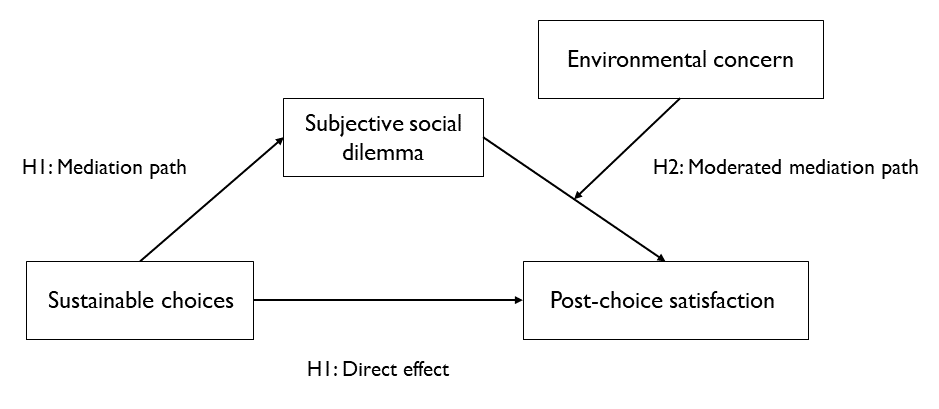
H1: Sustainable choices are positively associated with post-choice satisfaction.
Traditional constructs such as guilt, moral regret or cognitive dissonance explain why value-inconsistent choices can feel uncomfortable, but they do not fully capture the specific tension between self-interest (e.g., affordability) and collective environmental outcomes that arises at the moment of choosing between sustainable and non-sustainable options. To address this gap, we draw on social dilemma theory and extend it to the level of subjective experience in individual consumer decisions.
For environmentally concerned consumers, choosing a less sustainable option can trigger discomfort, especially when the decision favors short-term convenience over ecological responsibility (Bolderdijk et al., 2012; Elgaaied, 2012; Jagers & Matti, 2010; Kim & Seock, 2019).
This internal conflict can be understood through the lens of a social dilemma, a concept traditionally rooted in game theory and collective action models (Dawes, 1980; Hardin, 1968). A social dilemma is a situation in which individuals acting in their own self-interest can harm the collective, even when they would all be better off cooperating. Here, the conflict is external and arises from a structural situation in which the lack of incentive to act cooperatively creates the dilemma. In this situation, known as the “tragedy of the commons,” individuals, acting in their short-term self-interest, overuse and deplete a shared, limited resource, although it is in everyone’s long-term interest to conserve it.
Research has expanded this view to highlight the intrapersonal and emotional dimensions of social dilemmas, particularly in environmental contexts (Elgaaied, 2012; Jagers & Matti, 2010). According to this perspective, a dilemma is experienced not only structurally or externally but also internally as a form of psychological conflict. This conflict arises when individuals recognize a personal responsibility to act sustainably but perceive related actions as costly, inconvenient, or ineffective—especially if others do not act similarly. For Gen Z consumers, such conflict could stem from a misalignment between their environmental values and real-world constraints such as high prices, limited access, or a perceived lack of collective effort towards sustainability. The resulting thought—I want to do the right thing, but it’s expensive, uncomfortable, or pointless if others don’t care—captures the emotional discomfort at an individual level. We refer to this intrapersonal experience as a subjective social dilemma: a perceived conflict, at the moment of choice, between self-interested motives (e.g., saving money) and collective environmental motives. Unlike guilt, cognitive dissonance, or moral regret, which typically describe post-decisional affective reactions, a subjective social dilemma focuses on the conflict structure that can make even autonomous choices feel less satisfying.
This emotional discomfort reflects more than just regret; it stems from a perceived loss of ethical integrity. As Elgaaied (2012) argues, satisfaction in sustainable contexts depends on whether consumers perceive their choice as morally coherent. Value–behavior misalignment—particularly when a subjective social dilemma is experienced—may reduce post-choice satisfaction, even when the decision was made autonomously. We therefore conceptualize the subjective social dilemma as the proximal psychological mechanism through which choosing a less sustainable option leads to lower post-choice satisfaction in sustainability-related trade-offs.
Building on this reasoning, we propose that experiencing a subjective social dilemma serves as a psychological mechanism linking unsustainable choices to diminished post-choice satisfaction. That is, when individuals choose less sustainable options, they may experience internal conflict over failing to uphold their ecological values, thereby undermining the emotional payoff of the decision.
H2: The relationship between sustainable choices and post-choice satisfaction is mediated by the experience of a subjective social dilemma, such that less sustainable choices are more likely to cause a subjective social dilemma, which in turn reduces post-choice satisfaction.
The subjective social dilemma effect is especially salient for individuals who hold strong environmental values and for whom sustainability is not merely a preference but a moral or identity-based imperative. For such consumers, choices are evaluated not only based on functionality or convenience but also through the lens of personal values and ethical consistency.
Environmental concern extends beyond cognitive awareness of environmental problems; it includes affective and moral dimensions, often grounded in personal values and identity (Schwartz, 1977; Stern, 2000). For many consumers—particularly Gen Z—sustainability becomes a reflection of who they are and what they believe is ethically right. Consequently, environmentally friendly behavior is not only a matter of preference but also a form of moral expression. The stronger this internalized concern among consumers, the more they feel personally accountable for their environmental impact and for living up to their ideals (Jagers & Matti, 2010; Kim & Seock, 2019).
Therefore, environmental concern may influence how strongly a subjective social dilemma over a purchasing decision affects consumers' post-choice satisfaction. When consumers are highly concerned about the environment and make a decision that contradicts their values, the resulting emotional discomfort—stemming from failing to live up to their own standards—will likely be more acute. In short, the negative effect of the subjective social dilemma is amplified for consumers who are more environmentally concerned. In contrast, individuals with lower environmental concern may not experience the same internal degree of conflict, as they may feel less affected by the inconsistency between their actions and environmental ideals.
In this model, environmental concern is conceptualized as a boundary condition that shapes the impact of subjective social dilemma on post-choice satisfaction, yielding a conditional indirect effect of sustainable choices on post-choice satisfaction (moderated mediation).
Based on this reasoning, the following hypothesis is proposed:
H3: Environmental concern moderates the relationship between subjective social dilemma and post-choice satisfaction, such that the negative impact of the subjective social dilemma on post-choice satisfaction is stronger for consumers with greater environmental concern.
Figure 1 illustrates the hypothesized moderated mediation model.
Methodology
To test whether the effect of unsustainable choices on post-choice satisfaction operates indirectly through the experience of a subjective social dilemma and whether this indirect effect is moderated by the level of environmental concern, PROCESS Macro Model 14 (Hayes, 2022) was used.
Questionnaire design
The questionnaire was structured into three sections. In Section 1, participants completed three discrete-choice scenarios, each requiring them to choose between two consumer products. Each product was introduced with three pieces of information: a product image, the price, and, when applicable, a brief description of its sustainability attributes. After making each choice, participants were asked to rate their satisfaction with their decision using a 5-point Likert scale (1 = Not at all satisfied, 5 = Very satisfied). This section was designed to capture both the behavioral outcome (choice) and the emotional response (post-choice satisfaction) under conditions that involved sustainability trade-offs.
Section 2 included multiple items measuring participants' environmental concern and their subjective experience of a social dilemma regarding their product choice. The section also contained filler questions about general shopping habits to mask the study's central focus and reduce response bias.
Lastly, Section 3 sought demographic classification data, specifically age and gender, to ensure the sample represented the defined Gen Z segment.
Direct choice scenario design and pre-test
A multi-step procedure helped ensure the questionnaire's validity. First, a preliminary market analysis was conducted to identify everyday products commonly consumed by Gen Z. According to data from Opeepl (2024) and Holschuh (2025), the top product categories among Gen Z consumers are clothing and footwear, entertainment, electronics, and beauty and personal care. Additionally, grocery emerged as an emerging category among Gen Z. Based on these findings, clothing (specifically t-shirts), personal care (shampoo), and grocery (tomatoes) were selected for the study.
Second, three discrete-choice scenarios were designed to reflect realistic consumption trade-offs between standard and sustainable products, thereby increasing the ecological validity of the scenarios (Elgaaied, 2012; Griskevicius et al., 2010). In each scenario, the sustainable option had a higher price, in line with real-world market conditions, where sustainable alternatives often carry a 30–70% cost premium over conventional alternatives (Kearney, 2020). Across all three choice scenarios, price differences were maintained at 50% to facilitate comparability and isolate the effect of sustainability. After each choice, participants rated their satisfaction with the decision. Pre-test participants confirmed that this price premium was noticeable and economically meaningful across the three product categories while remaining realistic. Next, visual and descriptive materials for each product were created using publicly available product data (Appendix A).To minimize order effects and potential biases, the order in which the products (standard vs. sustainable) appeared was randomized across participants and scenarios. Because the visual materials were based on real products, some variation in visual appeal and product format between sustainable and non-sustainable options could not be completely eliminated. The inclusion of three product categories (grocery, apparel, and personal care) was intended to enhance external validity, although this heterogeneity may also imply differences in hedonic versus utilitarian orientation and involvement.
Third, the questionnaire was examined by a panel of experts to ensure content validity. To verify the clarity of the questions and obtain feedback on the length of the questionnaire, it was further tested (n = 25) with target participants who, based on a five-point Likert scale (1 = lowest and 5 = highest), evaluated the clarity (M = 4.46, SD = 0.78), realism (M = 4.00, SD = 0.88), and perceived sustainability regarding the product descriptions (M = 4.42, SD = 0.72). Based on participant feedback, some modifications were made to improve the visual design, the wording of sustainability claims, and the balance of attribute trade-offs (e.g., price vs. sustainability). This process ensured content validity, as the final product choices reflected realistic consumption decisions in which sustainability is weighed against cost.
Measurement scales
The measurement scales were selected and adapted after a thorough review of the literature. Sustainable choice behavior (SCHOICE) represented the independent variable. Participants completed three discrete choice tasks that required them to choose between a standard and a sustainable product. For each scenario, choices of the sustainable and standard options were coded as 1 and 0, respectively. A cumulative score (ranging from 0 to 3) was used to represent the number of sustainable choices made by each participant (Train, 2009).
Items used to assess the mediator variable, the subjective experience of a social dilemma in sustainable consumption, were adapted based on the theoretical and empirical work of Elgaaied (2012).
Environmental concern was included in the model as a moderator, measured with three items adapted from the New Ecological Paradigm (NEP) scale (Dunlap & Jones, 2002). Items were reverse-coded so that higher scores consistently reflected greater environmental concern.
Post-choice satisfaction, conceptualized in this study as a global, affective evaluation of the choice made in each scenario, represented the dependent variable. Given that the construct is clearly understood by respondents and can be easily self-assessed, a single-item measure was used (Wanous et al., 1997). The three post-choice satisfaction ratings (one per scenario) were averaged to form a single index of PCSAT for each participant, capturing a general evaluative response to repeated sustainability-related trade-offs at the individual level. All responses were measured on a 5-point Likert scale, ranging from “strongly disagree = 1” to “strongly agree = 5.” Cronbach’s Cronbach’s coefficients for the multi-item scales are reported in Table 1 and exceed conventional thresholds (Nunnally, 1978). All multi-item constructs were adapted from previously validated scales, supporting their content validity in the context of sustainable consumption. As post-choice satisfaction (PCSAT) was measured using a single item, internal consistency reliability is not applicable (Wanous et al., 1997). No direct measures of income, affordability, or price sensitivity were collected; affordability constraints are inferred from the imposed price differences and the resulting choice patterns, and these are discussed as a limitation of the design. Table 1 summarizes the variables, items, and scales used in the study.
Table 1. Variables, Items, and Scales
| Variable | Items | Adapted from | Cronbach’s α |
| Subjetive Social Dilemma (SDILEMMA) (Mediator variable) | Although I care about the environment, I find it difficult to pay more for eco-friendly products. Sometimes I feel guilty for not buying green products, but I can’t always afford them. I want to help the environment, but I doubt that one person’s purchase can make a real difference. I want to buy sustainable products, but if others don’t do the same, it feels pointless. | Elgaaied (2012) | 0.731 |
| Environmental Concern (ECONCERN) (Moderator variable) | We worry too much about the future of the environment and not enough about prices and employment.* People worry too much about the impact of human progress on the environment.* Many of the claims about environmental threats are exaggerated.* | Dunlap & Jones (2002) | 0.763 |
| Post-Choice Satisfaction (PCSAT) (Dependent variable) | How satisfied are you with the option you chose? | Wanous et al. (1997) | N/A |
Participants and sampling
The study participants represented a convenience sample recruited from social media sites (Mullinix et al., 2015) and comprised Spanish speakers (N = 557) aged between 18 and 25 years primarily residing in Spain (Table 2). The study employed a web survey (Schonlau et al., 2002), with the questionnaire requiring 3–5 minutes to complete and the task being self-paced. Participants were recruited via major social media platforms, WhatsApp and Instagram, and completed an online questionnaire hosted on Google Forms. Data collection occurred from April 9 to May 15, 2025.
Table 2. Sample profile
| Gender | Male | Male | 41.0 |
| Female | Female | 59.0 | |
| 100% | |||
| Age | 18–20 | 18–20 | 28.0 |
| 21–23 | 21–23 | 35.4 | |
| 24–25 | 24–25 | 36.6 | |
| 100% | |||
| Primary Activity | Students | Students | 58.0 |
| Workers | Workers | 26.0 | |
| Student Interns | Student Interns | 16.0 | |
| 100% |
Analysis and Results
To provide context for the subsequent analyses, preliminary checks were done on the main study variables. Table 3 reports the descriptive statistics. On average, participants exhibited moderate levels of sustainable choice behavior (M = 1.37, SD = 0.82, on a 0–3 scale) and relatively high post-choice satisfaction (M = 3.80, SD = 0.66, on a 1–5 scale). The mean values for subjective social dilemma (M = 2.24, SD = 0.76) and environmental concern (M = 3.44, SD = 0.99) indicate a moderate degree of internal conflict and environmental sensitivity across the respondents. The moderate level of subjective social dilemma suggests that, on average, participants experienced some tension between their environmental values and price considerations, but not to an extreme degree, making the sample particularly well-suited for examining how this conflict translates into variations in post-choice satisfaction. The observed distributions show adequate variability and no evidence of ceiling or floor effects, supporting the suitability of the measures for subsequent analyses (Klapproth et al., 2023).
Although post-choice satisfaction was measured after each of the three decisions, the variable used in the regression analyses corresponds to the individual's mean post-choice satisfaction across the three scenarios. Sustainable choice was operationalized as the total number of sustainable options selected (0–3). Thus, all variables were analyzed at the respondent level (N = 557), and the independence assumption required for regression analysis was not violated.
Table 3. Descriptive statistics
| Variable | M | SD |
| SCHOICE | 1.37 | 0.82 |
| PCSAT | 3.80 | 0.66 |
| SDILEMMA | 2.24 | 0.76 |
| ECONCERN | 3.44 | 0.99 |
To test the proposed hypotheses, a moderated mediation model was estimated using Model 14 of the PROCESS macro v5.0 for SPSS (Hayes, 2022), with a sample of 557 participants. The independent variable was the number of sustainable choices made (SCHOICE); the mediator variable was the level of subjective social dilemma experienced (SDILEMMA); the moderator variable was environmental concern (ECONCERN); and the dependent variable was post-choice satisfaction (PCSAT). All continuous variables were mean-centered prior to analysis. The model was estimated using 5,000 bias-corrected bootstrap samples to create confidence intervals (CIs) for indirect and conditional effects. Unstandardized coefficients (b), standard errors (SE), t-values, p-values, and 95% confidence intervals are reported for all relevant paths. Unless otherwise specified, conditional effects were evaluated at the 16th, 50th, and 84th percentiles of the moderator distribution. As a robustness check, the moderated mediation model was re-estimated, including gender, age group, and primary activity as covariates. The results remained substantively unchanged. Detailed results are reported in Appendix B (Table B1).
Sustainable choice and post-choice satisfaction (H1)
The first hypothesis posits that consumers who make more sustainable choices experience higher post-choice satisfaction, that is, satisfaction with the decision made in the hypothetical scenarios rather than satisfaction after actual product use. The results of the analysis (PROCESS Model 14) supported this hypothesis. The direct effect of sustainable choice (SCHOICE) on post-choice satisfaction (PCSAT) was positive and statistically significant (b = 0.2055, SE = 0.0333, t = 6.18, p < .001, 95% CI [0.1402, 0.2709]), indicating that, regardless of consumers' perceived subjective social dilemma or environmental concern, opting for more sustainable products leads to greater post-choice satisfaction.
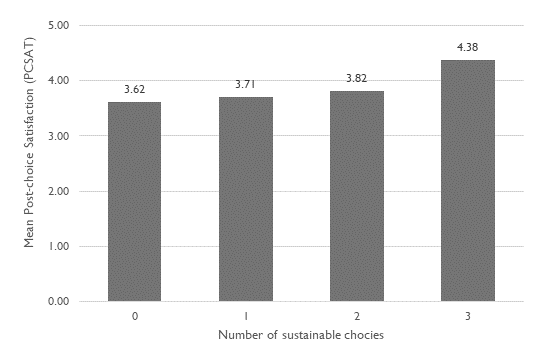
To complement these findings, participants were grouped into four categories based on the number of sustainable choices made (ranging from 0 to 3) across the three discrete-choice scenarios. As Figure 2 shows, there is a clear linear increase in post-choice satisfaction: average post-choice satisfaction rises with the number of sustainable choices, from 3.62 for participants who made no sustainable choices to 4.38 for those who selected the sustainable option in all three scenarios. This pattern reinforces not only the statistical significance of the direct effect but also its practical relevance in everyday consumer decisions.
The mediating role of subjective social dilemma (H2)
The second hypothesis proposes that the relationship between sustainable choice and post-choice satisfaction is mediated by the experience of a subjective social dilemma. Specifically, it posits that less sustainable choices are more likely to trigger a subjective social dilemma, which, in turn, reduces post-choice satisfaction. Table 4 presents the coefficients and significance levels of the model paths. The path from sustainable choice to subjective social dilemma was negative and statistically significant (b = –0.1823, SE = 0.0384, t = –4.74, p < .001, 95% CI [–0.2577, –0.1068]), indicating that participants who made more sustainable choices reported lower levels of subjective social dilemma.
Table 4. Path coefficients and significance
| Path | b | SE | t | p | LLCI | ULCI |
| X →Y (Direct) (SCHOICE →PCSAT) | 0.206 | 0.033 | 6.177 | ¡ .001 | 0.1402 | 0.2709 |
| X →M (SCHOICE →SDILEMMA) | –0.182 | 0.038 | –4.744 | ¡ .001 | –0.2577 | –0.1068 |
| M →Y (SDILEMMA →PCSAT) | –0.053 | 0.038 | –1.403 | .161 | –0.1270 | 0.0212 |
| W →Y (ECONCERN →PCSAT) | –0.084 | 0.029 | –2.886 | .004 | –0.1404 | –0.0267 |
| M × W →Y (Interaction) | –0.081 | 0.032 | –2.512 | 0.012 | –0.1443 | –0.0177 |
| Index of Moderated Mediation | 0.015 | 0.007 | - | - | 0.0026 | 0.0301 |
However, the path from subjective social dilemma to post-choice satisfaction was not statistically significant in the overall sample (b = –0.0529, SE = 0.0377, t = –1.40, p = .1612, 95% CI [–0.1270, 0.0212]). Therefore, the mediating role of the subjective social dilemma in explaining post-choice satisfaction is not supported at the aggregate level. This indicates that a simple mediation effect is not present across the full sample and that any indirect effect depends on the level of environmental concern, as examined in the moderated mediation analysis. These effects should be interpreted in light of the experimental design, which induced affordability constraints through price differences across scenarios rather than directly measuring them.
The moderating role of environmental concern (H3)
The third hypothesis proposes that the negative effect of subjective social dilemma on post-choice satisfaction is stronger among individuals with greater environmental concern. This assumes a moderated mediation effect, in which the indirect path from sustainable choice to post-choice satisfaction—via the experience of a subjective social dilemma—varies depending on the individual's environmental concern.
The results confirmed a significant interaction between subjective social dilemma and environmental concern (b = –0.0810, SE = 0.0322, t = –2.51, p = .0123), indicating that the strength and direction of their relationship depend on the level of environmental concern. More specifically, this interaction is negative, meaning that as environmental concern increases, the negative impact of subjective social dilemma on post-choice satisfaction becomes stronger. Although the overall path from subjective social dilemma to post-choice satisfaction was not statistically significant (see H2), this interaction shows that its effect emerges under specific conditions.
At low levels of environmental concern (e.g., W = 2.43), the effect of subjective social dilemma on post-choice satisfaction was not significant (b = 0.0294, p = .540), suggesting that these consumers’ experience of a subjective social dilemma during decision-making does not substantially affect their post-choice satisfaction. In contrast, at high levels of environmental concern (e.g., W = 4.33), the effect of subjective social dilemma becomes significantly negative (b = –0.1249, p = .011), indicating that environmentally conscious consumers’ experience of subjective social dilemma reduces their post-choice satisfaction. According to the Johnson-Neyman technique, the conditional effect of subjective social dilemma on post-choice satisfaction becomes statistically significant when environmental concern levels exceed 3.75.
Table 5 presents the conditional indirect effects of sustainable choice on post-choice satisfaction through subjective social dilemma at different levels of environmental concern. While the indirect effect was not significant at low levels of environmental concern, it reached significance at high levels (ab = 0.0228, Boot SE = 0.0105, 95% CI [0.0050, 0.0463]). The index of moderated mediation was also significant (Index = 0.0148, Boot SE = 0.0073, 95% CI [0.0027, 0.0307]), confirming that the indirect effect of sustainable choice on post-choice satisfaction via subjective social dilemma is contingent on the level of environmental concern. These findings provide robust support for H3, highlighting that the impact of sustainable decisions on post-choice satisfaction depends on how much consumers care about the environment and emerges specifically under higher levels of environmental concern.
Table 5. Conditional indirect effects by level of environmental concern
| Environmental Concern (W) | Indirect Effect (ab) | Effect | Boot SE | LLCI | ULCI |
| Low (2.43) | ns | –.005 | .0091 | –.0248 | .0123 |
| Medium (3.67) | marginal | .013 | .0077 | –.0005 | .0299 |
| High (4.33) | significant | .023 | .0105 | .0050 | .0463 |
To determine how alignment between values and choices, as well as internal conflict, influences post-choice satisfaction, participants were grouped based on their sustainable behavior: those who made 0–1 sustainable choices (low SCHOICE) and those who made 2–3 sustainable choices (high SCHOICE). Figure 3 depicts mean post-choice satisfaction (PCSAT) levels across combinations of environmental concern (ECONCERN: low vs. high) and subjective social dilemma (SDILEMMA: low vs. high), distinguishing groups by the number of sustainable choices made.
The results reveal that participants with great environmental concern who made fewer sustainable choices and reported high levels of subjective social dilemma experienced the lowest post-choice satisfaction (M = 3.49). This suggests that the misalignment between values (strong environmental concern) and behavior (low sustainability), as well as internal conflict (high subjective social dilemma), results in a substantial psychological cost. In contrast, the highest post-choice satisfaction was observed among those who reported high levels of environmental concern and subjective social dilemma, yet made more sustainable choices (M = 3.98), highlighting the importance of coherence among attitudes, behavior, and emotional experience. This pattern is presented in Figure 3.
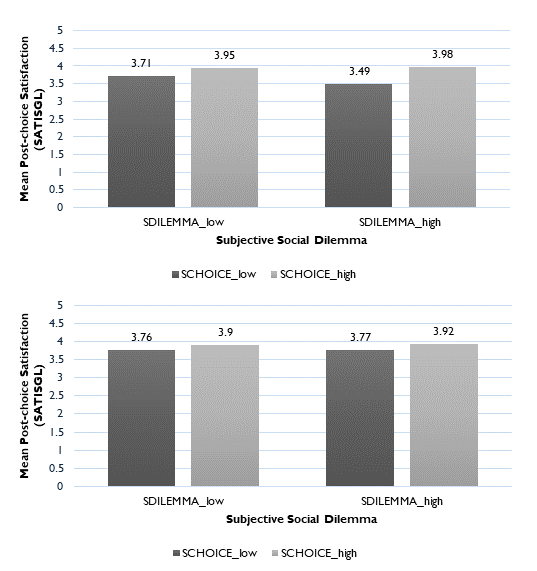
These findings reveal that sustainable consumption does not automatically guarantee post-choice satisfaction. Rather, post-choice satisfaction depends on the alignment between individuals’ environmental values (ECONCERN), their behavior (SCHOICE), and the absence of internal conflict (SDILEMMA).
Discussion
This study examined how subjective social dilemma—the psychological conflict that arises when consumers’ pro-environmental values clash with practical barriers, such as higher prices—shapes emotional outcomes in sustainable decision-making. Specifically, it aimed to understand how price-induced constraints lead consumers, particularly Gen Z individuals, to incur emotional costs when they are unable to act in line with their sustainability values. Notably, the subjective social dilemma studied emerged around everyday items priced differently depending on whether they were sustainable or standard.
This study tested three hypotheses grounded in self-determination theory and social dilemma theory. H1 was supported, as sustainable choices were positively associated with post-choice satisfaction. H2, proposing a simple mediation effect, was not supported at the aggregate level. However, H3 received support, indicating that the indirect effect of sustainable choice on post-choice satisfaction via subjective social dilemma operates conditionally at higher levels of environmental concern. These findings extend self-determination theory by showing that value-congruent autonomy enhances satisfaction in everyday consumption contexts, and they refine social dilemma theory by highlighting its subjective, intrapersonal dimension in consumer decision-making.
In more detail, the results show that first, consumers who made more sustainable choices reported higher levels of post-choice satisfaction. This finding is consistent with prior research showing that value-congruent decisions enhance emotional well-being and reinforce self-consistency (Grankvist & Biel, 2007; Hainmueller et al., 2015), and extends this logic to routine, low-involvement purchases among Gen Z.
Second, the simple mediation proposed in H2 was not supported at the aggregate level. Rather than indicating the absence of a subjective social dilemma, this suggests that its effect is not general across consumers but contingent on how strongly sustainability matters to the individual. In line with research highlighting the moral and identity-based dimensions of pro-environmental behavior (Elgaaied, 2012; Jagers & Matti, 2010), the findings show that internal conflict is psychologically consequential primarily at high levels of environmental concern.
Third, environmental concern amplifies the negative emotional effect of subjective social dilemma on post-choice satisfaction. For highly concerned consumers, choosing unsustainably for price reasons threatens self-consistency and reduces satisfaction, whereas for less concerned consumers, the same trade-off incurs a lower emotional cost. This refines prior literature on the value–behavior gap by showing that price is not only a structural barrier but also a psychological trigger whose consequences depend on identity-relevant concern. In this sense, the study contributes by showing that subjective social dilemmas operate as a conditional mechanism linking constrained, unsustainable choices to lower post-choice satisfaction. Notably, this pattern emerged even for routine, low-involvement products, suggesting that everyday sustainable consumption can also carry moral significance for Gen Z consumers.
This study has some limitations, which offer opportunities for future research. First, while hypothetical choice scenarios enabled experimental control and comparability, actual purchasing behavior may depend on additional variables, such as social influence, habit, or in-store context. Moreover, because the visual materials were based on real products and covered three product categories (grocery, apparel, and personal care), some variation in visual appeal, product format, hedonic versus utilitarian orientation, and the salience of the imposed price premium could not be fully controlled. Affordability constraints are therefore experimentally induced through the imposed price differences and inferred from the resulting choice patterns rather than directly measured (e.g., through income or price-sensitivity indicators). These factors should be taken into account when interpreting the findings. Future studies could enhance internal and ecological validity by incorporating real-world purchasing data or field experiments that capture observed behavior, and by holding visual aspects constant while systematically manipulating sustainability and price information across product types. Second, the order of the discrete choice scenarios was not randomized, which may have introduced minor order effects. Thus, future research should consider randomizing the order of scenarios to further improve internal validity. Third, the study relied on a convenience sample recruited via social media of Spanish-speaking Gen Z consumers in Spain, limiting broader generalizability. Cross-cultural and cross-generational comparisons using more diverse samples would help assess whether the experience of subjective social dilemma is culturally universal or identity-dependent. Fourth, the current operationalization of subjective social dilemma includes elements related to guilt, perceived affordability constraints, and perceived ineffectiveness of individual action, which may introduce partial overlap with related constructs. Future research could further refine this measurement by isolating more precisely the conflict between self-interest and collective environmental goals.
Conclusion
From a theoretical perspective, this study advances self-determination theory by showing that satisfaction with sustainable consumption is not driven solely by autonomy, but by the alignment between personal environmental concern and enacted behavior under economic constraints. The findings further refine social dilemma theory by shifting attention from collective-level dilemmas to the intrapersonal psychological conflict experienced during individual consumption decisions and by demonstrating that the indirect effects of sustainable choice on post-choice satisfaction are conditional on environmental concern.
From a practical and managerial perspective, the findings suggest that sustainability marketing should shift from simply promoting sustainable behavior to facilitating it by removing barriers to action. Positioning sustainability as a premium moral choice may inadvertently generate dissatisfaction among highly sustainability-oriented Gen Z consumers when financial constraints prevent value-congruent decisions. Firms may therefore consider pricing strategies, product architecture adjustments (e.g., making sustainable options standard rather than premium add-ons), and communication approaches that reduce perceived moral trade-offs. Policymakers and educators can support these efforts through measures such as price incentives for sustainable everyday products, student-oriented discounts, and educational programs that address the tension between moral values and economic constraints in daily consumption, particularly among Spanish Gen Z consumers.
Overall, the results highlight that even familiar, everyday products with modest but meaningful price differences can carry emotional and ethical weight. Reducing the barriers to sustainable action in daily contexts may be key to achieving both broader adoption and greater consumer well-being, particularly among environmentally committed cohorts such as Gen Z.
Appendix A
Choice 1: Clothing – White T-Shirt
![[Uncaptioned image]](https://luinimages.s3.us-east-1.amazonaws.com/JSM-2026-172-2730802213-image_4.png)
Synthetic fiber t-shirt, fast fashion, price €24
Fair Trade Certified™, made with 100% organic cotton, price €36
Choice 2: Personal Care – Shampoo
![[Uncaptioned image]](https://luinimages.s3.us-east-1.amazonaws.com/JSM-2026-172-2790861502-image_5.png)
Shampoo in plastic bottle, honey scent, price €8
Solid shampoo bar, packaging-free, honey scent, price €12
Choice 3: Grocery – Tomatoes
![[Uncaptioned image]](https://luinimages.s3.us-east-1.amazonaws.com/JSM-2026-172-0817814340-image_6.png)
Pesticide-free tomatoes at €3.6/kg
Intensively farmed tomatoes at €2.4/kg
Table 6. Robustness Check Including Covariates (PROCESS Model 14)
| SCHOICE PCSAT | 0.2060 | 0.0333 | ¡ .001 | [0.1406, 0.2713] |
| SCHOICE SDILEMMA | -0.1796 | 0.0383 | ¡ .001 | [-0.2549, -0.1043] |
| SDILEMMA PCSAT | -0.0600 | 0.0379 | .1138 | [-0.1345, 0.0144] |
| ECONCERN PCSAT | -0.0802 | 0.0292 | .0063 | [-0.1376, -0.0228] |
| SDILEMMA ECONCERN | -0.0785 | 0.0323 | .0153 | [-0.1419, -0.0151] |
References
- . Positive and negative antecedents of purchasing eco-friendly products: A comparison between green and non-green consumers. Journal of Business Ethics, 134(2), 229–247. https://doi.org/10.1007/s10551-014-2425-z. CrossRef | Google Scholar
- . Greening Generation Z: Unraveling pro-environmental purchase intentions for green apparel in Lithuania through an extended theory of planned behavior, social media influence and environmental self-identity. Social Responsibility Journal, 22(1), 208–224. https://doi.org/10.1108/srj-11-2024-0770. CrossRef | Google Scholar
- . Activation of social norms in social dilemmas: A review of the evidence and reflections on the implications for environmental behaviour. Journal of Economic Psychology, 28(1), 93–112. https://doi.org/10.1016/j.joep.2006.03.003. CrossRef | Google Scholar
- . Comparing the effectiveness of monetary versus moral motives in environmental campaigning. Nature Climate Change, 3(4), 413–416. https://doi.org/10.1038/nclimate1767. CrossRef | Google Scholar
- . The dark side of choice: When choice impairs social welfare. Journal of Public Policy & Marketing, 25(1), 24–38. https://doi.org/10.1509/jppm.25.1.24. CrossRef | Google Scholar
- . The nexus between sustainable behaviour of tourists from Generation Z and the factors that influence the protection of environmental quality. Sustainability, 14(19), 12103. https://doi.org/10.3390/su141912103. CrossRef | Google Scholar
- . Social dilemmas. Annual Review of Psychology, 31(1), 169–193. https://doi.org/10.1146/annurev.ps.31.020180.001125. CrossRef | Google Scholar
- . Morality and prosocial behavior: The role of awareness, responsibility, and norms in the norm activation model. The Journal of Social Psychology, 149(4), 425–449. https://doi.org/10.3200/socp.149.4.425-449. CrossRef | Google Scholar
- . The "what" and "why" of goal pursuits: Human needs and the self-determination of behavior. Psychological Inquiry, 11(4), 227–268. https://doi.org/10.1207/s15327965pli1104_01. CrossRef | Google Scholar
- . Determining factors in shaping the sustainable behavior of the Generation Z consumer. Frontiers in Environmental Science, 11, 1096183. https://doi.org/10.3389/fenvs.2023.1096183. CrossRef | Google Scholar
- . Environmental concern: Conceptual and measurement issues. Greenwood Press, 482–524.
- . Exploring the role of anticipated guilt on pro-environmental behavior: A suggested typology of residents in France based on their recycling patterns. Journal of Consumer Marketing, 29(5), 369–377. https://doi.org/10.1108/07363761211247488. CrossRef | Google Scholar
- . US consumer attitudes on sustainable shopping. Retrieved 2026.
- . Sustainable choices of Gen Y and Gen Z: Exploring green horizons. Management & Sustainability: An Arab Review, 4(3). https://doi.org/10.1108/msar-04-2024-0018. CrossRef | Google Scholar
- . Predictors of purchase of eco-labelled food products: A panel study. Food Quality and Preference, 18(4), 701–708. https://doi.org/10.1016/j.foodqual.2006.11.002. CrossRef | Google Scholar
- . Going green to be seen: Status, reputation, and conspicuous conservation. Journal of Personality and Social Psychology, 98(3), 392–404. https://doi.org/10.1037/a0017346. CrossRef | Google Scholar
- . Consumer demand for fair trade: Evidence from a multi-store field experiment. Review of Economics and Statistics, 97(2), 242–256. https://doi.org/10.1162/REST_a_00467. CrossRef | Google Scholar
- . Unveiling the future of responsible, sustainable, and ethical consumption: A bibliometric study on Gen Z and young consumers. Young Consumers, 26(7). https://doi.org/10.1108/yc-11-2024-2327. CrossRef | Google Scholar
- . The tragedy of the commons. Science, 162(3859), 1243–1248. https://doi.org/10.1126/science.162.3859.1243. CrossRef | Google Scholar
- . Introduction to mediation, moderation, and conditional process analysis: A regression-based approach. Guilford Press.
- . Green perceived value and green product purchase intention of Gen Z consumers: Moderating role of environmental concern. Environmental Economics, 14(2), 87–102. https://doi.org/10.21511/ee.14(2).2023.07. CrossRef | Google Scholar
- . Ecological citizens: Identifying values and beliefs that support individual environmental responsibility among Swedes. Sustainability, 2(4), 1055–1079. https://doi.org/10.3390/su2041055. CrossRef | Google Scholar
- . Why today's pricing is sabotaging sustainability. Published September 11, 2020.
- . The roles of values and social norm on personal norms and pro-environmentally friendly apparel product purchasing behavior: The mediating role of personal norms. Journal of Retailing and Consumer Services, 51, 83–90. https://doi.org/10.1016/j.jretconser.2019.05.023. CrossRef | Google Scholar
- . Scale agreement, ceiling and floor effects, construct validity, and relative efficiency of the PROPr and EQ-5D-3L in low back pain patients. Health and Quality of Life Outcomes, 21(1), 107. https://doi.org/10.1186/s12955-023-02188-w. CrossRef | Google Scholar
- . Exploring the influence of environmental values on green consumption behavior of apparel: A chain multiple mediation model among Chinese Generation Z. Sustainability, 14, 12850. https://doi.org/10.3390/su141912850. CrossRef | Google Scholar
- . Gen Z online shopping behaviour & trends: What brands need to know. Updated August 26, 2025.
- . The generalizability of survey experiments. Journal of Experimental Political Science, 2(2), 109–138. https://doi.org/10.1017/xps.2015.19. CrossRef | Google Scholar
- . Psychometric theory. McGraw-Hill.
- . Gen Z consumers & sustainability: 5 key trends shaping 2024.
- . Green consumers in the 1990s: Profile and implications for advertising. Journal of Business Research, 36(3), 217–231. https://doi.org/10.1016/0148-2963(95)00150-6. CrossRef | Google Scholar
- . Self-determination theory and the facilitation of intrinsic motivation, social development, and well-being. American Psychologist, 55(1), 68–78. https://doi.org/10.1037//0003-066x.55.1.68. CrossRef | Google Scholar
- . The link between green purchasing decisions and measures of environmental consciousness. European Journal of Marketing, 30(5), 35–55. https://doi.org/10.1108/03090569610118740. CrossRef | Google Scholar
- . Conducting research surveys via e-mail and the Web. RAND Corporation. https://www.rand.org/content/dam/rand/pubs/monograph_reports/MR1480/RAND_MR1480.pdf.
- . Normative influences on altruism. Elsevier, Vol. 10. https://doi.org/10.1016/s0065-2601(08)60358-5. CrossRef | Google Scholar
- . Predicting sustainable consumption behavior among Generation Z: Role of nature relatedness and environmental concern. Psychological Research on Urban Society, 7, 25–38. https://doi.org/10.7454/proust.v7i1.1154. CrossRef | Google Scholar
- . New environmental theories: Toward a coherent theory of environmentally significant behavior. Journal of Social Issues, 56(3), 407–424. https://doi.org/10.1111/0022-4537.00175. CrossRef | Google Scholar
- . Sustainable consumption and branding for Gen Z: How brand dimensions influence consumer behavior and adoption of newly launched technological products. Sustainability, 17(9), 4124. https://doi.org/10.3390/su17094124. CrossRef | Google Scholar
- . Discrete choice methods with simulation. Cambridge University Press.
- . Eco-friendly fashion among Generation Z: Mixed-methods study on price value image, customer fulfillment, and pro-environmental behavior. PLOS ONE, 17(8), 272789. https://doi.org/10.1371/journal.pone.0272789. CrossRef | Google Scholar
- . Gen Z consumption: Who chooses green?. Business Strategy and the Environment, 34(7), 8034–8051. https://doi.org/10.1002/bse.70008. CrossRef | Google Scholar
- . Overall job satisfaction: How good are single-item measures?. Journal of Applied Psychology, 82(2), 247–252. https://doi.org/10.1037/0021-9010.82.2.247. CrossRef | Google Scholar
- . How to SHIFT consumer behaviors to be more sustainable: A literature review and guiding framework. Journal of Marketing, 83(3), 22–49. https://doi.org/10.1177/0022242919825649. CrossRef | Google Scholar
About contributors

Susana Fernandez-Lores
Department of Marketing, Facultad de Comercio y Turismo, Universidad Complutense de Madrid, Spain
Diana Gavilan
Department of Marketing, Facultad de Ciencias de la Información, Universidad Complutense de Madrid, Spain
Spain
Carlos Sandoval-Álvarez
Escuela de Administración de Empresas, Universidad de Costa Rica, Costa Rica
Costa Rica