





Abstract
Sustainability communication can shape consumer responses to environmentally positioned products, yet its relationship with economic behavior remains insufficiently understood in utilitarian product contexts. Drawing on signaling theory and incorporating insights from the Elaboration Likelihood Model and AIDA framework, this study examines how green brand awareness relates to consumers’ willingness to pay a green premium for building materials in Indonesia. Perceived sustainability message strength and green message credibility are modeled as serial mediators, while greenwashing skepticism moderates the relationship between credibility and willingness to pay. Survey data from 345 consumers were analyzed using covariance-based structural equation modeling. Green brand awareness significantly predicted perceived sustainability message strength, which subsequently predicted green message credibility. Green message credibility was positively associated with willingness to pay a green premium, whereas the direct relationship between green brand awareness and willingness to pay was not statistically different from zero. The significant serial indirect effect was consistent with an indirect-only mediation pattern. Greenwashing skepticism weakened the positive relationship between message credibility and willingness to pay. These findings show that sustainability communication influences economic responses through signal formation and credibility evaluation rather than awareness alone, extending sustainable marketing theory to an emerging-market and utilitarian-product context.
Introduction
Sustainability has become a central concern in contemporary marketing as firms and consumers respond to climate change, resource depletion, waste generation, and increasing pressure for responsible consumption. Marketing is therefore expected not only to promote products but also to support environmentally responsible choices and the transition towards circular economic systems (Aguilar-Morales et al., 2023; Ungemach et al., 2026). However, environmental attributes are often difficult for consumers to verify because they involve complex production processes, long term consequences, and credence based claims. Sustainability communication consequently occurs under conditions of information asymmetry, requiring consumers to rely on signals provided by firms to assess the authenticity and value of environmental claims. Its effectiveness therefore depends not merely on whether environmental information is communicated, but on whether the communication is perceived as clear, consistent, coherent, and credible (Dasmi et al., 2026; Seyfi et al., 2025).
These challenges are especially relevant in emerging economies such as Indonesia, where urbanisation, infrastructure expansion, and population growth are increasing both construction activity and environmental pressure. Indonesia represents a rapidly developing construction market, supported by continued demand for residential, commercial, and tourism related development (ASEAN Briefing, 2025). At the same time, the built environment faces persistent concerns related to carbon emissions, material waste, and resource efficiency (Iswara et al., 2024). Indonesian consumers are therefore increasingly exposed to environmental information while continuing to consider price, functionality, and product durability. This combination makes Indonesia an appropriate setting for examining how sustainability communication is associated with economic responses.
The building materials sector provides a particularly relevant empirical context. Construction and interior finishing materials contribute to embodied carbon, waste generation, and long term environmental impacts (Hasselsteen et al., 2025; Nguyen & Pishdad, 2025). Products such as gypsum boards, ceiling panels, acoustic tiles, and interior surfaces are commonly evaluated according to price, durability, safety, and functional performance. Sustainability has historically received less attention in these utilitarian categories, although growing concerns regarding recyclability, emissions, indoor air quality, and environmental safety are beginning to reshape consumer expectations (Maduku, 2024). In this category, brands may signal sustainability through environmental product declarations, third party ecolabels, recycled or responsibly sourced material claims, recyclability information, low emission certifications, and statements concerning embodied carbon or indoor air quality (Hasselsteen et al., 2025; Nguyen & Pishdad, 2025). These signals appear on packaging, technical documents, company websites, retail displays, and promotional materials. However, their technical complexity and uneven presentation may make it difficult for consumers to determine whether a brand’s environmental positioning is coherent and credible.
Actual product communications in the Indonesian gypsum board market illustrate variation in the visibility and prominence of sustainability signals. As shown in Figure 1, the Jayaboard SHEETROCK PROTECH communication explicitly foregrounds environmental certification and material safety claims, including Green Label Singapore and Green Listing Indonesia certifications, low TVOC content, asbestos free composition, non-radioactive material, and recyclable material. By contrast, the Knauf MoistureShield communication distributed in the Indonesian market primarily emphasises functional attributes, including moisture resistance, durability, surface quality, sound reduction, and technical specifications. This contrast indicates that consumers in the study context encounter different levels of sustainability signal visibility rather than uniformly positive environmental messaging.
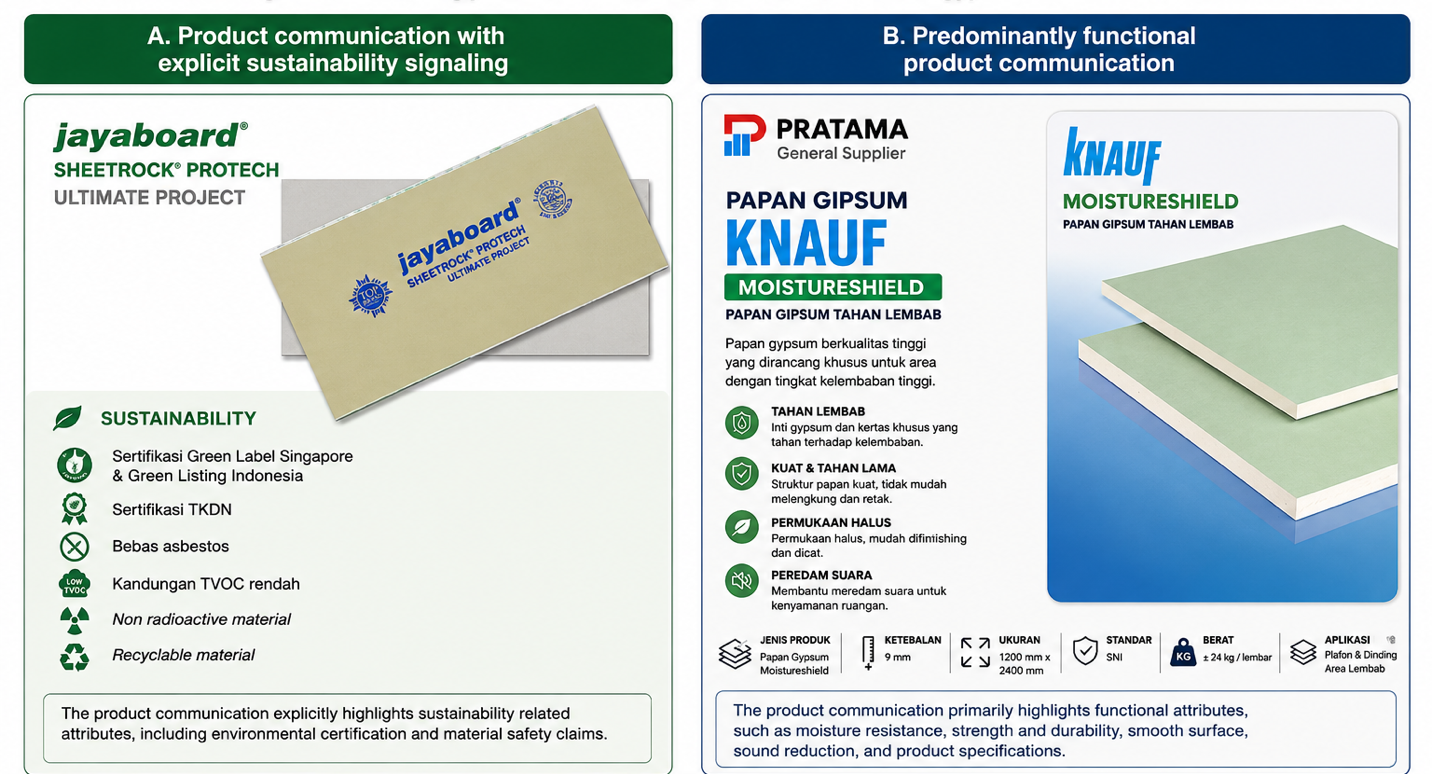
Note : Note: Panel A presents a product communication that explicitly foregrounds environmental certification and sustainability related material attributes. Panel B presents an Indonesian market communication that primarily foregrounds functional attributes, including moisture resistance, durability, surface quality, sound reduction, and technical specifications. The comparison concerns the information visible in the selected communications and does not imply that the manufacturer represented in Panel B lacks environmental certifications or sustainability practices.
Source: Jayaboard official product communication; PT Pratama General Supplier Indonesian market communication.
Signaling theory offers a useful explanation of how consumers interpret such communication. When environmental attributes cannot be observed directly, firms use signals to convey information about underlying product qualities. Consumers evaluate these signals according to their perceived clarity, consistency, repetition, and coherence. In this study, perceived sustainability message strength reflects consumers’ cumulative interpretation of sustainability information encountered through advertising, packaging, digital communication, retail environments, and interpersonal sources. It therefore captures consumer perceptions of communication strength rather than the technical integration of communication activities at the managerial level.
Despite increasing interest in sustainable marketing, existing research has concentrated largely on attitudes, intentions, and lifestyle oriented products. Less attention has been given to how sustainability communication is associated with willingness to pay a green premium in utilitarian product categories, where functional risk and price considerations are particularly influential (Syed et al., 2024; Zhang & Dong, 2020). Furthermore, although brand awareness and message credibility have been examined individually, limited research has explained how they operate sequentially through perceived message strength. The awareness logic of the AIDA framework suggests that green brand awareness enables sustainability information to enter consumers’ consideration sets. Signaling theory explains how consumers evaluate the perceived strength of that information, while the Elaboration Likelihood Model clarifies how credibility supports more considered responses to environmental claims.
This study addresses these gaps by examining the direct relationship between green brand awareness and willingness to pay a green premium and the serial mediating roles of perceived sustainability message strength and green message credibility. Green brand awareness is positioned as the upstream construct, followed by perceived sustainability message strength, green message credibility, and willingness to pay a green premium. The model also examines greenwashing skepticism as a moderator of the relationship between green message credibility and willingness to pay. A competing model reverses the order of the mediators to assess whether credibility may precede perceived message strength.
The study contributes in four ways. First, it complements firm level research on communication integration by conceptualising sustainability message strength as consumers’ perceptions of message consistency, clarity, repetition, and coherence. Second, it integrates AIDA, signaling theory, and the Elaboration Likelihood Model to explain the cognitive sequence connecting awareness with economic acceptance. Third, it identifies greenwashing skepticism as a boundary condition that may weaken credibility based persuasion. Finally, it extends sustainable marketing research to building materials, where sustainability signals such as environmental product declarations, ecolabels, recycled content claims, and low emission certifications compete with price, durability, and functional performance.
Literature Review and Hypothesis Development
Theoretical Foundation
This study draws primarily on signaling theory, complemented by the Elaboration Likelihood Model (ELM) and the awareness logic of the AIDA framework, to explain how sustainability communication is associated with consumers’ willingness to pay a green premium under conditions of information asymmetry. Signaling theory explains how firms communicate difficult-to-observe environmental attributes, ELM clarifies how consumers evaluate the credibility of such information, and AIDA positions awareness as the initial stage through which sustainability-related information enters consumers’ consideration sets. Greenwashing skepticism is incorporated as a boundary condition that may weaken the translation of credible sustainability claims into willingness to pay a green premium.
Signaling theory provides the principal theoretical lens for understanding sustainability communication in consumer markets. Sustainability attributes, including reduced environmental impact, responsible sourcing, recyclability, and improved indoor environmental quality, are commonly treated as credence attributes because consumers cannot easily verify them before or after purchase (Park & Minton, 2025; Sparacino et al., 2025). Firms therefore rely on signals to communicate information about these otherwise unobservable qualities (Saes et al., 2025). However, the effectiveness of such signals depends not merely on their presence but also on how consumers perceive their strength. Perceived sustainability message strength is shaped by the consistency, repetition, clarity, and alignment of sustainability-related claims encountered across different points of exposure (Herédia-Colaço, 2022). When environmental messages are coherent and repeatedly encountered, they can reduce information asymmetry and strengthen consumers’ confidence in interpreting a brand’s sustainability positioning (Marinelli et al., 2025; Suphasomboon & Vassanadumrongdee, 2026). Accordingly, perceived sustainability message strength is conceptualized in this study as a consumer-level evaluation of the cumulative signals associated with a brand rather than as an objective assessment of the firm’s communication integration.
Although signaling theory explains how sustainability information is conveyed under uncertainty, ELM provides insight into how consumers cognitively evaluate such information. ELM distinguishes between central-route processing, which involves careful evaluation of message content, and peripheral-route processing, which relies more heavily on heuristic cues (El Hedhli & Zourrig, 2022; Wang et al., 2025). In sustainability contexts, message credibility is especially important because environmental claims frequently concern technical, long-term, and difficult-to-verify outcomes (Choubey et al., 2025; Koch & Denner, 2025). When consumers perceive sustainability messages as strong, clear, and consistent, they are more likely to regard the claims as trustworthy and diagnostically useful. Credibility therefore represents an evaluative mechanism through which perceived message strength may be translated into economic responses, including willingness to accept a price premium for environmentally positioned products (Suphasomboon & Vassanadumrongdee, 2026).
The awareness logic of the AIDA framework further clarifies the position of green brand awareness as the upstream construct in the proposed model. Awareness is the initial stage of consumer response and determines whether brand-related information is recognized, recalled, and included in subsequent evaluation (Montazeribarforoushi et al., 2017). Consumers must first be aware of a brand’s environmental positioning before they can assess the strength or credibility of its sustainability messages. This role is particularly important in utilitarian product categories, such as building materials, where environmental differentiation may be less visible than functional characteristics such as price, durability, and technical performance. Green brand awareness may therefore have a direct association with willingness to pay a green premium, while also enabling the subsequent formation and evaluation of sustainability signals.
Finally, the persuasive influence of credible sustainability claims may depend on consumers’ pre-existing skepticism toward corporate environmental communication. Greenwashing skepticism reflects the tendency to question whether environmental claims are exaggerated, misleading, or motivated primarily by impression management. As sustainability communication has become increasingly common, consumers have become more attentive to discrepancies between firms’ claims and their actual environmental conduct (Martínez et al., 2025). Highly skeptical consumers may discount sustainability claims even when those claims are perceived as credible, thereby weakening the relationship between green message credibility and willingness to pay a green premium (Sansome et al., 2024; Virkus & Klein, 2026). Greenwashing skepticism is therefore positioned as a moderator of the relationship between green message credibility and willingness to pay a green premium.
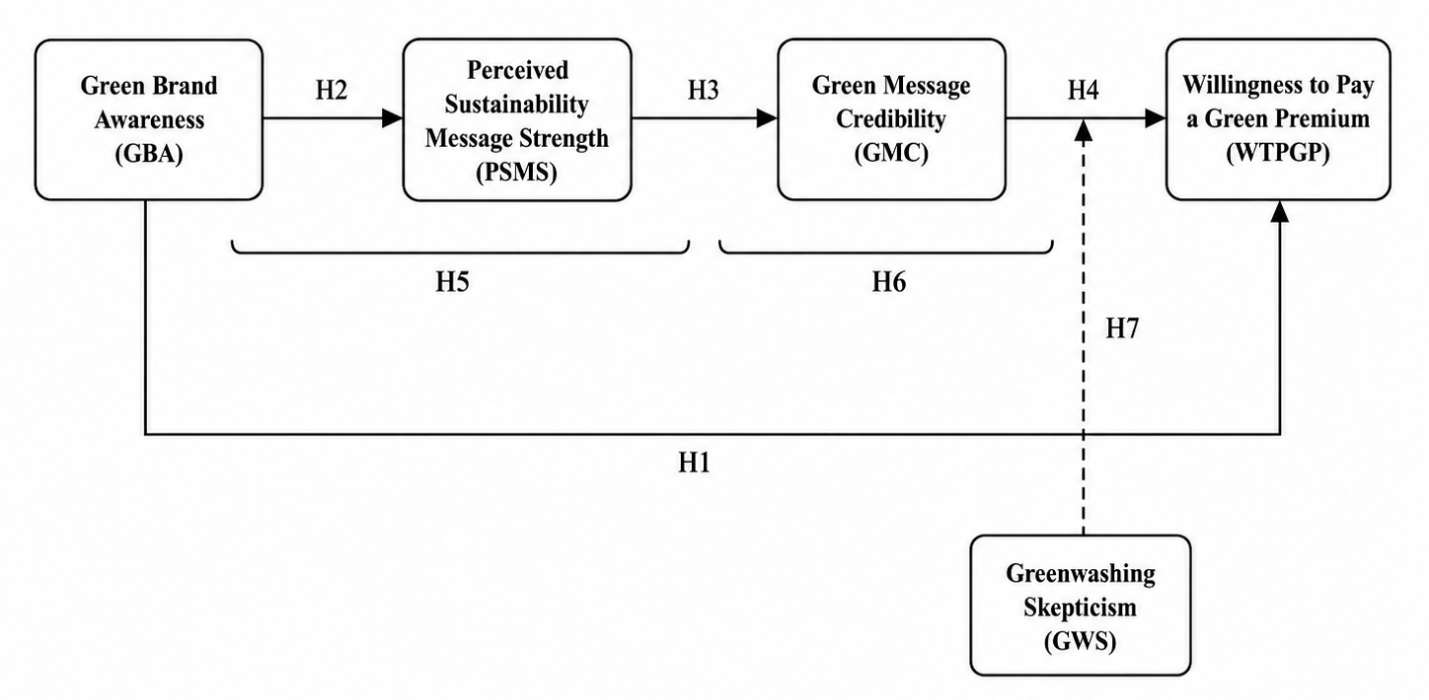
Taken together, signaling theory, ELM, and AIDA provide an integrated explanation of the proposed process. Green brand awareness serves as the initial condition that enables consumers to recognize sustainability positioning. Awareness is expected to contribute to perceived sustainability message strength, which subsequently supports the formation of green message credibility. Credibility, in turn, is expected to be associated with willingness to pay a green premium. The model also recognizes that this credibility-based relationship may be weaker among consumers with high levels of greenwashing skepticism (See Figure 2).
Green Brand Awareness and Willingness to Pay a Green Premium
Green brand awareness refers to consumers’ ability to recognize and recall a brand in association with its environmental or sustainability positioning during purchase decision making (Keller, 1993). Within the AIDA framework, awareness represents the initial stage through which a brand enters the consumer’s consideration set. In the context of sustainable consumption, awareness allows consumers to retrieve environmental associations when comparing available alternatives and evaluating whether a brand is consistent with their values or preferences.
Green brand awareness may be directly associated with willingness to pay a green premium because familiar sustainability positioning can function as a heuristic cue during complex purchasing decisions. When consumers readily recognize a brand as environmentally responsible, they may infer that the product provides additional environmental or social value, increasing their openness to paying more for it (Keller, 2003; Wang et al., 2024). This relationship may be particularly relevant in building-material markets, where consumers frequently face technical information, uncertain environmental claims, and multiple product alternatives. A recognizable sustainability position may simplify evaluation and reduce the cognitive effort required to distinguish one brand from another.
However, awareness alone does not guarantee that consumers will accept a price premium. In accordance with AIDA, awareness initiates the response process but may require further evaluation of the strength and credibility of the brand’s environmental information before it is translated into economic acceptance (Montazeribarforoushi et al., 2017). Nevertheless, because recognized sustainability positioning may increase perceived relevance and value, the study proposes a direct relationship between green brand awareness and willingness to pay a green premium.
H1: Green brand awareness positively influences willingness to pay a green premium
Green Brand Awareness and Perceived Sustainability Message Strength
Beyond its possible direct relationship with willingness to pay a green premium, green brand awareness is expected to contribute to the formation of perceived sustainability message strength. Awareness determines whether consumers recognize environmental claims as being associated with a particular brand and whether those claims can be retrieved from memory during product evaluation. Consumers who are more aware of a brand’s sustainability positioning are more likely to notice and connect related messages encountered across advertising, packaging, digital platforms, retail environments, and interpersonal communication.
Repeated recognition of sustainability-related information can enable consumers to identify patterns of consistency, clarity, and coherence across different exposures. These characteristics form the basis of perceived sustainability message strength. Awareness also facilitates the cognitive integration of otherwise dispersed information into a more unified representation of the brand’s environmental positioning. Rather than interpreting each environmental claim as an isolated statement, consumers with stronger brand awareness are more likely to interpret the claims as part of a coherent and intentional sustainability message.
From a signaling perspective, awareness therefore precedes perceived message strength because consumers must first recognize and recall the brand’s environmental positioning before they can judge the cumulative quality of its signals. Increased awareness is consequently expected to strengthen consumers’ perceptions that the brand communicates sustainability in a consistent, clear, and aligned manner.
H2: Green brand awareness positively influences perceived sustainability message strength.
Perceived Sustainability Message Strength and Green Message Credibility
Perceived sustainability message strength refers to the extent to which consumers regard a brand’s sustainability communication as consistent, repeated, clear, and coherent across their cumulative exposure to brand-related information. From a signaling perspective, message strength is not determined solely by whether a firm objectively coordinates its communication channels. Instead, it reflects how consumers organize and interpret the environmental signals they encounter over time (Kharouf et al., 2020; Schweidel et al., 2022).
Consistency refers to the alignment of environmental claims across different points of exposure, repetition concerns the frequency with which the claims are encountered, and clarity indicates whether the environmental information is understandable and unambiguous. Together, these characteristics allow consumers to form a stable interpretation of the brand’s sustainability positioning. When messages are inconsistent, vague, or contradictory, consumers may question whether the environmental positioning reflects a genuine organizational commitment. Conversely, when environmental claims are repeatedly communicated in a clear and aligned manner, consumers are more likely to perceive the communication as intentional and reliable.
ELM provides an additional explanation for the relationship between message strength and credibility. Sustainability claims frequently require careful evaluation because their accuracy cannot be readily verified. Strong messages reduce ambiguity and provide consumers with a clearer basis for judging whether environmental claims are trustworthy (Braca & Dondio, 2023). Consistency and clarity may also reduce suspicions that the claims are opportunistic or symbolic. Consequently, stronger perceived sustainability messages are expected to be associated with higher green message credibility.
H3: Perceived sustainability message strength positively influences green message credibility.
Green Message Credibility and Willingness to Pay a Green Premium
Green message credibility refers to consumers’ perceptions that a brand’s sustainability claims are trustworthy, accurate, reliable, and professionally communicated (Fella & Bausa, 2024). Credibility is particularly important in sustainability contexts because consumers often lack the technical knowledge or objective information required to verify environmental attributes. They must therefore assess whether a brand’s claims provide a dependable representation of its products and environmental conduct.
Credible sustainability claims can reduce uncertainty and perceived risk by increasing consumers’ confidence that the environmental benefits associated with a product are genuine. When consumers trust a brand’s sustainability information, they are more likely to regard environmental attributes as meaningful sources of value rather than as promotional exaggeration. Such credibility can provide a stronger justification for paying more because the premium is perceived as being connected to authentic environmental benefits (Martínez et al., 2025).
This mechanism is especially relevant in utilitarian product categories such as building materials. Consumers purchasing these products commonly evaluate price, durability, safety, and functional performance. Credible environmental information can reduce concerns that sustainability attributes come at the expense of product quality or performance. It can also reassure consumers that the additional price reflects verifiable environmental value. Green message credibility is therefore expected to increase consumers’ willingness to pay a green premium.
H4: Green message credibility positively influences willingness to pay a green premium.
Mediating Effects
The proposed model suggests that green brand awareness is associated with green message credibility through perceived sustainability message strength. Awareness enables consumers to recognize and retrieve a brand’s sustainability positioning, but awareness does not automatically establish whether the brand’s environmental claims are credible. Instead, consumers are likely to form credibility judgments after assessing the cumulative strength of the sustainability messages they encounter.
When consumers are aware of a brand’s environmental positioning, they are better able to connect messages from different sources and identify whether those messages appear consistent, clear, and coherent. Stronger perceived sustainability messaging subsequently provides a basis for judging the claims as trustworthy and reliable. Perceived sustainability message strength therefore represents the intervening mechanism through which awareness is associated with green message credibility.
H5: Perceived sustainability message strength mediates the relationship between green brand awareness and green message credibility.
Green message credibility is also expected to mediate the relationship between perceived sustainability message strength and willingness to pay a green premium. Although consistent and clear sustainability messages may create a strong impression, message strength alone may not be sufficient to justify economic acceptance. Consumers must also believe that the claims are truthful and accurate before accepting a higher product price.
In accordance with ELM, credibility represents a central evaluative mechanism through which sustainability information becomes persuasive. Strong sustainability messages can reduce ambiguity, but their economic relevance depends on whether consumers interpret them as credible. When credibility is established, consumers may be more confident that the environmental benefits are genuine and that the price premium is justified. Green message credibility therefore connects perceived sustainability message strength with willingness to pay a green premium.
H6: Green message credibility mediates the relationship between perceived sustainability message strength and willingness to pay a green premium.
Together, these mediating relationships constitute a serial mediation process in which green brand awareness precedes perceived sustainability message strength, perceived message strength precedes green message credibility, and credibility precedes willingness to pay a green premium. Following Zhao et al. (2010), the statistical assessment of mediation should focus on the significance of the bootstrapped indirect effects rather than requiring a statistically significant direct effect as a precondition for mediation. Accordingly, the serial indirect effect from green brand awareness to willingness to pay a green premium through perceived sustainability message strength and green message credibility will be examined as part of the mediation analysis.
Moderating Effect of Greenwashing Skepticism
Although green message credibility is expected to increase willingness to pay a green premium, the strength of this relationship may vary according to consumers’ skepticism toward environmental claims. Greenwashing skepticism refers to consumers’ tendency to doubt whether corporate environmental claims accurately represent firms’ practices, products, or environmental commitments (Delmas & Burbano, 2011; Nyilasy et al., 2013).
From a signaling perspective, skepticism influences how consumers interpret the informational value of environmental claims. Consumers with low levels of skepticism may accept credible sustainability information as a reliable indication of environmental performance. They may therefore be more willing to translate perceived credibility into acceptance of a green price premium. In contrast, highly skeptical consumers may continue to question the motives, completeness, or accuracy of sustainability communication even when the message appears credible.
Greenwashing skepticism may consequently reduce the behavioral influence of credibility. Highly skeptical consumers may attribute sustainability messages to strategic impression management rather than genuine environmental commitment (Monfort et al., 2025). They may also scrutinize claims more critically, search for inconsistencies, or demand stronger external verification before accepting a higher price. In such cases, the positive relationship between green message credibility and willingness to pay a green premium is expected to become weaker.
The moderating role of greenwashing skepticism is particularly relevant in markets where environmental attributes are difficult to verify and where consumers are frequently exposed to broad or unsubstantiated green claims. Under low-skepticism conditions, credible messages should have a stronger association with willingness to pay. Under high-skepticism conditions, the same level of credibility may produce a weaker economic response.
H7: Greenwashing skepticism moderates the relationship between green message credibility and willingness to pay a green premium, such that the positive relationship is weaker when greenwashing skepticism is high.
Research Method
Research Design and Study Context
This study employed a quantitative cross-sectional survey design to examine the relationships among green brand awareness, perceived sustainability message strength, green message credibility, greenwashing skepticism, and willingness to pay a green premium for building materials in Indonesia. Perceived sustainability message strength and green message credibility were specified as serial mediators linking green brand awareness with willingness to pay a green premium. Greenwashing skepticism was examined as a moderator of the relationship between green message credibility and willingness to pay a green premium. This design was appropriate because the study involved latent perceptual constructs and required the simultaneous assessment of direct, indirect, and conditional relationships within a structural equation modeling framework.
The target population consisted of consumers who had experience with, or responsibility for, purchasing ceiling and interior building materials for residential or commercial purposes. Relevant product categories included gypsum boards, polyvinyl chloride panels, acoustic tiles, ceiling panels, and related interior finishing materials. Respondents were required to have sufficient familiarity with purchasing, evaluating, or comparing these products to provide informed assessments of the selected brand.
A combination of purposive and convenience sampling was used. Purposive sampling ensured that respondents met the experience-based eligibility criteria, while convenience sampling facilitated access to relevant consumers through online communities and physical retail locations. Data were collected between February and April 2025 in major urban and peri-urban markets in Indonesia, including Jakarta and its metropolitan area, Surabaya, Medan, Makassar, Bandung, and Denpasar. Online questionnaires were distributed through social media communities related to home renovation, interior design, and construction, while offline questionnaires were administered at selected hardware stores and building material outlets.
At the beginning of the questionnaire, respondents were instructed to identify a building material brand with which they were familiar or that they had recently considered or purchased. All subsequent questions referred to this self-selected brand, allowing participants to base their responses on actual market experience rather than a hypothetical scenario. Because respondents were not restricted to brands with independently verified environmental performance, the study measured consumer perceptions of sustainability signals and claims rather than objective environmental performance. This approach was consistent with the study’s focus on how consumers interpret sustainability communication.
Sample and Data Collection
A total of 412 questionnaires were collected. The data were screened for completeness, response consistency, and suitability for analysis. Following this screening process, 345 usable responses were retained, representing a data-retention rate of 83.7 percent. The term retention rate is used because the total number of individuals who received or accessed the questionnaire was not recorded; therefore, a conventional survey response rate could not be calculated.
The final sample consisted of approximately 61 percent male and 39 percent female respondents, ranging from 22 to 54 years of age. Approximately 68 percent held at least a bachelor’s degree. The respondents included homeowners, small-business owners, freelance contractors, and other consumers involved in purchasing building materials. This profile was consistent with the study’s focus on individuals who participate directly in building-material purchase decisions.
Because the data were collected through both online and offline channels, independent-samples t-tests were conducted to determine whether the two groups differed on the principal study constructs. No statistically significant differences were found between the online and offline respondents at the 5 percent significance level. The two subsamples were therefore combined for the subsequent analyses.
Measurement of Constructs
All constructs were measured using multi-item scales adapted from established studies. The measurement items were adjusted to reflect the context of sustainability communication and building-material brands in Indonesia. Responses were recorded using a seven-point Likert scale ranging from 1, strongly disagree, to 7, strongly agree.
Green brand awareness was measured using three items adapted from Chi et al. (2024) and Keller (2003). The items captured respondents’ ability to recognize and recall the selected brand in association with environmentally responsible or sustainable building materials.
Perceived sustainability message strength was measured using four items adapted from (Butkouskaya et al., 2023; Rehman et al., 2025). The items assessed the extent to which respondents perceived the selected brand’s sustainability communication as frequently encountered, consistent, clear, coherent, and aligned across their cumulative exposure to brand-related information. Respondents were not asked to determine whether the brand had technically integrated its communication across every channel. Instead, they reported their overall perception based on the sustainability information they had encountered. This consumer-level operationalization was consistent with signaling theory, according to which individuals form cumulative judgments from signals received through multiple sources.
Green message credibility was measured using four items adapted from (Jia et al., 2024; Teruel--Sánchez et al., 2021). The items assessed the perceived trustworthiness, accuracy, credibility, and professionalism of the selected brand’s sustainability claims.
Willingness to pay a green premium was measured using three items adapted from (Laroche et al., 2001). The items assessed respondents’ willingness to accept a higher price for a building-material brand that offered credible or verified environmental benefits.
Greenwashing skepticism was measured using three items adapted from Dorfleitner & Utz (2023) and Nyilasy et al. (2013). The items assessed respondents’ general tendency to doubt the truthfulness, accuracy, and underlying motives of corporate environmental claims. The complete list of items is presented in Table 1.
Table 1. Measurement Items and Sources
| Construct | Measurement Items | Source |
| Green Brand Awareness (GBA) |
GBA1. I can easily recognize this brand as an environmentally friendly brand among its competitors.
GBA2. I am aware of this brand when considering sustainable building materials. GBA3. This brand is one of the first brands that comes to mind when I think about environmentally friendly building products. |
Adapted from Chi et al. (2024) and Keller (2003) |
| Perceived Sustainability Message Strength (PSMS) |
PSMS1. I frequently encounter sustainability-related messages about this brand from different sources.
PSMS2. The sustainability claims associated with this brand are consistent across the information I encounter. PSMS3. The brand’s sustainability-related messages are clear and easy to understand. PSMS4. The brand’s sustainability communication appears coherent and aligned. |
Adapted from Butkouskaya et al. (2023) and Rehman et al. (2025) |
| Green Message Credibility (GMC) |
GMC1. The brand’s sustainability claims are trustworthy.
GMC2. I believe the environmental information provided by this brand is accurate. GMC3. The sustainability information communicated by this brand is credible. GMC4. The brand communicates sustainability information with expertise and professionalism. |
Adapted from Jia et al. (2024) and Teruel--Sánchez et al. (2021) |
| Willingness to Pay a Green Premium (WTPGP) |
WTPGP1. I am willing to pay more for this brand when it offers verified environmentally friendly features.
WTPGP2. I would accept a higher price for this brand because of its environmental benefits. WTPGP3. I would choose this environmentally responsible brand even if it cost more than competing brands. |
Adapted from Laroche et al. (2001) |
| Greenwashing Skepticism (GWS) |
GWS1. I am skeptical about the truthfulness of environmental claims made by companies.
GWS2. I believe that many brands exaggerate their environmentally friendly practices. GWS3. I doubt whether companies that promote sustainability are genuinely committed to environmental responsibility. |
Adapted from Dorfleitner & Utz (2023) and Nyilasy et al. (2013) |
A pilot test involving 35 respondents was conducted before the main data collection. The pilot test assessed the clarity, contextual appropriateness, and preliminary reliability of the measurement items. Minor wording adjustments were made to improve comprehensibility and contextual relevance. Participation in both the pilot study and the main survey was voluntary. Respondents were informed of the purpose of the research, provided informed consent, and retained the right to discontinue their participation at any stage.
Preliminary Data Assessment
Before estimating the measurement and structural models, the data were assessed for multivariate normality. Mardia’s normalized coefficient of multivariate kurtosis was 3.21. Because this value was below the conservative threshold of 5.00, the data were considered to demonstrate an acceptable approximation to multivariate normality (Kline, 2016). Maximum likelihood estimation was therefore used. Bias-corrected bootstrapping was also applied when assessing indirect effects to reduce reliance on the assumption that the sampling distribution of indirect effects was normal.
Potential common method variance was addressed through procedural and statistical measures. Procedurally, the questionnaire incorporated randomized item ordering and psychological separation between the predictor and criterion constructs. Respondents were also informed that there were no correct or incorrect answers and that their responses would be treated confidentially. Statistically, a latent common method-factor model was estimated as part of the confirmatory factor analysis and compared with the original measurement model. The inclusion of the common method factor did not produce a statistically significant improvement in model fit and accounted for only 3.7 percent of the total variance. These findings indicate that common method variance was unlikely to pose a substantial threat to the validity or interpretation of the results (Podsakoff et al., 2003; Williams et al., 2010).
Data Analysis
Covariance-based structural equation modeling was conducted using AMOS 28.0 following a two-step procedure. First, confirmatory factor analysis assessed the measurement model. Indicator reliability was evaluated through standardized factor loadings, internal consistency through composite reliability values of at least 0.70, and convergent validity through average variance extracted values of at least 0.50. Discriminant validity was assessed using the Fornell-Larcker criterion and HTMT values below 0.85.
Model fit was evaluated using /df, CFI, TLI, RMSEA, and SRMR. The structural model then tested the direct relationships in H1 to H4, including the direct path from green brand awareness to willingness to pay a green premium and the serial pathway through perceived sustainability message strength and green message credibility.
The mediating effects in H5 and H6 were tested using bias-corrected bootstrapping with 5,000 resamples, with significance determined when the 95 percent confidence interval excluded zero. The serial indirect effect was also examined and interpreted following (Zhao et al., 2010). Moderation was assessed using the interaction between mean-centered green message credibility and greenwashing skepticism, followed by simple-slope analysis at one standard deviation below and above the moderator mean.
Competing Model Analysis
A competing structural model was estimated by reversing the order of the two mediators, with green message credibility preceding perceived sustainability message strength. Both models were estimated using the same sample, measurement specification, estimation procedure, and outcome construct. Their relative performance was compared using , degrees of freedom, CFI, TLI, RMSEA, and SRMR. Lower , RMSEA, and SRMR values and higher CFI and TLI values indicated better model fit.
Results
Sample Characteristics
The final sample consisted of 345 valid respondents after data screening. Data were collected through both online and offline channels, with 198 responses (57.4 percent) obtained via online surveys and 147 responses (42.6 percent) collected through in-store distribution at hardware and building material outlets.
Table 2. Sample Characteristics
| Category | Item | Frequency (n) | Percentage (%) |
| Data Collection Mode | Online | 198 | 57.4 |
| Offline | 147 | 42.6 | |
| Gender | Male | 210 | 60.9 |
| Female | 135 | 39.1 | |
| Age Group | 22–30 years | 102 | 29.6 |
| 31–40 years | 128 | 37.1 | |
| 41–50 years | 79 | 22.9 | |
| 51–54 years | 36 | 10.4 | |
| Education Level | High school or below | 58 | 16.8 |
| Diploma | 52 | 15.1 | |
| Bachelor’s degree | 175 | 50.7 | |
| Postgraduate degree | 60 | 17.4 | |
| Occupation | Homeowner | 122 | 35.4 |
| Small business owner | 88 | 25.5 | |
| Freelance contractor | 74 | 21.4 | |
| Others | 61 | 17.7 |
Table 2 presents the demographic profile of the respondents. The sample was composed of 60.9 percent male and 39.1 percent female participants. In terms of age distribution, the largest proportion of respondents was in the 31–40 age group (37.1 percent), followed by the 22–30 age group (29.6 percent), the 41–50 age group (22.9 percent), and the 51–54 age group (10.4 percent). Regarding educational attainment, most respondents held a bachelor’s degree (50.7 percent), followed by postgraduate qualifications (17.4 percent), high school or below (16.8 percent), and diploma-level education (15.1 percent). In terms of occupation, respondents were primarily homeowners (35.4 percent), small business owners (25.5 percent), and freelance contractors (21.4 percent), with the remaining 17.7 percent categorized as other occupations.
To assess potential differences between data collection modes, independent-samples t-tests were conducted to compare online and offline respondents on the main study constructs. The results indicated no statistically significant differences (p > 0.05), supporting the decision to pool the data for subsequent analysis.
Preliminary Analysis
Prior to estimating the measurement and structural models, preliminary analyses were conducted to assess multivariate normality and the potential influence of common method variance (CMV).
Multivariate normality was evaluated using Mardia’s coefficient. The results indicated that the normalized estimate of multivariate kurtosis was 3.21, which is below the conservative threshold of 5.00, suggesting that the assumption of multivariate normality was reasonably satisfied (Kline, 2016). Therefore, maximum likelihood estimation was deemed appropriate for subsequent analyses.
To assess the potential impact of common method variance, both procedural and statistical remedies were employed. Procedurally, the questionnaire design incorporated randomization of item order and psychological separation between predictor and criterion variables. Statistically, a latent common method factor approach was applied in the confirmatory factor analysis. As shown in Table 3, including the common method factor did not significantly improve model fit ( = 7.16, p > 0.05), and the method factor accounted for only 3.7% of the total variance. This value is substantially below the conservative 25 percent threshold commonly used to indicate problematic method bias (Podsakoff et al., 2003; Williams et al., 2010). These findings suggest that CMV is unlikely to pose a serious threat to the validity of the results.
Table 3. Preliminary Analysis Results
| Test | Indicator | Value | Evaluation Criterion | Interpretation |
| Multivariate normality | Mardia’s normalized kurtosis coefficient | 3.21 | Below 5.00 | Multivariate normality was adequately satisfied |
| Common method variance | between models with and without a common method factor | 7.16, n.s. | No statistically significant improvement in model fit | Adding the common method factor did not improve the measurement model |
| Common method variance | Variance explained by the common method factor | 3.7% | Low proportion of total variance | Common method variance was unlikely to pose a substantial concern |
Measurement Model (CFA)
As shown in Table 4, the confirmatory factor analysis results support the reliability and convergent validity of the measurement model. All standardized factor loadings exceeded the recommended threshold of 0.70, ranging from 0.81 to 0.89. Composite reliability values ranged from 0.85 to 0.91, exceeding the minimum criterion of 0.70, while average variance extracted values ranged from 0.66 to 0.75, surpassing the recommended threshold of 0.50. Collectively, these results demonstrate satisfactory indicator reliability, internal consistency, and convergent validity.
Table 4. Measurement Model Results
| Construct | Item | Loading | CR | AVE |
| Green Brand Awareness | GBA1 | 0.89 | 0.90 | 0.75 |
| GBA2 | 0.87 | |||
| GBA3 | 0.85 | |||
| Perceived Sustainability Message Strength | PSMS1 | 0.84 | 0.89 | 0.67 |
| PSMS2 | 0.87 | |||
| PSMS3 | 0.81 | |||
| PSMS4 | 0.83 | |||
| Green Message Credibility | GMC1 | 0.88 | 0.91 | 0.71 |
| GMC2 | 0.86 | |||
| GMC3 | 0.85 | |||
| GMC4 | 0.87 | |||
| Willingness to Pay a Green Premium | WTPGP1 | 0.84 | 0.88 | 0.70 |
| WTPGP2 | 0.83 | |||
| WTPGP3 | 0.85 | |||
| Greenwashing Skepticism | GWS1 | 0.82 | 0.85 | 0.66 |
| GWS2 | 0.81 | |||
| GWS3 | 0.83 |
Discriminant validity was supported because the square root of the AVE for each construct exceeded its correlations with the other constructs, while all HTMT values were below 0.85, as shown in Table 5.
Table 5. Discriminant Validity Assessment
| Panel A. Fornell–Larcker Criterion | |||||
| Construct | GBA | PSMS | GMC | WTPGP | GWS |
| GBA | 0.87 | ||||
| PSMS | 0.58 | 0.82 | |||
| GMC | 0.63 | 0.61 | 0.84 | ||
| WTPGP | 0.65 | 0.55 | 0.66 | 0.84 | |
| GWS | 0.39 | 0.37 | 0.42 | 0.44 | 0.81 |
| Panel B. Heterotrait–Monotrait Ratio | |||||
| GBA | — | ||||
| PSMS | 0.70 | — | |||
| GMC | 0.76 | 0.74 | — | ||
| WTPGP | 0.78 | 0.68 | 0.79 | — | |
| GWS | 0.47 | 0.45 | 0.51 | 0.53 | — |
The overall model fit indices indicate that the measurement model fits the data well. The -square statistic was significant ( = 486.32, df = 260, p < 0.001), which is expected in samples of this size. However, the /df ratio was 1.87, below the recommended threshold of 3.00. Incremental fit indices were also satisfactory, with the Comparative Fit Index (CFI) = 0.963 and Tucker–Lewis Index (TLI) = 0.956, both exceeding the 0.95 benchmark. The Root Mean Square Error of Approximation (RMSEA) was 0.045 with a 90 percent confidence interval between 0.038 and 0.052, indicating close model fit, while the Standardized Root Mean Square Residual (SRMR) was 0.041, well below the 0.08 threshold. Collectively, these results confirm that the measurement model demonstrates adequate reliability, validity, and overall goodness-of-fit.
Structural Model Evaluation
The structural model demonstrated satisfactory fit to the data, with = 512.47, df = 272, /df = 1.88, CFI = 0.961, TLI = 0.954, RMSEA = 0.046, and SRMR = 0.043. These results supported proceeding with the examination of the hypothesised structural relationships.
Table 6. Structural Model Results
| Hypothesis | Path | t value | p value | Result | |
| H1 | GBA WTPGP | 0.09 | 1.75 | 0.081 | Not supported |
| H2 | GBA PSMS | 0.58 | 9.42 | ¡ 0.001 | Supported |
| H3 | PSMS GMC | 0.61 | 10.15 | ¡ 0.001 | Supported |
| H4 | GMC WTPGP | 0.52 | 8.76 | ¡ 0.001 | Supported |
Table 6 presents the standardized path coefficients and hypothesis-testing results. The direct relationship between green brand awareness and willingness to pay a green premium was not statistically significant and was therefore not statistically different from zero (β= 0.09, p = 0.081). Accordingly, H1 was not supported.
Green brand awareness had a statistically significant positive relationship with perceived sustainability message strength (β= 0.58, p < 0.001), supporting H2. This finding indicates that consumers who demonstrated greater awareness of a brand’s sustainability positioning were more likely to perceive its sustainability messages as consistent, clear, and coherent.
Perceived sustainability message strength was positively and significantly related to green message credibility (β= 0.61, p < 0.001), providing support for H3. Thus, stronger perceptions of sustainability message consistency and clarity were associated with higher evaluations of the trustworthiness and reliability of the brand’s environmental claims.
Green message credibility also had a statistically significant positive relationship with willingness to pay a green premium (β= 0.52, p < 0.001), supporting H4. Consumers who regarded the brand’s sustainability claims as more credible demonstrated a greater willingness to accept a higher price for environmentally positioned building materials.
Overall, the structural results indicate that green brand awareness was not directly associated with willingness to pay a green premium at the conventional significance level. Instead, awareness was associated with perceived sustainability message strength, which was subsequently associated with green message credibility and willingness to pay a green premium.
Mediation Analysis
The mediating effects were assessed using bias-corrected bootstrapping with 5,000 resamples. An indirect effect was considered statistically significant when its 95 percent bias-corrected confidence interval did not contain zero. Table 7 presents the standardized indirect effects and their corresponding confidence intervals.
Table 7. Mediation Analysis Results
| Hypothesis | Indirect Path | Standardized Indirect Effect | 95% Bias Corrected CI | p value | Result |
| H5 | GBA PSMS GMC | 0.35 | [0.27, 0.44] | ¡ 0.001 | Supported |
| H6 | PSMS GMC WTPGP | 0.32 | [0.24, 0.41] | ¡ 0.001 | Supported |
Perceived sustainability message strength significantly mediated the relationship between green brand awareness and green message credibility (β= 0.35, 95% CI [0.27, 0.44], p < 0.001). The confidence interval did not include zero, providing support for H5. This result indicates that green brand awareness was associated with greater green message credibility through consumers’ perceptions that the brand’s sustainability communication was strong, coherent, and consistent.
Green message credibility also significantly mediated the relationship between perceived sustainability message strength and willingness to pay a green premium (β= 0.32, 95% CI [0.24, 0.41], p < 0.001). The confidence interval excluded zero, supporting H6. This finding suggests that perceived sustainability message strength was associated with willingness to pay a green premium through its relationship with the credibility assigned to the brand’s environmental claims.
In addition to the two hypothesized mediation effects, the serial indirect effect from green brand awareness to willingness to pay a green premium through perceived sustainability message strength and green message credibility was examined. The serial indirect effect was statistically significant (β= 0.19, 95% CI [0.14, 0.26], p < 0.001), as its confidence interval did not include zero. This result supports the proposed serial process in which awareness precedes perceived sustainability message strength, which subsequently precedes green message credibility and willingness to pay a green premium.
The serial indirect effect was not treated as a separate hypothesis because it represents the sequential combination of the mediation relationships specified in H5 and H6. Following (Zhao et al., 2010), the combination of a statistically significant indirect effect and a direct effect that was not statistically different from zero is consistent with an indirect-only mediation pattern. The findings therefore indicate that the association between green brand awareness and willingness to pay a green premium operated through perceived sustainability message strength and green message credibility rather than through a statistically significant direct relationship.
Moderating Effect of Greenwashing Skepticism
The moderating effect of greenwashing skepticism on the relationship between green message credibility and willingness to pay a green premium was tested using an interaction term between the mean-centered values of green message credibility and greenwashing skepticism. As reported in Table 8, the interaction effect was negative and statistically significant ( = , ), supporting H7. This finding indicates that the positive relationship between green message credibility and willingness to pay a green premium weakened as greenwashing skepticism increased.
Table 8. Moderation Analysis Results
| Hypothesis | Interaction Path | t value | p value | Result | |
| H7 | GMC GWS WTPGP | ¡ 0.01 | Supported |
A simple-slope analysis was conducted at one standard deviation below and above the mean of greenwashing skepticism. Under low skepticism, the predicted willingness to pay a green premium increased from 2.10 at low green message credibility to 3.21 at the mean and 4.31 at high credibility. Under high skepticism, the corresponding values increased more modestly from 1.65 to 2.31 and 2.97. This pattern indicates that green message credibility was more strongly associated with willingness to pay when greenwashing skepticism was low.
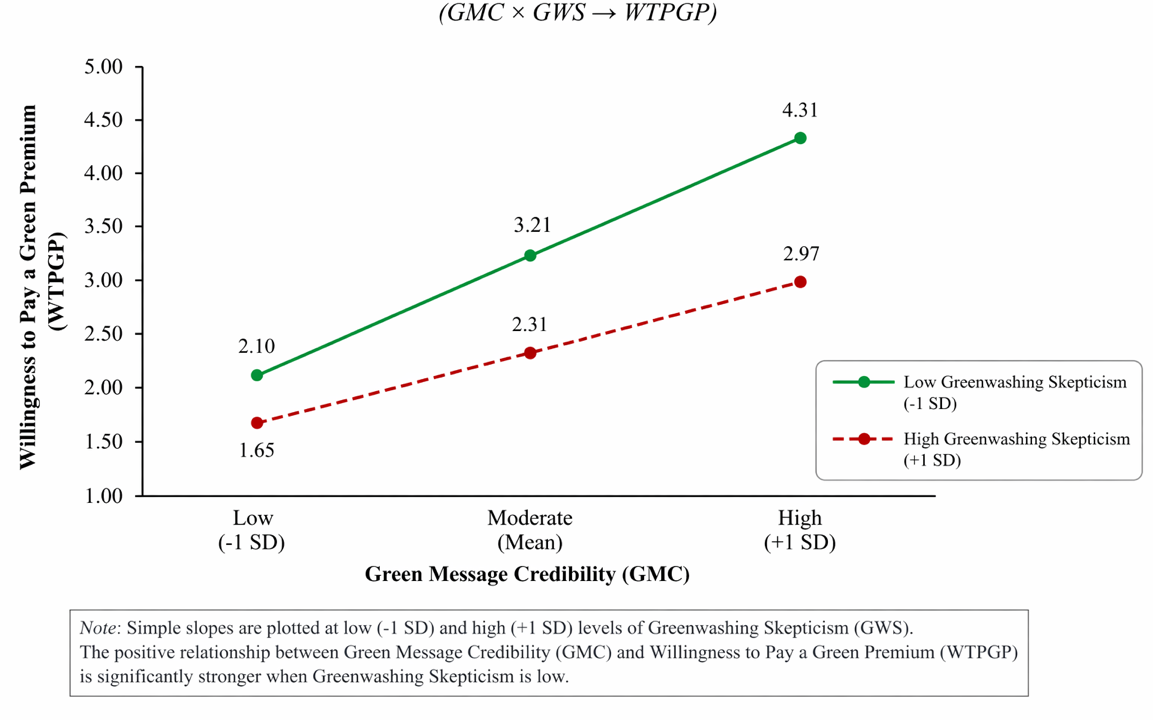
As illustrated in Figure 3, the slope for consumers with low greenwashing skepticism was considerably steeper than that for consumers with high skepticism. This pattern is consistent with the negative interaction coefficient and confirms that greenwashing skepticism constrains the extent to which message credibility is translated into willingness to pay a green premium.
Competing Model Analysis
To assess whether the proposed ordering of the mediating constructs provided the more appropriate theoretical specification, a competing model was estimated by reversing the positions of green message credibility and perceived sustainability message strength. As illustrated in Figure 4, the competing model specified that green brand awareness was associated first with green message credibility, followed by perceived sustainability message strength and willingness to pay a green premium. The direct path from green brand awareness to willingness to pay a green premium was retained to ensure comparability with the hypothesised model.
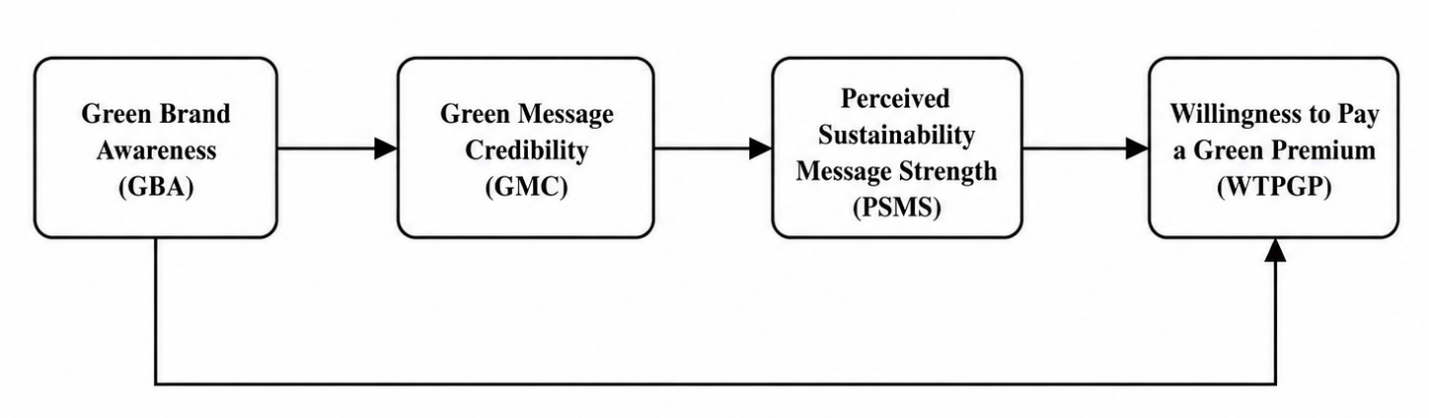
The competing model therefore differed substantively from the hypothesised model. The hypothesised model proposes that consumers first evaluate the consistency, clarity, and coherence of a brand’s sustainability communication, after which perceived message strength informs the credibility assigned to its environmental claims. The competing model instead assumes that consumers first form credibility judgements and subsequently use those judgements to assess sustainability message strength.
The competing model demonstrated substantially poorer fit than the hypothesised model, with = 1183.20, df = 272, /df = 4.35, CFI = 0.884, TLI = 0.869, RMSEA = 0.079, 90 per cent CI [0.074, 0.084], and SRMR = 0.096. By comparison, the hypothesised model produced = 512.47, df = 272, /df = 1.88, CFI = 0.961, TLI = 0.954, RMSEA = 0.046, and SRMR = 0.043. Because the models were non nested and had identical degrees of freedom, a conventional square difference significance test was not applicable. The consistently poorer comparative and residual fit indices nevertheless supported the hypothesised specification.
These findings suggest that consumers are more likely to evaluate the consistency, clarity, and coherence of sustainability communication before assigning credibility to the brand’s environmental claims. Nevertheless, because the study is based on cross sectional data, the competing model comparison should be interpreted as support for the theoretical specification rather than definitive evidence of temporal or causal ordering.
Discussion
The findings provide a theoretically grounded explanation of how sustainability communication is associated with consumers’ willingness to pay a green premium in a utilitarian product context. Drawing on signaling theory, the results indicate that the relationship between green brand awareness and willingness to pay is transmitted through a structured sequence involving perceived sustainability message strength and green message credibility. This pattern is consistent with the proposition that consumers rely on interpretable signals to reduce information asymmetry when important product attributes are difficult to observe or verify (Spence, 2002). Such a process is particularly relevant in sustainability contexts, where environmental characteristics are often credence-based and cannot be easily evaluated through direct product use (Delmas & Burbano, 2011).
The direct relationship between green brand awareness and willingness to pay a green premium was not statistically different from zero. This finding suggests that awareness of a brand’s sustainability positioning, by itself, may not be sufficient to produce economic acceptance of a green price premium. Within the AIDA framework, awareness enables sustainability-related information to enter the consumer’s consideration set, but it does not ensure that the information will be perceived as coherent, credible, or sufficiently valuable to justify a higher price (Montazeribarforoushi et al., 2017). The result is consistent with prior research indicating that awareness often requires additional cognitive evaluation before it is associated with behavioral responses (Balaskas et al., 2025; Godinho Filho et al., 2024). Green brand awareness should therefore be understood as an upstream enabling condition in the proposed framework rather than as a direct determinant of willingness to pay.
The relationship between green brand awareness and perceived sustainability message strength further indicates that awareness plays an interpretive role beyond simple recognition. Consumers who are more familiar with a brand’s sustainability positioning are better able to connect environmental claims encountered across different touchpoints and to identify recurring patterns of consistency, clarity, and coherence. From a signaling perspective, awareness facilitates the cognitive organization of dispersed information into a more unified representation of the brand’s sustainability communication. This extends the role of brand awareness by showing that it contributes to the formation of perceived message strength.
Perceived sustainability message strength also emerged as an important precursor to green message credibility. Sustainability communication that appears consistent, repeated, and clear provides consumers with a more stable basis for evaluating environmental claims. Stronger signals reduce ambiguity and make the brand’s sustainability positioning easier to interpret, thereby strengthening perceptions of trustworthiness and reliability (Nadeem et al., 2025). This finding refines prior research by showing that consumer responses depend not merely on exposure to environmental information but on whether the communication forms a coherent and interpretable pattern.
Green message credibility represents the principal evaluative mechanism linking sustainability communication with willingness to pay a green premium. When consumers regard environmental claims as accurate and trustworthy, they are more likely to perceive the associated environmental benefits as genuine and meaningful. This interpretation is consistent with the Elaboration Likelihood Model, which suggests that credible information can strengthen persuasion when consumers carefully evaluate message content (Cyr et al., 2018; Li & See-To, 2023). In utilitarian product categories such as building materials, credibility is especially important because purchasing decisions involve long-term considerations of durability, safety, functionality, and economic value. Credible sustainability information can reduce uncertainty regarding whether environmental benefits justify the additional financial cost.
The mediation findings further clarify how these relationships operate. Perceived sustainability message strength connects green brand awareness with green message credibility, while green message credibility connects perceived message strength with willingness to pay a green premium. Together, these relationships form a serial mediation process in which awareness supports signal formation, signal strength supports credibility evaluation, and credibility supports economic acceptance.
Because the serial indirect effect was significant while the direct relationship between awareness and willingness to pay was not statistically different from zero, the findings are consistent with indirect-only mediation as described by (Zhao et al., 2010). This pattern indicates that the association between green brand awareness and willingness to pay operates through the proposed sequence of perceived message strength and green message credibility. However, because the data are cross-sectional, the finding should be interpreted as support for the proposed indirect process rather than as definitive evidence of temporal causality.
The moderating role of greenwashing skepticism identifies an important boundary condition for credibility-based persuasion. The relationship between green message credibility and willingness to pay becomes weaker as skepticism increases. Consumers with lower levels of skepticism appear more willing to translate credible environmental information into acceptance of a price premium. By contrast, highly skeptical consumers may continue to question the motives of the firm, the completeness of the information, or the extent to which environmental claims reflect actual organizational conduct. This finding is consistent with prior research showing that skepticism can weaken consumer trust and reduce the persuasive effectiveness of sustainability communication (Baharuddin et al., 2026; Martínez et al., 2025).
The moderation result also indicates that credibility is not uniformly persuasive across consumers. A sustainability message may be regarded as credible, yet its behavioral relevance can still depend on the consumer’s general predisposition to doubt environmental claims. This contributes to signaling theory by showing that signal interpretation is shaped not only by message characteristics but also by characteristics of the receiver. Firms therefore cannot assume that improving the credibility of sustainability communication will produce equivalent responses among consumers with different levels of skepticism.
The competing model analysis provides additional support for the hypothesized ordering of the constructs. The reversed model, in which green message credibility preceded perceived sustainability message strength, provided a less adequate representation of the data than the proposed sequence. This comparison supports the theoretical argument that consumers are more likely to evaluate the consistency, clarity, and coherence of sustainability communication before forming judgments about its credibility. The competing model therefore strengthens the rationale for positioning perceived sustainability message strength before green message credibility.
Nevertheless, the model comparison should be interpreted as comparative support rather than conclusive proof of causal ordering. The cross-sectional design does not establish temporal precedence, and alternative explanations cannot be entirely excluded. Future experimental or longitudinal research could provide stronger evidence regarding the sequence through which sustainability signals are processed.
Overall, the findings demonstrate that sustainability communication in a utilitarian product context is associated with willingness to pay through interconnected cognitive and evaluative mechanisms. Green brand awareness enables sustainability information to become salient, perceived sustainability message strength supports credibility formation, and green message credibility is associated with willingness to accept a price premium. Greenwashing skepticism constrains this final credibility-based relationship. Together, these findings provide a more nuanced explanation of how sustainability signals are interpreted and translated into economic responses in an emerging-market context.
Conclusion
This study advances sustainable marketing research by clarifying how sustainability communication is associated with consumers’ willingness to pay a green premium in a utilitarian product context. Drawing on signaling theory, the findings indicate that green brand awareness does not have a statistically significant direct relationship with willingness to pay a green premium. Instead, its association with willingness to pay operates through perceived sustainability message strength and green message credibility. Awareness therefore functions as an upstream enabling condition that supports the recognition and interpretation of sustainability signals rather than as a direct determinant of economic acceptance.
The study contributes to the literature by integrating signaling theory with the Elaboration Likelihood Model and the awareness logic of AIDA. This integration explains how consumers move from recognizing a brand’s sustainability positioning to evaluating the strength and credibility of its environmental communication. The indirect-only mediation pattern further indicates that the mere dissemination or recognition of sustainability information may be insufficient to influence willingness to pay. What matters is whether consumers perceive the communication as coherent, clear, and credible. The competing model analysis provides additional comparative support for this ordering by showing that the reversed sequence, in which credibility precedes perceived message strength, offers a less adequate representation of the data.
The moderating role of greenwashing skepticism extends this explanation by identifying an important boundary condition. Even credible sustainability claims may have a weaker association with willingness to pay among consumers who are highly skeptical of corporate environmental communication. This finding highlights that effective sustainability messaging depends not only on the quality of the signal but also on the interpretive predispositions of the audience.
From a managerial perspective, firms should not rely solely on increasing awareness of their sustainability positioning. They should ensure that environmental messages are consistent, clear, repeated appropriately, and aligned across consumer touchpoints. Sustainability claims should also be supported by specific, transparent, and verifiable information that strengthens credibility. Because greenwashing skepticism can weaken the persuasive influence of credible communication, firms should avoid vague or exaggerated claims and provide credible evidence of environmental performance.
Several limitations should be acknowledged. First, sustainability attributes were not explicitly standardized for respondents, which may have introduced variation in how participants interpreted the meaning of sustainability. Second, the cross-sectional survey design limits causal inference and does not establish the temporal ordering of the constructs. Although the competing model analysis provides comparative support for the hypothesized sequence, longitudinal or experimental research is required to examine temporal precedence more rigorously. Third, perceived sustainability message strength reflects consumer interpretations rather than objective assessments of firm-level communication practices. Future studies could compare perceived and objectively coded communication strategies, manipulate message consistency experimentally, and incorporate more precise definitions of environmental attributes.
Future research could also examine whether the proposed relationships vary across product categories, consumer segments, or cultural settings. Additional studies may explore the role of third-party certification, environmental knowledge, perceived product quality, and price sensitivity in strengthening or weakening the proposed mechanisms. Such extensions would help determine whether the framework applies beyond building materials and emerging-market settings.
Overall, the study offers an empirically supported framework for understanding how sustainability communication is associated with willingness to pay a green premium. It shows that awareness becomes economically relevant when it contributes to the formation of strong sustainability signals and credible environmental claims, while skepticism constrains the final translation of credibility into willingness to pay.
Funding Statement
We would like to express our gratitude to the Directorate of Community Service Research (DPPM), Directorate General of Research and Development, for providing funding for this research, LLDIKTI Region IX Sultan Batara Higher Education Service Institution Region XI LPPM, and its staff within the scope of STIE Amkop Makassar.
Conflict of Interest
The authors declare no conflict of interest.
Data Availability
The data supporting the findings of this study are available from the corresponding author upon reasonable request.
Supplementary Materials
Supplementary material for this article is available online via https://doi.org/10.51300/JSM-2026-173.
Publisher Disclaimer
The views expressed in this article are solely those of the author(s) and do not necessarily reflect those of their institutions, the publisher, editors, or reviewers. The publisher and editorial team make no warranties regarding the accuracy or completeness of the content and accept no responsibility for errors, omissions, or any consequences arising from its use. The publisher remains neutral regarding jurisdictional claims in maps and institutional affiliations.
References
- . Marketing strategies for waste recycling: a bibliometric analysis towards the circular economy. Environmental Science and Pollution Research, 30(25), 67565–67581. https://doi.org/10.1007/s11356-023-27040-y CrossRef | Google Scholar
- . Indonesia's construction market: Key growth drivers and 2030 forecast. Accessed: [add access date]. https://www.aseanbriefing.com/news/indonesias-construction-market-growth-drivers-and-2030-forecast/
- . Building trust, reducing skepticism: Green branding and sustainable purchase behavior in Indonesia. Asian Management and Business Review, 6(1), 259–273. https://doi.org/10.20885/ambr.vol6.iss1.art16 CrossRef | Google Scholar
- . From Awareness to Action: Modeling Sustainable Behavior Among Winter Tourists in the Context of Climate Change. Psychology International, 7(3), 72. https://doi.org/10.3390/psycholint7030072 CrossRef | Google Scholar
- . Developing persuasive systems for marketing: the interplay of persuasion techniques, customer traits and persuasive message design. Italian Journal of Marketing, 2023(3), 369–412. https://doi.org/10.1007/s43039-023-00077-0 CrossRef | Google Scholar
- . The impact of omnichannel integrated marketing communications on product and retail service satisfaction. Journal of Economics, Finance and Administrative Science, 28(56), 319–334. https://doi.org/10.1108/JEFAS-09-2022-0237 CrossRef | Google Scholar
- . Investigation into the festival brand co-creation mechanism: Extended application of the customer-based brand equity model. Journal of Travel & Tourism Marketing, 41(3), 377–395. https://doi.org/10.1080/10548408.2024.2317738 CrossRef | Google Scholar
- . Signals vs. Reality: Consumer Responses to Green Claims in Quick Commerce. Business Strategy and the Environment, 34(3), 3656–3671. https://doi.org/10.1002/bse.4165 CrossRef | Google Scholar
- . Using the elaboration likelihood model to examine online persuasion through website design. Information & Management, 55(7), 807–821. https://doi.org/10.1016/j.im.2018.03.009 CrossRef | Google Scholar
- . Linking sustainability to consumer brand engagement in omnichannel communication of luxury fashion brands. Journal of Consumer Marketing, . https://doi.org/10.1108/jcm-11-2024-7378 CrossRef | Google Scholar
- . The Drivers of Greenwashing. California Management Review, 54(1), 64–87. https://doi.org/10.1525/cmr.2011.54.1.64 CrossRef | Google Scholar
- . Green, green, it’s green they say: a conceptual framework for measuring greenwashing on firm level. Review of Managerial Science, 18(12), 3463–3486. https://doi.org/10.1007/s11846-023-00718-w CrossRef | Google Scholar
- . Dual routes or a one-way to persuasion? The elaboration likelihood model versus the unimodel. Journal of Marketing Communications, 29(5), 433–454. https://doi.org/10.1080/13527266.2022.2034033 CrossRef | Google Scholar
- . Green or greenwashed? Examining consumers' ability to identify greenwashing. Journal of Environmental Psychology, 95, 102281. https://doi.org/10.1016/j.jenvp.2024.102281 CrossRef | Google Scholar
- . Awareness as a catalyst for sustainable behaviors: A theoretical exploration of planned behavior and value-belief-norms in the circular economy. Journal of Environmental Management, 368, 122181. https://doi.org/10.1016/j.jenvman.2024.122181 CrossRef | Google Scholar
- . Evaluating the environmental impact of construction waste: A comprehensive analysis of End-of-Life scenarios in Environmental Product Declarations. Building and Environment, 280, 113159. https://doi.org/10.1016/j.buildenv.2025.113159 CrossRef | Google Scholar
- . Pro-environmental messages have more effect when they come from less familiar brands. Journal of Product & Brand Management, 32(3), 436–453. https://doi.org/10.1108/jpbm-12-2021-3782 CrossRef | Google Scholar
- . The inquiries for efficient decarbonization in the Indonesian upstream oil and gas field. Case Studies in Chemical and Environmental Engineering, 9, 100730. https://doi.org/10.1016/j.cscee.2024.100730 CrossRef | Google Scholar
- . News bylines and perceived AI authorship: Effects on source and message credibility. Computers in Human Behavior: Artificial Humans, 2(2), 100093. https://doi.org/10.1016/j.chbah.2024.100093 CrossRef | Google Scholar
- . Conceptualizing, Measuring, and Managing Customer-Based Brand Equity. Journal of Marketing, 57(1), 1–22. https://doi.org/10.1177/002224299305700101 CrossRef | Google Scholar
- . Brand Synthesis: The Multidimensionality of Brand Knowledge. Journal of Consumer Research, 29(4), 595–600. https://doi.org/10.1086/346254 CrossRef | Google Scholar
- . A signaling theory approach to relationship recovery. European Journal of Marketing, 54(9), 2139–2170. https://doi.org/10.1108/ejm-10-2019-0751 CrossRef | Google Scholar
- . Principles and practice of structural equation odelling. Guilford Press.
- . Different shades of green deception. Greenwashing’s adverse effects on corporate image and credibility. Public Relations Review, 51(1), 102521. https://doi.org/10.1016/j.pubrev.2024.102521 CrossRef | Google Scholar
- . Targeting consumers who are willing to pay more for environmentally friendly products. Journal of Consumer Marketing, 18(6), 503–520. https://doi.org/10.1108/eum0000000006155 CrossRef | Google Scholar
- . Source credibility plays the central route: an elaboration likelihood model exploration in social media environment with demographic profile analysis. Journal of Electronic Business & Digital Economics, 3(1), 36–60. https://doi.org/10.1108/jebde-10-2022-0038 CrossRef | Google Scholar
- . How environmental concerns influence consumers’ anticipated emotions towards sustainable consumption: The moderating role of regulatory focus. Journal of Retailing and Consumer Services, 76, 103593. https://doi.org/10.1016/j.jretconser.2023.103593 CrossRef | Google Scholar
- . The linguistic butterfly effect: the hidden cost of ambiguous translations in consumer decisions. International Marketing Review, 42(7), 47–66. https://doi.org/10.1108/imr-08-2024-0281 CrossRef | Google Scholar
- . Genuine sustainability VS. Greenwashing: Consumer responses to environmental practices and biodegradable material in Colombian service firms. Cleaner Environmental Systems, 19, 100375. https://doi.org/10.1016/j.cesys.2025.100375 CrossRef | Google Scholar
- . Building trust in sustainable brands: Revisiting perceived value, satisfaction, customer service, and brand image. Sustainable Technology and Entrepreneurship, 4(3), 100105. https://doi.org/10.1016/j.stae.2025.100105 CrossRef | Google Scholar
- . On the hierarchy of choice: An applied neuroscience perspective on the AIDA model. Cogent Psychology, 4(1), 1363343. https://doi.org/10.1080/23311908.2017.1363343 CrossRef | Google Scholar
- . Fostering consumer engagement with sustainability marketing using augmented reality (SMART): A climate change response. Journal of Business Research, 192, 115289. https://doi.org/10.1016/j.jbusres.2025.115289 CrossRef | Google Scholar
- . Assessing the life cycle environmental impacts of modular construction: a US case study of a prototype housing unit. Journal of Environmental Engineering and Science, 21(2). https://doi.org/10.1680/jenes.24.00146 CrossRef | Google Scholar
- . Perceived Greenwashing: The Interactive Effects of Green Advertising and Corporate Environmental Performance on Consumer Reactions. Journal of Business Ethics, 125(4), 693–707. https://doi.org/10.1007/s10551-013-1944-3 CrossRef | Google Scholar
- . Common method biases in behavioral research: A critical review of the literature and recommended remedies. Journal of Applied Psychology, 88(5), 879–903. https://doi.org/10.1037/0021-9010.88.5.879 CrossRef | Google Scholar
- . Role of Greenwashing in Influencing Brand Attitude and Consumption: Identifying Sustainable Business Strategies. Business Strategy and the Environment, 34(6), 6686–6703. https://doi.org/10.1002/bse.4300 CrossRef | Google Scholar
- . Signaling theory and quality cues: The willingness to pay for high-and low-involvement sustainable attributes. Revista de Gestão, 32(4), 247–266. https://doi.org/10.1108/REGE-08-2024-0129 CrossRef | Google Scholar
- . Beyond information availability: Specifying the dimensions of consumer perceived brand transparency. Journal of Business Research, 170, 114358. https://doi.org/10.1016/j.jbusres.2023.114358 CrossRef | Google Scholar
- . How consumer digital signals are reshaping the customer journey. Journal of the Academy of Marketing Science, 50(6), 1257–1276. https://doi.org/10.1007/s11747-022-00839-w CrossRef | Google Scholar
- . Bridging the Green Marketing Communication Gap: Assessing Image Coherence in Green Hotels. International Journal of Tourism Research, 27(2), 70027. https://doi.org/10.1002/jtr.70027 CrossRef | Google Scholar
- . Exploring consumers’ knowledge and level of importance of sustainable agri-food certifications in purchasing behavior. Journal of Agriculture and Food Research, 22, 102127. https://doi.org/10.1016/j.jafr.2025.102127 CrossRef | Google Scholar
- . Signaling in Retrospect and the Informational Structure of Markets. American Economic Review, 92(3), 434–459. https://doi.org/10.1257/00028280260136200 CrossRef | Google Scholar
- . Perceived greenwashing and its impact on consumer behavior in the cosmetic industry. Cleaner and Responsible Consumption, 20, 100377. https://doi.org/10.1016/j.clrc.2025.100377 CrossRef | Google Scholar
- . Decoding sustainable consumption behavior: A systematic review of theories and models and provision of a guidance framework. Resources, Conservation & Recycling Advances, 23. https://doi.org/10.1016/j.rcradv.2024.200232 CrossRef | Google Scholar
- . Influence of the entrepreneur's capacity in business performance. Business Strategy and the Environment, 30(5), 2453–2467. https://doi.org/10.1002/bse.2757 CrossRef | Google Scholar
- . Marketing scholarship and environmentally-sustainable retailing: a two-stage framework for greener consumption and production. Journal of Retailing, . https://doi.org/10.1016/j.jretai.2026.03.001 CrossRef | Google Scholar
- . The role of authenticity and skepticism in consumers’ reactions to brand activism. Journal of Business Research, 206, 115944. https://doi.org/10.1016/j.jbusres.2025.115944 CrossRef | Google Scholar
- . Optimizing brand loyalty through user-centric product package design: A study of user experience in dairy industry. Heliyon, 10(3), 25484. https://doi.org/10.1016/j.heliyon.2024.e25484 CrossRef | Google Scholar
- . When peripheral route meets central route: An elaboration likelihood model of sales performance in live commerce. Journal of Retailing and Consumer Services, 84. https://doi.org/10.1016/j.jretconser.2024.104218 CrossRef | Google Scholar
- . Method Variance and Marker Variables: A Review and Comprehensive CFA Marker Technique. Organizational Research Methods, 13(3), 477–514. https://doi.org/10.1177/1094428110366036 CrossRef | Google Scholar
- . Why Do Consumers Make Green Purchase Decisions? Insights from a Systematic Review. International Journal of Environmental Research and Public Health, 17(18), 6607. https://doi.org/10.3390/ijerph17186607 CrossRef | Google Scholar
- . Reconsidering Baron and Kenny: Myths and Truths about Mediation Analysis. Journal of Consumer Research, 37(2), 197–206. https://doi.org/10.1086/651257 CrossRef | Google Scholar
About contributors

Gunawan
Management Department, STIE AMKOP Makassar, Indonesia
Indonesia
Abdul Latief
Postgraduate Department, STIE AMKOP Makassar, Indonesia
Indonesia
Kurniawaty
Postgraduate Department, STIE AMKOP Makassar, Indonesia
Indonesia
Sitti Mujahida Baharuddin
Postgraduate Department, STIE AMKOP Makassar, Indonesia
Indonesia