





Abstract
This article introduces the Diffusion-Discontinuance Sustainability Framework, a model that integrates innovation dynamics with economic orientations and theoretical positions to guide sustainable innovation strategies. While diffusion has been extensively studied in marketing, discontinuance, defined here as the deliberate phase-out of harmful products, services, and infrastructures whose life-cycle impacts materially contribute to ecological boundary transgression or undermine social well-being and equity, remains conceptually and managerially underdeveloped. The Diffusion-Discontinuance Sustainability Framework addresses this gap by linking these dynamics across sustainable growth, degrowth, ecological economics, and environmental economics. The framework organizes sustainability approaches along two axes: economic orientation (growth vs. degrowth) and theoretical focus (ecological vs. environmental economics), yielding four quadrants. Each reflects a distinct logic: efficiency-oriented innovation and market-mediated phase-outs in Sustainable Growth + Environmental Economics; boundary-compatible technological transitions in Sustainable Growth + Ecological Economics; reduction-oriented transitions under market-based instruments in Degrowth + Environmental Economics; and sufficiency-oriented innovation with planned discontinuance in Degrowth + Ecological Economics. By connecting innovation dynamics to economic reasoning, the Diffusion-Discontinuance Sustainability Framework offers a strategic lens for alignment with planetary boundaries and social equity. It provides a conceptual structure for research on sustainable innovation strategies, capabilities for managing discontinuance, and the implications of diffusion and discontinuance for sustainable marketing theory.
Introduction
Marketing is not neutral. It reflects dominant logics and can either reinforce or challenge unsustainable business orientations (Papadas et al., 2017; Papadas et al., 2019). Product life cycle and innovation diffusion decisions are key elements of strategic orientation (Peres et al., 2010). Over time, diffusion theory has consistently attracted scholarly attention across disciplines such as marketing, management, and economics among others. Notably, analytical models have been developed to describe and forecast innovation adoption, most prominently the Bass diffusion model (Bass, 1969) and the diffusion of innovations theory by Rogers (2003).
Yet, in the face of escalating ecological and social challenges, its strategic application demands critical reevaluation to better align marketing with stakeholder orientation and societal well-being (Ferrell et al., 2010). In particular, despite growing interest, sustainability orientation remains conceptually fragmented and lacks a broadly accepted framework for examining its wider implications across economic systems, environmental outcomes, and social structures (Khizar et al., 2022). Furthermore, limited attention has been given to how sustainability orientation interacts with other strategic orientations, such as marketing orientation or innovation orientation (Khizar et al., 2021).
Diffusion theory has been applied across a wide range of sectors and adopted by firms such as IBM, Kodak, and AT&T to support innovation strategies (Guidolin, 2023). In economics, several subfields have drawn on diffusion theory to examine how social structures shape the adoption of innovations. In particular, the role of networks has been recognized as critical in determining the dynamics of diffusion, highlighting how the structure and quality of interactions within a system influence the spread of innovations across communities and markets (Jackson, 2008).
Recent research shows that our understanding of innovation diffusion continues to evolve, contributing to more strategic marketing decisions. For example, studies have explored how various factors influence diffusion in real-world contexts. Agent-based models simulate how innovations spread through social interactions in complex systems (Rand & Stummer, 2021), while stochastic models examine how uncertainty and randomness affect the adoption process, particularly in market-driven environments (Singh, 2024).
At the same time, the growing influence of digital platforms and online reviews has become central to understanding consumer adoption behavior, as user-generated content and social influence not only shape decision-making but also affect brand and corporate image in consumers' minds, as illustrated by companies such as Apple, Google, Microsoft, and Dell (Sun et al., 2023). This growing complexity in diffusion research underscores the need to complement adoption-focused strategies with mechanisms for responsible withdrawal, understood as the planned phase-out of harmful products, services, and infrastructures in coordination with viable alternatives and measures to mitigate burdens on affected workers, consumers, and communities (Kivimaa & Kern, 2016; McCauley & Heffron, 2018). In this article, products, services, and infrastructures are considered harmful when their life-cycle impacts materially contribute to ecological boundary transgression or undermine social well-being and equity (Raworth, 2018; Steffen et al., 2015).
In the face of the global climate crisis and growing recognition of planetary boundaries, sustainability has become a core strategic priority for many organizations in the fields of marketing and innovation (Griffith, 2021; Verma & Diwan, 2025). As a result, firms and researchers are increasingly recognizing that advancing sustainability does not only require promoting the adoption of environmentally responsible products, but also critically reassessing and phasing out those products, practices, and technologies that generate negative environmental or social impacts. That is, a dual approach becomes both urgent and essential, one that combines the diffusion of sustainable innovations with the concept of discontinuance (Lehmann & Parker, 2017).
Discontinuance, or disadoption, focuses on how and when consumers and organizations abandon unsustainable solutions. In this sense, the diffusion-discontinuance duality offers a useful lens for sustainable marketing theory that aligns closely with the principles of the circular economy and with emerging perspectives of sustainable economic development (Androniceanu et al., 2021; Corvellec et al., 2021; Khetriwal & First, 2012). With further research and theoretical development, it holds the potential to become a critical component of sustainability strategies, which could evolve into a strategic tool to support a more comprehensive and ethically grounded approach to sustainability. In doing so, it could enable organizations, through a structured framework, to withdraw from harmful practices in a way that is both socially and ecologically responsible (Alem et al., 2014; Palacios-Fenech & Vrain, 2024). Nevertheless, for these dynamics to inform coherent sustainability strategies, they must be embedded within economically grounded and context-sensitive models that translate principles into clear and actionable strategies supported by aligned public policies and business decision-making frameworks.
To address this need, this research presents a conceptual framework that integrates the processes of diffusion and discontinuance of innovations to advance sustainable marketing theory, drawing on degrowth, sustainable growth, ecological economics, and environmental economics (Engler et al., 2024; Polewsky et al., 2024). By examining the systematic interaction between diffusion and discontinuance, the framework provides a comparative lens for evaluating sustainable marketing strategies across different economic orientations and theoretical positions, while also offering a holistic perspective on both adopting sustainable innovations and phasing out harmful practices to enable sustainable transitions (Singh et al., 2024).
The four concepts - degrowth, sustainable growth, ecological economics, and environmental economics - can be structured along two axes to highlight their distinctions. The Economic Orientation axis spans from Degrowth, which emphasizes reducing consumption to respect ecological limits, to Sustainable Growth, which broadly focuses on innovation within planetary boundaries (van den Bergh, 2010). The Theoretical Focus axis ranges from Ecological Economics, a holistic view embedding the economy within the biosphere, to Environmental Economics, which addresses externalities by designing market-based mechanisms such as taxes, subsidies, or cap-and-trade systems to internalize the environmental costs or benefits of economic activities.
Aligning innovation processes with logics such as degrowth, sustainable growth, ecological economics, and environmental economics reinforces Elkington’s (2018) call to transcend traditional frameworks like the Triple Bottom Line and pursue deeper systemic transformation. In the absence of such alignment, there is a risk that well-intentioned innovations, disconnected from coherent economic foundations, may inadvertently perpetuate unsustainable dynamics, echoing the logic of the “tragedy of the commons” (Hardin, 1968).
Inspired by Ostrom (1990) insight that well-informed institutions can effectively govern shared resources, this study proposes a conceptual framework that integrates diffusion and discontinuance dynamics with key economic orientations and theories. This integration aims to overcome structural barriers to sustainability transitions by fostering clearer, more strategic conversations grounded in a systemic, context-sensitive approach and coherent economic principles (Venkatachalam, 2025). To address this gap, the paper introduces the Diffusion-Discontinuance Sustainability Framework (DDSF), an integrative conceptual contribution that unifies diffusion and discontinuance within a single analytical lens.
The article contributes to sustainable marketing theory by offering a model that links innovation adoption and strategic discontinuance to foundational economic logics, while grounding these dynamics in core marketing theories. The DDSF engages directly with stakeholder theory (Ferrell et al., 2010), as diffusion and discontinuance decisions shape relationships with consumers, regulators, communities, and other stakeholders. It also draws on legitimacy theory (Handelman & Arnold, 1999), treating strategic discontinuance as a mechanism through which firms maintain institutional credibility and social license to operate. Furthermore, insights from sustainability-oriented consumer behavior (Sheth et al., 2011) help explain how changing value orientations shape consumers’ responses to both new sustainable offerings and the withdrawal of harmful ones. Together, these perspectives situate the DDSF within sustainable marketing by clarifying how firms navigate adoption and discontinuance in ways aligned with broader economic orientations and stakeholder expectations.
The remainder of the article proceeds as follows. Section 2 reviews the theoretical foundations of innovation diffusion, discontinuance, and sustainability-oriented economic perspectives. Section 3 develops the DDSF. Section 4 examines its theoretical and practical implications and illustrates its use through four illustrative real-world cases. Section 5 concludes.
Theoretical Framework
This theoretical framework aims to situate innovation diffusion and discontinuance processes within economic orientations and theories that can guide sustainable marketing strategies in times of systemic transition. It unfolds in two parts. First, it revisits and expands on recent advances in the understanding of diffusion and discontinuance dynamics. Second, it introduces four key economic configurations - ecological economics, environmental economics, sustainable growth, and degrowth - each offering a distinct point of view on how innovation should be assessed and managed in light of environmental and social constraints.
Diffusion and discontinuance of innovations
The theory of innovation diffusion has served for decades as a foundational framework for understanding how ideas, products, and technologies spread throughout society. Through its characterization of adoption profiles, innovators, early adopters, early majority, late majority, and laggards, this theory has guided marketing strategies, technological innovation processes, and organizational change (Rogers, 2003). However, Rogers himself pointed to an inherent bias within this approach: the tendency to assume that all innovations are positive, desirable, and should be adopted universally. This pro-innovation bias has limited the development of frameworks that examine, with equal depth, the reverse process, namely the abandonment, rejection, or replacement of previously accepted innovations (Libai et al., 2009; Prins et al., 2009; Singhal et al., 2025).
This reverse process is generally described as disadoption or discontinuance (Altrichter & Benoit, 2025; Palacios-Fenech & Longford, 2014). The notion of discontinuance, understood as the voluntary or involuntary decision to abandon an innovation, introduces a critical dimension that completes the product and technology life cycle (Chandrasekaran et al., 2020). In this direction, more recent work has proposed the concept of consumer discontinuousness (or disadoption) to describe consumers’ propensity to abandon products, even when those products have become fully integrated into daily life. This perspective also allows for the segmentation of consumers based on their speed and disposition toward abandonment, enriching sustainable marketing strategies with a more dynamic and context-sensitive lens (Lehmann & Parker, 2017; Palacios-Fenech & Cervera-Itarte, 2025).
For sustainable marketing, this dual perspective is particularly relevant for portfolio, communication, and transition strategies (Mahajan & Peterson, 1978). Understanding not only how to encourage the adoption of responsible solutions but also how to promote the discontinuation of environmentally or socially harmful products is essential to accelerating necessary transitions (Altrichter & Benoit, 2025; Chandrasekaran et al., 2020). Instead of focusing solely on innovation and its promotion, sustainable marketing strategies must also incorporate the active management of obsolescence, detachment, and substitution (Palacios-Fenech & Tellis, 2016). For instance, the success of an eco-friendly product depends not only on its value proposition but also on the market’s ability to let go of its more polluting alternative.
Integrating adoption and discontinuance processes offers a more coherent transition strategy by aligning the uptake of sustainable innovations with the responsible withdrawal of harmful offerings (Vrain et al., 2022). This dual perspective enables more effective campaigns, supports better planning of product life cycles, and enhances resource allocation across sectors such as energy, mobility, and consumer goods, where innovation must go hand in hand with the managed phase-out of obsolete systems (Palacios-Fenech & Vrain, 2024).
Nonetheless, understanding these processes is not enough unless they are situated within an economic framework compatible with the planet’s biophysical limits and today’s ecological challenges (Li et al., 2021; Kennedy, 2022; Sovacool et al., 2020). For this reason, it is essential to explore how diffusion and discontinuance models can be aligned with economic logics that support structural transformation toward sustainability-oriented strategies (Adams et al., 2015; Claro & Esteves, 2021). In this context, four approaches become particularly relevant: ecological economics, environmental economics, sustainable growth, and degrowth. Each offers a distinct vision of how innovation should be managed in relation to natural resources, social well-being, and systems of production and consumption (Kallis et al., 2012; Venkatachalam, 2025). The following sections develop the principles and tensions that define these four economic perspectives.
Degrowth vs. Sustainable Growth
The debate between degrowth and sustainable growth lies at the heart of contemporary sustainability discourse (Kallis et al., 2018; Sandberg et al., 2019). While both economic orientations aim to align human development with ecological integrity, they differ fundamentally in their assumptions about economic expansion, their interpretations of environmental limits, and the roles they assign to businesses and consumers within the sustainability transition (Lopez et al., 2022; Kallis et al., 2012; Skare & Porada-Rochoń, 2022).
Proponents of sustainable growth contend that economic development can proceed in harmony with environmental protection, provided it is steered by innovation, resource efficiency, and smart policy instruments. This orientation builds upon theoretical frameworks such as ecological modernization theory (Mol & Spaargaren, 2000), a sociological approach to environmentally driven societal transformation. It emphasizes the integration of ecological rationality into institutional design, the advancement of science and technology for cleaner production and consumption, and the active role of state, market, and civil society in environmental reform. While sustainable growth shares with ecological economics a concern for environmental limits, in its mainstream formulations, it generally remains grounded in the logic of continued economic expansion, setting it apart from the more systemic, scale-sensitive perspective of ecological economics (Venkatachalam, 2007). Nonetheless, there are formulations where both economic orientations can be partially reconciled, particularly when growth is redefined in qualitative terms, such as well-being, education, or low-entropy services, and is pursued strictly within ecological boundaries. In such cases, sustainable growth aligns with certain principles of ecological economics, emphasizing resilience, sufficiency, and the long-term preservation of natural capital (Raworth, 2018; van den Bergh, 2011).
However, in practice, it is often operationalized within the framework of environmental economics, through instruments such as carbon pricing, emissions trading schemes, and environmental taxation (Blanchard et al., 2023). These market-based mechanisms aim to internalize externalities while preserving economic momentum. However, if not embedded in broader systemic change, these tools risk reinforcing narrow or overly simplistic technology-centered interpretations of sustainability transitions. For example, some interpretations of the Environmental Kuznets Curve (Grossman & Krueger, 1995) reflect this optimism by suggesting that environmental degradation initially rises during early stages of economic growth but eventually declines as societies become wealthier and better equipped to invest in cleaner technologies and regulatory frameworks. Yet, this discourse is increasingly challenged by degrowth scholars, particularly regarding biophysical limits.
Degrowth scholars argue that indefinite global growth is fundamentally incompatible with the finite capacity of Earth’s ecosystems (Latouche, 2009; Kallis, 2018). Evidence of absolute decoupling between economic activity and environmental impact remains limited at the global scale (Hickel & Kallis, 2019). The planetary boundaries framework adds a biophysical perspective to this debate, identifying critical thresholds, such as those related to climate stability, biodiversity, and nitrogen cycles, whose transgression may increase the risk of abrupt or irreversible ecological change (Rockström et al., 2009; Steffen et al., 2015). For example, whereas the Kuznets Curve suggests that growth may eventually reduce certain environmental pressures, the planetary boundaries concept warns that growth beyond ecological limits can precipitate systemic ecological risks, regardless of technological advancement.
Within a sustainable growth orientation, marketing serves as a vehicle to accelerate the diffusion of eco-innovations, encouraging the adoption of green products, services, and behaviors (Karakaya et al., 2014). Firms are urged to scale up low-carbon technologies, circular business models, and sustainable consumption patterns. However, such efforts may remain insufficient if they fail to address the strategic discontinuance of harmful products, practices, and infrastructures (Vrain et al., 2022). Without planned phase-outs of fossil fuels, single-use plastics, or overproduction logics, “green” innovations risk functioning as incremental adaptations rather than transformative shifts, thereby enabling greenwashing (Forliano et al., 2025).
A key characteristic of degrowth-aligned strategies is their focus on strategic discontinuance, understood as a central mechanism of change rather than a residual outcome of product adoption or market failure (Roux, 2025; Scaraboto et al., 2025; Benton, 2022). Companies operating under this logic may intentionally reduce product offerings, design for longevity and repair, or actively promote sufficiency and demarketing, moving away from driving ever-expanding consumption (Lawrence & Mekoth, 2023). Within this marketing orientation, resilience, equity, and ecological regeneration become relevant markers of value (Sen et al., 2024).
Crucially, inequality sits at the core of this debate (Schneider et al., 2010). Rammelt et al. (2022) show that satisfying the basic needs of the world’s poorest third would result in a climate impact comparable to that of the wealthiest 1%, who account for a disproportionate share of global environmental impacts. Similarly, growth without redistribution can exacerbate intra-national inequality, even as global poverty may decline (Piketty, 2013; Chancel & Piketty, 2021; Sala-i-Martin, 2006). Together, these findings highlight that without redistribution, growth may struggle to deliver equitable and environmentally sustainable outcomes. For business and marketing, this presents a strategic and ethical challenge: promoting green innovation while neglecting elite consumption patterns risks reproducing the very inequalities and impacts such innovation seeks to mitigate.
The question is not whether to grow or shrink, but how to strategically redefine prosperity within planetary boundaries. In high-income countries, degrowth strategies may be necessary in selected sectors to safeguard ecological thresholds, while in low- and middle-income countries, economic growth may remain essential to securing basic rights, yet must proceed within a globally equitable and environmentally safe operating space (Raworth, 2018). In this context, sustainable marketing increasingly extends the promotion of innovation to incorporate the strategic discontinuance of unsustainable products, practices, and narratives (Alden, 2023; Kemper & Ballantine, 2023). Its role is not only to accelerate adoption of responsible solutions, but to guide businesses and consumers through transitions that align market behavior with ecological limits and social justice considerations.
Table 1 presents a comparative overview of their dominant approaches to diffusion and discontinuance. While sustainable growth tends to emphasize technological scaling and market-driven transitions, degrowth promotes sufficiency-oriented innovation and strategically planned phase-outs. This typology illustrates how economic orientation influences the strategic balance between adoption and discontinuance in sustainability transitions.
Table 1. Comparative diffusion and discontinuance strategies under growth-oriented versus sufficiency-oriented approaches
| Orientation | Diffusion | Discontinuance |
| Sustainable Growth | Scaling up eco-innovations through technology, efficiency, and market incentives. Examples: electric vehicles, smart cities, circular supply chains. | Gradual market-driven phase-out of unsustainable practices via carbon pricing, environmental taxes, or regulation of outdated technologies. |
| Degrowth | Promotion of sufficiency-based, low-impact innovations (e.g., repairable products, community renewable energy, local exchange networks). | Intentional reduction of consumption and dismantling of harmful systems. Emphasis on decommodification, sufficiency, and strategically planned phase-outs. |
Yet economic orientation alone does not fully determine innovation pathways. Equally critical is the underlying vision of how the economy relates to the biosphere. This leads us to a second axis of distinction, which contrasts Ecological Economics and Environmental Economics. These two orientations differ fundamentally in their ontological assumptions and operational logics for sustainability.
Ecological Economics vs. Environmental Economics
A fundamental distinction within sustainability-oriented economic paradigms lies in the contrast between Ecological Economics (ECE) and Environmental Economics (ENE) (Venkatachalam, 2007; Venkatachalam, 2025). Unlike degrowth and sustainable growth, which are best understood as economic orientations rather than full paradigms, ECE and ENE rest on distinct ontological and epistemological foundations. While ENE assumes that ecological problems can be addressed by integrating environmental variables into economic systems, often through pricing mechanisms and market-based instruments, ECE inverts this logic. It conceives the economy as a subsystem fully embedded within the biosphere, constrained by ecological boundaries and governed by biophysical laws such as thermodynamics and entropy (Daly, 1973; Georgescu-Roegen, 1971; Passet, 1979). These contrasting worldviews reflect fundamentally different assumptions about what the economy is (ontology) and what counts as valid knowledge for addressing sustainability (epistemology) (See Figure 1).
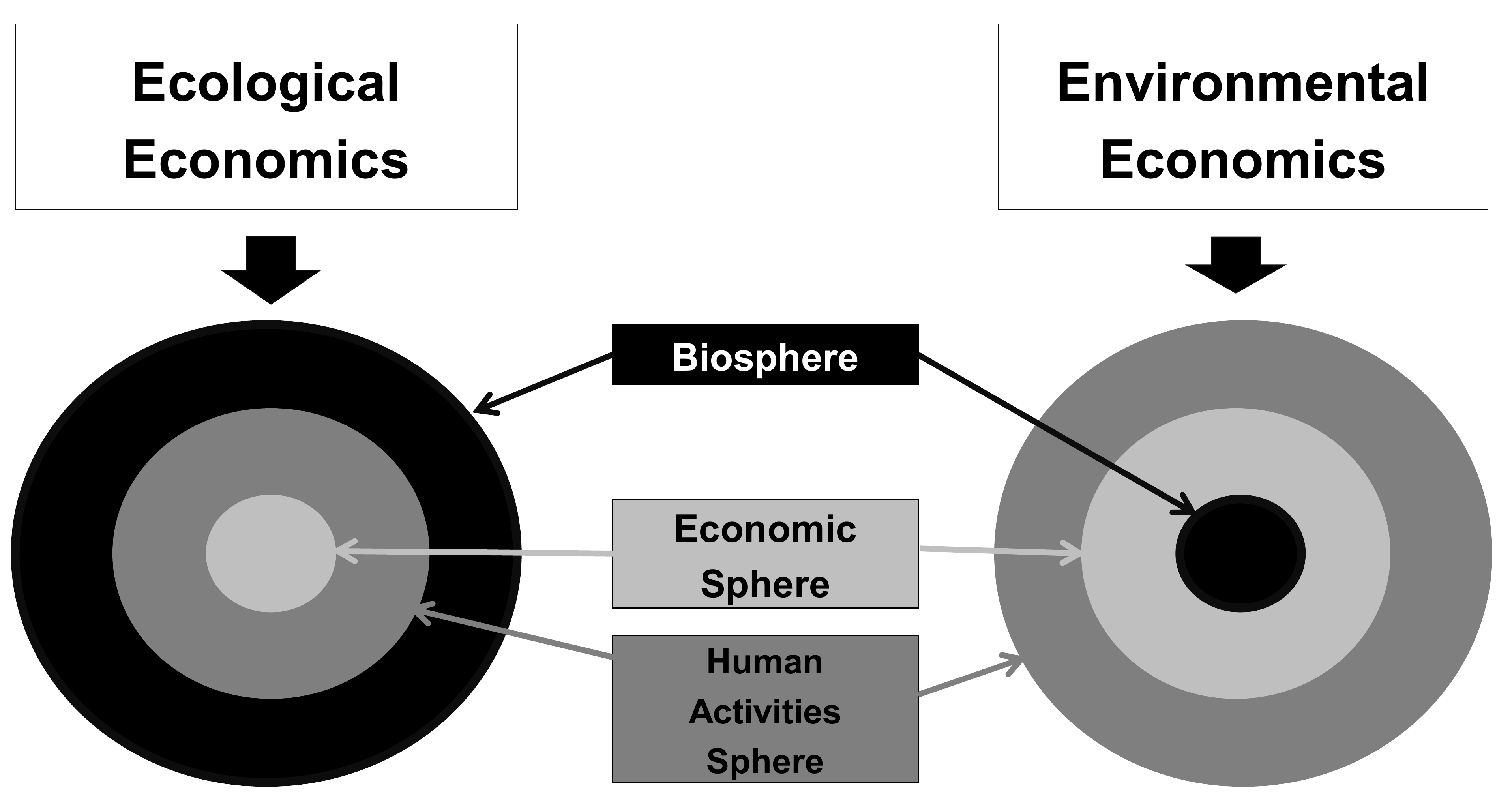
Note: The figure shows how the predominant sphere (economic vs. biosphere) differs across theoretical perspectives and its implications for entropy variation.
Source: Authors’ own elaboration.
This core distinction has significant implications for how each paradigm approaches the dual processes of diffusion and discontinuance (Palacios-Fenech & Tellis, 2016). Strategically, ENE typically focuses on incentivizing the diffusion of eco-efficient technologies (e.g., electric vehicles, carbon capture, or energy-saving devices) using instruments such as subsidies, environmental taxes, and emissions trading (Blanchard et al., 2023; van den Bergh, 2010). Discontinuance in this framework is generally seen as a market-driven outcome: unsustainable technologies are phased out when they become unprofitable or heavily taxed (Barbier et al., 1991). However, this approach may be constrained by the inertia embedded in infrastructures, consumer behavior, and institutional settings, thus slowing or weakening the pace and equity of ecological transitions (R{\o}pke, 2015).
ECE, by contrast, promotes the diffusion of regenerative, systemic practices, such as agroecological farming, repairable products, cooperative networks, and circular models grounded in ecological design (Geissdoerfer et al., 2017; Korhonen et al., 2018; Kotabe, 2023). In this perspective, discontinuance is viewed as a deliberate and normative process, rather than a passive market adjustment. The strategic removal of environmentally and socially harmful practices is treated as a key pillar of sustainability-oriented transformation (Duchin & Lange, 1994), including the dismantling of infrastructures, reduction of throughput, and contraction of ecologically damaging sectors (Ryberg et al., 2020).
ENE operates within a largely Cartesian and linear tradition, based on atomistic analysis and the principle of marginal utility (Thampapillai & Ruth, 2024). ECE adopts a complex systems view (van den Bergh, 2001), conceptualizing sustainability as an emergent outcome of interdependencies across ecological, social, and economic domains, with an emphasis on long-term resilience, distributive justice, and ecological thresholds. Although both paradigms may share some analytical tools and overlapping contributors, they embody fundamentally distinct ontological and epistemological foundations. ENE remains primarily rooted in neoclassical assumptions, seeking to internalize environmental costs via market mechanisms (Ma & Stern, 2006). ECE, in contrast, reframes the economy as biophysically constrained, advocating for strong sustainability and systemic interdependence (Costanza et al., 2004).
Entropy, rarely central in ENE, is a foundational concept in ECE (Georgescu-Roegen, 1971). From this perspective, economic processes are inherently entropic, transforming high-quality energy into degraded waste, making restorative, low-throughput, and more circular strategies essential for aligning economic activity with planetary functioning. In contrast, ENE tends to prioritize economic efficiency, often with less emphasis on biophysical coherence, proposing incremental change within production-consumption systems that remain largely linear.
These contrasting assumptions shape distinct approaches to managing innovation. Table 2 summarizes the diffusion and discontinuance logics across both paradigms. While ENE tends to rely on market signals to drive adoption and phase-outs, ECE calls for proactive, regenerative innovation and the strategic dismantling of harmful infrastructures. This comparison reveals how foundational views on the economy–nature relationship shape the strategic horizons of sustainability transitions and the transformative scope of sustainable marketing (Bendle, 2023; Griffith, 2021; Kemper & Ballantine, 2023).
Table 2. Comparative strategic approaches to diffusion and discontinuance across two economic paradigms with contrasting views on sustainability
| Paradigm | Diffusion | Discontinuance |
| Environmental Economics | Promotion of eco-efficient technologies through economic incentives such as subsidies, taxes, or emissions trading. Examples include electric vehicles, carbon capture systems, and efficient appliances. | Market-driven phase-out of unsustainable products and practices as they become unprofitable or overregulated (e.g., fossil fuels via carbon taxes). |
| Ecological Economics | Diffusion of regenerative, systemic innovations rooted in circularity and resilience (e.g., agroecology, repairable goods, local production systems). | Strategic and equitable dismantling of harmful infrastructures and consumption patterns based on ecological thresholds and thermodynamic constraints. |
Taken together, these dimensions illuminate the epistemological, strategic, and operational contrasts that underpin contemporary debates on sustainable innovation. These analytical foundations enable the construction of a conceptual model that systematically integrates diffusion and discontinuance across economic orientations and theoretical positions. This integrative approach is developed in the following section, which presents the Diffusion–Discontinuance Sustainability Framework (DDSF).
Conceptual Foundations of the Diffusion-Discontinuance Sustainability Framework for Economic Orientations and Theoretical Positions
This section introduces the DDSF, developed through a theory-building and conceptual synthesis process (Jabareen, 2009). Following (MacInnis, 2011) criteria for conceptual contributions, the DDSF identifies a previously unarticulated link between diffusion and discontinuance, differentiates sustainability orientations via two analytical axes (economic orientation and theoretical focus), and integrates insights from innovation studies and sustainability economics into a coherent lens. This provides a theory-generative contribution to sustainable marketing theory.
The DDSF extends the diffusion of innovations tradition (Rogers, 2003) by incorporating discontinuance, an increasingly relevant but underexplored process in sustainability transitions (Palacios-Fenech & Vrain, 2024). It then maps adoption and discontinuance across four sustainability-oriented economic perspectives: degrowth, sustainable growth, ecological economics, and environmental economics (Engler et al., 2024; Polewsky et al., 2024), clarifying how different economic logics shape innovation pathways.
Following the logic of integrative thinking, the DDSF reveals how innovation dynamics interact with the economic orientations and theoretical positions that structure sustainability transitions. This synthesis results in a framework that is both theoretically robust and strategically actionable, responding to the growing need for systemic, multidimensional models that can overcome siloed approaches to sustainable innovation (Elkington, 2018; Singh et al., 2024). By embedding both diffusion and discontinuance within broader economic worldviews, the framework offers a more holistic perspective through which businesses and policymakers can align innovation strategies with diverse sustainability priorities and ecological considerations (Griffith, 2021; van den Bergh, 2010).
Analytical Structure of the DDSF
To structure these relationships, the DDSF organizes its logic around two intersecting analytical axes, each capturing a fundamental dimension of sustainability-oriented thought:
Economic Orientation (horizontal axis): This axis spans from Degrowth to Sustainable Growth, reflecting contrasting assumptions about the role of economic expansion. While degrowth emphasizes planned reductions in consumption and production to stay within ecological limits, sustainable growth promotes technological innovation and market instruments to achieve relative decoupling from environmental degradation (Polewsky et al., 2024; van den Bergh, 2010).
Theoretical Focus (vertical axis): This axis contrasts Ecological Economics, which embeds the economy within the biosphere and prioritizes biophysical limits and systemic interdependence, with Environmental Economics, which assumes that market-based mechanisms (e.g., carbon pricing, cap-and-trade) can internalize environmental externalities, thereby prioritizing correction within existing economic structures over structural transformation (Engler et al., 2024; Singh et al., 2024).
By crossing these axes, the framework generates a 2×2 matrix that distinguishes four strategic quadrants. Each quadrant combines a specific economic orientation with a theoretical logic, producing a typology of approaches to diffusion (the promotion of sustainable innovations) and discontinuance (the phase-out of harmful practices). This matrix supports the identification of innovation strategies aligned with diverse visions of sustainability and enables a more nuanced understanding of how economic worldviews shape both the direction and pace of transition.
Transition Mechanisms and Boundary Conditions
The shift between DDSF positions occurs when changes in stakeholder pressure, legitimacy risk, regulatory expectations, consumer value orientations, or cost structures redefine the attractiveness of maintaining or discontinuing practices, technologies, or behaviors (Ferrell et al., 2010; Handelman & Arnold, 1999; Suddaby et al., 2017). These dynamics work through institutional mechanisms, such as legitimacy management, stakeholder expectations, value-based decisions, and resource reallocation, that explain how economic logics guide firms’ movement within the DDSF.
These transition mechanisms operate under several structural and institutional boundary conditions that constrain or enable movement across DDSF configurations. Technological and infrastructural lock-ins associated with established systems and sunk investments can limit firms’ ability to discontinue unsustainable products, services, or business models, even when stakeholder pressure or legitimacy risks increase (Geels, 2011; Voulvoulis et al., 2022; Chandrasekaran et al., 2020). Regulatory environments also function as boundary conditions when policy frameworks delay, weaken, or strategically postpone discontinuance incentives, allowing incumbent offerings to persist despite the availability of more sustainable alternatives (Blanchard et al., 2023). In such contexts, discontinuance tends to unfold as a gradual and contested process rather than a discrete managerial decision, leading to prolonged coexistence between incumbent and emerging market solutions (Vrain et al., 2022; Altrichter & Benoit, 2025; Sardo & Pfotenhauer, 2025). Conversely, stronger regulatory signals, shifts in stakeholder pressures, or changes in consumer value orientations can accelerate repositioning across DDSF configurations by altering the perceived legitimacy and market viability of diffusion and discontinuance strategies.
One possible transition scenario may emerge when a firm situated in a Sustainable Growth + Environmental Economics position shifts toward a Degrowth + Ecological Economics logic, because rising stakeholder pressure and legitimacy concerns reveal that incremental eco-efficiency is no longer sufficient. In such cases, the firm may discontinue a resource-intensive product line and redirect resources toward sufficiency-based value propositions, potentially strengthening its legitimacy and aligning its market strategy with deeper ecological commitments. Across DDSF configurations, key boundary conditions recur, particularly technological and infrastructural lock-ins, regulatory timing and strength, and misalignment between stakeholder value orientations and prevailing market incentives. Together, these conditions shape whether diffusion and discontinuance unfold as coordinated transitions, delayed coexistence, or contested phase-outs.
Quadrant Logic and Propositions
Figure 2 provides a visual synthesis of the DDSF matrix, illustrating how the two analytical axes intersect to generate four distinct strategic quadrants. Each quadrant represents a unique combination of economic orientation and theoretical focus, resulting in differentiated logics of diffusion and discontinuance.
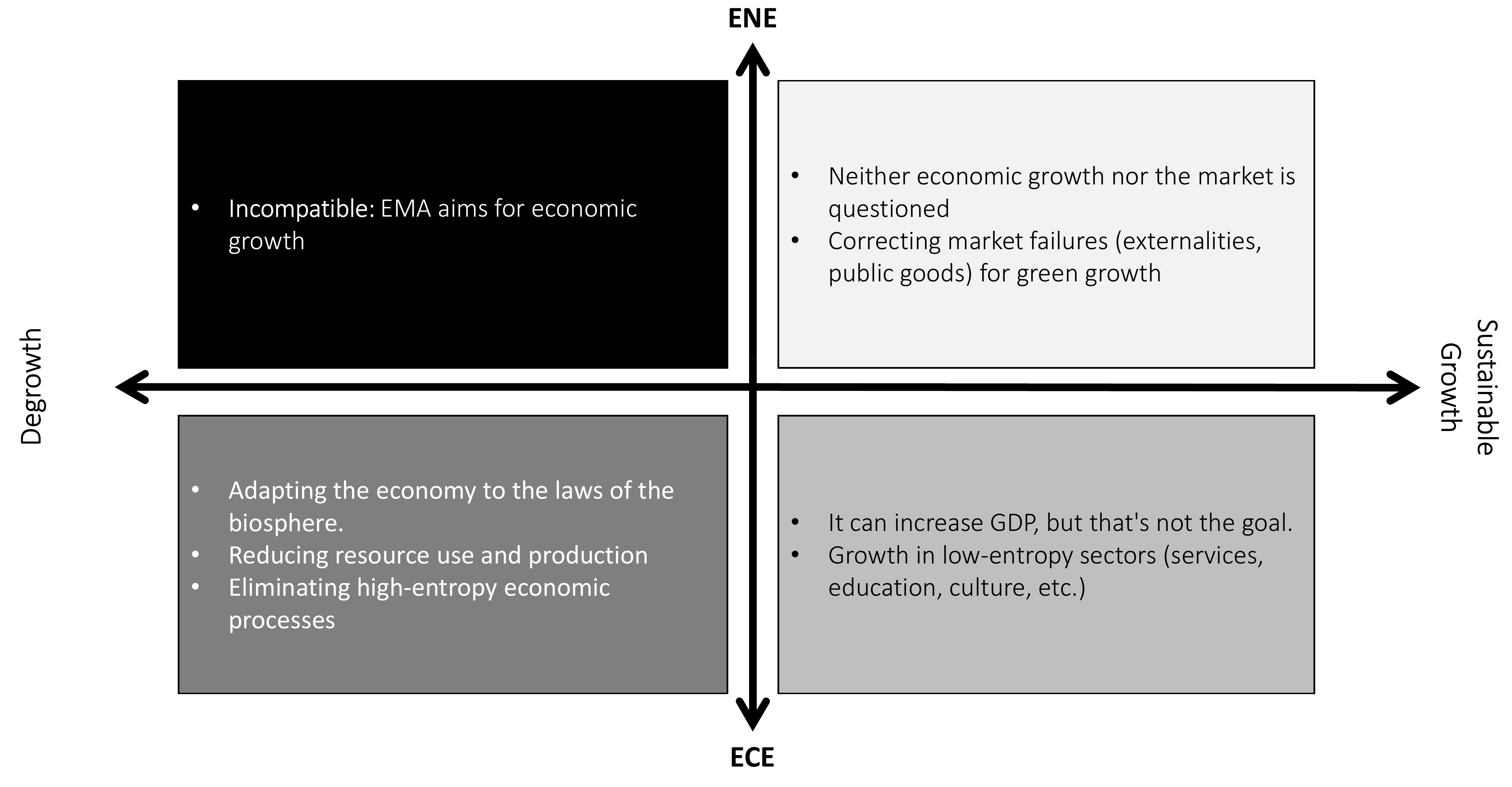
Note: The figure illustrates the conceptual structure of the DDSF, depicting the four configurations generated by the intersection of two axes: Theoretical Focus (Environmental Economics vs. Ecological Economics) and Economic Orientation (Sustainable Growth vs. Degrowth). Firms may shift between positions over time, or combine elements of adjacent configurations, as stakeholder pressures, legitimacy risks, regulatory signals, and resource conditions evolve. Innovation variables: Diffusion vs. Discontinuance.
Source: Authors’ own elaboration.
The bottom-left quadrant (Degrowth + Ecological Economics) emphasizes sufficiency-oriented innovations and planned discontinuance of resource-intensive systems under explicit ecological constraints.
Proposition 1. Degrowth + Ecological Economics configurations are likely to generate sufficiency-oriented innovation and planned discontinuance aligned with ecological limits.
The bottom-right quadrant (Sustainable Growth + Ecological Economics) supports regenerative technologies and circular systems with attention to biophysical constraints within a growth-compatible logic.
Proposition 2. Sustainable Growth + Ecological Economics configurations are expected to promote regenerative and circular innovations while pursuing transitions compatible with biophysical boundaries.
The top-right quadrant (Sustainable Growth + Environmental Economics) emphasizes market-led diffusion of eco-efficient solutions and gradual phase-outs driven by economic signals, such as carbon pricing.
Proposition 3. Sustainable Growth + Environmental Economics configurations tend to favor efficiency-oriented eco-innovation and gradual, market-led phase-outs incentivized by economic signals.
Finally, the top-left quadrant (Degrowth + Environmental Economics) represents a theoretically tensioned configuration. While both approaches may promote reduction-oriented strategies, they differ in purpose and logic. Degrowth emphasizes broader socio-ecological transformation beyond market-centered rationality, whereas Environmental Economics is grounded in neoclassical principles that prioritize economic efficiency and incremental adjustment.
In this quadrant, diffusion may take the form of policy-induced adoption of regulatory and technological solutions, such as emissions caps or bans, that trigger unintended reduction effects (e.g., industrial closures, unemployment) without addressing deeper structural reform (Blanchard et al., 2023). Discontinuance, induced by ENE instruments like taxes, regulations, or divestment, may result in abrupt sectoral reductions when alternatives, compensation mechanisms, or transition supports are limited. When these measures are implemented without adequate transition planning, they can generate serious transition problems, including supply shortages, public backlash, or deepening inequality.
Proposition 4. Degrowth + Environmental Economics configurations are likely to produce strategic tensions and potentially disruptive phase-outs when reduction-oriented discontinuance is pursued through market-centered instruments without adequate alternatives or transition planning.
This quadrant illustrates the coordination challenges that may arise when market-centered instruments are used to pursue reduction-oriented transition outcomes. It can be understood as a theoretically tensioned configuration in which policy-induced discontinuance depends on the availability of transition support, credible alternatives, and institutional legitimacy. When these conditions are weak, implementation and legitimacy risks may arise (See Figure 3).
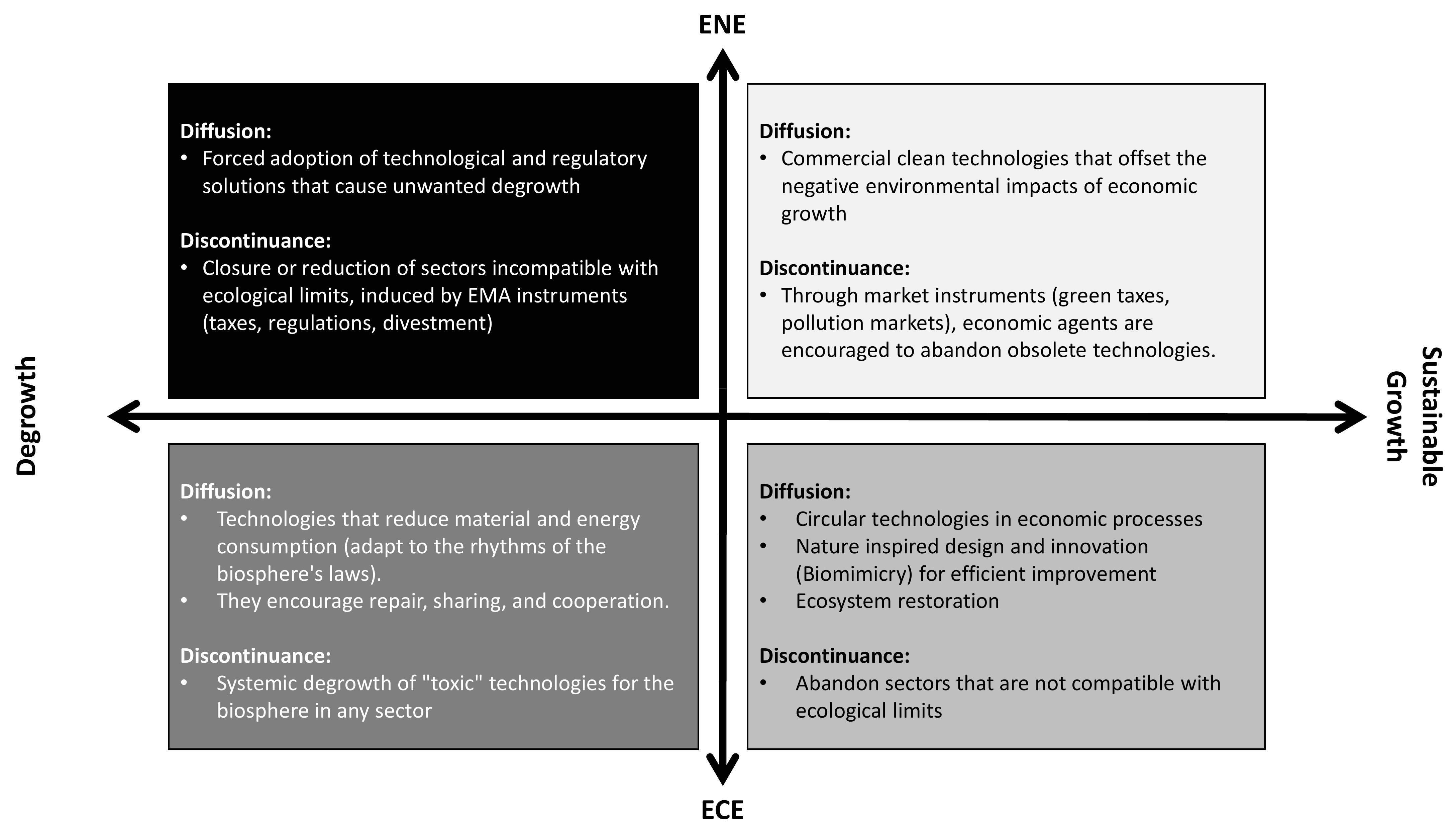
Note: The figure illustrates the innovation dynamics associated with each DDSF configuration, highlighting how diffusion and discontinuance strategies vary across the four quadrants. Theoretical Focus: Environmental Economics vs. Ecological Economics; Economic Orientation: Sustainable Growth vs. Degrowth; Innovation Variables: Diffusion vs. Discontinuance.
Source: Authors’ own elaboration.
Although the four propositions describe distinct outcome patterns across DDSF configurations, they are grounded in a shared set of transition mechanisms introduced earlier in this section. These mechanisms include stakeholder pressure, legitimacy management, value-based decision-making, regulatory signals, and resource reallocation. Table 3 summarizes how these mechanisms connect to each proposition and clarifies the explanatory logic of the framework.
Table 3. Transition Mechanisms and Boundary Conditions Across DDSF Configurations
| DDSF configuration | Key mechanisms | Boundary conditions | Strategic outcome |
| Degrowth + Ecological Economics (P1) | Value-based decisions; stakeholder and legitimacy pressure | Cultural support for sufficiency; low technological lock-in | Sufficiency-oriented innovation and deliberate discontinuance of resource-intensive offerings |
| Sustainable Growth + Ecological Economics (P2) | Resource reallocation; ecological legitimacy management | Technological feasibility of circular solutions; supportive regulatory frameworks | Regenerative and circular innovation within ecological constraints |
| Sustainable Growth + Environmental Economics (P3) | Market incentives; regulatory signals | Stable market institutions; availability of efficiency-enhancing technologies | Eco-efficiency innovation and gradual phase-out of harmful practices |
| Degrowth + Environmental Economics (P4) | Regulatory pressure; policy enforcement | Institutional misalignment between market logics and degrowth objectives | Policy-driven discontinuance generating potentially unstable transition dynamics |
This typology offers a strategic compass for organizations and policymakers to situate their current sustainability logic, identify underlying tensions, and explore more coherent and effective pathways for transformation. By integrating both the directional axis (growth vs. degrowth) and the structural axis (ecocentric vs. market-centric), the DDSF provides a strategic lens for navigating complex innovation landscapes within ecological limits and social imperatives.
Crucially, by pairing the dynamics of diffusion and discontinuance, the DDSF goes beyond the traditional focus on innovation adoption to incorporate the equally strategic need to phase out harmful products, practices, and infrastructures. This dual perspective equips sustainable marketing with the tools not only to accelerate responsible innovation, but also to actively manage obsolescence, shaping transitions that are not only efficient, but ethically grounded and ecologically coherent.
The Strategic Relevance of the DDSF: From Theory to Practice
This section outlines the dual contribution of the DDSF to both theory and practice. It first explores how the model advances sustainable marketing theory by integrating innovation dynamics within broader economic orientations and theoretical positions. Then, it examines its practical implications for organizations and policymakers, illustrating its strategic utility through four real-world cases.
Theoretical Implications
The DDSF makes a distinct contribution to sustainable marketing theory, and more broadly to strategic and innovation-oriented marketing, by integrating two interrelated yet historically underexamined dynamics, diffusion and discontinuance, within a comparative economic framework. While diffusion has long been studied in marketing (Bass, 1969; Peres et al., 2010; Rogers, 2003), research has mostly focused on the adoption of innovations, often overlooking the equally strategic process of discontinuing harmful products, technologies, or behaviors (Lehmann & Parker, 2017; Vrain et al., 2022).
By explicitly incorporating discontinuance into the strategic equation, the DDSF challenges the pro-innovation bias (Chandrasekaran et al., 2020; Rogers, 2003), advancing a more balanced approach to creating and marketing new sustainable products. This is particularly relevant in sustainability contexts, where letting go of environmentally damaging systems and offerings is as critical as adopting eco-innovations (Palacios-Fenech & Vrain, 2024; Altrichter & Benoit, 2025).
Moreover, by including innovation strategies within broader system-level perspectives, the DDSF situates strategic marketing decisions within systemic worldviews (Kallis et al., 2012; van den Bergh, 2010). This approach aligns with recent calls to expand sustainable marketing’s theoretical scope beyond firm-level actions to engage more fully with ecological limits, structural inequalities, and socio-technical transitions (Adams et al., 2015; Claro & Esteves, 2021; Bendle, 2023). Therefore, the DDSF contributes to positioning sustainable marketing by integrating innovation strategy, marketing decision-making, and economic reasoning. It encourages researchers to adopt multi-level, interdisciplinary perspectives that address not only what to adopt, but also what to discontinue, and why. In relation to competing economic orientations and theoretical positions, and informed by the concept of planetary boundaries, this enables more informed discussions about firms’ contributions to sustainability (Rockström et al., 2009; Steffen et al., 2015; Hickel & Kallis, 2019).
In doing so, the DDSF contributes to advancing a stakeholder-oriented view of sustainable marketing (Ferrell et al., 2010; Hult et al., 2011), wherein discontinuance is not simply a managerial decision, but a response to evolving demands for corporate accountability from regulators, consumers, employees, and communities. By reframing withdrawal from unsustainable products as a legitimacy-building practice (Handelman & Arnold, 1999), the DDSF engages marketing theory with the institutional logics that govern firm-stakeholder relations, and positions discontinuance as a mechanism for maintaining reputational trust and social license to operate. This shift has particular relevance in sustainability-oriented industries, where maintaining brand legitimacy increasingly depends not only on innovation adoption, but on the public visibility and ethical credibility of corporate withdrawal strategies (Mish & Scammon, 2010).
The framework also accommodates consumer behavior dynamics, recognizing that individuals navigate sustainability both by adopting responsible alternatives and by discontinuing options they perceive as harmful (Lehmann & Parker, 2017). The DDSF enables researchers to examine how these behavioral changes align with different economic orientations and theories and how they express deeper environmental, economic, and societal values (White et al., 2019).
Movement across DDSF positions occurs when changes in stakeholder pressure, regulatory expectations, legitimacy risk, consumer value orientations, or cost structures alter the relative attractiveness of maintaining or discontinuing existing market offerings (Handelman & Arnold, 1999; Mish & Scammon, 2010). These dynamics operate through mechanisms such as legitimacy management, stakeholder expectations, value-based decision-making, and opportunity structures, which help explain how economic worldviews shape firms’ transitions within the framework (Hult et al., 2011; Suddaby et al., 2017). They are further conditioned by broader system-level factors, as sustainability transitions depend on interconnected changes in technologies, markets, behaviors, and institutions (Voulvoulis et al., 2022). This systemic perspective clarifies how economic orientations shape firms’ diffusion and discontinuance decisions by highlighting the market rigidities and behavioral path dependencies that limit movement across DDSF positions.
Practical Implications
For business leaders and policymakers, the DDSF offers a strategic tool to assess the coherence, depth, and systemic relevance of their sustainability strategies. It allows organizations to situate their current logic of action and to identify potential misalignments between innovation diffusion and the discontinuance of unsustainable practices (Lehmann & Parker, 2017; Altrichter & Benoit, 2025; Kemper & Ballantine, 2023).
By encouraging the integration of both dynamics, the framework supports the design of more coherent strategies that promote sustainable innovations while guiding the responsible withdrawal from harmful products, behaviors, or infrastructures. This is especially critical in sectors such as energy, mobility, and consumer goods, where neglecting discontinuance can dilute or offset the gains from green innovation (Alem et al., 2014; Chandrasekaran et al., 2020; Vrain et al., 2022). Moreover, the DDSF makes visible how inconsistencies between a stated sustainability orientation and the economic logic guiding decision-making can give rise to inefficiencies, stakeholder resistance, and unintended consequences, ranging from job losses and public backlash to symbolic or superficial sustainability initiatives (Barbier et al., 1991; Corvellec et al., 2021; Forliano et al., 2025). By situating marketing and innovation choices within broader economic and theoretical logics, the DDSF supports more coherent strategies and enables more stable and institutionally supported transitions.
To illustrate the strategic relevance of the DDSF, we briefly examine four real-world cases where sustainability strategies reveal tensions between innovation diffusion and discontinuance. Each case highlights how alignment among economic orientations, theoretical positions, and innovation logic shapes the outcomes of sustainability transitions.
Case 1: Digital services and circular apps. Digital services and circular apps often promote eco-efficiency through rapid innovation diffusion, supported by market incentives and behavioral nudges (Vrain et al., 2022). However, they rarely incorporate the deliberate discontinuance of harmful practices, such as data extraction or overconsumption. Such initiatives can unintentionally reinforce extractive or efficiency-oriented models while maintaining a sustainability-oriented market narrative, as highlighted in critical perspectives on digital marketing and data-driven business models (Chintalapati & Pandey, 2021; Miller & Skiera, 2024).
Case 2: Renewable-energy expansion without fossil-fuel phase-out. While global energy strategies have expanded renewables, they often fall short in phasing out fossil fuels, leaving most consumers dependent on both systems (Chandrasekaran et al., 2020). These policies tend to remain diffusion-dominant and rooted in environmental economics, placing them in the Sustainable Growth + Environmental Economics quadrant. The DDSF shows that without planned discontinuance, green growth may be additive rather than transformative, expanding capacity without reducing harm (Karakaya et al., 2014).
Case 3: Wind-energy deployment in Wayúu Territory, La Guajira, Colombia. The DDSF helps reframe sustainability challenges through diverse cultural and economic perspectives, as shown by the wind energy deployment in La Guajira, Colombia (Ramírez et al., 2024; Ulloa, 2023). Large-scale renewable projects were introduced through technocratic diffusion and international investment, with limited consideration for local autonomy or the discontinuance of fossil infrastructures. Within the DDSF, these initiatives reflect a Sustainable Growth + Environmental Economics logic, prioritizing expansion over local socio-ecological considerations. A shift toward Sustainable Growth + Ecological Economics would retain clean-energy expansion while embedding it within biophysical limits and just transition principles. From the Indigenous Wayúu worldview, rooted in ecological balance and territorial self-determination, a Degrowth + Ecological Economics approach may represent a more coherent configuration. The case thus highlights potential misalignments between innovation strategies and socio-ecological contexts and supports more place-sensitive transitions. These dynamics resonate with broader critiques of technocolonial sustainability interventions, where externally imposed technologies undermine local autonomy and reinforce historical inequalities (Madianou, 2024).
Case 4: Ecuador’s 2019 fuel-subsidy reform. In 2019, Ecuador attempted to eliminate fuel subsidies abruptly through Decree 883, applying price liberalization as a discontinuance-only measure (Montenegro-Casa & Ramírez-Álvarez, 2025). Without viable alternatives, compensation mechanisms, or participatory governance, the policy provoked massive social unrest and was ultimately reversed. This case illustrates a discontinuance-dominant strategy rooted in Environmental Economics, positioned within the Degrowth + Environmental Economics quadrant of the DDSF. Here, environmental goals were pursued through withdrawal and price correction, but without adequate social safeguards or sufficient ecological coherence. The framework highlights that ENE-based discontinuance approaches require conditions for responsible withdrawal, such as transition support, participatory governance, and credible alternatives to avoid backlash when implemented under weak institutional or social conditions. When such tensions arise, firms and policymakers may need to selectively combine elements from different DDSF logics, pairing discontinuance with diffusion-oriented support to make transitions socially legitimate and environmentally durable.
These cases show how the DDSF operates as a strategic tool for business leaders, policymakers, and marketers, promoting integrated strategies that combine the diffusion of sustainable innovations with the discontinuance of harmful practices. The framework enables managers or policymakers to assess whether organizational practices align with their economic and theoretical positions; identify barriers, such as symbolic sustainability without discontinuance, inconsistencies between stated goals and operational routines, or portfolio lock-ins that limit investment in substitutive innovations; and adjust marketing and market strategies accordingly.
By mapping current practices onto diffusion-discontinuance dynamics, the DDSF helps reveal structural misalignments and governance gaps that obstruct coordinated sustainability transitions. In doing so, it strengthens sustainable marketing’s capacity to navigate complexity and support coordinated sustainability transition pathways (Papadas et al., 2017; Adams et al., 2015). In this way, the model extends the notion of the Triple Bottom Line toward a more systemic framework that connects values, actions, and outcomes for the common good, rather than treating it as a single undifferentiated outcome (Elkington, 2018; Kallis et al., 2012; Rockström et al., 2009).
The cases discussed are intended as illustrative analytical scenarios rather than traditional empirical evidence. They offer a way to visualize how the tensions within the DDSF unfold in practice. By highlighting these dynamics, the examples show that systems operating across inconsistent positions within the framework are more likely to face coordination failures in the alignment of economic, societal, and environmental value environmental value (Elkington, 2018). Rather than reflecting tragedy-of-the-commons dynamics, the DDSF is positioned within the Triple Bottom Line space, where these value dimensions are intentionally coordinated. Such failures include situations where innovation diffusion progresses without a parallel phase-out of harmful practices, resulting in delayed or stalled discontinuance processes.
The DDSF also opens a wide range of empirical research avenues that can deepen our understanding of sustainable transitions. Key questions include: (1) how firms operating under different economic perspectives balance innovation diffusion and discontinuance (Polewsky et al., 2024); (2) what organizational capabilities are required to manage these processes effectively under different institutional conditions (Altrichter & Benoit, 2025); (3) how marketing narratives vary between diffusion and discontinuance-oriented approaches (Bendle, 2023; Verma & Diwan, 2025); (4) whether aligning these dynamics with underlying economic orientations and theoretical positions enhances stakeholder trust and long-term brand legitimacy (Ferrell et al., 2010), and (5) how public policy enables or obstructs such alignment (Barbier et al., 1991; Blanchard et al., 2023).
These research directions support the development of more holistic models of sustainable innovation, moving beyond fragmented approaches and redefining marketing’s role as a catalyst for systemic transformation (Strizhakova & Coulter, 2024). In this perspective, marketing becomes not just a tool for promotion but a driver of ecological sustainability and social welfare, aligned with planetary boundaries and intergenerational equity (Hickel & Kallis, 2019; Raworth, 2018; Schneider et al., 2010).
Limitations and Future Research
As a conceptual framework, the DDSF therefore requires systematic empirical validation to assess whether the diffusion-discontinuance dynamics predicted across configurations emerge in real organizational and policy contexts. Subsequent research may build on the DDSF by testing the four propositions derived from the framework and assessing whether each quadrant generates the diffusion and discontinuance patterns theorized across market strategies. To support this empirical validation agenda, future studies may examine research questions such as:
-
RQ1. How do stakeholder pressures influence firms’ movement across DDSF configurations?
-
RQ2. Under what institutional conditions do diffusion strategies coexist with discontinuance processes in sustainability-oriented offering portfolios?
-
RQ3. How do technological lock-ins and regulatory constraints limit transitions toward coordinated diffusion-discontinuance portfolio strategies?
-
RQ4. Do firms aligned with different economic orientations exhibit distinct diffusion-discontinuance balances in their sustainability-oriented market strategies?
Empirical studies may also analyze how organizational capabilities, stakeholder expectations, and policy environments jointly enable or constrain diffusion-discontinuance dynamics in firms’ offering portfolios (Handelman & Arnold, 1999). In particular, further investigation may explore whether aligning diffusion and discontinuance decisions with firms’ underlying economic orientations improves environmental and market performance in practice (Papadas et al., 2017) and supports transitions from diffusion-dominant initiatives toward more coordinated diffusion-discontinuance portfolio strategies under increasing legitimacy expectations (Ferrell et al., 2010).
At the same time, the framework suggests that such transitions are likely to remain contingent on structural boundary conditions. Technological lock-ins, institutional inertia, and regulatory constraints may limit firms’ capacity to reconfigure value propositions by combining the diffusion of lower-impact solutions with the discontinuance of environmentally harmful offerings. More broadly, opportunities for empirical inquiry include assessing how these conditions sustain coexistence between incumbent and emerging market systems (Vrain et al., 2022) while rendering discontinuance processes subject to regime maintenance dynamics, legitimacy-based counter-positioning, and strategic delay that stabilize existing offering portfolios over time (Sardo & Pfotenhauer, 2025), thereby shaping how organizations navigate DDSF configurations in practice (Voulvoulis et al., 2022). Additional empirical questions include:
-
RQ5. Under what conditions do incumbent and emerging sustainability-oriented offerings coexist rather than substitute for one another across DDSF configurations?
-
RQ6. How do regime maintenance dynamics and strategic delay mechanisms shape the timing and effectiveness of discontinuance processes across DDSF configurations?
Empirical extensions of the framework may also clarify how the DDSF relates to established models of innovation and sustainability in order to assess its conceptual distinctiveness and empirical robustness. As with any typological framework, the DDSF necessarily abstracts from empirical complexity and may not fully capture hybrid or transitional configurations observed in practice MacInnis (2011). Future research may also expand the framework by integrating non-Western perspectives, Indigenous ecological knowledge and post-colonial critiques, as well as concepts such as technocolonialism, which reveal how Eurocentric technological and sustainability frameworks can reproduce exclusion and power asymmetries (Couldry & Mejias, 2019; Couldry & Mejias, 2024; Madianou, 2024). A further line of inquiry concerns the following question:
-
RQ7. How do diffusion–discontinuance dynamics vary across institutional, cultural, and epistemic contexts, particularly when non-Western sustainability perspectives challenge dominant economic orientations underlying the DDSF?
Marketing is not only about diffusing new products; it is equally about discontinuing those that no longer serve society or the planet. Discontinuance functions as a strategic reallocation mechanism, freeing material, financial, organizational, and symbolic resources that can be redirected toward regenerative value creation. In this sense, discontinuance can enable regenerative purpose (Sarkar et al., 2023). The DDSF makes this link explicit by showing how diffusion and discontinuance jointly shape an organization’s capacity to support environmentally and socially sustainable outcomes. Finally, future research may examine:
-
RQ8. How does regenerative purpose influence the balance between diffusion and discontinuance strategies, and do purpose-driven firms develop distinctive capabilities for managing responsible withdrawal within sustainability-oriented offering portfolios across DDSF configurations?
Conclusion
The DDSF offers a timely and strategic contribution to sustainable marketing theory by bridging two interrelated but often disconnected innovation dynamics, diffusion and discontinuance, within a coherent economic typology. In doing so, it provides not only analytical clarity, but also a conceptual compass for organizations and researchers seeking to navigate the complexity of sustainability transitions. It enables firms to strategically position themselves in relation to systemic worldviews and to make more deliberate decisions about what to adopt, what to discontinue, and why. The framework also recognizes that firms may move across configurations or combine strategic logics over time as stakeholder pressures, legitimacy risks, regulatory signals, and resource conditions change. Such strategic flexibility is essential for aligning business strategies with ecological constraints and long-term sustainability considerations (Steffen et al., 2015).
The DDSF does not imply a normative hierarchy among configurations but offers an analytical framework to examine how economic orientations shape diffusion and discontinuance strategies across institutional contexts. Each configuration reflects a distinct strategic logic. Sustainable Growth + Environmental Economics emphasizes eco-efficiency, market incentives, and gradual phase-outs. Sustainable Growth + Ecological Economics combines innovation and circularity with attention to biophysical constraints. Degrowth + Ecological Economics emphasizes sufficiency-oriented and regenerative innovation, while discontinuance becomes a deliberate and participatory strategic process for withdrawing from harmful practices, linking post-growth marketing with planned reductions in harmful consumption under explicit ecological constraints (Roux, 2025).
The DDSF also highlights how paradigmatic misalignment may create coordination risks in certain contexts, particularly in the Degrowth + Environmental Economics quadrant. Here, environmental objectives may be pursued primarily through market-driven tools, such as subsidy removals or price-based discontinuance measures, while transition support and complementary diffusion dynamics remain limited. In these cases, discontinuance may occur without sufficient coordination, potentially generating social backlash, institutional distrust, and unstable transition outcomes (Montenegro-Casa & Ramírez-Álvarez, 2025; Blanchard et al., 2023). Together, these configurations clarify how firms may align adoption, withdrawal, and value creation with different sustainability assumptions.
Ultimately, the DDSF equips sustainable marketing with the tools to move beyond symbolic innovation and toward structurally coherent sustainability transitions (Adams et al., 2015). It advances sustainable marketing theory by reframing diffusion and discontinuance as core strategic marketing choices embedded in economically grounded worldviews, enabling marketing to engage more directly with the transformations associated with sustainability and to guide organizations toward strategies aligned with emerging environmental and economic logics.
References
- . Sustainability-oriented Innovation: A Systematic Review. International Journal of Management Reviews, 18(2), 180–205. https://doi.org/10.1111/ijmr.12068 CrossRef | Google Scholar
- . A Call for Research on Climate Adaptive Products. Journal of Sustainable Marketing, 4(1), 1–6. https://doi.org/10.51300/jsm-2023-106 CrossRef | Google Scholar | Luminous Insights
- . Adoption and disadoption of electric cookstoves in urban Ethiopia: Evidence from panel data. Resource and Energy Economics, 38, 110–124. https://doi.org/10.1016/j.reseneeco.2014.06.004 CrossRef | Google Scholar
- . Technology discontinuance: a systematic literature review and research agenda. European Journal of Information Systems, 34(6), 1088–1112. https://doi.org/10.1080/0960085x.2025.2516427 CrossRef | Google Scholar
- . Circular economy as a strategic option to promote sustainable economic growth and effective human development. Journal of International Studies, 14(1), 60–73. https://doi.org/10.14254/2071-8330.2021/14-1/4 CrossRef | Google Scholar
- . Technological Substitution Options for Controlling Greenhouse Gas Emissions. In Dornbusch, Rudiger and Poterba, James M. (Ed.), Global Warming: Economic Policy Responses (pp. 109–160). MIT Press.
- . A New Product Growth for Model Consumer Durables. Management Science, 15(5), 215–227. https://doi.org/10.1287/mnsc.15.5.215 CrossRef | Google Scholar
- . Politics and Better Business. Journal of Sustainable Marketing, 4(2), 207–217. https://doi.org/10.51300/jsm-2023-113 CrossRef | Google Scholar | Luminous Insights
- . Despair, Rigging, Anger, and Degrowth. Journal of Macromarketing, 42(3), 345–355. https://doi.org/10.1177/02761467221086299 CrossRef | Google Scholar
- . The Portfolio of Economic Policies Needed to Fight Climate Change. Annual Review of Economics, 15(1), 689–722. https://doi.org/10.1146/annurev-economics-051520-015113 CrossRef | Google Scholar
- . Global Income Inequality, 1820-2020: the Persistence and Mutation of Extreme Inequality. Journal of the European Economic Association, 19(6), 3025–3062. https://doi.org/10.1093/jeea/jvab047 CrossRef | Google Scholar
- . Leapfrogging, Cannibalization, and Survival During Disruptive Technological Change: The Critical Role of Rate of Disengagement. Journal of Marketing, 86(1), 149–166. https://doi.org/10.1177/0022242920967912 CrossRef | Google Scholar
- . Artificial intelligence in marketing: A systematic literature review. International Journal of Market Research, 64(1), 38–68. https://doi.org/10.1177/14707853211018428 CrossRef | Google Scholar
- . Sustainability-oriented strategy and Sustainable Development Goals. Marketing Intelligence and Planning, 39(4), 613–630. https://doi.org/10.1108/mip-08-2020-0365 CrossRef | Google Scholar
- . Critiques of the circular economy. Journal of Industrial Ecology, 26(2), 421–432. https://doi.org/10.1111/jiec.13187 CrossRef | Google Scholar
- . Influential publications in ecological economics: a citation analysis. Ecological Economics, 50(3-4), 261–292. https://doi.org/10.1016/j.ecolecon.2004.06.001 CrossRef | Google Scholar
- . The Costs of Connection: How Data Is Colonizing Human Life and Appropriating It for Capitalism. Stanford University Press. https://doi.org/10.1515/9781503609754 CrossRef | Google Scholar
- . Today's Colonial "Data Grab" is Deepening Global Inequalities. https://blogs.lse.ac.uk/inequalities/2024/05/01/todays-colonial-data-grab-is-deepening-global-inequalities/
- . Toward a Steady-State Economy. W.H. Freeman.
- . The future of the environment: Ecological economics and technological change. Oxford University Press.
- . 25 Years Ago I Coined the Phrase ``Triple Bottom Line.'' Here's Why It's Time to Rethink It. Harvard Business Review, . https://hbr.org/2018/06/25-years-ago-i-coined-the-phrase-triple-bottom-line-heres-why-im-giving-up-on-it
- . 15 years of degrowth research: A systematic review. Ecological Economics, 218, 108101. https://doi.org/10.1016/j.ecolecon.2023.108101 CrossRef | Google Scholar
- . From Market Orientation to Stakeholder Orientation. Journal of Public Policy & Marketing, 29(1), 93–96. https://doi.org/10.1509/jppm.29.1.93 CrossRef | Google Scholar
- . Mapping the greenwashing research landscape: a theoretical and field analysis. Review of Managerial Science, 19(11), 3407–3456. https://doi.org/10.1007/s11846-025-00856-3 CrossRef | Google Scholar
- . The multi-level perspective on sustainability transitions: Responses to seven criticisms. Environmental Innovation and Societal Transitions, 1(1), 24–40. https://doi.org/10.1016/j.eist.2011.02.002 CrossRef | Google Scholar
- . The Circular Economy - A new sustainability paradigm?. Journal of Cleaner Production, 143, 757–768. https://doi.org/10.1016/j.jclepro.2016.12.048 CrossRef | Google Scholar
- . The Entropy Law and the Economic Process. Harvard University Press. https://doi.org/10.4159/harvard.9780674281653 CrossRef | Google Scholar
- . Connecting Sustainable Marketing and International Marketing Strategy Standardization/Adaptation: Research Opportunities. Journal of Sustainable Marketing, 2(2), 39–42. https://doi.org/10.51300/jsm-2021-40 CrossRef | Google Scholar | Luminous Insights
- . Economic Growth and the Environment. The Quarterly Journal of Economics, 110(2), 353–377. https://doi.org/10.2307/2118443 CrossRef | Google Scholar
- . Innovation diffusion models: Theory and practice. John Wiley & Sons. https://doi.org/10.1002/9781119756231 CrossRef | Google Scholar
- . The Role of Marketing Actions with a Social Dimension: Appeals to the Institutional Environment. Journal of Marketing, 63(3), 33–48. https://doi.org/10.1177/002224299906300303 CrossRef | Google Scholar
- . The Tragedy of the Commons. Science, 162(3859), 1243–1248. https://doi.org/10.1126/science.162.3859.1243 CrossRef | Google Scholar
- . Is Green Growth Possible?. New Political Economy, 25(4), 469–486. https://doi.org/10.1080/13563467.2019.1598964 CrossRef | Google Scholar
- . Stakeholder marketing: a definition and conceptual framework. AMS Review, 1(1), 44–65. https://doi.org/10.1007/s13162-011-0002-5 CrossRef | Google Scholar
- . Building a Conceptual Framework: Philosophy, Definitions, and Procedure. International Journal of Qualitative Methods, 8(4), 49–62. https://doi.org/10.1177/160940690900800406 CrossRef | Google Scholar
- . Social and Economic Networks. Princeton University Press. https://doi.org/10.2307/j.ctvcm4gh1 CrossRef | Google Scholar
- . Degrowth. Agenda Publishing, Vol. 7.
- . Research on Degrowth. Annual Review of Environment and Resources, 43(1), 291–316. https://doi.org/10.1146/annurev-environ-102017-025941 CrossRef | Google Scholar
- . The economics of degrowth. Ecological Economics, 84, 172–180. https://doi.org/10.1016/j.ecolecon.2012.08.017 CrossRef | Google Scholar
- . Diffusion of eco-innovations: A review. Renewable and Sustainable Energy Reviews, 33, 392–399. https://doi.org/10.1016/j.rser.2014.01.083 CrossRef | Google Scholar
- . Where to Next? How Marketing Needs to Take a Lead in the Circular Economy. Journal of Sustainable Marketing, 4(2), 239–245. https://doi.org/10.51300/jsm-2023-112 CrossRef | Google Scholar | Luminous Insights
- . The Intersection of Biophysical Economics and Political Economy. Ecological Economics, 192, 107272. https://doi.org/10.1016/j.ecolecon.2021.107272 CrossRef | Google Scholar
- . Enabling Closed Resource Loops in Electronics: Understanding Consumer Disposal Behaviour using insights from Diffusion models. Economic Research-Ekonomska Istraživanja, 25(sup2), 47–68. https://doi.org/10.1080/1331677x.2012.11517573 CrossRef | Google Scholar
- . Addressing the Conceptualization and Measurement Challenges of Sustainability Orientation: A Systematic Review and Research Agenda. Journal of Business Research, 142, 718–743. https://doi.org/10.1016/j.jbusres.2022.01.029 CrossRef | Google Scholar
- . Business orientation and sustainable development: A systematic review of sustainability orientation literature and future research avenues. Sustainable Development, 29(5), 1001–1017. https://doi.org/10.1002/sd.2190 CrossRef | Google Scholar
- . Creative Destruction or Mere Niche Support? Innovation Policy Mixes for Sustainability Transitions. Research Policy, 45(1), 205–217. https://doi.org/10.1016/j.respol.2015.09.008 CrossRef | Google Scholar
- . Circular Economy: The Concept and its Limitations. Ecological Economics, 143, 37–46. https://doi.org/10.1016/j.ecolecon.2017.06.041 CrossRef | Google Scholar
- . Thoughts on Sustainable Business, Circular Economy, and Circular Supply Chain Management. Journal of Sustainable Marketing, 4(1), 7–14. https://doi.org/10.51300/JSM-2023-84 CrossRef | Google Scholar | Luminous Insights
- . Farewell to Growth. Polity.
- . Demarketing for sustainability: A review and future research agenda. International Journal of Consumer Studies, 47(6), 2157–2180. https://doi.org/10.1111/ijcs.12904 CrossRef | Google Scholar
- . Disadoption. AMS Review, 7(1-2), 36–51. https://doi.org/10.1007/s13162-017-0093-8 CrossRef | Google Scholar
- . The Role of Planetary Boundaries in Assessing Absolute Environmental Sustainability Across Scales. Environment International, 152, 106475. https://doi.org/10.1016/j.envint.2021.106475 CrossRef | Google Scholar
- . The Diffusion of Services. Journal of Marketing Research, 46(2), 163–175. https://doi.org/10.1509/jmkr.46.2.163 CrossRef | Google Scholar
- . The impact of corporate social responsibility strategy on the management and governance axis for sustainable growth. Journal of Business Research, 150, 690–698. https://doi.org/10.1016/j.jbusres.2022.06.025 CrossRef | Google Scholar
- . Environmental and ecological economics: A citation analysis. Ecological Economics, 58(3), 491–506. https://doi.org/10.1016/j.ecolecon.2005.07.023 CrossRef | Google Scholar
- . A Framework for Conceptual Contributions in Marketing. Journal of Marketing, 75(4), 136–154. https://doi.org/10.1509/jmkg.75.4.136 CrossRef | Google Scholar
- . Technocolonialism: When Technology for Good is Harmful. Polity Press.
- . Innovation Diffusion in a Dynamic Potential Adopter Population. Management Science, 24(15), 1589–1597. https://doi.org/10.1287/mnsc.24.15.1589 CrossRef | Google Scholar
- . Just transition: Integrating climate, energy and environmental justice. Energy Policy, 119, 1–7. https://doi.org/10.1016/j.enpol.2018.04.014 CrossRef | Google Scholar
- . Economic consequences of online tracking restrictions: Evidence from cookies. International Journal of Research in Marketing, 41(2), 241–264. https://doi.org/10.1016/j.ijresmar.2023.10.001 CrossRef | Google Scholar
- . Principle-Based Stakeholder Marketing: Insights from Private Triple-Bottom-Line Firms. Journal of Public Policy & Marketing, 29(1), 12–26. https://doi.org/10.1509/jppm.29.1.12 CrossRef | Google Scholar
- . Ecological modernisation theory in debate: A review. Environmental Politics, 9(1), 17–49. https://doi.org/10.1080/09644010008414511 CrossRef | Google Scholar
- . Fuel Subsidies in Ecuador: A Computable General Equilibrium Model for Targeting Evaluation. Latin American Research Review, 60(2), 337–365. https://doi.org/10.1017/lar.2024.38 CrossRef | Google Scholar
- . Governing the Commons: The Evolution of Institutions for Collective Action. Cambridge University Press. https://doi.org/10.1017/CBO9780511807763 CrossRef | Google Scholar
- . Rethinking Product Disadoption: Unmasking Disposal, Dispossession, Eco-Friendly Behavior, Innovativeness, and Discontinuousness. In Ajour El Zein, Sari and Morillo, Carolina (Ed.), Business Entrepreneurship and Innovation: The Advocacy for a Tech-Corporate Ecosystem (pp. 71–93). Springer Nature Switzerland. https://doi.org/10.1007/978-3-032-05730-3_5 CrossRef | Google Scholar
- . The International Rate of Discontinuance of Some Old Products. Journal of Global Marketing, 27(2), 59–73. https://doi.org/10.1080/08911762.2013.850142 CrossRef | Google Scholar
- . The Dive and Disruption of Successful Current Products: Measures, Global Patterns, and Predictive Model. Journal of Product Innovation Management, 33(1), 53–68. https://doi.org/10.1111/jpim.12256 CrossRef | Google Scholar
- . Measuring the Adoption and Discontinuance of Low Carbon Digitally-Enabled Innovations: Exploring Repeat Survey Quality. Journal of Cleaner Production, 434, 140311. https://doi.org/10.1016/j.jclepro.2023.140311 CrossRef | Google Scholar
- . Green marketing orientation: Conceptualization, scale development and validation. Journal of Business Research, 80, 236–246. https://doi.org/10.1016/j.jbusres.2017.05.024 CrossRef | Google Scholar
- . The interplay of strategic and internal green marketing orientation on competitive advantage. Journal of Business Research, 104, 632–643. https://doi.org/10.1016/j.jbusres.2018.07.009 CrossRef | Google Scholar
- . L'économique et le vivant. Payot.
- . Innovation diffusion and new product growth models: A critical review and research directions. International Journal of Research in Marketing, 27(2), 91–106. https://doi.org/10.1016/j.ijresmar.2009.12.012 CrossRef | Google Scholar
- . Le capital au XXIe siècle. Éditions du Seuil.
- . Degrowth vs. Green Growth: A Computational Review and Interdisciplinary Research Agenda. Ecological Economics, 217, 108067. https://doi.org/10.1016/j.ecolecon.2023.108067 CrossRef | Google Scholar
- . The impact of adoption timing on new service usage and early disadoption. International Journal of Research in Marketing, 26(4), 304–313. https://doi.org/10.1016/j.ijresmar.2009.07.002 CrossRef | Google Scholar
- . Sustainable Consumption: Transitions, Systems and Practices. In Martínez-Alier, Joan and Muradian, Roldan (Ed.), Handbook of Ecological Economics (pp. 332–359). Edward Elgar Publishing. https://doi.org/10.4337/9781783471416.00018 CrossRef | Google Scholar
- . Body-Territory in Energy Transition: Wayúu Women's Struggle in Colombia. Academy of Management Proceedings, 2024(1). https://doi.org/10.5465/AMPROC.2024.9bp CrossRef | Google Scholar
- . Impacts of Meeting Minimum Access on Critical Earth Systems amidst the Great Inequality. Nature Sustainability, 6(2), 212–221. https://doi.org/10.1038/s41893-022-00995-5 CrossRef | Google Scholar
- . Agent-based modeling of new product market diffusion: an overview of strengths and criticisms. Annals of Operations Research, 305(1-2), 425–447. https://doi.org/10.1007/s10479-021-03944-1 CrossRef | Google Scholar
- . Doughnut Economics: Seven Ways to Think Like a 21st-Century Economist. Random House Business Books.
- . A Safe Operating Space for Humanity. Nature, 461(7263), 472–475. https://doi.org/10.1038/461472a CrossRef | Google Scholar
- . Diffusion of Innovations. Free Press.
- . Marketing (for) a Post-Growth Future. Marketing Theory, 25(4), 539–546. https://doi.org/10.1177/14705931251342548 CrossRef | Google Scholar
- . Downscaling the planetary boundaries in absolute environmental sustainability assessments - A review. Journal of Cleaner Production, 276, 123287. https://doi.org/10.1016/j.jclepro.2020.123287 CrossRef | Google Scholar
- . The World Distribution of Income: Falling Poverty and ... Convergence, Period. The Quarterly Journal of Economics, 121(2), 351–397. https://doi.org/10.1162/qjec.2006.121.2.351 CrossRef | Google Scholar
- . Green growth or degrowth? Assessing the normative justifications for environmental sustainability and economic growth through critical social theory. Journal of Cleaner Production, 206, 133–141. https://doi.org/10.1016/j.jclepro.2018.09.175 CrossRef | Google Scholar
- . Technology discontinuation as a continuous process: diesel, sustainability, and the politics of delay. Research Policy, 54(4), 105198. https://doi.org/10.1016/j.respol.2025.105198 CrossRef | Google Scholar
- . Regeneration: The Future of Community in a Permacrisis World. Idea Bite Press.
- . Degrowth and the future of marketing. Marketing Theory, 25(4), 519–524. https://doi.org/10.1177/14705931251352041 CrossRef | Google Scholar
- . Crisis or opportunity? Economic degrowth for social equity and ecological sustainability. Introduction to this special issue. Journal of Cleaner Production, 18(6), 511–518. https://doi.org/10.1016/j.jclepro.2010.01.014 CrossRef | Google Scholar
- . Enhancing Consumer and Planetary Well-Being by Consuming Less, Consuming Better. Journal of Sustainable Marketing, 5(1), 30–42. https://doi.org/10.51300/jsm-2024-121 CrossRef | Google Scholar | Luminous Insights
- . Mindful consumption: a customer-centric approach to sustainability. Journal of the Academy of Marketing Science, 39(1), 21–39. https://doi.org/10.1007/s11747-010-0216-3 CrossRef | Google Scholar
- . Stochastic Diffusion Process Models for Driving Innovation in Market-Driven Product Development. American Journal of Business & Operations Research, 11(2), 25–33. https://doi.org/10.54216/AJBOR.110203 CrossRef | Google Scholar
- . Delivering Sustainable Climate Action: Reframing the Sustainable Development Goals. npj Climate Action, 3(1), 110. https://doi.org/10.1038/s44168-024-00194-2 CrossRef | Google Scholar
- . Investigating the role of customer's disadoption and dynamic shifts in mobile cellular diffusion: Evidence from emerging economies. Technological Forecasting and Social Change, 219, 124252. https://doi.org/10.1016/j.techfore.2025.124252 CrossRef | Google Scholar
- . The role of innovation in sustainable growth: A dynamic panel study on micro and macro levels 1990-2019. Technological Forecasting and Social Change, 175, 121337. https://doi.org/10.1016/j.techfore.2021.121337 CrossRef | Google Scholar
- . Beyond Cost and Carbon: The Multidimensional Co-Benefits of Low Carbon Transitions in Europe. Ecological Economics, 169, 106529. https://doi.org/10.1016/j.ecolecon.2019.106529 CrossRef | Google Scholar
- . Planetary Boundaries: Guiding Human Development on a Changing Planet. Science, 347(6223), 1259855. https://doi.org/10.1126/science.1259855 CrossRef | Google Scholar
- . Environmental and Social Sustainability: A Consumer Cultural Identity Perspective in the Global-Local Marketplace. Journal of Sustainable Marketing, 5(1), 43–49. https://doi.org/10.51300/JSM-2024-118 CrossRef | Google Scholar | Luminous Insights
- . Legitimacy. Academy of Management Annals, 11(1), 451–478. https://doi.org/10.5465/annals.2015.0101 CrossRef | Google Scholar
- . How online reviews with different influencing factors affect the diffusion of new products. International Journal of Consumer Studies, 47(4), 1377–1396. https://doi.org/10.1111/ijcs.12915 CrossRef | Google Scholar
- . Environmental Economics: Concepts, Methods and Policies. Routledge. https://doi.org/10.4324/9781003408574 CrossRef | Google Scholar
- . Aesthetics of Green Dispossession: From Coal to Wind Extraction in La Guajira, Colombia. Journal of Political Ecology, 30(1), 743–764. https://doi.org/10.2458/jpe.5475 CrossRef | Google Scholar
- . Ecological economics: themes, approaches, and differences with environmental economics. Regional Environmental Change, 2(1), 13–23. https://doi.org/10.1007/s101130000020 CrossRef | Google Scholar
- . Externality or sustainability economics?. Ecological Economics, 69(11), 2047–2052. https://doi.org/10.1016/j.ecolecon.2010.02.009 CrossRef | Google Scholar
- . Environment versus growth - A criticism of ``degrowth'' and a plea for ``a-growth''. Ecological Economics, 70(5), 881–890. https://doi.org/10.1016/j.ecolecon.2010.09.035 CrossRef | Google Scholar
- . Environmental economics and ecological economics: Where they can converge?. Ecological Economics, 61(2-3), 550–558. https://doi.org/10.1016/j.ecolecon.2006.05.012 CrossRef | Google Scholar
- . Environmental Economics and Ecological Economics: Historical Evolution and the Current Status. Review of Development and Change, 30(1_suppl), S25–S49. https://doi.org/10.1177/09722661241309458 CrossRef | Google Scholar
- . Marketing innovation for sustainability: Review, trends, and way forward. Business Ethics, the Environment & Responsibility, 34(3), 912–935. https://doi.org/10.1111/beer.12686 CrossRef | Google Scholar
- . Systems thinking as a paradigm shift for sustainability transformation. Global Environmental Change, 75, 102544. https://doi.org/10.1016/j.gloenvcha.2022.102544 CrossRef | Google Scholar
- . The discontinuance of low carbon digital products and services. Technological Forecasting and Social Change, 185, 122051. https://doi.org/10.1016/j.techfore.2022.122051 CrossRef | Google Scholar
- . How to SHIFT Consumer Behaviors to be More Sustainable: A Literature Review and Guiding Framework. Journal of Marketing, 83(3), 22–49. https://doi.org/10.1177/0022242919825649 CrossRef | Google Scholar
- . Sustainability-oriented Innovation: A Systematic Review. International Journal of Management Reviews, 18(2), 180–205. https://doi.org/10.1111/ijmr.12068 CrossRef | Google Scholar
- . A Call for Research on Climate Adaptive Products. Journal of Sustainable Marketing, 4(1), 1–6. https://doi.org/10.51300/jsm-2023-106 CrossRef | Google Scholar | Luminous Insights
- . Adoption and disadoption of electric cookstoves in urban Ethiopia: Evidence from panel data. Resource and Energy Economics, 38, 110–124. https://doi.org/10.1016/j.reseneeco.2014.06.004 CrossRef | Google Scholar
- . Technology discontinuance: a systematic literature review and research agenda. European Journal of Information Systems, 34(6), 1088–1112. https://doi.org/10.1080/0960085x.2025.2516427 CrossRef | Google Scholar
- . Circular economy as a strategic option to promote sustainable economic growth and effective human development. Journal of International Studies, 14(1), 60–73. https://doi.org/10.14254/2071-8330.2021/14-1/4 CrossRef | Google Scholar
- . Technological Substitution Options for Controlling Greenhouse Gas Emissions. In Dornbusch, Rudiger and Poterba, James M. (Ed.), Global Warming: Economic Policy Responses (pp. 109–160). MIT Press.
- . A New Product Growth for Model Consumer Durables. Management Science, 15(5), 215–227. https://doi.org/10.1287/mnsc.15.5.215 CrossRef | Google Scholar
- . Politics and Better Business. Journal of Sustainable Marketing, 4(2), 207–217. https://doi.org/10.51300/jsm-2023-113 CrossRef | Google Scholar | Luminous Insights
- . Despair, Rigging, Anger, and Degrowth. Journal of Macromarketing, 42(3), 345–355. https://doi.org/10.1177/02761467221086299 CrossRef | Google Scholar
- . The Portfolio of Economic Policies Needed to Fight Climate Change. Annual Review of Economics, 15(1), 689–722. https://doi.org/10.1146/annurev-economics-051520-015113 CrossRef | Google Scholar
- . Global Income Inequality, 1820-2020: the Persistence and Mutation of Extreme Inequality. Journal of the European Economic Association, 19(6), 3025–3062. https://doi.org/10.1093/jeea/jvab047 CrossRef | Google Scholar
- . Leapfrogging, Cannibalization, and Survival During Disruptive Technological Change: The Critical Role of Rate of Disengagement. Journal of Marketing, 86(1), 149–166. https://doi.org/10.1177/0022242920967912 CrossRef | Google Scholar
- . Artificial intelligence in marketing: A systematic literature review. International Journal of Market Research, 64(1), 38–68. https://doi.org/10.1177/14707853211018428 CrossRef | Google Scholar
- . Sustainability-oriented strategy and Sustainable Development Goals. Marketing Intelligence and Planning, 39(4), 613–630. https://doi.org/10.1108/mip-08-2020-0365 CrossRef | Google Scholar
- . Critiques of the circular economy. Journal of Industrial Ecology, 26(2), 421–432. https://doi.org/10.1111/jiec.13187 CrossRef | Google Scholar
- . Influential publications in ecological economics: a citation analysis. Ecological Economics, 50(3-4), 261–292. https://doi.org/10.1016/j.ecolecon.2004.06.001 CrossRef | Google Scholar
- . The Costs of Connection: How Data Is Colonizing Human Life and Appropriating It for Capitalism. Stanford University Press. https://doi.org/10.1515/9781503609754 CrossRef | Google Scholar
- . Today's Colonial "Data Grab" is Deepening Global Inequalities. https://blogs.lse.ac.uk/inequalities/2024/05/01/todays-colonial-data-grab-is-deepening-global-inequalities/
- . Toward a Steady-State Economy. W.H. Freeman.
- . The future of the environment: Ecological economics and technological change. Oxford University Press.
- . 25 Years Ago I Coined the Phrase ``Triple Bottom Line.'' Here's Why It's Time to Rethink It. Harvard Business Review, . https://hbr.org/2018/06/25-years-ago-i-coined-the-phrase-triple-bottom-line-heres-why-im-giving-up-on-it
- . 15 years of degrowth research: A systematic review. Ecological Economics, 218, 108101. https://doi.org/10.1016/j.ecolecon.2023.108101 CrossRef | Google Scholar
- . From Market Orientation to Stakeholder Orientation. Journal of Public Policy & Marketing, 29(1), 93–96. https://doi.org/10.1509/jppm.29.1.93 CrossRef | Google Scholar
- . Mapping the greenwashing research landscape: a theoretical and field analysis. Review of Managerial Science, 19(11), 3407–3456. https://doi.org/10.1007/s11846-025-00856-3 CrossRef | Google Scholar
- . The multi-level perspective on sustainability transitions: Responses to seven criticisms. Environmental Innovation and Societal Transitions, 1(1), 24–40. https://doi.org/10.1016/j.eist.2011.02.002 CrossRef | Google Scholar
- . The Circular Economy - A new sustainability paradigm?. Journal of Cleaner Production, 143, 757–768. https://doi.org/10.1016/j.jclepro.2016.12.048 CrossRef | Google Scholar
- . The Entropy Law and the Economic Process. Harvard University Press. https://doi.org/10.4159/harvard.9780674281653 CrossRef | Google Scholar
- . Connecting Sustainable Marketing and International Marketing Strategy Standardization/Adaptation: Research Opportunities. Journal of Sustainable Marketing, 2(2), 39–42. https://doi.org/10.51300/jsm-2021-40 CrossRef | Google Scholar | Luminous Insights
- . Economic Growth and the Environment. The Quarterly Journal of Economics, 110(2), 353–377. https://doi.org/10.2307/2118443 CrossRef | Google Scholar
- . Innovation diffusion models: Theory and practice. John Wiley & Sons. https://doi.org/10.1002/9781119756231 CrossRef | Google Scholar
- . The Role of Marketing Actions with a Social Dimension: Appeals to the Institutional Environment. Journal of Marketing, 63(3), 33–48. https://doi.org/10.1177/002224299906300303 CrossRef | Google Scholar
- . The Tragedy of the Commons. Science, 162(3859), 1243–1248. https://doi.org/10.1126/science.162.3859.1243 CrossRef | Google Scholar
- . Is Green Growth Possible?. New Political Economy, 25(4), 469–486. https://doi.org/10.1080/13563467.2019.1598964 CrossRef | Google Scholar
- . Stakeholder marketing: a definition and conceptual framework. AMS Review, 1(1), 44–65. https://doi.org/10.1007/s13162-011-0002-5 CrossRef | Google Scholar
- . Building a Conceptual Framework: Philosophy, Definitions, and Procedure. International Journal of Qualitative Methods, 8(4), 49–62. https://doi.org/10.1177/160940690900800406 CrossRef | Google Scholar
- . Social and Economic Networks. Princeton University Press. https://doi.org/10.2307/j.ctvcm4gh1 CrossRef | Google Scholar
- . Degrowth. Agenda Publishing, Vol. 7.
- . Research on Degrowth. Annual Review of Environment and Resources, 43(1), 291–316. https://doi.org/10.1146/annurev-environ-102017-025941 CrossRef | Google Scholar
- . The economics of degrowth. Ecological Economics, 84, 172–180. https://doi.org/10.1016/j.ecolecon.2012.08.017 CrossRef | Google Scholar
- . Diffusion of eco-innovations: A review. Renewable and Sustainable Energy Reviews, 33, 392–399. https://doi.org/10.1016/j.rser.2014.01.083 CrossRef | Google Scholar
- . Where to Next? How Marketing Needs to Take a Lead in the Circular Economy. Journal of Sustainable Marketing, 4(2), 239–245. https://doi.org/10.51300/jsm-2023-112 CrossRef | Google Scholar | Luminous Insights
- . The Intersection of Biophysical Economics and Political Economy. Ecological Economics, 192, 107272. https://doi.org/10.1016/j.ecolecon.2021.107272 CrossRef | Google Scholar
- . Enabling Closed Resource Loops in Electronics: Understanding Consumer Disposal Behaviour using insights from Diffusion models. Economic Research-Ekonomska Istraživanja, 25(sup2), 47–68. https://doi.org/10.1080/1331677x.2012.11517573 CrossRef | Google Scholar
- . Addressing the Conceptualization and Measurement Challenges of Sustainability Orientation: A Systematic Review and Research Agenda. Journal of Business Research, 142, 718–743. https://doi.org/10.1016/j.jbusres.2022.01.029 CrossRef | Google Scholar
- . Business orientation and sustainable development: A systematic review of sustainability orientation literature and future research avenues. Sustainable Development, 29(5), 1001–1017. https://doi.org/10.1002/sd.2190 CrossRef | Google Scholar
- . Creative Destruction or Mere Niche Support? Innovation Policy Mixes for Sustainability Transitions. Research Policy, 45(1), 205–217. https://doi.org/10.1016/j.respol.2015.09.008 CrossRef | Google Scholar
- . Circular Economy: The Concept and its Limitations. Ecological Economics, 143, 37–46. https://doi.org/10.1016/j.ecolecon.2017.06.041 CrossRef | Google Scholar
- . Thoughts on Sustainable Business, Circular Economy, and Circular Supply Chain Management. Journal of Sustainable Marketing, 4(1), 7–14. https://doi.org/10.51300/JSM-2023-84 CrossRef | Google Scholar | Luminous Insights
- . Farewell to Growth. Polity.
- . Demarketing for sustainability: A review and future research agenda. International Journal of Consumer Studies, 47(6), 2157–2180. https://doi.org/10.1111/ijcs.12904 CrossRef | Google Scholar
- . Disadoption. AMS Review, 7(1-2), 36–51. https://doi.org/10.1007/s13162-017-0093-8 CrossRef | Google Scholar
- . The Role of Planetary Boundaries in Assessing Absolute Environmental Sustainability Across Scales. Environment International, 152, 106475. https://doi.org/10.1016/j.envint.2021.106475 CrossRef | Google Scholar
- . The Diffusion of Services. Journal of Marketing Research, 46(2), 163–175. https://doi.org/10.1509/jmkr.46.2.163 CrossRef | Google Scholar
- . The impact of corporate social responsibility strategy on the management and governance axis for sustainable growth. Journal of Business Research, 150, 690–698. https://doi.org/10.1016/j.jbusres.2022.06.025 CrossRef | Google Scholar
- . Environmental and ecological economics: A citation analysis. Ecological Economics, 58(3), 491–506. https://doi.org/10.1016/j.ecolecon.2005.07.023 CrossRef | Google Scholar
- . A Framework for Conceptual Contributions in Marketing. Journal of Marketing, 75(4), 136–154. https://doi.org/10.1509/jmkg.75.4.136 CrossRef | Google Scholar
- . Technocolonialism: When Technology for Good is Harmful. Polity Press.
- . Innovation Diffusion in a Dynamic Potential Adopter Population. Management Science, 24(15), 1589–1597. https://doi.org/10.1287/mnsc.24.15.1589 CrossRef | Google Scholar
- . Just transition: Integrating c
- . Sustainability-oriented Innovation: A Systematic Review. International Journal of Management Reviews, 18(2), 180–205. https://doi.org/10.1111/ijmr.12068 CrossRef | Google Scholar
- . A Call for Research on Climate Adaptive Products. Journal of Sustainable Marketing, 4(1), 1–6. https://doi.org/10.51300/jsm-2023-106 CrossRef | Google Scholar | Luminous Insights
- . Adoption and disadoption of electric cookstoves in urban Ethiopia: Evidence from panel data. Resource and Energy Economics, 38, 110–124. https://doi.org/10.1016/j.reseneeco.2014.06.004 CrossRef | Google Scholar
- . Technology discontinuance: a systematic literature review and research agenda. European Journal of Information Systems, 34(6), 1088–1112. https://doi.org/10.1080/0960085x.2025.2516427 CrossRef | Google Scholar
- . Circular economy as a strategic option to promote sustainable economic growth and effective human development. Journal of International Studies, 14(1), 60–73. https://doi.org/10.14254/2071-8330.2021/14-1/4 CrossRef | Google Scholar
- . Technological Substitution Options for Controlling Greenhouse Gas Emissions. In Dornbusch, Rudiger and Poterba, James M. (Ed.), Global Warming: Economic Policy Responses (pp. 109–160). MIT Press.
- . A New Product Growth for Model Consumer Durables. Management Science, 15(5), 215–227. https://doi.org/10.1287/mnsc.15.5.215 CrossRef | Google Scholar
- . Politics and Better Business. Journal of Sustainable Marketing, 4(2), 207–217. https://doi.org/10.51300/jsm-2023-113 CrossRef | Google Scholar | Luminous Insights
- . Despair, Rigging, Anger, and Degrowth. Journal of Macromarketing, 42(3), 345–355. https://doi.org/10.1177/02761467221086299 CrossRef | Google Scholar
- . The Portfolio of Economic Policies Needed to Fight Climate Change. Annual Review of Economics, 15(1), 689–722. https://doi.org/10.1146/annurev-economics-051520-015113 CrossRef | Google Scholar
- . Global Income Inequality, 1820-2020: the Persistence and Mutation of Extreme Inequality. Journal of the European Economic Association, 19(6), 3025–3062. https://doi.org/10.1093/jeea/jvab047 CrossRef | Google Scholar
- . Leapfrogging, Cannibalization, and Survival During Disruptive Technological Change: The Critical Role of Rate of Disengagement. Journal of Marketing, 86(1), 149–166. https://doi.org/10.1177/0022242920967912 CrossRef | Google Scholar
- . Artificial intelligence in marketing: A systematic literature review. International Journal of Market Research, 64(1), 38–68. https://doi.org/10.1177/14707853211018428 CrossRef | Google Scholar
- . Sustainability-oriented strategy and Sustainable Development Goals. Marketing Intelligence and Planning, 39(4), 613–630. https://doi.org/10.1108/mip-08-2020-0365 CrossRef | Google Scholar
- . Critiques of the circular economy. Journal of Industrial Ecology, 26(2), 421–432. https://doi.org/10.1111/jiec.13187 CrossRef | Google Scholar
- . Influential publications in ecological economics: a citation analysis. Ecological Economics, 50(3-4), 261–292. https://doi.org/10.1016/j.ecolecon.2004.06.001 CrossRef | Google Scholar
- . The Costs of Connection: How Data Is Colonizing Human Life and Appropriating It for Capitalism. Stanford University Press. https://doi.org/10.1515/9781503609754 CrossRef | Google Scholar
- . Today's Colonial "Data Grab" is Deepening Global Inequalities. https://blogs.lse.ac.uk/inequalities/2024/05/01/todays-colonial-data-grab-is-deepening-global-inequalities/
- . Toward a Steady-State Economy. W.H. Freeman.
- . The future of the environment: Ecological economics and technological change. Oxford University Press.
- . 25 Years Ago I Coined the Phrase ``Triple Bottom Line.'' Here's Why It's Time to Rethink It. Harvard Business Review, . https://hbr.org/2018/06/25-years-ago-i-coined-the-phrase-triple-bottom-line-heres-why-im-giving-up-on-it
- . 15 years of degrowth research: A systematic review. Ecological Economics, 218, 108101. https://doi.org/10.1016/j.ecolecon.2023.108101 CrossRef | Google Scholar
- . From Market Orientation to Stakeholder Orientation. Journal of Public Policy & Marketing, 29(1), 93–96. https://doi.org/10.1509/jppm.29.1.93 CrossRef | Google Scholar
- . Mapping the greenwashing research landscape: a theoretical and field analysis. Review of Managerial Science, 19(11), 3407–3456. https://doi.org/10.1007/s11846-025-00856-3 CrossRef | Google Scholar
- . The multi-level perspective on sustainability transitions: Responses to seven criticisms. Environmental Innovation and Societal Transitions, 1(1), 24–40. https://doi.org/10.1016/j.eist.2011.02.002 CrossRef | Google Scholar
- . The Circular Economy - A new sustainability paradigm?. Journal of Cleaner Production, 143, 757–768. https://doi.org/10.1016/j.jclepro.2016.12.048 CrossRef | Google Scholar
- . The Entropy Law and the Economic Process. Harvard University Press. https://doi.org/10.4159/harvard.9780674281653 CrossRef | Google Scholar
- . Connecting Sustainable Marketing and International Marketing Strategy Standardization/Adaptation: Research Opportunities. Journal of Sustainable Marketing, 2(2), 39–42. https://doi.org/10.51300/jsm-2021-40 CrossRef | Google Scholar | Luminous Insights
- . Economic Growth and the Environment. The Quarterly Journal of Economics, 110(2), 353–377. https://doi.org/10.2307/2118443 CrossRef | Google Scholar
- . Innovation diffusion models: Theory and practice. John Wiley & Sons. https://doi.org/10.1002/9781119756231 CrossRef | Google Scholar
- . The Role of Marketing Actions with a Social Dimension: Appeals to the Institutional Environment. Journal of Marketing, 63(3), 33–48. https://doi.org/10.1177/002224299906300303 CrossRef | Google Scholar
- . The Tragedy of the Commons. Science, 162(3859), 1243–1248. https://doi.org/10.1126/science.162.3859.1243 CrossRef | Google Scholar
- . Is Green Growth Possible?. New Political Economy, 25(4), 469–486. https://doi.org/10.1080/13563467.2019.1598964 CrossRef | Google Scholar
- . Stakeholder marketing: a definition and conceptual framework. AMS Review, 1(1), 44–65. https://doi.org/10.1007/s13162-011-0002-5 CrossRef | Google Scholar
- . Building a Conceptual Framework: Philosophy, Definitions, and Procedure. International Journal of Qualitative Methods, 8(4), 49–62. https://doi.org/10.1177/160940690900800406 CrossRef | Google Scholar
- . Social and Economic Networks. Princeton University Press. https://doi.org/10.2307/j.ctvcm4gh1 CrossRef | Google Scholar
- . Degrowth. Agenda Publishing, Vol. 7.
- . Research on Degrowth. Annual Review of Environment and Resources, 43(1), 291–316. https://doi.org/10.1146/annurev-environ-102017-025941 CrossRef | Google Scholar
- . The economics of degrowth. Ecological Economics, 84, 172–180. https://doi.org/10.1016/j.ecolecon.2012.08.017 CrossRef | Google Scholar
- . Diffusion of eco-innovations: A review. Renewable and Sustainable Energy Reviews, 33, 392–399. https://doi.org/10.1016/j.rser.2014.01.083 CrossRef | Google Scholar
- . Where to Next? How Marketing Needs to Take a Lead in the Circular Economy. Journal of Sustainable Marketing, 4(2), 239–245. https://doi.org/10.51300/jsm-2023-112 CrossRef | Google Scholar | Luminous Insights
- . The Intersection of Biophysical Economics and Political Economy. Ecological Economics, 192, 107272. https://doi.org/10.1016/j.ecolecon.2021.107272 CrossRef | Google Scholar
- . Enabling Closed Resource Loops in Electronics: Understanding Consumer Disposal Behaviour using insights from Diffusion models. Economic Research-Ekonomska Istraživanja, 25(sup2), 47–68. https://doi.org/10.1080/1331677x.2012.11517573 CrossRef | Google Scholar
- . Addressing the Conceptualization and Measurement Challenges of Sustainability Orientation: A Systematic Review and Research Agenda. Journal of Business Research, 142, 718–743. https://doi.org/10.1016/j.jbusres.2022.01.029 CrossRef | Google Scholar
- . Business orientation and sustainable development: A systematic review of sustainability orientation literature and future research avenues. Sustainable Development, 29(5), 1001–1017. https://doi.org/10.1002/sd.2190 CrossRef | Google Scholar
- . Creative Destruction or Mere Niche Support? Innovation Policy Mixes for Sustainability Transitions. Research Policy, 45(1), 205–217. https://doi.org/10.1016/j.respol.2015.09.008 CrossRef | Google Scholar
- . Circular Economy: The Concept and its Limitations. Ecological Economics, 143, 37–46. https://doi.org/10.1016/j.ecolecon.2017.06.041 CrossRef | Google Scholar
- . Thoughts on Sustainable Business, Circular Economy, and Circular Supply Chain Management. Journal of Sustainable Marketing, 4(1), 7–14. https://doi.org/10.51300/JSM-2023-84 CrossRef | Google Scholar | Luminous Insights
- . Farewell to Growth. Polity.
- . Demarketing for sustainability: A review and future research agenda. International Journal of Consumer Studies, 47(6), 2157–2180. https://doi.org/10.1111/ijcs.12904 CrossRef | Google Scholar
- . Disadoption. AMS Review, 7(1-2), 36–51. https://doi.org/10.1007/s13162-017-0093-8 CrossRef | Google Scholar
- . The Role of Planetary Boundaries in Assessing Absolute Environmental Sustainability Across Scales. Environment International, 152, 106475. https://doi.org/10.1016/j.envint.2021.106475 CrossRef | Google Scholar
- . The Diffusion of Services. Journal of Marketing Research, 46(2), 163–175. https://doi.org/10.1509/jmkr.46.2.163 CrossRef | Google Scholar
- . The impact of corporate social responsibility strategy on the management and governance axis for sustainable growth. Journal of Business Research, 150, 690–698. https://doi.org/10.1016/j.jbusres.2022.06.025 CrossRef | Google Scholar
- . Environmental and ecological economics: A citation analysis. Ecological Economics, 58(3), 491–506. https://doi.org/10.1016/j.ecolecon.2005.07.023 CrossRef | Google Scholar
- . A Framework for Conceptual Contributions in Marketing. Journal of Marketing, 75(4), 136–154. https://doi.org/10.1509/jmkg.75.4.136 CrossRef | Google Scholar
- . Technocolonialism: When Technology for Good is Harmful. Polity Press.
- . Innovation Diffusion in a Dynamic Potential Adopter Population. Management Science, 24(15), 1589–1597. https://doi.org/10.1287/mnsc.24.15.1589 CrossRef | Google Scholar
- . Just transition: Integrating c
Licensing
https://creativecommons.org/licenses/by/4.0/
Copyright
Copyright © 2026 by authors. This is an open access article distributed under the Creative Commons Attribution License, which permits unrestricted use, distribution, and reproduction in any medium, provided the original work is properly cited.
Copyright Year
2026
Correction statement
About contributors

Javier Palacios-Fenech
EAE Business School, Barcelona, Spain
Spain
Dídac Cervera-Itarte
EAE Business School, Barcelona, Spain
Spain