





Abstract
How can marketers encourage consumers to choose sustainable apparel products? As consumer skepticism toward firms' sustainability efforts increases, it becomes increasingly important to understand the conditions under which consumers are more likely to purchase sustainable apparel products. Our research suggests that employing a simple, low-cost, and subtle nostalgia marketing intervention can offer a promising approach. A field study conducted with a genuinely sustainable activewear brand on social media platforms demonstrates that triggering nostalgic feelings can increase consumers' click-through rates. Four follow-up studies across various product categories, including jeans, running shoes, and activewear, show that nostalgia increases participants' purchase intention for sustainable apparel. Our findings also indicate that this nostalgia-evoked approach is especially effective among consumers with low levels of environmental consciousness, offering valuable insights for marketers seeking to deliver genuinely sustainable apparel products to the market.
Introduction
“When choosing between a conventional apparel product and a sustainable apparel product, which one would you prefer and why?”
“I usually do not favor one over the other. Recently, I have been focusing on sustainable footwear amid growing awareness of plastic pollution in our oceans. However, my choice depends on the product’s value and on whether the brand’s commitment to environmental responsibility is genuine. It is hard to trust the brand’s green advertising, though!”
(Male, 38 years old)
With the apparel industry accounting for 10 percent of global emissions and slow worldwide progress toward the United Nations Sustainable Development Goals, promoting sustainable apparel choice has become a strategic priority (Fuso Nerini et al., 2024).However, this task remains a significant challenge. Although consumers claim to care more about environmental issues, their positive attitudes do not always translate into purchasing sustainable products, a phenomenon known as the ‘attitude-behavior gap’ (Chaihanchanchai & Anantachart, 2022). As illustrated by the interview quote above from a consumer (male, 38 years old), a key factor behind the attitude–behavior gap is consumers’ green skepticism—defined as the tendency to doubt a product’s environmental benefits or performance (Obermiller et al., 2005).This skepticism often stems from widespread greenwashing—corporate practices that intentionally spread incomplete or misleading information to create overly positive perceptions of a company's environmental responsibility (Lyon & Montgomery, 2015). Accordingly, consumers have become not only increasingly confused by sustainability claims but also progressively more distrustful of sustainability-related communications in general (do Pa\c{c}o & Reis, 2012). In the apparel industry, where instances of unethical practices or greenwashing by major brands (e.g., H&M, Nike) are widespread (Wicker, 2022), this skepticism may spill over to the entire sector, preventing consumers from purchasing genuinely sustainable apparel (Mohr et al., 1998).
The current situation calls for a more innovative approach.We ask: How can we motivate consumers to select sustainable apparel without directly emphasizing its sustainability features, as traditional marketing often does? Drawing upon nostalgia literature and the Elaboration-Likelihood Model (ELM, (Petty & Cacioppo, 1990)), we suggest that nostalgia marketing could be an effective approach. We present converging evidence that nostalgia boosts sustainable apparel purchase intention by increasing perceived social connectedness.Additionally, we find that this nostalgia-evoked approach works best with consumers who have low environmental consciousness, typically characterized by lower involvement and motivation, leading to peripheral processing, as explained by the ELM (Petty & Cacioppo, 1990). Because a nostalgia-evoked approach avoids explicitly highlighting a product’s sustainability features, it may also help reduce skepticism among consumers with higher environmental consciousness.
Our research makes three contributions.First, we expand the literature on the impact of nostalgia on consumer behavior. While previous research has mainly explored how nostalgia influences consumer behavior toward brands or products linked to their memories (Cheng & Yan, 2022), we demonstrate that nostalgia can shape consumer behavior toward brands or products that are not connected to their memories, such as sustainable apparel.Our research on sustainable apparel, a high-involvement category with significant environmental impacts, also provides deeper insights into tackling environmental issues than other low-involvement categories examined in the literature (Table 1). Second, we advance knowledge in the understudied domain of consumer emotions in sustainability.Research has primarily investigated the effects of positive and negative emotions triggered by external stimuli on sustainable behaviors (White et al., 2019). Our research uncovers a distinct effect of nostalgia—a fundamental human social emotion marked by the simultaneous experience of positive and negative feelings—on the purchase intention of sustainable apparel.Third, based on the ELM (Petty & Cacioppo, 1990), we examine the boundary condition—individual levels of environmental consciousness—that affects the effectiveness of nostalgia marketing in the sustainability domain (Muehling et al., 2014). According to the ELM, at low levels of environmental consciousness, consumers tend to show less involvement and motivation to process information, and are more influenced by peripheral or heuristic cues, such as emotions, especially nostalgia.Managerially, we provide practitioners with insights on how to encourage consumers to purchase sustainable apparel without explicitly highlighting its sustainability features, as this may unintentionally trigger consumer skepticism.
Next, we review the literature and test these ideas through one field study and four experiments. We then discuss our research contributions and future research direction.
Emotions and Sustainable Consumer Behaviors
Triggering the right consumer emotions is a key marketing approach to promote sustainable consumer behaviors. Research has primarily examined how positive emotions, such as warm glow, joy, pride, gratitude, and hope, or negative emotions, including fear, sadness, and guilt, influence sustainable consumer behavior (White et al., 2019; Liang & Guo, 2021). These emotions are often triggered by external environmental stimuli, which can be either too intense (Kollmuss & Agyeman, 2002) or too weak, as consumers lack direct experience with them (Meng & Trudel, 2017), both of which can reduce their persuasive impact (see (White et al., 2019) for a review).
Table 1. Contribution Relative to Relevant Literature
| Study | Independent Variable | Dependent Variables | Product Categories | Moderator | Mediator | Methods | Key findings |
|---|---|---|---|---|---|---|---|
| Zhang et al. (2021) | Primed nostalgia (through Event Reflection Task, nostalgic songs, and nostalgic logos) | Recycling behavior | Low- and high-involvement product categories: Raffle tickets, A5 paper, paper cups, bottles, computer equipment, huge home appliances, used clothes | N/A | Sense of meaning | Field experiment, online experiments | Nostalgia fosters a sense of meaning, subsequently motivating consumers to recycle. |
| Lasaleta et al. (2021) | Primed nostalgia (through Event Reflection Task) | Healthy (vs. unhealthy) food consumption | Low-involvement product categories: Baby carrots, M&Ms | Food type | Social support | Online experiments | Nostalgia increases (vs. decreases) healthy (vs. unhealthy) consumption through heightened perceptions of social support. |
| Wang et al. (2020) | Primed nostalgia (through Event Reflection Task) | Disposable behavior | Low- and high-involvement product categories: Clothes, stool, cups | N/A | Self-continuity, collective efficacy | Online experiments | Personal nostalgia encourages retaining and reusing products, while collective nostalgia promotes recycling and donating them. Both personal and collective nostalgia diminish the intention to dispose of products.Self-continuity explains the effect of personal nostalgia on the intention to retain and reuse products.Collective efficacy explains the effect of collective nostalgia on the intention to donate and recycle. |
| Wang et al. (2018) | Primed nostalgia (through Event Reflection Task, and nostalgic images) | Healthy (vs. unhealthy) food consumption | Low-involvement product categories: Rich ice cream, fat-free ice cream, ’sachima’*, wholegrain oatmeal high-fibre biscuits, fried potato chips, mixed nuts, rich chocolate cake, fresh fruit platter | Eating companions | Social connectedness | Online experiments | Highly nostalgic consumers feel more socially connected, leading to a heightened preference for indulgent foods.The effect is heightened (vs. diminished) when dining with friends (vs. alone or with strangers). |
| This study | Primed nostalgia (through Event Reflection Task, nostalgic photo, and nostalgic ad) | Purchase intention, click-through rate, cost per click for the sustainable apparel ads | High-involvement product categories: Activewear, jeans, running shoes | Environmental consciousness | Social connectedness | Field study (Facebook A/B Testing), Online experiments, Text analysis | Nostalgia reinforces perceived social connectedness, thereby promoting consumers’ purchase intention toward sustainable apparel.Triggering nostalgic feelings (vs. neutral) in an ad yielded higher click-through rates and lower costs.Consumers with low environmental consciousness are more receptive to this nostalgia-evoked approach. |
In this paper, we explore the novel effect of nostalgia, a sentimental longing for the past and emotional reminiscing linked to familiar environments, people, and activities (Wildschut et al., 2006). In the following paragraphs, we describe how nostalgia, a core human social emotion, can promote sustainable apparel purchase intention by enhancing perceived social connectedness.
Nostalgia and Sustainable Apparel Purchase Intention
Perceived Social Connectedness Triggered by Nostalgia Counteracts the Self-Other Tradeoff in Sustainable Apparel Purchase Intention
Despite increased consumer awareness of environmental issues, the self–other tradeoff remains a key barrier to sustainable product choice (White et al., 2019). This tradeoff implies that, to act sustainably, consumers may forgo individual benefits for those that contribute to the broader collective well-being (Luchs & Kumar, 2015). However, consumers often prioritize products that fulfill their immediate needs, overlooking broader considerations that involve external entities beyond their personal interests (White et al., 2019). This is understandable, as adopting sustainable products often involves compromises in product functionality (Skard et al., 2020), aesthetic appeal (Luchs et al., 2012), trendiness (McNeill & Moore, 2015), fashion, or personal lifestyle (Rausch & Kopplin, 2021).
The self-other tradeoff becomes particularly noticeable when consumers choose between sustainable and conventional apparel. We define sustainable apparel as clothing made from eco-friendly materials (e.g., natural fibers from food crop waste), recycled garments made from discarded clothing, or eco-friendly production practices (e.g., dyeing processes that minimize chemical use and water consumption). Choosing sustainable apparel over conventional clothing can be challenging, as it is viewed as a high-involvement, high-risk product category (Sutinen et al., 2021). Apparel consumption, per se, is also closely linked to social identity construction (McNeill & Venter, 2019) and is characterized by experiential characteristics (McNeill et al., 2020).
To attenuate the self–other tradeoff in sustainable apparel choice, reinforcing consumers’ role within a larger social group may be effective. This can be achieved by eliciting nostalgic feelings, which prompt individuals to reflect on meaningful social interactions with close others, often tied to significant life events (e.g., childbirth, graduation; (Wildschut et al., 2006)). The symbolic link to the social world enhances consumers’ perception of social connectedness—defined as the “subjective awareness of being in close relation with the social world” [p. 338](Lee & Robbins, 1998, p. 338)—which may facilitate their decision-making process that benefits others. Prior research has shown that nostalgia strengthens perceptions of friendship, social support, and social bonds (Zhou et al., 2008). Nostalgia also fosters human sociality, such as empathy and attachment security, promoting socially oriented actions (Juhl et al., 2019). Moreover, nostalgia increases the inclusion of others in the self, boosts trust, and fosters positive attitudes toward outgroups (Turner et al., 2013), while reducing hesitation to seek help from others (Juhl et al., 2021). Additionally, nostalgia proneness strengthens the collective self, encompassing both relational collectivism (affiliations with small social networks) and group collectivism (affiliations with a national ingroup) (Abakoumkin et al., 2020). In the sustainability literature, nostalgia elicits a sense of meaning in life, which, in turn, promotes recycling behavior (Zhang et al., 2021).
Since nostalgia encourages perceived social connectedness, it may reduce self-focus and reinforce an individual’s role within a broader social identity. The self-other tradeoff in choosing sustainable versus conventional clothing may therefore be less important.
Perceived Social Connectedness Triggered by Nostalgia Counteracts Risk Perceptions in Sustainable Apparel Purchase Intention
Sustainable products might present higher risks than conventional ones. Sustainable products often have lower performance (i.e., performance risk) relative to their higher price (i.e., financial risk), reducing their perceived value compared to other alternatives (Sadiq et al., 2021). The materials and production processes of sustainable products, which often involve recycled inputs, may increase concerns about contamination and disease transmission (i.e., physical risk, Meng & Leary (2019)), thereby discouraging consumers from choosing such products to protect their personal health. Choosing sustainable products can also expose consumers to social judgment (i.e., social risk) due to the overall green stigma (Johnstone & Tan, 2014) and the green–feminine stereotype, which particularly discourages men from engaging in green behaviors (Brough et al., 2016). More importantly, the rise of greenwashing may cause post-purchase anxiety and stress as consumers become uncertain about the results of their purchases (i.e., psychological risk, Elshurafa202169).
Nostalgia can effectively lower these risk perceptions. Research indicates that nostalgia facilitates consumers’ high-risk behaviors, including financial risk-taking (Zou et al., 2018) and new product adoption (Zhou et al., 2021). Perceived social connectedness—the sense of care, protection, and love derived from social bonds—elicited by nostalgia may reinforce individuals’ beliefs in their access to additional resources to mitigate the adverse outcomes of risky decisions (Zhou et al., 2021). Since choosing sustainable apparel is perceived as a high-risk behavior (Sutinen et al., 2021), we expect that nostalgia-induced social connectedness will reduce perceived risks and encourage consumers to choose sustainable apparel.
Taken together:
H1. Nostalgia increases consumers’ purchase intention toward sustainable apparel.
H2. Perceived social connectedness mediates the relationship between nostalgia and consumers’ purchase intention toward sustainable apparel.
The Moderating Role of Environmental Consciousness
Suppose the nostalgia-evoked approach promotes sustainable apparel purchase intention as hypothesized. We further examine whether this effect varies with consumers’ environmental consciousness, defined as their awareness of environmental issues and the behavioral implications thereof (Schlegelmilch et al., 1996). Specifically, we explore whether the nostalgia-evoked approach is more convincing for consumers with lower or higher levels of environmental consciousness. This understanding is important. Although prior studies have examined the moderating role of environmental consciousness in sustainability communication (Haj-Salem et al., 2022), little evidence exists on the effectiveness of emotion-based sustainability communication for consumers with different levels of environmental consciousness. We identified only two studies in this area–Matthes et al. (2014) and Schwartz & Loewenstein (2017)—both grounded in the Elaboration Likelihood Model (ELM, Petty & Cacioppo, 1990).
As the ELM suggests, highly involved individuals are more influenced by arguments than by emotions, while less involved consumers rely on heuristic cues such as feelings or emotions (Petty & Cacioppo, 1990). In sustainability advertising, highly involved consumers are more affected by functional green arguments presented in ads (Matthes & Wonneberger, 2014), while emotional appeals influence less involved consumers more (Matthes et al., 2014). The empirical evidence, however, is minimal. While McFerran & Argo (2014) predicted that emotional ads would be most effective among individuals with low levels of environmental involvement, they did not find support for their hypothesis. Meanwhile, Schwartz & Loewenstein (2017) found that emotional videos are particularly effective at eliciting donations from consumers who are less concerned about global warming. Building on the Elaboration Likelihood Model (ELM) and related research, we predict that a nostalgia-evoked approach will be more effective among consumers with low levels of environmental consciousness, who tend to exhibit lower involvement and motivation to process information and are therefore more susceptible to peripheral or heuristic cues such as nostalgia.
H3. The effect of nostalgia on sustainable apparel purchase intention, mediated by perceived social connectedness, is more pronounced among consumers with low environmental consciousness.

Overview of Present Studies
We conducted five studies to test our predictions. Study 1 offered real-world evidence that nostalgia boosts consumer interest in a sustainable activewear brand. Studies 2, 3, and 4 examined how (H1) and why (H2) nostalgia affects sustainable apparel purchase intention across categories such as jeans, running shoes, and activewear. Study 4 tested whether environmental consciousness moderates the effect (H3). Study 5 tested the mediating role of social connectedness (H2), using a process-by-moderation design (Spencer et al., 2005). The stimuli and measures used in all studies are listed in Appendices A and B.
Study 1: A Pilot Study
Method
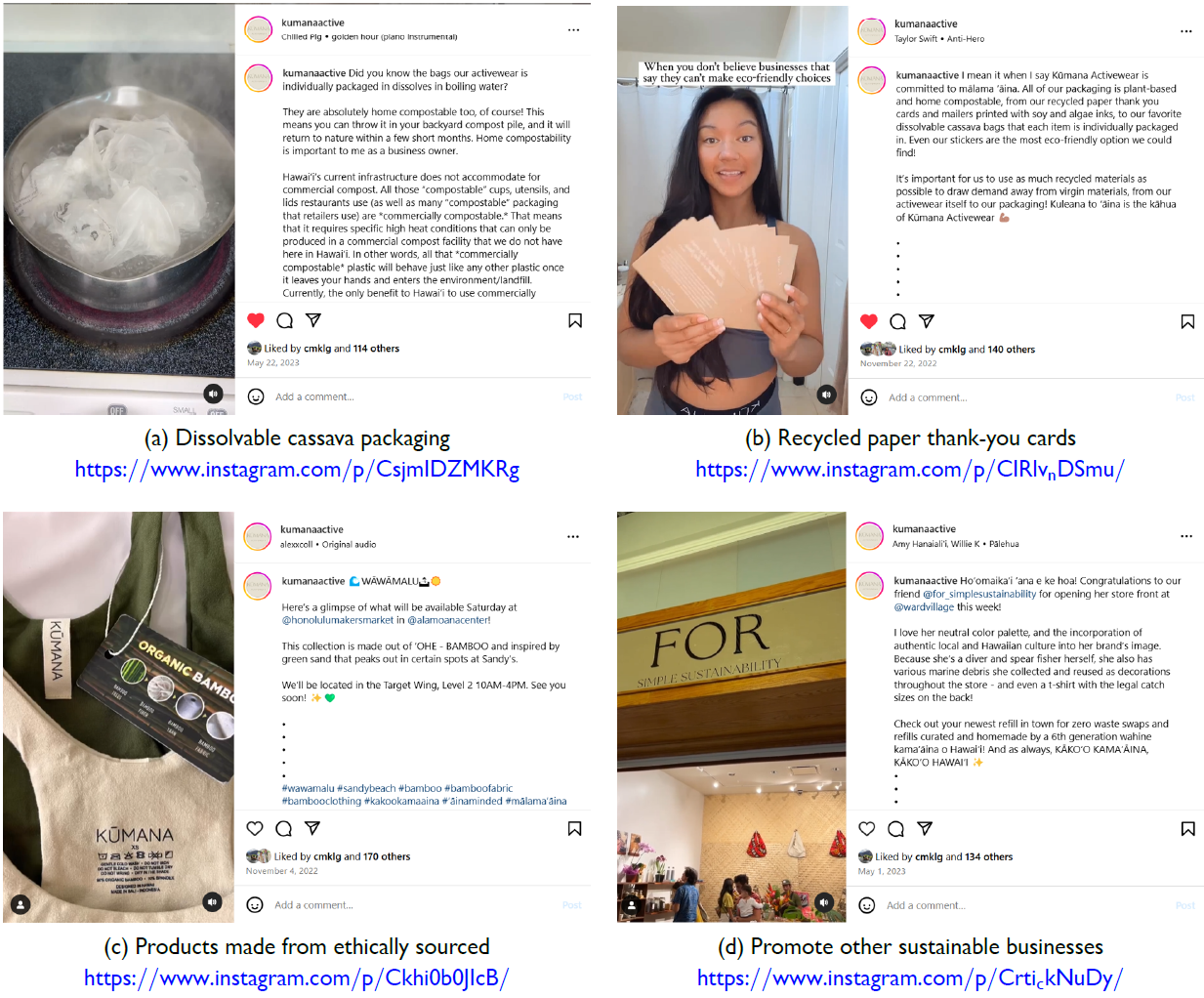
We partnered with a company that provides sustainable activewear products to run ads (a nostalgia ad vs. a control ad) on social media platforms. This company was selected for its commitment to sustainable practices. Its activewear products use ethically sourced materials, such as organic bamboo, recycled ocean waste, biodegradable cassava packaging, recycled paper cards, and mailers printed with plant-based inks (Figure 2). We targeted consumers aged 18 to 40 who are interested in travel, fitness, wellness, sports, and outdoor activities.
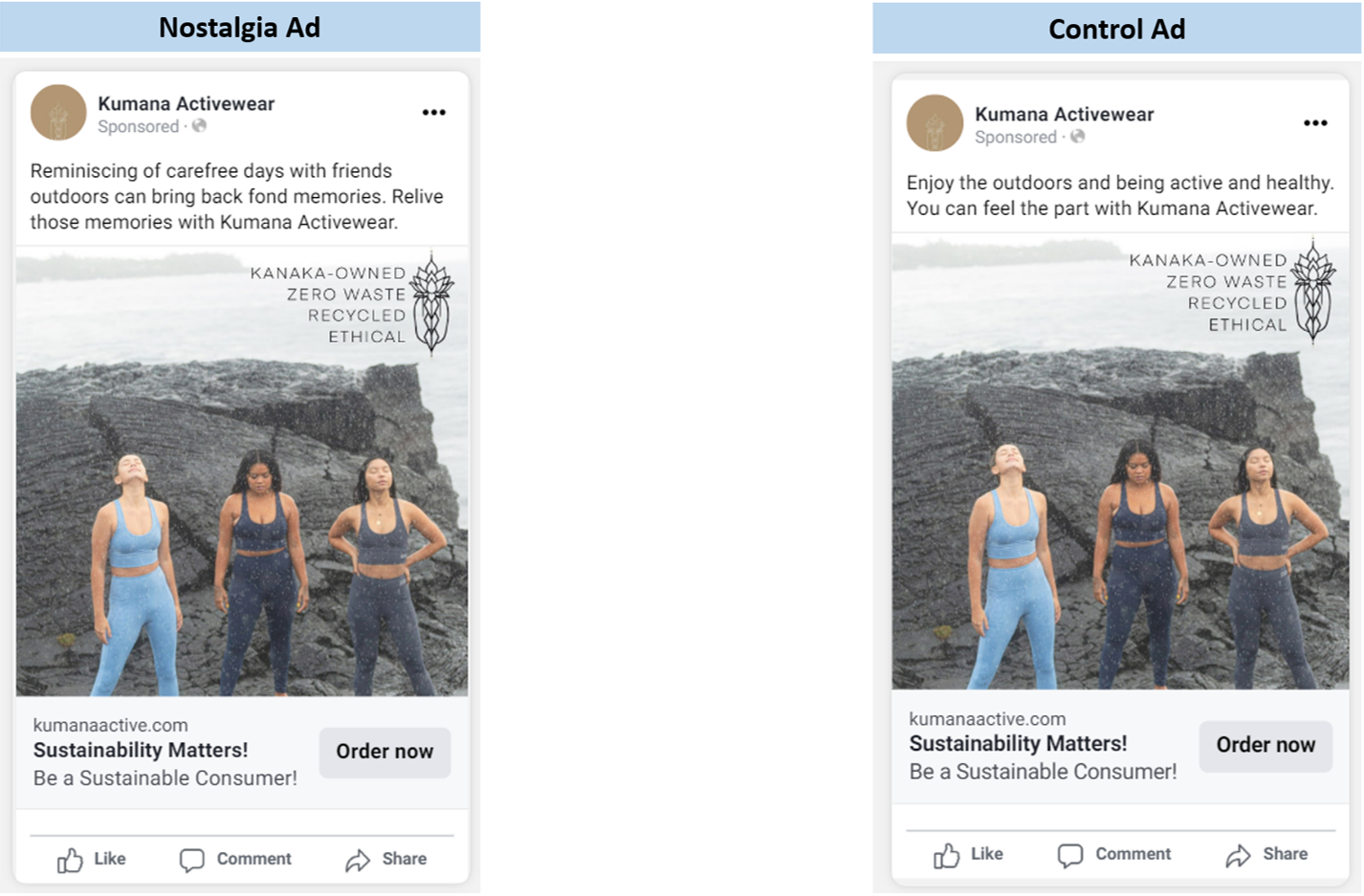
We created two ads that were identical in all aspects except the primary text (Figure 3). A pretest with 75 US Prolific workers confirmed that the nostalgia ad (vs. control ad) (MNostalgia = 3.14, SD = 1.56, t(73) = 5.17, p < .001) made participants feel significantly more nostalgic (MControl = 2.51, SD = 1.42) and greater longing for the past (MNostalgia = 3.42, SD = 1.62, MControl = 3.00, SD = 1.56, t(73) = 3.58, p = .001).
Results
As of August 4, 2022, the algorithms identified the nostalgia ad as the winning one due to its higher click-through rate (CTRImpression_Nostalgia = 0.80% vs. CTRImpression_Control = 0.58%, p = .02; CTRReach_Nostalgia = 1.11% vs. CTRReach_Control = 0.81%, p = .01) and lower cost (CPCNostalgia = $0.53, CPCControl = $0.77, representing a 31.17% cost reduction). As of August 8, 2022, the nostalgia ad still generated higher traffic than the control condition (CTRImpression_Nostalgia = 0.70% vs. CTRImpression_Control = 0.66%; CTRReach_Nostalgia = 1.08% vs. CTRReach_Control = 0.99%, p > .05) and was more cost-efficient (CPCNostalgia = $0.60, CPCControl = $0.66, representing a 9.09% cost reduction) (Table 2).
Table 2. Study 1: Field Study Results
| August 01-04, 2022 | |||||||
| Version | CPC | Clicks | Reach | CTR | Impressions | CTR | Amount spent |
| Nostalgia Ad | $0.53 | 113 | 10,172 | 1.11% | 14,067 | 0.80% | $ 59.76 |
| Control Ad | $0.77 | 78 | 9,668 | 0.81% | 13,350 | 0.58% | $ 59.93 |
| August 01-08, 2022 | |||||||
| Version | CPC | Clicks | Reach | CTR | Impressions | CTR | Amount spent |
| Nostalgia Ad | $0.60 | 232 | 21,516 | 1.08% | 33,276 | 0.70% | $ 139.98 |
| Control Ad | $0.66 | 212 | 21,435 | 0.99% | 32,037 | 0.66% | $ 139.98 |
Discussion
This study provides initial evidence that nostalgia can enhance consumer interest in sustainable apparel products.
Study 2
Method
We examined how (H1) and why (H2) nostalgia affects sustainable apparel purchase intention. We recruited 310 US mTurkers (Mage = 37.32 years, 61.61% male) for a 2 (Nostalgic event vs. Ordinary event) × 2 (Sustainability-focused vs. Benefit-focused ad) between-subjects design study within the jeans category.
Procedures and Measures
Participants in the nostalgia (vs. control) condition wrote about the most nostalgic event (vs. ordinary event) and reported their nostalgic feelings (Wildschut et al., 2006). Participants were then randomly assigned to either a sustainability-focused or a benefit-focused ad. These two ad appeals presented four identical product attributes. Two sustainability-focused attributes highlighted sustainability claims, and two benefit-focused attributes emphasized the product benefits. We designed the font size, text position, and background (i.e., green vs. neutral) differently in these two ads to reflect sustainability-focused and benefit-focused themes. Participants indicated their purchase intention (Peloza et al., 2013) and evaluated the stimuli (i.e., manipulation check).
Participants rated their perceived social connectedness (Wildschut et al., 2006), familiarity with green products (Lin & Chang, 2012; Watson et al., 1988). We assessed participants’ sense of meaning in life (Steger et al., 2006) to rule out this explanation, as Zhang et al. (2021) found that nostalgia increases perceived meaning in life, which, in turn, promotes product disposability behaviors.
Triggering nostalgia often produces effects beyond the perception of social connectedness, including social processes, affiliation motivation, positive emotions, and positive sentiments, which can explain nostalgia's impact on sustainable apparel purchase intention. Since participants in the nostalgia (vs. control) condition wrote about the most nostalgic (vs. ordinary) event in response to an open-ended question on Qualtrics, using two text analysis tools helped analyze consumers’ narratives and eliminate alternative explanations. Valence Aware Dictionary for sEntiment Reasoning (i.e., VADER, Hutto & Gilbert, 2014) is a rule-based lexicon that uses Python programming language to detect polarity (i.e., positive, negative, or neutral) and sentiment intensity (-1 = extremely negative to 1 = extremely positive) in a narrative. Linguistic Inquiry and Word Count (i.e., LIWC, Pennebaker et al. (2015)) is a dictionary-based lexicon that matches each word in a narrative to an internal dictionary. Together, we used (1) LIWC to exclude social process and affiliation motivation, and (2) LIWC, VADER, and self-reported measures to exclude positive emotions and sentiments. Ruling out these alternative explanations is necessary for several reasons. First, although the LIWC social process has been used as a proxy for social connectedness (Lasaleta et al., 2014), these constructs are distinct and should be tested separately. Perceived social connectedness captures the feelings of protection, love, and connection to loved ones that accompany nostalgia. Meanwhile, social process refers to words (e.g., “friends”, “family” detected by LIWC) relating to one’s social world. Second, the experience of symbolically reconnecting with close others after nostalgia may increase affiliation motivation (e.g., “ally”, “friend”, and “social” detected by LIWC), which can encourage consumer decision-making to benefit others as consumers seek to form interpersonal relationships (McClelland, 1961). Third, a nostalgic experience may activate positive emotions and sentiments (e.g., enthusiasm, pride) that promote sustainable behavior (White et al., 2019).
Results
6.3.1 Manipulation Check
The manipulation of nostalgia worked: participants in the nostalgia (vs. control) condition felt more nostalgic (MNostalgia = 6.08, SD = 1.00; MControl = 3.50, SD = 1.91, F(1, 308) = 221.18, p < .001, = .42). The manipulation of ad appeals also worked. Compared to benefit-focused ad, sustainability-focused ad focused more on sustainability (MSustainability-focused = 6.01, SD = 1.05; MBenefit-focused = 4.64, SD = 1.67, F(1, 306) = 76.27, p < .001, = .20) and less on product benefits (MSustainability-focused = 3.58, SD = 1.79; MBenefit-focused = 4.80, SD = 1.57, F(1, 306) = 41.10, p < .001, = .12). The main effect of nostalgia and its interaction effect were non-significant (p-values ≥ .16).
6.3.2 Dependent Measures
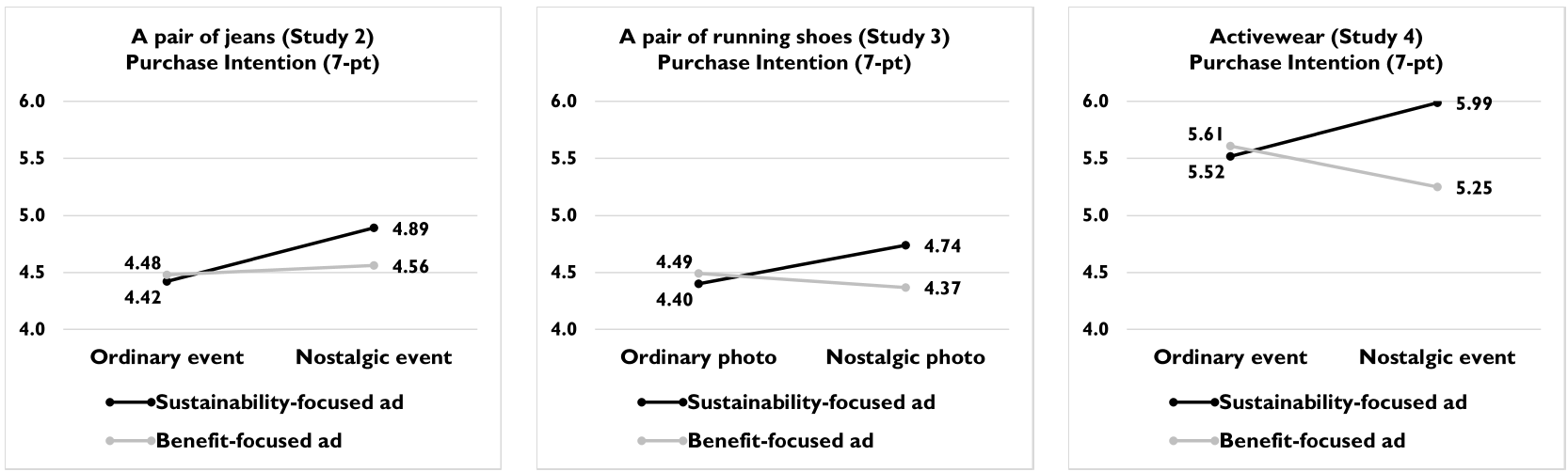
UniANOVA, with nostalgia, ad appeals, and their interaction as independent variables and purchase intention as the dependent variable, showed that there was no main effect from nostalgia, no main effect from ad appeal, and no interaction effect (p≥ .14). The graph (Figure 4), however, shows that the effect of nostalgia differs between sustainability-focused and benefit-focused ads, consistent with our prediction. We then conducted a more liberal approach—two separate independent t-tests. The results showed that participants in the nostalgia (vs. control) condition reported a marginally significant higher purchase intention for sustainable jeans (MNostalgia = 4.89, SD = 1.40; MControl = 4.42, SD = 1.81, t(153.47) = 1.85, p = .07, Cohen’s d = .29). There were no significant differences in purchase intention for conventional jeans between the two conditions (MNostalgia = 4.56, SD = 1.64; MControl = 4.48, SD = 1.72, t(150) = .29, p = .77, Cohen’s d = .05)—see Figure 4. This result provides directional evidence to support H1, which states that nostalgia fosters sustainable apparel purchase intention.
6.3.3 Mediation Analysis
Nostalgia fostered perceived social connectedness (MNostalgia = 5.41, SD = 1.27; MControl = 3.74, SD = 1.97, F(1, 308) = 79.56, p < .001, = .21). Mediation analysis (PROCESS Model 4, Hayes, 2018) showed that perceived social connectedness mediated the effect of nostalgia on the purchase intention of sustainable jeans (b = .42, 95% CI [.16; .74]). The direct effect became non-significant (p = .85), suggesting an indirect-only mediation (Zhao et al., 2010). The results remained robust after including familiarity with green products and gender as covariates. H2 is therefore supported.
6.3.4 Rule Out Alternative Accounts
LIWC suggested that narratives about nostalgic events (vs. ordinary events) contained more words relating to social process (MNostalgia = 8.23, SD = 5.32; MControl = 5.39, SD = 6.26, t(308) = 4.31, p < .001, Cohen’s d = .49) and affiliation motivation (MNostalgia = 4.64, SD = 3.95; MControl = 3.25, SD = 5.14, t(308) = 2.34, p = .02, Cohen’s d = .27). Additionally, participants in nostalgia (vs. control) scored significantly higher in positive sentiments detected by VADER (MNostalgia = .15, SD = .09; MControl = .12, SD = .11, t(308) = 2.45, p = .02, Cohen’s d = .28) and marginally higher in self-reported positive emotions (MNostalgia = 32.88, SD = 8.81; MControl = 30.92, SD = 9.75, t(308) = 1.86, p = .07, Cohen’s d = .21). We found no significant difference between the two conditions in positive emotions detected by LIWC, and meaning in life (p-values > .10).
We conducted PROCESS Model 4 (Hayes, 2018) with social process, affiliation, and positive sentiments as mediators. We found non-significant indirect effects going through social process (95% CI [-.11, .19]), affiliation motivation (95% CI [-.02, .16]), self-reported positive emotions (95% CI [-.04, .14]), and positive sentiments (95% CI [-.05, .18]). These accounts, therefore, cannot explain the effect.
Discussion
We found that nostalgia increases purchase intention for sustainable jeans, supporting H1. The effect was mediated by perceived social connectedness following a nostalgic experience, supporting H2. Social process, affiliation motivation, positive sentiments, and a sense of meaning in life were ruled out as alternative accounts.
Study 3
In this study, we used old photographs to manipulate nostalgia and tested the effects on running shoes. We selected this category for testing because footwear serves not only basic functional purposes (e.g., protection) but also as a medium for fashion, identity, and status signaling (Miller, 2023).
Method
We recruited 626 US mTurkers (Mage = 41.97 years, 44.73% male) for a 2 (Nostalgic photo vs. Ordinary event) × 2 (Sustainability-focused vs. Benefit-focused ad) between-subjects study.
Procedures and Measures
In the nostalgia (vs. control) condition, participants wrote about an old photograph that made them feel nostalgic about (vs. an ordinary event) and then indicated their purchase intention for running shoes. The product was displayed in either a sustainability-focused or a benefit-focused ad. These two ads were designed using the same criteria as in Study 1, except that they had a white background to reduce potential demand effects. The manipulation check for the stimuli was identical to that in Study 1. Participants also rated the hedonic and utilitarian value of ad appeals.
The manipulation check of nostalgia was measured by three items, as in Study 1, and “How much do you feel longing for the past?” Participants rated their perceived social connectedness, familiarity with green products (Lin & Chang, 2012), and emotions (I-PANAS-SF, Thompson, 2007).
Results
7.3.1 Manipulation Check
UniANOVA, with nostalgia, ad appeals, and their interaction as independent variables and nostalgia as the dependent variable, showed that participants in the nostalgia (vs. control) condition felt more nostalgic (MNostalgia = 5.38, SD = 1.21; MControl = 3.45, SD = 1.64, F(1, 622) = 278.13, p < .001, partial = .31). The main effect from ad appeals (p = .54) and the interaction effect (p = .11) were non-significant.
The manipulation of stimuli also worked. Compared to the benefit-focused ad, the sustainability-focused ad was focused more on sustainability attributes (MSustainability-focused = 5.94, SD = 0.98; MBenefit-focused = 4.38, SD = 1.68, F(1, 622) = 202.521, p < .001, partial = .25), less on product benefits (MSustainability-focused = 3.67, SD = 1.62; MBenefit-focused = 5.07, SD = 1.37, F(1, 622) = 135.54, p < .001, partial = .18), less on utilitarian values (MSustainability-focused = 4.14, SD = 1.65; MBenefit-focused = 5.30, SD = 1.28, F(1, 622) = 96.09, p < .001, partial = .13), and even less on hedonic values (MSustainability-focused = 3.09, SD = 1.55; MBenefit-focused = 3.72, SD = 1.57, F(1, 622) = 24.70, p < .001, partial = .04). The main effect from nostalgia and the interaction effect were non-significant (p-values ≥ .12).
7.3.2 Dependent Measures
UniANOVA with nostalgia, ad appeals, and their interaction as independent variables, and purchase intention as the dependent variable showed a marginally significant interaction effect (F(1, 622) = 2.81, p = .09). The graph (Figure 4), however, indicates that the effect of nostalgia differs between sustainability-focused and benefit-focused ads, consistent with our prediction. To further examine this pattern, we conducted a more liberal analysis using two separate independent t-tests. In the nostalgia condition, participants’ purchase intention for sustainable running shoes was higher than for conventional ones (MSustainability-focused = 4.74, SD = 1.69; MBenefit-focused = 4.37, SD = 1.59, t(297) = 1.95, p = .05, Cohen’s d = .23). In the control condition, participants’ purchase intention for sustainable running shoes and conventional ones did not differ (MSustainability-focused = 4.40, SD = 1.76; MBenefit-focused = 4.49, SD = 1.68, t(325) = -.43, p = .67)—see Figure 4. This result supports H1.
7.3.3 Mediation Analysis
Participants in the nostalgia (vs. control) condition felt more socially connected (MNostalgia = 5.45, SD = 1.22; MControl = 3.67, SD = 1.86, F(1, 622) = 195.28, p < .001, partial = .24). Mediation analysis (PROCESS Model 4, (Hayes, 2018) revealed that perceived social connectedness mediated the effect of nostalgia on the purchase intention of sustainable running shoes (b = .59, 95% CI [.34; .85]). The direct effect became non-significant (p = .72), suggesting an indirect-only mediation (Zhao et al., 2010). The results remained robust after including familiarity with green products and gender as covariates. H2 is therefore supported.
7.3.4 Rule Out Alternative Accounts
Similar to Study 2, we found that alternative explanations, such as social processes, affiliation motivation, positive emotions, and sentiments, could not explain the observed relationship between nostalgia and sustainable apparel purchase intention. For brevity, the detailed analysis ruling out these alternative explanations is available in Appendix C.
Discussion
We replicated Study 2's findings, showing that nostalgia enhanced perceived social connectedness, which in turn increased purchase intention for sustainable running shoes (H1 and H2). We also ruled out social processes, affiliation motivation, positive emotions, and sentiments as alternative explanations.
Study 4
This study aimed to replicate the findings in the activewear product category (H1 and H2) and to examine the moderating effect of environmental consciousness (H3).
Method
We recruited 387 US Prolific workers (Mage = 35.17 years, 42.64% male) for a 2 (Nostalgic event vs. Ordinary event) × 2 (Sustainable ad vs. Conventional ad) between-subjects study.
Procedures and Measures
Nostalgia manipulation resembled that in Study 1. Afterwards, participants were randomly assigned to view either a sustainable or a conventional activewear ad from a hypothetical company and then indicated their purchase intention (Peloza et al., 2013). Participants also reported their perceived social connectedness, environmental consciousness (Dunlap & Van Liere, 2008), familiarity with green products (Lin & Chang, 2012), nostalgic feelings (manipulation check), and provided demographic information.
Results
8.3.1 Manipulation Check
The manipulation of nostalgia worked: participants in the nostalgia condition reported feeling more nostalgic than those in the control condition (MNostalgia = 5.60, SD = 1.19; MControl = 4.52, SD = 1.82; F(1, 386) = 46.90, p < .001, = .11).
8.3.2 Dependent Variables
A UniANOVA with nostalgia and ad appeals as independent variables, and purchase intention as the dependent variable, revealed a significant main effect of ad appeals (F(1, 386) = 6.85, p = .01, partial = .02, MSustainable_Activewear= 5.75, SD = 1.22, MConventional_Activewear = 5.43, SD = 1.24) and a non-significant main effect of nostalgia (p = .69). As expected, the interaction between nostalgia and ad appeals was significant (F(1, 386) = 11.31, p < .001, partial = .03). Pairwise comparisons showed that in the nostalgia condition, purchase intention for sustainable activewear was significantly higher than for conventional activewear (MSustainable_Activewear = 5.99, SD = .94; MConventional_Activewear = 5.25, SD = 1.29; p < .001, partial = .04). Conversely, in the control condition, there was no significant difference in purchase intention between sustainable activewear and conventional activewear (MSustainable_Activewear = 5.52, SD = 1.41; MConventional_Activewear = 5.61, SD = 1.17; p = .60) (Figure 4). This result supports H1.
8.3.3 Mediation Analysis
Participants in the nostalgia (vs. control) condition felt more socially connected (MNostalgia = 5.85, SD = 1.31; MControl = 5.32, SD = 1.64, F(1, 386) = 13.37, p < .001, partial = .03). Mediation analysis (PROCESS Model 4, Hayes, 2018) indicated that perceived social connectedness mediated the relationship between nostalgia and purchase intention for sustainable activewear (b = .16, 95% CI [.02; .36]). The direct effect became non-significant (p = .09), suggesting an indirect-only mediation (Zhao et al., 2010). The results remained robust after including familiarity with green products and gender as covariates. H2 is therefore supported.
8.3.4 Moderated Mediation Analysis
PROCESS Model 14 Hayes (2018) showed that as expected, the indirect effect through social connectedness was stronger (vs. weaker) when environmental consciousness was lower (vs. higher) (Environmental consciousness = 3.84, b = .34, 95% CI [.08, .60]; Environmental consciousness = 4.50, b = .24, 95% CI [.07, .45]; Environmental consciousness = 5.50, b = .10, 95% CI [-.01, .27]), supporting H3. The interaction effect between social connectedness and environmental consciousness on purchase intention for sustainable activewear was significant (b = -.16, p = .00, 95% CI [-.26, -.05]).
Discussion
We replicated our previous findings. Triggering nostalgic feelings increases purchase intention for sustainable activewear products, thereby supporting H1. The effect is mediated by perceived social connectedness, supporting H2. We further find that this effect is more pronounced among consumers with low environmental consciousness than among those with high environmental consciousness, supporting H3.
Study 5
In Studies 2, 3, and 4, we tested the mediating role of perceived social connectedness by measuring this variable after manipulating nostalgia (i.e., measurement-of-mediation design). Following (Spencer et al., 2005) suggestion, we manipulated social connectedness to provide a cleaner test using a process-by-moderation design. We hypothesized that consumers act more sustainably after a nostalgic experience because they feel socially connected. Therefore, if participants are first primed to feel socially connected, the effect of nostalgia will diminish.
Method
We recruited 614 US Prolific workers (Mage = 38.80 years, male 39.58%) for a 2 (Nostalgic event vs. Ordinary event) × 2 (Social connectedness vs. Baseline) between-subjects study within the activewear category.
Procedures and Measures
In the social-connectedness condition, participants generated a list of the three most important people who foster their sense of belonging and make them feel loved, protected, safe, and connected. Participants then reported the difficulty level of the task, the extent to which they used the term “we” to describe their relationships with those people, and their perceived inclusion of others in the self. Participants in the baseline condition reported what they had consumed in the past 48 hours. All then rated their perceived social connectedness (McFerran & Argo, 2014). Nostalgia was manipulated as in Study 2. Participants were then exposed to a sustainable activewear ad and indicated their purchase intention.
Results
9.3.1 Manipulation Check
Participants asked to generate a list of three close others found this task relatively easy (M = 2.41, SD = 1.63, t(273) = -16.15, p < .001, Cohen’s d = 1.63), used “we” to describe their relationship (M = 5.57, SD = 1.55, t(273) = 16.79, p < .001, Cohen’s d = 1.55), and reported higher levels of inclusion of others in the self (M = 5.04, SD = 1.36, t(273) = 12.61, p < .001, Cohen’s d = 1.36), significantly higher than the midpoint of the 7-point scale. Participants in the social-connectedness (vs. control) condition also felt more socially connected (MSocial_Connectedness = 4.88, SD = 1.44, MControl = 3.76, SD = 1.47, F(1, 612) = 88.38, p < .001, partial = .13).
The manipulation of nostalgia was successful. Participants in the nostalgia (vs. control) condition felt more nostalgic (MNostalgia = 5.60, SD = 1.12, MControl = 3.60, SD = 1.59, F(1, 612) = 325.39, p < .001, partial = .35). The sustainable activewear ad (MActivewear = 5.86, SD = 1.02, t(613) = 45.27, p < .001, Cohen’s d = 1.02) focused more on sustainable attributes, greater than the midpoint of the 7-point scale.
9.3.2 Dependent Measures
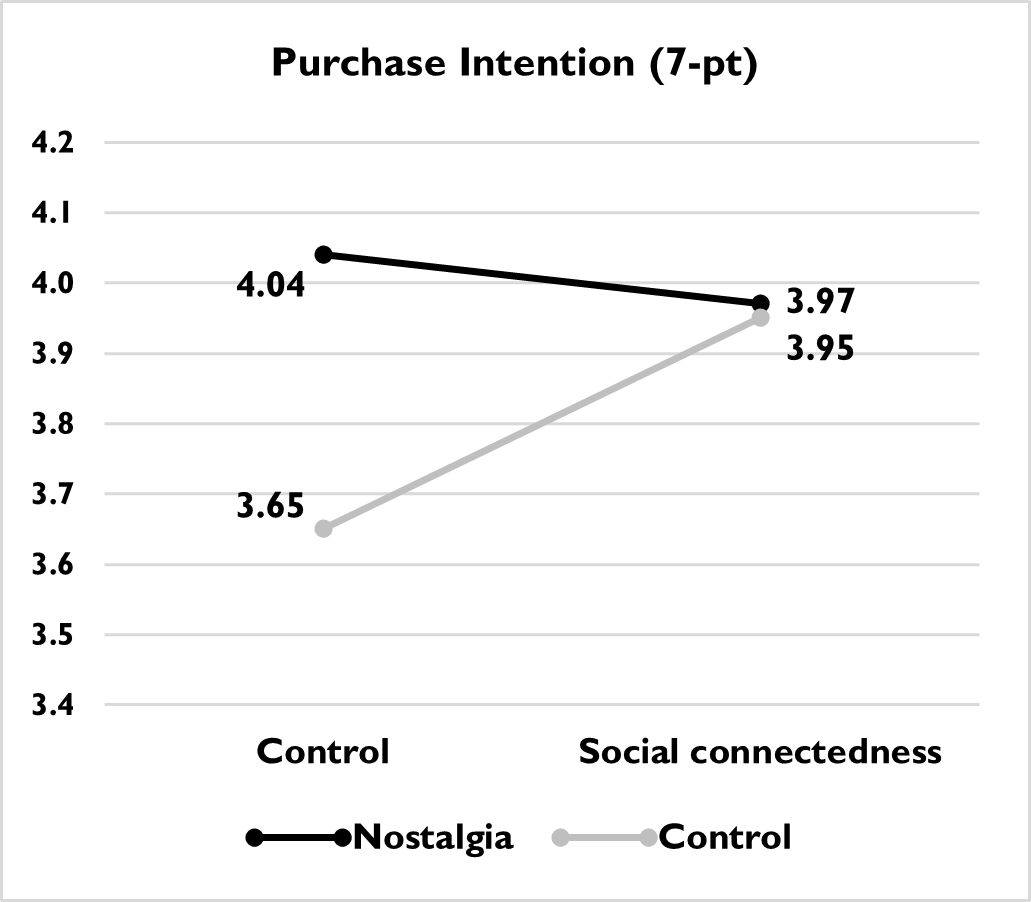
UniANOVA analysis, with social connectedness, nostalgia, and their interaction as independent variables, and purchase intention as dependent variable, revealed non-significant main effects for social connectedness (p = .41), nostalgia (p = .16), and non-significant interaction effect (p = .19). Pairwise comparisons indicated that when social connectedness was not primed, participants in the nostalgia (vs. control) condition (MNostalgia = 4.04, SD = 1.86, MControl = 3.65, SD = 1.83, p = .05, Cohen’s d = .21) reported higher purchase intention toward sustainable activewear. The effect dissipated when social connectedness was primed (MNostalgia = 3.97, SD = 1.57, MControl = 3.95, SD = 1.65, p = .93) (Figure 5). These results confirm the mediating role of perceived social connectedness through a process-by-moderation design (H2).
Discussion
Using a process-by-moderation design (Spencer et al. 2005), we revealed that nostalgia fosters sustainable apparel purchase intention through perceived social connectedness, supporting H1 and H2. Specifically, nostalgia promoted consumers’ purchase intention for sustainable activewear only when social connectedness was not activated, and the effect dissipated when social connectedness was activated.
General Discussion
General Discussion
The apparel industry has grown quickly, but this rapid expansion has also caused significant environmental harm. Yet, convincing consumers to pick sustainable apparel remains challenging. Although consumers often express a preference for sustainable options, they frequently refrain from purchasing them, as conventional marketing campaigns that emphasize sustainability claims can inadvertently heighten consumer skepticism (Wicker, 2022). Consequently, many firms avoid highlighting sustainability claims during sales transactions, even when they genuinely provide sustainable products to the market (i.e., greenhushing, Acuti et al., 2022). Therefore, a more subtle approach to promoting sustainable apparel choice without explicitly highlighting a product’s sustainability features can not only benefit firms that genuinely offer sustainable products but also accelerate global progress toward the United Nations Sustainable Development Goals (Fuso Nerini et al., 2024).
We suggest that nostalgia marketing has potential. As a social emotion, nostalgia can help consumers reconnect with their social circle and enhance their sense of social belonging, reaffirming their role within a broader social identity they often overlook in daily life (Juhl & Biskas, 2023). This effect, in turn, encourages consumer decision-making that benefits others rather than the self, such as adopting sustainable apparel. We also find that nostalgia marketing is more effective among consumers with low environmental consciousness, while it is less likely to cause skepticism among highly conscious consumers because it avoids directly emphasizing sustainability claims.
Theoretical Contributions and Managerial Implications
The resurgence of nostalgia marketing has prompted further exploration of its impact on consumer behavior (Huang et al., 2016). Our research responds to that call. Recent meta-analytic reviews indicate that nostalgia positively affects advertising persuasiveness, especially when a personal memory is linked to a brand (Cheng & Yan, 2022). In practice, marketers have strategically evoked consumers’ nostalgic sentiments associated with well-established apparel brands to boost sales (e.g., Levi’s ‘Baggy Jeans’, Hesterberg, 2023 ). We present a different perspective: nostalgia marketing can be used to increase consumer interest and willingness to adopt sustainable apparel products, especially those without a personal memory attached. A stronger sense of social connection after a nostalgic experience can encourage consumers to choose products that benefit others, the environment, and society, such as sustainable clothing options. Our research thus broadens the application of nostalgia to address societal problems (Juhl et al., 2019; Zhang et al., 2021).
Second, we contribute to the relatively understudied domain of consumer emotions within the sustainability literature. Research has mainly examined how positive and negative emotions triggered by external environment-related stimuli influence sustainable behavior (White et al., 2019). Our research shows that nostalgia affects people differently than other specific emotions (e.g., guilt, pride). First, nostalgia encompasses both positive and negative emotional valences, with positive emotions being more predominant (Wildschut et al., 2006). Second, nostalgia is a readily evoked emotion, deeply embedded in consumers’ memories, making it easier to trigger than the effort required with external stimuli unrelated to consumers’ personal experiences. Reminiscing about the past, especially with pleasure, can also evoke strong feelings, which can help with information processing (Kollmuss & Agyeman, 2002). Lastly, the activation of nostalgia may avoid the unintended effects of persuasion in sustainability messages, such as triggering insufficient emotions (Meng & Trudel, 2017) or excessive emotions (White et al., 2019).
Finally, we present a key boundary condition with managerial implications that helps marketers in the apparel industry (Muehling et al., 2014). Our research shows that the nostalgia-evoked approach works best among consumers with low environmental awareness, supporting the ELM theory Petty & Cacioppo, 1990 and previous albeit limited research in the sustainability field (Matthes et al., 2014; Schwartz & Loewenstein, 2017) . This finding is significant. In recent years, escalating environmental degradation and growing activism have heightened consumers’ environmental consciousness Haj-Salem et al. (2022). While this shift may foster a preference for environmentally friendly products, it also brings new challenges. Environmentally conscious consumers, with their awareness of sustainable practices, can also easily detect greenwashing practices and are therefore hesitant to purchase products from firms they perceive as engaging in such practices (Isac et al., 2024). In the apparel industry, where instances of unethical practices or greenwashing by major brands (e.g., H&M, Nike) are widespread, this skepticism may spill over to the entire sector. To lower the chance of being seen as greenwashing, employing nostalgia-based communication that avoids explicitly emphasizing a product’s sustainability features might encourage consumers with lower environmental consciousness to choose sustainable apparel while reducing skepticism among those with higher environmental consciousness.
We introduce a novel approach to leveraging nostalgia marketing for the greater good. Amidst consumers’ rising skepticism towards sustainability claims, strategically implementing nostalgia marketing can accelerate demand for sustainable apparel. That demand can transform sustainability initiatives forward and foster positive societal and environmental impacts. Ultimately, nostalgia marketing can benefit consumers, marketers, and a sustainable world, aligning with the goals of the Better Marketing for a Better World movement (www.bmbw.org).
Acknowledgments
The authors thank the editor, associate editor, and reviewers for their helpful comments. They are grateful to the marketing faculty at various schools, especially Lisa Cavanaugh, who provided constructive feedback on earlier drafts of this article, and to the I.H. Asper School of Business at the University of Manitoba for providing access to their behavioral lab. They are also grateful to both the I.H. Asper School of Business at the University of Manitoba and the University of Exeter Business School for their financial support.
Funding Statement
This project was funded by the F. Ross Johnson Professorship held by the second author.
Conflict of Interest
The author declares that there is no conflict of interest regarding the publication of this paper.
Authors Contributions
Ngan Vo: Writing-Original Draft, Conceptualization, Methodology, Formal analysis, Software, Investigation, Visualization, Project administration.
Rajesh V. Manchanda: Writing-Review & Editing, Supervision.
Ethical Approval
The research was conducted in accordance with the approval granted by the Psychology/Sociology Research Ethics Board (PSREB) of the University of Manitoba (protocol code P (2019) :155 (HS23542) “A Study of Nostalgia”, date of approval January 03, 2020).
Supplementary Materials
Supplementary material for this article is available online via https://doi.org/10.51300/JSM-2026-163.
References
- . Nostalgia Proneness and the Collective Self. Frontiers in Psychology, 11, 570621--570621. https://doi.org/10.3389/fpsyg.2020.570621. CrossRef | Google Scholar
- . When sustainability backfires: A review on the unintended negative side-effects of product and service sustainability on consumer behavior. Psychology \& Marketing, 39(10), 1933--1945. https://doi.org/10.1002/mar.21709. CrossRef | Google Scholar
- . Is Eco-Friendly Unmanly? The Green-Feminine Stereotype and Its Effect on Sustainable Consumption. Journal of Consumer Research, 43(4), 567--582. https://doi.org/10.1093/jcr/ucw044. CrossRef | Google Scholar
- . Encouraging green product purchase: Green value and environmental knowledge as moderators of attitude and behavior relationship. Business Strategy and the Environment, 32(1), 289--303. https://doi.org/10.1002/bse.3130. CrossRef | Google Scholar
- . Effects of nostalgic messages on ad persuasiveness: a meta-analysis. International Journal of Advertising, 42(2), 263--287. https://doi.org/10.1080/02650487.2022.2064593. CrossRef | Google Scholar
- . Factors Affecting Skepticism toward Green Advertising. Journal of Advertising, 41(4), 147--155. https://doi.org/10.1080/00913367.2012.10672463. CrossRef | Google Scholar
- . The "New Environmental Paradigm". The Journal of Environmental Education, 40(1), 19--28. https://doi.org/10.3200/joee.40.1.19-28. CrossRef | Google Scholar
- . 69\% of Canadian consumers expect companies to solve sustainability issues. .
- . Extending the Sustainable Development Goals to 2050 --- a road map. Nature, 630(8017), 555--558. https://doi.org/10.1038/d41586-024-01754-6. CrossRef | Google Scholar
- . How anticipated pride and guilt influence green consumption in the Middle East: The moderating role of environmental consciousness. Journal of Retailing and Consumer Services, 68, 103062--103062. https://doi.org/10.1016/j.jretconser.2022.103062. CrossRef | Google Scholar
- . Introduction to mediation, moderation, and conditional process analysis: A regression-based approach. The Guilford Press.
- . 22 examples of nostalgia marketing that make customers feel good. .
- . Slowing Down in the Good Old Days: The Effect of Nostalgia on Consumer Patience. Journal of Consumer Research, 43(3), 372--387. https://doi.org/10.1093/jcr/ucw033. CrossRef | Google Scholar
- . VADER: A Parsimonious Rule-Based Model for Sentiment Analysis of Social Media Text. Proceedings of the International AAAI Conference on Web and Social Media, 8(1), 216--225. https://doi.org/10.1609/icwsm.v8i1.14550. CrossRef | Google Scholar
- . Is greenwashing impacting on green brand trust and purchase intentions? Mediating role of environmental knowledge. Environment, Development and Sustainability, 27(9). https://doi.org/10.1007/s10668-023-04352-0. CrossRef | Google Scholar
- . Exploring the Gap Between Consumers' Green Rhetoric and Purchasing Behaviour. Journal of Business Ethics, 132(2), 311--328. https://doi.org/10.1007/s10551-014-2316-3. CrossRef | Google Scholar
- . Nostalgia: An impactful social emotion. Current Opinion in Psychology, 49, 101545--101545. https://doi.org/10.1016/j.copsyc.2022.101545. CrossRef | Google Scholar
- . Nostalgia proneness and empathy: Generality, underlying mechanism, and implications for prosocial behavior. Journal of Personality, 88(3), 485--500. https://doi.org/10.1111/jopy.12505. CrossRef | Google Scholar
- . Nostalgia promotes help seeking by fostering social connectedness. Emotion, 21(3), 631--643.
- . Mind the Gap: Why do people act environmentally and what are the barriers to pro-environmental behavior?. Environmental Education Research, 8(3), 239--260. https://doi.org/10.1080/13504620220145401. CrossRef | Google Scholar
- . Nostalgia Weakens the Desire for Money. Journal of Consumer Research, 41(3), 713--729. https://doi.org/10.1086/677227. CrossRef | Google Scholar
- . Nostalgia makes people eat healthier. Appetite, 162, 105187--105187. https://doi.org/10.1016/j.appet.2021.105187. CrossRef | Google Scholar
- . The relationship between social connectedness and anxiety, self-esteem, and social identity. Journal of Counseling Psychology, 45(3), 338--345. https://doi.org/10.1037/0022-0167.45.3.338. CrossRef | Google Scholar
- . Gratitude and sustainable consumer behavior: A moderated mediation model of time discounting and connectedness to the future self. Psychology \& Marketing, 38(8), 1238--1249. https://doi.org/10.1002/mar.21502. CrossRef | Google Scholar
- . Double Standard: The Role of Environmental Consciousness in Green Product Usage. Journal of Marketing, 76(5), 125--134. https://doi.org/10.1509/jm.11.0264. CrossRef | Google Scholar
- . "Yes, but this Other One Looks Better/Works Better": How do Consumers Respond to Trade-offs Between Sustainability and Other Valued Attributes?. Journal of Business Ethics, 140(3), 567--584. https://doi.org/10.1007/s10551-015-2695-0. CrossRef | Google Scholar
- . Product Choice and the Importance of Aesthetic Design Given the Emotion-laden Trade-off between Sustainability and Functional Performance. Journal of Product Innovation Management, 29(6), 903--916. https://doi.org/10.1111/j.1540-5885.2012.00970.x. CrossRef | Google Scholar
- . The Means and End of Greenwash. Organization \& Environment, 28(2), 223--249. https://doi.org/10.1177/1086026615575332. CrossRef | Google Scholar
- . Consumers' green involvement and the persuasive effects of emotional versus functional ads. Journal of Business Research, 67(9), 1885--1893. https://doi.org/10.1016/j.jbusres.2013.11.054. CrossRef | Google Scholar
- . The Skeptical Green Consumer Revisited: Testing the Relationship Between Green Consumerism and Skepticism Toward Advertising. Journal of Advertising, 43(2), 115--127. https://doi.org/10.1080/00913367.2013.834804. CrossRef | Google Scholar
- . The achieving society. D Van Nostrand Company. https://doi.org/10.1037/14359-000. CrossRef | Google Scholar
- . The Entourage Effect. Journal of Consumer Research, 40(5), 871--884. https://doi.org/10.1086/673262. CrossRef | Google Scholar
- . Identity, self-concept and young women's engagement with collaborative, sustainable fashion consumption models. International Journal of Consumer Studies, 43(4), 368--378. https://doi.org/10.1111/ijcs.12516. CrossRef | Google Scholar
- . Fashion sensitive young consumers and fashion garment repair: Emotional connections to garments as a sustainability strategy. International Journal of Consumer Studies, 44(4), 361--368. https://doi.org/10.1111/ijcs.12572. CrossRef | Google Scholar
- . Sustainable fashion consumption and the fast fashion conundrum: fashionable consumers and attitudes to sustainability in clothing choice. International Journal of Consumer Studies, 39(3), 212--222. https://doi.org/10.1111/ijcs.12169. CrossRef | Google Scholar
- . It might be ethical, but I won't buy it: Perceived contamination of, and disgust towards, clothing made from recycled plastic bottles. Psychology \& Marketing, 38(2), 298--312. https://doi.org/10.1002/mar.21323. CrossRef | Google Scholar
- . Using emoticons to encourage students to recycle. The Journal of Environmental Education, 48(3), 196--204. https://doi.org/10.1080/00958964.2017.1281212. CrossRef | Google Scholar
- . How have shoes changed over time: Exploring the evolution of footwear. .
- . The Development and Testing of a Measure of Skepticism Toward Environmental Claims in Marketers' Communications. Journal of Consumer Affairs, 32(1), 30--55. https://doi.org/10.1111/j.1745-6606.1998.tb00399.x. CrossRef | Google Scholar
- . Exploring the Boundaries of Nostalgic Advertising Effects: A Consideration of Childhood Brand Exposure and Attachment on Consumers' Responses to Nostalgia-Themed Advertisements. Journal of Advertising, 43(1), 73--84. https://doi.org/10.1080/00913367.2013.815110. CrossRef | Google Scholar
- . AD SKEPTICISM: The Consequences of Disbelief. Journal of Advertising, 34(3), 7--17. https://doi.org/10.1080/00913367.2005.10639199. CrossRef | Google Scholar
- . Good and Guilt-Free: The Role of Self-Accountability in Influencing Preferences for Products with Ethical Attributes. Journal of Marketing, 77(1), 104--119. https://doi.org/10.1509/jm.11.0454. CrossRef | Google Scholar
- . Linguistic Inquiry and Word Count: LIWC2015. . Pennebaker Conglomerates.
- . Involvement and persuasion: Tradition versus integration. Psychological Bulletin, 107(3), 367--374. https://doi.org/10.1037/0033-2909.107.3.367. CrossRef | Google Scholar
- . Bridge the gap: Consumers' purchase intention and behavior regarding sustainable clothing. Journal of Cleaner Production, 278, 123882--123882. https://doi.org/10.1016/j.jclepro.2020.123882. CrossRef | Google Scholar
- . An innovation resistance theory perspective on purchase of eco-friendly cosmetics. Journal of Retailing and Consumer Services, 59, 102369--102369. https://doi.org/10.1016/j.jretconser.2020.102369. CrossRef | Google Scholar
- . The link between green purchasing decisions and measures of environmental consciousness. European Journal of Marketing, 30(5), 35--55. https://doi.org/10.1108/03090569610118740. CrossRef | Google Scholar
- . The Chill of the Moment: Emotions and Proenvironmental Behavior. Journal of Public Policy \& Marketing, 36(2), 255--268. https://doi.org/10.1509/jppm.16.132. CrossRef | Google Scholar
- . When is Sustainability a Liability, and When Is It an Asset? Quality Inferences for Core and Peripheral Attributes. Journal of Business Ethics, 173(1), 109--132. https://doi.org/10.1007/s10551-019-04415-1. CrossRef | Google Scholar
- . Establishing a causal chain: Why experiments are often more effective than mediational analyses in examining psychological processes. Journal of Personality and Social Psychology, 89(6), 845--851. https://doi.org/10.1037/0022-3514.89.6.845. CrossRef | Google Scholar
- . The meaning in life questionnaire: Assessing the presence of and search for meaning in life. Journal of Counseling Psychology, 53(1), 80--93. https://doi.org/10.1037/0022-0167.53.1.80. CrossRef | Google Scholar
- . Shop at your own risk? Consumer activities in fashion e-commerce. International Journal of Consumer Studies, 46(4), 1299--1318. https://doi.org/10.1111/ijcs.12759. CrossRef | Google Scholar
- . Development and Validation of an Internationally Reliable Short-Form of the Positive and Negative Affect Schedule (PANAS). Journal of Cross-Cultural Psychology, 38(2), 227--242. https://doi.org/10.1177/0022022106297301. CrossRef | Google Scholar
- . Combating the mental health stigma with nostalgia. European Journal of Social Psychology, 43(5), 413--422. https://doi.org/10.1002/ejsp.1952. CrossRef | Google Scholar
- . Nostalgia and consumer preference for indulgent foods: The role of social connectedness. International Journal of Consumer Studies, 42(3), 316--326. https://doi.org/10.1111/ijcs.12419. CrossRef | Google Scholar
- . Nostalgia prompts sustainable product disposal. Journal of Consumer Behaviour, 19(6), 570--580. https://doi.org/10.1002/cb.1832. CrossRef | Google Scholar
- . Development and validation of brief measures of positive and negative affect: The PANAS scales. Journal of Personality and Social Psychology, 54(6), 1063--1070. https://doi.org/10.1037/0022-3514.54.6.1063. CrossRef | Google Scholar
- . How to SHIFT Consumer Behaviors to be More Sustainable: A Literature Review and Guiding Framework. Journal of Marketing, 83(3), 22--49. https://doi.org/10.1177/0022242919825649. CrossRef | Google Scholar
- . H\&M is being sued for greenwashing. What does that mean for fashion. .
- . Nostalgia: Content, triggers, functions. Journal of Personality and Social Psychology, 91(5), 975--993. https://doi.org/10.1037/0022-3514.91.5.975. CrossRef | Google Scholar
- . Dump or recycle? Nostalgia and consumer recycling behavior. Journal of Business Research, 132, 594--603. https://doi.org/10.1016/j.jbusres.2020.11.033. CrossRef | Google Scholar
- . Reconsidering Baron and Kenny: Myths and Truths about Mediation Analysis. Journal of Consumer Research, 37(2), 197--206. https://doi.org/10.1086/651257. CrossRef | Google Scholar
- . Longing for the past and embracing the new: Does nostalgia increase new product adoption?. Marketing Letters, 32(4), 477--498. https://doi.org/10.1007/s11002-021-09574-8. CrossRef | Google Scholar
- . Counteracting loneliness: On the restorative function of nostalgia. Psychological Science, 19(10), 1023--1029. https://doi.org/10.1111/j.1467-9280.2008.02194.x. CrossRef | Google Scholar
- . Nostalgia Increases Financial Risk Taking. Personality and Social Psychology Bulletin, 45(6), 907--919. https://doi.org/10.1177/0146167218799717. CrossRef | Google Scholar
|
Supplementary Material(s) |
Download |
|---|---|
|
Supplementary Materials |
About contributors

Ngan Vo
Department of Management, University of Exeter Business School, University of Exeter, Exeter, United Kingdom
United Kingdom
Rajesh V. Manchanda
Department of Marketing, I.H. Asper School of Business, University of Manitoba, Winnipeg, Canada
Canada